Why Leaders Lose Empathy with Power
When leaders gain power, their ability to empathise often diminishes. This paradox is rooted in psychological and social changes that occur with authority. Research shows that power can reduce brain activity in areas linked to understanding others' emotions, while social isolation and moral distortions compound the problem. Leaders may become overly self-focused, less receptive to feedback, and detached from their teams' realities. This can lead to poor decision-making, reduced trust, and higher employee turnover.
Key findings:
- Brain changes: Power dampens activity in mirror neurons, reducing empathy.
- Social isolation: Leaders often receive filtered feedback, disconnecting them from others.
- Moral licensing: Prolonged power can lead to ethical lapses and dehumanisation.
- Impact on teams: Low-empathy environments see higher stress, errors, and resignations.
Practical solutions include creating systems for honest feedback, practising perspective-taking, and managing stress to maintain emotional awareness. Leaders who prioritise empathy can build trust, improve decision-making, and foster healthier team dynamics. Organisations should reflect on how power structures may unintentionally erode empathy and take steps to counteract these effects.
Why Leaders Lose Empathy as They Gain Power
As leaders climb the ranks, their behaviour often shifts in ways that are shaped not just by their personal traits but also by the psychological, social, and moral effects of power. These interconnected changes can have a noticeable impact on how they lead.
The Psychological Effects of Power
Power has been shown to influence brain function, particularly in ways that impair empathy. Research suggests that individuals in positions of power experience reduced activity in mirror neurons - brain cells associated with understanding and sharing the feelings of others. This can lead to a diminished ability to adopt others' perspectives, as they increasingly anchor their thinking on their own viewpoints. Dacher Keltner, a psychology professor at UC Berkeley, starkly describes this phenomenon:
"The experience of power might be thought of as having someone open up your skull and take out that part of your brain so critical to empathy and socially-appropriate behavior."
One experiment highlights this effect vividly. Participants primed to feel powerful were three times more likely to draw a letter on their forehead in a way that was readable to themselves but reversed for others. This self-focused behaviour contrasts sharply with those in low-power conditions, who were more likely to consider the observer's perspective.
Social Isolation and Insulation from Feedback
Leadership roles often come with increasing isolation, particularly as subordinates grow reluctant to offer honest feedback. This creates a vacuum where leaders may become disconnected from the realities faced by others. High-stakes responsibilities further intensify this isolation, as leaders focus more on outcomes and performance metrics. This narrowed focus can lead them to treat the emotions and needs of others as secondary concerns. Rasmus Hougaard, CEO of Potential Project, notes:
"It's not that power makes people want to be less empathetic; it's that taking on greater responsibilities and pressure can rewire our brains and, through no fault of our own, force us to stop caring about other people as much as we used to."
The social insulation that accompanies power can also pave the way for moral distortions.
Moral Licensing and Dehumanisation
When leaders hold power over long periods, they may develop what is known as moral licensing. This phenomenon dulls their sensitivity to ethical standards, allowing them to justify questionable decisions. David Owen, a physician and former parliamentarian, has linked this to "hubris syndrome" - a condition characterised by impulsiveness, recklessness, and a lack of regard for others.
The erosion of empathy can lead to troubling outcomes. Leaders may begin to rely on stereotypes and lose the ability to see people as individuals, reducing them to abstract categories. A striking example of this occurred during the 2016 Wells Fargo scandal. CEO John Stumpf faced Congressional scrutiny for a scheme involving 2 million fraudulent accounts and the dismissal of 5,300 employees. Observers noted his detached demeanour, which seemed to disregard the human toll of these actions. This clinical detachment illustrates how power can erode empathy, even in the face of significant human consequences.
sbb-itb-ce676ec
The Real-World Impact of Losing Empathy
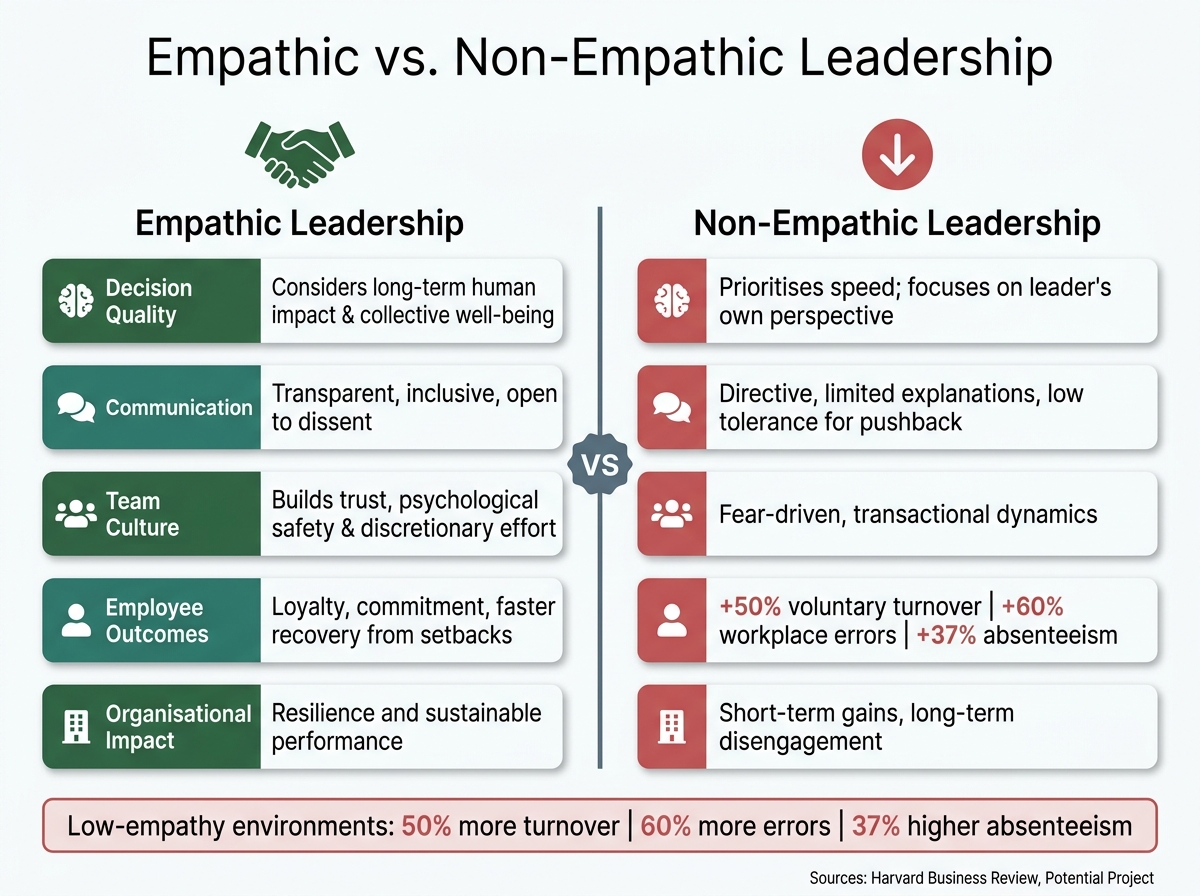
Empathic vs. Non-Empathic Leadership: Key Differences & Impact
Empathy Loss and Decision-Making
When empathy diminishes, decision-making may quicken, but it often sacrifices broader understanding. Leaders who lack empathy tend to focus heavily on their own perspective, disregarding what experts refer to as "peripheral information." This includes emotional cues, team morale, and the social repercussions of decisions - factors that are crucial but may not align directly with immediate objectives.
Social psychologist Adam Galinsky succinctly captures the issue:
"Perspective-taking without agency is ineffective, and agency without perspective-taking is dangerous and irresponsible."
The role of power in this context is critical. Power amplifies decision-making speed, but without empathy as a counterbalance, it can lead leaders astray. Under stress, this imbalance becomes more pronounced. One clinical psychologist observes that leaders under pressure often revert to instinctive, control-oriented decisions. Empathy, a learned skill, tends to fade under such conditions, replaced by more rigid, directive actions.
The collapse of Enron in the early 2000s serves as a stark example. Despite having a mission statement that emphasised integrity and respect, the company’s leadership became increasingly disconnected from the human consequences of their actions. The relentless focus on financial targets eclipsed ethical considerations, as well as the well-being of employees and shareholders.
This narrow focus not only distorts decision-making but also erodes trust and cooperation within teams.
Trust and Team Dynamics
The impact on team dynamics, though not always immediately visible, is profound. When leaders fail to recognise or respond to team sentiment, employees often stop sharing honest feedback. A culture develops where raising concerns or showing vulnerability feels unsafe, transforming collaboration into mere transactional exchanges.
The data paints a stark picture. High-stress environments devoid of empathy are associated with a 50% rise in voluntary turnover, 60% more workplace errors, and 37% higher absenteeism rates. These figures translate directly into operational disruptions and the loss of valuable institutional knowledge.
As highlighted by the Harvard Business Review:
"While a cut-throat environment and a culture of fear can ensure engagement... for some time, research suggests that the inevitable stress it creates will likely lead to disengagement over the long term."
Over time, the lack of trust becomes self-reinforcing. Teams in low-empathy settings become less inclined to take initiative, report problems early, or go beyond the minimum effort required. What might appear as a high-performing culture from the outside can, in reality, be hollowing out internally.
Empathic vs. Non-Empathic Leadership: A Comparison
The operational challenges linked to empathy loss highlight its critical role in leadership. The table below contrasts empathic and non-empathic leadership styles across key dimensions:
| Feature | Empathic Leadership | Non-Empathic Leadership |
|---|---|---|
| Decision Quality | Considers long-term human impact and collective well-being | Prioritises speed; focuses on leader’s perspective and immediate goals |
| Communication | Transparent, inclusive, and open to dissent | Directive, with limited explanations and low tolerance for pushback |
| Team Culture | Builds trust, psychological safety, and discretionary effort | Driven by urgency or fear; transactional dynamics dominate |
| Employee Outcomes | Encourages loyalty, commitment, and quicker recovery from setbacks | Leads to higher stress, increased turnover, and more frequent mistakes |
| Organisational Impact | Promotes resilience and sustainable performance under pressure | Achieves short-term gains but risks long-term disengagement |
The evidence is clear: while non-empathic leadership might deliver short-term results, it undermines the human relationships and trust essential for sustained success. Once trust is lost, rebuilding it is a formidable challenge.
How Leaders Can Protect and Strengthen Empathy
Empathy can diminish under certain pressures, but it is possible to rebuild it intentionally. Below are practical habits that leaders can adopt to combat the erosion of empathy and foster a more connected leadership style.
Build Systems for Honest Accountability
Power often distorts the flow of feedback, leaving leaders insulated from critical insights. Subordinates may sugar-coat bad news or avoid dissent altogether, creating an incomplete picture of reality. To counter this, leaders must create structures that make honest feedback unavoidable. Tools like anonymous surveys and "red team" exercises - designed to identify blind spots - can reveal unspoken truths. Publicly recognising and appreciating individuals who voice uncomfortable realities helps normalise dissent and signals its value to the entire team.
An example of embedding empathy into leadership comes from John Chambers, former CEO of Cisco. He introduced a system where he was informed within 48 hours whenever an employee experienced a significant personal loss or illness. Chambers would then write a personal letter of support, a codified act of care that demonstrated empathy from the top down.
"Empathy at the executive level is about actively counteracting power's impact." - David Buirs, Leadership and Executive Coach
Make Perspective-Taking a Habit
David Buirs highlights that empathy in leadership is not just an emotional issue but an intellectual one: "That is where empathy becomes a leadership problem. Not a feelings problem. An intelligence problem". Leaders can integrate perspective-taking into their routines to address this challenge.
One simple tactic is the five-minute rule: before making a decision, pause to consider how it will affect those impacted. Replace vague questions like "How’s it going?" with focused ones such as "What’s one thing we could improve?" These targeted inquiries encourage more meaningful responses. Similarly, practising "walking the floor" - spending time among frontline staff - provides leaders with unfiltered insights and reinforces their attentiveness to the human side of operations, not just performance metrics.
While structured feedback and perspective-taking are essential, ethical discipline plays a key role in sustaining empathy.
Cultivate Ethical Leadership Habits
Empathy is not just a mindset; it is a neurological capacity that can be nurtured or diminished by daily habits. High stress, for instance, activates the brain’s fight-or-flight response, which inhibits the ability to empathise. Managing stress, therefore, becomes a professional responsibility, not just a personal one.
One practical approach is adopting a "benefit mantra": before each interaction, ask, "How can I help this person?" Research indicates that even brief compassion-focused exercises - such as four minutes of daily compassion meditation - can rewire neural pathways, fostering a more caring response to others’ challenges. Additionally, leaders can protect their emotional resilience by distinguishing between their own emotions and those of their team, reducing the risk of compassion fatigue that can lead to emotional withdrawal.
"Compassion is the intent to contribute to the happiness and well-being of others. Compassion, therefore, is more proactive, which means we can make a habit of it." - Sukhvinder Obhi, Neuroscientist
Embedding Empathy into High-Stakes Leadership
Integrating Empathy into Leadership Disciplines
Building on strategies to safeguard empathy, leaders must actively integrate it into their leadership practices. Empathy, when left untrained, often falters under pressure. As Merete Wedell-Wedellsborg, Adjunct Professor of Leadership at IMD, aptly states:
"Under pressure, we don't rise to the level of our expectations, we fall to the level of our training."
This underscores the importance of treating empathy not as an occasional gesture but as a skill embedded deeply into a leader’s approach. It requires consistent effort and deliberate practice.
One powerful method to achieve this is through encouraging dissent and embracing uncomfortable truths. For instance, when a team member voices a challenging perspective, acknowledging their input publicly and expressing gratitude sends a strong message: candour is valued over comfort. Such practices help dismantle the echo chambers that often accompany positions of power, enabling leaders to remain connected to the human realities behind their decisions. Over time, this approach reshapes the leader’s information ecosystem, reducing the likelihood of operating within a filtered reality.
Leaders can also benefit from cultivating relationships outside their immediate hierarchy. Trusted colleagues and mentors can provide fresh perspectives and counteract the isolating effects of leadership.
The Future of Jobs Report 2025 by the World Economic Forum identifies empathy and active listening as two of the top 10 skills of the future. This highlights that understanding others is not becoming obsolete but increasingly essential. In high-pressure environments, empathy is not a luxury but a form of operational effectiveness. It equips leaders to interpret the emotional and social dynamics essential for strategy execution.
By embedding these practices into their leadership, individuals lay the groundwork for additional support systems that reinforce empathy in demanding environments. These methods naturally evolve into structured frameworks designed to sustain empathy-driven leadership.
How House of Birch Supports Empathy-Driven Leadership
For senior leaders and executives, the question is not whether empathy is necessary, but how to maintain it without compromising on decisiveness. This is where expert-led, structured support becomes invaluable.
House of Birch offers bespoke 1:1 advisory engagements tailored to the unique challenges of high-level leadership. Their approach focuses on developing emotional discipline - enabling leaders to use empathy as a strategic tool while retaining clarity and decisiveness. Rather than viewing empathy as a fixed personality trait, House of Birch treats it as a trainable skill that can be integrated alongside other critical leadership capacities like decision-making, influence, and strategic thinking.
This personalised support ensures that leaders maintain their human connections, preventing the erosion of trust and authority that can occur when empathy is neglected. By addressing both the emotional and operational dimensions of leadership, House of Birch equips leaders to navigate their roles with both empathy and effectiveness.
Conclusion: Empathy as a Cornerstone of Leadership
Leadership itself does not inherently corrupt, but the pressures and dynamics of power can gradually erode a leader’s connection to their team. Psychological changes such as reduced mirroring, increased isolation, and moral licensing are not personal failings but predictable patterns that emerge over time. If left unaddressed, these patterns can create significant barriers to effective leadership.
The timing of these challenges is critical. As Merete Wedell-Wedellsborg, Adjunct Professor of Leadership at IMD, observes:
"Empathy matters most when the system is under strain, just when leaders tend to abandon it."
The consequences of neglecting empathy are severe. High-pressure workplace cultures, often a by-product of strained leadership, can increase voluntary turnover by nearly 50% and lead to a 60% rise in errors made on the job. These figures highlight the tangible costs of empathy deficits, both in human and financial terms.
The encouraging news is that empathy is not an innate trait but a skill that can be developed. Like strategic thinking, it improves with intentional practice. Leaders who integrate empathy into their daily routines - rather than relying on sporadic goodwill - are better equipped to maintain it over time.
Recognising the early warning signs of empathy erosion is essential. Are you listening less? Making decisions more hastily? Do your team members appear anxious instead of motivated? These are subtle indicators that demand attention before they escalate into broader organisational challenges.
Empathy plays a crucial role in countering the isolating effects of power. For senior leaders seeking to strengthen their empathy while maintaining decisiveness, House of Birch provides tailored 1:1 advisory services. These engagements are designed to help leaders balance operational effectiveness with genuine human connection, even in the most high-pressure environments.
FAQs
How can I tell if power is reducing my empathy?
Pay close attention to how you make decisions and interact with your team. Indicators of diminishing empathy might include brushing off feedback, becoming emotionally distant, or prioritising tasks without considering their emotional consequences. If your team appears tense, unmotivated, or disengaged, this could also signal a decline in empathetic leadership. House of Birch provides tailored coaching designed to support leaders in sustaining emotional balance and maintaining social influence, even in the face of challenging leadership demands.
How do I get honest feedback when people feel intimidated?
To promote honest feedback, it’s essential to actively reward input that challenges your perspectives. Holding a position of power often makes people reluctant to speak openly, so it’s crucial to intentionally create opportunities for dissenting opinions rather than assuming they will surface on their own. House of Birch supports leaders in cultivating emotional discipline and honing their social influence, helping them encourage authentic conversations and appreciate differing viewpoints during critical discussions.
How can I stay decisive without becoming cold or detached?
To maintain decisiveness without sacrificing empathy, it’s helpful to view empathy as a strategic advantage. While power can sometimes narrow focus to purely outcomes, cultivating deliberate habits can keep leaders grounded. Consider these approaches:
- Shift away from rigid 'right or wrong' thinking by using more flexible terms, such as 'most likely scenario'.
- Take a moment to reflect before making decisions, thinking about whom the choice benefits and its broader consequences.
- Use open-ended questions and actively seek input from diverse viewpoints to avoid relying solely on instinct.
House of Birch provides tailored coaching designed to help leaders enhance their emotional discipline and strategic thinking, ensuring they remain both decisive and empathetic.

