Ultimate Guide to Emotional Balance for Leaders
Maintaining emotional balance is a critical skill for leaders navigating high-pressure environments. Research shows that leaders with strong emotional intelligence achieve better organisational outcomes, including 21% higher profitability and 40% lower turnover rates. Emotional balance allows leaders to make clear decisions, manage stress, and create psychologically safe teams.
Key takeaways include:
- Emotional Intelligence Matters: Employers value emotional intelligence over technical skills in leadership roles.
- Four Core Skills: Self-awareness, self-management, social awareness, and relationship management are essential for effective leadership.
- Practical Techniques: Strategies like mindfulness, the STOP method, and emotional journaling help leaders regulate emotions under stress.
- Daily Habits: Regular reflection, physical well-being, and structured emotional regulation routines are foundational for resilience.
Leaders should focus on building these skills through consistent practice and, where needed, seek professional coaching to strengthen their emotional discipline and decision-making under pressure.
Emotional Intelligence: The #1 ability for leaders | Daniel Goleman
sbb-itb-ce676ec
Core Components of Emotional Intelligence in Leadership
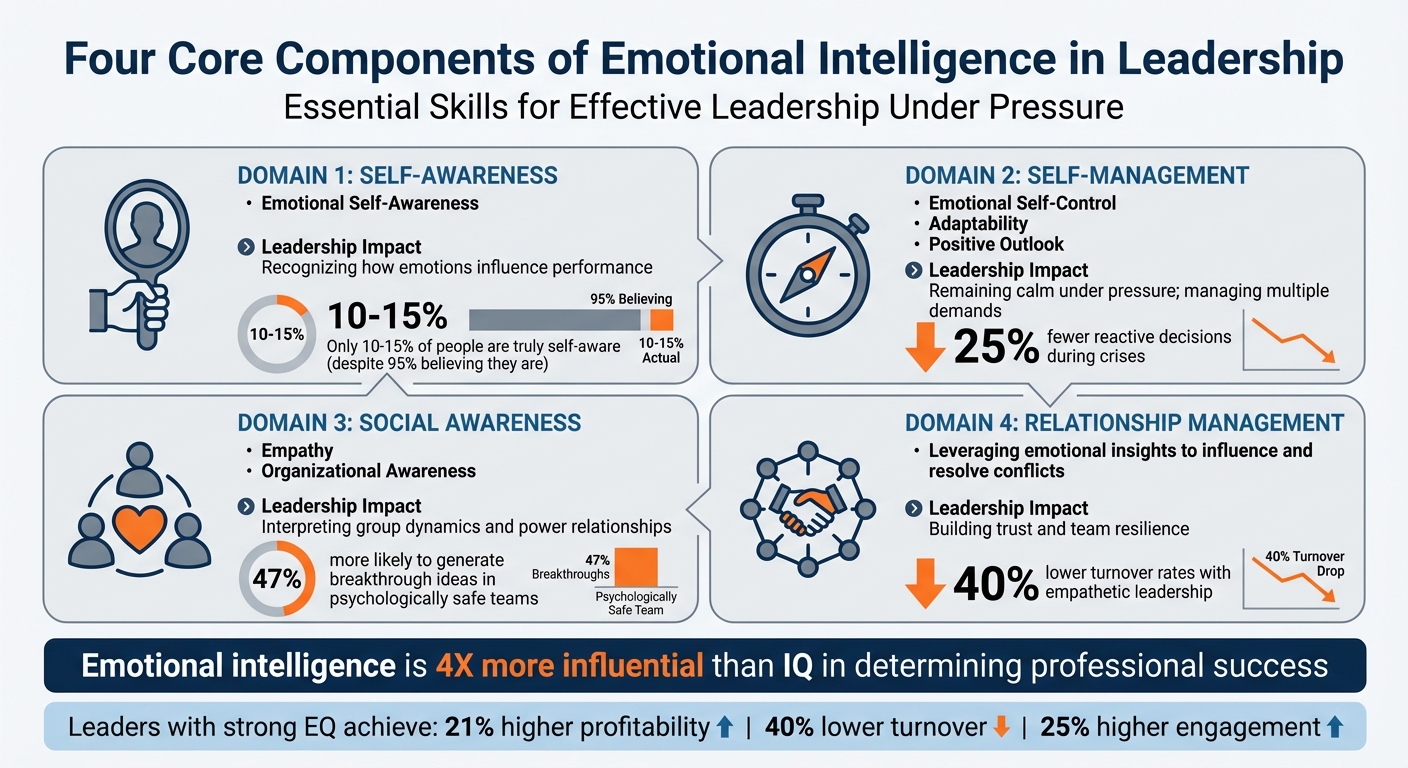
Four Core Components of Emotional Intelligence for Leaders
Emotional intelligence isn't a single skill - it’s a collection of interconnected abilities that enable leaders to manage pressure, build relationships, and make sound decisions. Research highlights its importance, noting that emotional and social skills are four times more influential than IQ in determining professional success. Yet, while 95% of people believe they are self-aware, only 10% to 15% actually exhibit this trait. Understanding the core components of emotional intelligence can reshape how leaders handle high-stakes situations.
The framework is divided into four domains: self-awareness (recognising emotions and triggers), self-management (controlling impulses and maintaining composure), social awareness (understanding others' emotions and group dynamics), and relationship management (leveraging emotional insights to influence and resolve conflicts). These skills not only enhance individual performance but also build resilience in demanding scenarios. With this foundation, we can now delve into practical strategies for emotional regulation under pressure.
| Domain | Key Competencies | Leadership Impact |
|---|---|---|
| Self-Awareness | Emotional Self-Awareness | Recognising how emotions influence performance |
| Self-Management | Emotional Self-Control, Adaptability, Positive Outlook | Remaining calm under pressure; managing multiple demands |
| Social Awareness | Empathy, Organisational Awareness | Interpreting group dynamics and power relationships |
Self-Awareness: Identifying Your Emotional Triggers
Self-awareness is the cornerstone of emotional intelligence. It involves recognising how emotions shape thoughts, behaviours, and decisions in real time. Leadership challenges often stem from predictable triggers: public criticism, tight deadlines, team conflicts, or challenges to authority. The difference between reactive and composed leaders lies in their ability to spot these triggers before emotions spiral.
Physical cues such as a tightened chest, clenched jaw, or raised shoulders signal when productive urgency is tipping into reactive stress. Labelling these emotions - mentally noting "I am feeling defensive" - creates a moment of psychological distance, allowing leaders to treat emotions as information rather than instructions for immediate action. This brief pause is often the key to thoughtful decision-making.
Mapping personal triggers helps refine this skill. Over time, patterns emerge: perhaps defensiveness arises when questioned publicly, or impatience surfaces under deadline pressure. Distinguishing between ego-driven reactions ("How does this make me look?") and values-based responses ("What supports the mission?") helps leaders maintain focus during challenges. Leaders who practise this awareness reportedly make 25% fewer reactive decisions during organisational crises.
A useful technique is post-meeting reflection. Spend two minutes considering, "What emotion drove my strongest reaction today?" and "Did I respond thoughtfully or react impulsively?". Additionally, 360-degree feedback can help uncover blind spots that may otherwise go unnoticed.
Self-Management: Staying Composed Under Pressure
Self-management involves regulating impulses and emotions to ensure responses are deliberate rather than reactive. This distinction becomes critical when decisions carry significant consequences.
One effective approach is the 3-second pause - a brief moment to identify emotions before responding - and a 24-hour delay for high-stakes decisions to avoid knee-jerk reactions. Regular body scans can also help leaders stay composed. By periodically checking for signs of physical stress, such as a clenched jaw or shallow breathing, leaders can address tension before it escalates. When these signals arise, techniques like strategic pausing - taking a moment to breathe deeply - can shift the mindset from reactive to reflective.
Modern leadership is moving beyond the "never let them see you sweat" mindset. Instead, leaders are finding strength in balancing confidence with transparency, acknowledging uncertainty while processing emotions in real time. This approach reinforces decision-making grounded in values, not ego, and fosters trust within teams.
Social Awareness: Using Empathy to Strengthen Teams
Social awareness enables leaders to interpret the emotional undercurrents of their organisations, identifying unspoken concerns and understanding group dynamics before issues escalate. Empathy, a key driver of psychological safety, plays a pivotal role in transforming command-and-control environments into collaborative cultures built on trust. The benefits are tangible: psychologically safe teams are 47% more likely to generate breakthrough ideas.
Active listening is fundamental to social awareness. This means focusing entirely on the speaker, avoiding premature responses, and using non-verbal cues like nodding to show engagement. Leaders should also pay close attention to tone, pace, and body language to fully understand the emotional context. Practising "listening without fixing" allows leaders to validate emotions without rushing to offer solutions.
Observing team dynamics is another crucial skill. Noticing who speaks, who remains silent, and how ideas are received can reveal the mood and power structures within a group. Before important meetings, leaders can practise perspective-taking by considering how each stakeholder might view the situation and what emotional concerns they may have. This exercise enhances empathic accuracy and strengthens relationships.
A simple yet effective practice is starting team meetings with emotional temperature checks. Team members can share their current state using a 1–5 scale or a single word, normalising emotional awareness and preparing the group for challenging conversations. Leaders who excel in empathy see measurable results: they perform 40% better in coaching, engagement, and decision-making, while their teams experience 40% lower turnover and 25% higher engagement. Developing social awareness not only enhances leadership effectiveness but also builds team resilience under pressure.
"Emotional intelligence accounts for 90% of what moves people up the career ladder when IQ and technical skills are roughly similar." – Laura Bouttell, Executive Coach, Quarterdeck
Practical Tools for Emotional Regulation
Understanding emotional intelligence is one thing; applying it effectively under pressure is quite another. The ability to bridge this gap often determines whether leaders maintain their composure or succumb to reactivity. By building on self-awareness and self-management, these strategies aim to turn theory into actionable practice.
Research highlights that mindfulness enhances activity in the prefrontal cortex - key for impulse control - while reducing reactivity in the amygdala, the brain's stress centre. Leaders practising mindfulness have been shown to reduce employee turnover by up to 20%. Meanwhile, a global McKinsey survey revealed that 60% of executives frequently feel exhausted, a condition linked to diminished organisational performance. The tools outlined below provide practical methods for managing emotions effectively, allowing leaders to act thoughtfully rather than impulsively.
Mindfulness and Grounding Techniques
Grounding techniques are essential for breaking reactive cycles before they escalate. Since the body reacts to stress faster than the mind can consciously process it, physical resets are a critical first step.
"Emotional self-regulation is not a soft skill to be added after the fact. It is a structural requirement for sustainable leadership." – Andi Roberts, Executive Coach
The Grey Wolf Sequence is a five-step method designed to interrupt reactive "Black Wolf" states. The steps are: pause, name your emotion, stabilise your body through breath and posture, expand your options, and then decide. This process helps shift neural activity from the amygdala to the prefrontal cortex, enabling clearer judgement.
Start by releasing physical tension: relax your jaw and shoulders, adopt an open posture, and focus your gaze on a fixed point. These adjustments signal safety to the nervous system. Incorporating breathing exercises - such as inhaling for 4 seconds, holding for 4, and exhaling for 6 - can further help regulate the "emotional thermostat". Leaders who sleep less than six hours per night are 400% more likely to struggle with focus and emotional control, underscoring the importance of physical well-being.
Naming specific emotions, a practice known as emotional granularity, can also reduce reactivity. For example, instead of broadly labelling emotions as "stress", try specifying whether it's frustration, disappointment, or apprehension.
"The organisation always follows the dominant nervous system, not the org chart." – Terry Hamilton, Author
A practical daily regulation routine might include three key touchpoints: a morning check-in to gauge your emotional state, a "body before strategy" pause before high-stakes meetings, and a midday reset to release accumulated tension. If emotional regulation proves challenging, it’s wise to acknowledge your state and delay decision-making. These habits help leaders maintain effectiveness under pressure and avoid impulsive choices.
The STOP Method for Better Decision-Making
The STOP method offers a four-step framework to interrupt reactive cycles and engage the rational mind. By creating a deliberate pause between stimulus and response, it shifts control from the emotional amygdala to the logical prefrontal cortex.
- S - Sense: Observe your emotions without judgement. For instance, frame it as "There is anger" rather than "I am angry" to create psychological distance.
- T - Trace: Identify and label the emotion, as this practice reduces amygdala activity.
- O - Orchestrate: Act with intention and presence, focusing fully on the current moment.
- P - Ponder: Reflect on the experience after taking action to build awareness for future situations.
Neuroscience suggests that pausing for just 90 seconds allows stress hormones to dissipate, enabling the prefrontal cortex to re-engage. Leaders who adopt this "90-second rule" often gain credibility, as their teams value thoughtful pauses over rash decisions. Research also indicates that one-to-one coaching in emotional regulation can deliver an ROI exceeding 500% for organisations.
| Approach | Internal Dialogue | Outcome |
|---|---|---|
| Self-Absorption | "I'm anxious and angry." | Highly personal; often leads to impulsive actions. |
| Acknowledgment | "I'm feeling anxious and angry." | Less personal; allows reason to enter the process. |
| Self-Observation | "There is anxiousness. There is anger." | Detached recognition; creates space for wiser decisions. |
Daily Reflection and Journaling
While in-the-moment techniques are vital, regular reflection builds long-term emotional resilience.
Reflection should be structured and forward-looking, focusing on lessons learned rather than dwelling on problems. Leaders who dedicate just 15 minutes a day to reflective practice report measurable performance improvements. For example, employees who spent 15 minutes reflecting at the end of each day improved their performance by 23% within ten days.
Structured frameworks like the Gibbs Reflective Cycle (Description, Feelings, Evaluation, Analysis, Conclusion, Action Plan) or the "What? So What? Now What?" model can guide productive reflection. Interestingly, handwriting reflections rather than typing them engages different cognitive processes, often leading to deeper insights.
To build this habit, start with 10 minutes of daily reflection during Weeks 1–2. Gradually introduce a formal framework in Weeks 3–4, and over time, identify recurring leadership patterns (Weeks 5–12). Morning prompts may include, "What kind of leader do I want to be today?" or "What leadership behaviours will I prioritise?" Evening questions might focus on, "What am I most proud of?" or "What would I do differently next time?".
Avoid "why" questions, which can trigger defensiveness; instead, use "what" or "how" to promote clarity. Treat this reflection time as a non-negotiable meeting - disable notifications and find a quiet space to ensure focus. Reviewing journal entries monthly can help identify themes, growth areas, and unmet commitments, fostering continuous learning and adaptability.
| Reflection Type | Duration | Focus Area |
|---|---|---|
| Daily Micro-Reflection | 10–15 mins | Immediate wins, emotional triggers, daily learning |
| Weekly Deep Dive | 30–60 mins | Progress towards goals, team dynamics, patterns |
| Monthly Strategic Review | 60–90 mins | Leadership vision, stakeholder impact, long-term growth |
"Self-awareness gives you the capacity to learn from your mistakes as well as your successes. It enables you to keep growing." – Lawrence Bossidy
Managing Emotions in High-Stress Situations
In critical moments, it’s not technical expertise but character that often determines whether leaders retain their authority. Research indicates that 70% of leadership failures during crises stem from character-related shortcomings - such as the inability to stay composed - rather than a lack of technical know-how. Effective leadership under pressure hinges on cognitive abilities like working memory, adaptability, and self-control, all of which help resist impulsive reactions. As the Duke of Wellington aptly put it, "The true test of leadership arrives precisely when plans fall apart and improvisation becomes survival".
Handling Team Conflicts with Emotional Discipline
Conflict often provokes immediate emotional reactions, but effective leaders create a pause between the trigger and their response, allowing the brain’s prefrontal cortex - responsible for rational thinking - to re-engage. Reframing challenges as opportunities can reduce defensiveness and open the door to constructive discussions. During tense moments, physiological regulation techniques like box breathing (inhale for four counts, hold for four counts, exhale for four counts, hold for four counts) can activate the parasympathetic nervous system, helping to calm the body.
Frameworks such as the OODA Loop (Observe, Orient, Decide, Act) provide a structured way to process information quickly and respond with intention. Clear communication of objectives ensures team members can adapt while staying aligned with the mission. After conflicts, conducting an after-action review - asking questions like "What happened? Why did it happen? What should we do differently?" - helps consolidate lessons and build resilience over time. Such disciplined approaches to conflict management also reduce the risk of emotional contagion spreading across the team.
| VUCA Element | Definition | Leadership Response |
|---|---|---|
| Volatility | Rapid, unpredictable change | Stay composed and maintain a commanding presence |
| Uncertainty | Lack of predictability | Operate effectively despite unclear outcomes |
| Complexity | Multiple interconnected factors | Focus on priorities and delegate with precision |
| Ambiguity | Unclear cause-and-effect relationships | Treat plans as flexible hypotheses to be tested |
Preventing Emotional Contagion
Emotional contagion occurs when a leader absorbs and mirrors the stress of their team, potentially undermining their own emotional regulation. To counter this, leaders should establish firm emotional boundaries. Practising emotional granularity - identifying specific emotions like frustration, fear, or disappointment rather than broadly labelling them as stress - can reduce the brain's amygdala activity and offer more nuanced strategies for self-regulation.
When team members express strong emotions, acknowledging their feelings with statements like, "I understand this is frustrating", while staying calm yourself, helps maintain trust and stability. Physical health also plays a crucial role in emotional regulation. Setting strict boundaries for digital communication in the evening to secure 7–9 hours of sleep, alongside proper nutrition and hydration, supports cognitive resilience. During periods of volatility, leaders must also recognise when to step back and allow those with the most relevant expertise to take charge. This demonstrates both humility and adaptability, which are critical for effective crisis leadership.
Recovering After Emotional Triggers
Once a conflict has been managed and emotional contagion contained, leaders must focus on quick recovery from emotional triggers. Every leader encounters such moments, but the ability to recover swiftly is what sets exceptional leaders apart. Dr. Jill Bolte Taylor, a neuroanatomist, discovered that the physiological process of an emotional reaction lasts around 90 seconds. Any prolonged emotional response beyond this point typically stems from re-engaging with the triggering thought.
To leverage the 90-second rule, begin by acknowledging the emotional surge and its physical symptoms - such as a racing heart or chest tension - and mentally note the start of the 90-second window. Employ sensory grounding techniques to disrupt escalating emotional spirals and label the emotion (e.g., “anger surge”) to reduce activity in the amygdala, allowing the prefrontal cortex to take over. Once the initial reaction subsides, examine the thought by asking, "Is this true? Is it helpful? Does it align with my goals?" This reflection prevents rumination and reduces the chance of re-triggering the emotional response.
For leaders managing high-stakes scenarios - whether in investor relations, mergers, or organisational changes - maintaining composure before, during, and after emotional triggers is a critical skill that builds team confidence. These recovery strategies complement earlier methods of emotional regulation, reinforcing a leader’s ability to sustain balance under pressure. House of Birch’s leadership advisory services specialise in cultivating emotional discipline, enabling leaders to shorten their recovery time and maintain clarity during pivotal moments.
Building Long-Term Emotional Resilience
Developing emotional resilience is not a quick fix; it demands consistent effort and a long-term approach. Leaders who prioritise emotional regulation as part of their ongoing development see tangible benefits, including a 21% rise in profitability and a 40% drop in team turnover rates. The key lies in treating resilience as a structural necessity rather than an optional skill. Below, we explore strategies such as creating personalised development plans, leveraging executive coaching, and tracking measurable outcomes to build lasting resilience.
Creating a Personal Development Plan
A strong starting point is a 360° emotional intelligence (EQ) assessment, such as the EQ-i 2.0, MSCEIT, or ESCI, to pinpoint areas for improvement. From there, an Individual Development Plan can be crafted, targeting specific skills like managing frustration during high-stakes meetings or staying composed when deadlines slip. Effective plans typically span three to six months, blending focused learning phases with reinforcement over time.
Daily habits are integral to this process. Techniques like the STOP method (Stop, Take a breath, Observe, Proceed) and emotional journaling help leaders identify recurring triggers and patterns. Physical well-being also plays a critical role. Ensuring sufficient sleep (7–9 hours), balanced nutrition, and regular exercise supports cognitive clarity and impulse control.
| Development Phase | Key Activity | Measurement/Tool |
|---|---|---|
| Baseline | 360-Degree Assessment | EQ-i, MSCEIT, or ESCI |
| Daily Habit | Self-Regulation | STOP Technique & Mindfulness |
| Biological | Physical Resilience | 7–9 hours of sleep & nutrition |
| Social | Connection Building | Peer-coaching & "Holding Environments" |
| Review | Progress Tracking | Post-programme 360-degree ratings |
Working with Bespoke Executive Coaching
While general leadership training can provide a foundation, it often fails to address the unique emotional challenges leaders face in high-pressure scenarios. Bespoke executive coaching fills this gap, offering tailored guidance to help leaders build emotional discipline. Whether handling mergers, managing investor relations, or navigating organisational change, personalised coaching equips leaders to respond with clarity and composure.
"I build individuals who are emotionally disciplined, strategically intelligent, socially dominant, and unshakeable under pressure."
- Tommy Birch, Founder, House of Birch
House of Birch’s approach combines neuroscience and behavioural psychology to strengthen leaders' ability to manage stress. By enhancing prefrontal cortex function and reducing amygdala-driven reactivity, leaders gain better impulse control. Unlike static workshops, bespoke coaching provides real-time feedback on emotional and non-verbal patterns, enabling immediate adjustments in high-pressure situations. Techniques such as cognitive reappraisal and purposeful pauses are transformed into everyday habits through this dynamic, hands-on approach.
Tracking Progress and Measuring Results
To ensure resilience strategies are effective, progress must be tracked. Reassessing emotional intelligence through tools like the EQ-i 2.0 or ESCI on an annual or biannual basis offers objective insights into growth. However, the true value of these assessments lies in how leaders act on the insights they provide. For instance, can you now pause for ten seconds before reacting in tense situations, or have you reduced impulsive late-night emails?
Team-level metrics also indicate progress. Improvements in employee engagement, lower turnover rates, and fewer team conflicts reflect a leader’s growing emotional resilience. Leaders practising mindfulness can reduce turnover by as much as 20%. Additionally, digital tools and apps can track how often self-regulation techniques like the STOP method are used, creating a record of habit formation over time.
Regularly auditing personal boundaries is another key practice. Questions like "What commitments consistently drain me?" and "What can I let go of?" help leaders evaluate whether their resilience strategies remain sustainable. These metrics not only demonstrate personal growth but also reinforce stability and performance within their teams, ensuring emotional balance even in high-stress environments.
Conclusion
Maintaining emotional balance is a cornerstone of effective and sustainable leadership. Leaders who cultivate self-awareness, self-regulation, and empathy foster environments where teams excel, decisions hold steady under pressure, and financial performance can see as much as a 21% boost. This skill set is increasingly valued in leadership evaluations.
The strategies outlined - such as the STOP method and emotional journaling - are designed to fit seamlessly into the daily routines of leaders. Building emotional resilience is less about sporadic efforts and more about consistent, small habits. Executive coach Andi Roberts aptly states, "Emotional self-regulation is not a soft skill to be added after the fact. It is a structural requirement for sustainable leadership". While these practices won’t eliminate challenges or complexity, they do equip leaders with the tools to face them with greater composure. This emotional discipline is deeply intertwined with physical well-being.
Physical health lays the groundwork for effective emotional regulation. Without sufficient sleep (7–9 hours), balanced nutrition, and regular physical activity, maintaining cognitive and emotional control becomes significantly harder. Research highlights that executives who sleep fewer than six hours a night are 400% more likely to struggle with focus and emotional stability.
Emotionally regulated leaders set the tone for their organisations, stabilising team dynamics and fostering psychological safety. A leader’s emotional state often shapes the organisation’s culture more than its formal hierarchy. Additionally, mindfulness practices have been shown to reduce employee turnover by up to 20%, demonstrating the tangible benefits of emotional discipline. Together, these practices form the backbone of a well-rounded leadership approach.
As highlighted, emotional balance involves creating a pause between a trigger and a reaction, enabling thoughtful decision-making even under pressure. Whether managing major organisational shifts or navigating day-to-day challenges, the ability to remain calm and focused separates competent leaders from exceptional ones.
To begin, adopt just one practice - whether it’s a brief pause during a stressful moment, a morning emotional check-in, or an evening reflection - and make it part of your routine today. For leaders seeking further support, House of Birch (https://houseofbirch.co.uk) provides tailored executive coaching to help sustain emotional and professional balance.
FAQs
How can I quickly identify my emotional triggers?
To recognise emotional triggers more effectively, focus on developing self-awareness by observing the initial signs of your emotional reactions. These responses often stem from the limbic system, which holds unconscious emotional memories and influences automatic behaviours. By consistently monitoring your emotions and reflecting on your experiences, you can identify these triggers as they occur, allowing for improved emotional control during challenging situations.
Which technique works best in the moment?
The best approaches for staying emotionally steady under pressure include cognitive reframing and breathwork, both supported by neuroscience. These techniques assist in managing stress while ensuring the prefrontal cortex - the brain region responsible for decision-making and self-control - remains active. Additionally, leaders may benefit from visualisation techniques, which involve mentally practising calm and measured responses. Together, these strategies help leaders remain composed, make sound decisions, and exude confidence in challenging or high-stakes scenarios.
How can I measure my emotional resilience progress?
You can assess your emotional resilience with tools such as the Brief Resilience Scale (BRS), designed to measure how well you bounce back from stress. Additionally, structured emotional intelligence questionnaires can offer valuable insights into your ability to recognise and manage emotions - skills that are closely tied to resilience. Using these assessments regularly allows for tracking progress and pinpointing areas where growth is needed.

