Stress Management Tools for High-Stakes Leaders
High-stakes leadership is demanding, with over 60% of board-level executives reporting regular anxiety. Stress, if unmanaged, can impair decision-making, emotional control, and strategic thinking. Effective leaders don’t aim to eliminate stress but instead focus on managing it through evidence-based strategies.
Key approaches include:
- The Five Rs Framework: Recognise stress signals, reframe perspectives, relax through techniques like deep breathing, and recharge with sleep and recovery.
- Cognitive Reframing: Tools like the FOG List separate facts, opinions, and guesses, helping leaders focus on actionable realities.
- Real-Time Stress Regulation: Techniques like breathwork and micro mindfulness practices provide immediate relief during high-pressure moments.
- Long-Term Resilience: Prioritising sleep, physical activity, and delegation builds capacity to handle sustained pressure.
- External Support Systems: Trusted advisors, coaching, and peer networks offer additional layers of support when internal strategies are stretched.
These tools equip leaders to maintain composure, clarity, and performance under pressure. For personalised guidance, bespoke advisory services such as House of Birch provide tailored solutions to strengthen decision-making and emotional resilience.
Tools for Managing Stress & Anxiety
sbb-itb-ce676ec
Core Stress Management Strategies for High-Stakes Leaders
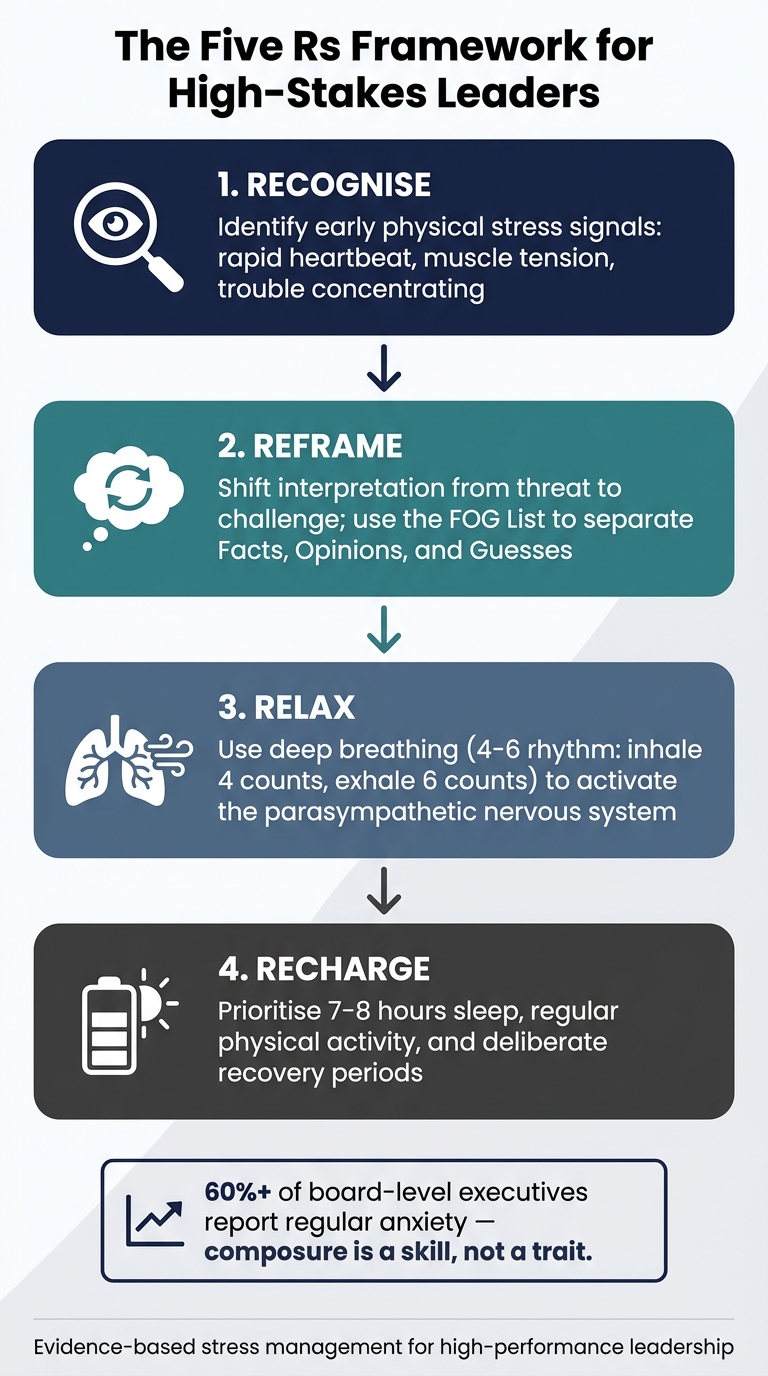
The Five Rs Framework: Stress Management for High-Stakes Leaders
Effective leadership in high-pressure environments isn't just about endurance - it involves adopting structured methods to manage stress before it clouds judgement. The following strategies provide actionable tools that leaders can use in critical moments, from boardroom crises to intense negotiations, helping to address stress before it escalates.
The Five Rs Framework
The Five Rs - Recognise, Reframe, Relax, Recharge - offer a step-by-step approach to managing stress, from identifying its onset to ensuring long-term recovery.
- Recognise: This step involves identifying early physical signs of stress, such as a rapid heartbeat, muscle tension, or trouble concentrating. Leaders often overlook these signals, reacting instinctively rather than pausing to assess their state.
- Reframe: Here, the focus shifts to altering the interpretation of the situation. Instead of viewing it as an insurmountable threat, leaders can see it as a challenge to overcome.
- Relax: Techniques like deep breathing or intentional pauses disrupt the fight-or-flight response, activating the parasympathetic nervous system to promote calmness.
- Recharge: Sustained recovery is crucial. This includes prioritising sleep, regular physical activity, and deliberate periods of rest to maintain long-term resilience.
Cognitive Reframing Techniques
Under acute stress, the amygdala - the brain's emotional processing centre - can suppress the prefrontal cortex by up to 70%, impairing reasoning and impulse control. Cognitive reframing helps redirect the brain towards logical problem-solving. Leaders can reframe their perspective by interpreting challenges as opportunities to solve problems, rather than threats to endure.
One effective tool is the FOG List, which consists of three columns to separate:
- Facts: Verifiable, objective information.
- Opinions: Subjective interpretations.
- Guesses: Assumptions or predictions.
This exercise helps clarify the situation, cutting through stress-induced narratives to focus on reality.
"The situation didn't change. The interpretation of the situation did. And that interpretation is where performance actually lives." - Dan Docherty, Chief Coaching Officer, Braintrust
Another helpful approach is reframing reactive questions like "Why is this happening to me?" into reflective ones such as "What is this teaching me?". This shift encourages introspection and growth rather than defensiveness.
While cognitive strategies are powerful, pairing them with emotional awareness can further enhance stress management.
Awareness and Emotional Acceptance
Awareness is a cornerstone of managing stress effectively. Leaders must first acknowledge their stress before applying any techniques. Emotional labelling - a method grounded in neuroscience - has proven particularly effective. By naming emotions (e.g., "I feel tense" or "I feel cornered"), leaders activate their prefrontal cortex, which calms the amygdala and restores clarity.
"The act of naming what is happening, such as 'I am tense,' or 'I feel cornered,' reduces the emotional charge. Neuroscientists have demonstrated that labelling emotions engages the prefrontal cortex and calms the amygdala, restoring capacity for reflection." - Andi Roberts, Executive Coach
Combining emotional awareness with reframing techniques equips leaders to navigate high-stakes situations with greater composure and focus. These strategies not only mitigate stress but also enhance decision-making and overall performance.
Real-Time Stress Regulation Tools
While long-term strategies are essential for building resilience, there are moments when immediate stress relief is necessary. In high-pressure situations like board meetings or negotiations, leaders often need to find their footing quickly. The techniques below are designed to help maintain composure and clarity without having to step away.
Breathwork for Instant Calm
Breathing is one of the fastest ways to regain control when stress strikes. During moments of tension, the body’s fight-or-flight response kicks in, but consciously extending the exhale can activate the vagus nerve. This signals the brain to slow the heart rate and shift into a calmer state. A simple yet effective method is the 4-6 rhythm: inhale through the nose for four counts and exhale slowly through the mouth for six. Even a single intentional breath can disrupt the stress response and promote clearer thinking.
Leaders practising controlled breathing not only help themselves but also influence the atmosphere around them. Employees often mirror the emotional state of their leaders, so visible calm can ripple through the team. Once breathing is under control, short mindfulness techniques can provide an additional mental reset.
Micro Mindfulness Practices
Mindfulness doesn’t require a quiet room or extended time. The STOP technique is a quick four-step process that can be applied in under a minute:
- Stop: Pause to interrupt the automatic reaction.
- Breathe: Use the 4-6 rhythm to regain physical control.
- Refocus: Ask questions like, “What is the truth here?” or “What is my goal?”
- Choose: Respond intentionally, guided by values instead of fear.
Another grounding exercise involves focusing on the sensation of your feet on the floor. This simple act brings attention back to the present, cutting through mental clutter and helping with high-stakes decisions.
"Stopping is not hesitation; it is leadership composure. It means creating a small gap before speaking, sending, or deciding." - Andi Roberts, Executive Coach
When mindfulness isn’t enough to fully manage stress, thought labelling offers a way to regain emotional clarity.
Thought Labelling for Emotional Clarity
In stressful moments, negative thoughts can feel overwhelmingly real. A technique from acceptance-based psychology, called cognitive defusion, helps create distance between a person and their thoughts. For instance, instead of thinking, “I am going to fail,” reframing it as, “I am having the thought that I am going to fail,” shifts the perspective. This subtle adjustment stops the brain’s amygdala from treating the thought as an immediate threat, allowing rational thinking to take over.
Labelling thoughts in this way - such as saying, “I am having the thought that I am not prepared” - provides a sense of detachment from the narrative of stress.
"Calm isn't about staying quiet or stepping back - it's about choosing a clear, grounded response when it matters most." - Noa Marley, The Mental Game Clinic
Long-Term Resilience Strategies for High-Stakes Leaders
While quick fixes can ease immediate stress, true resilience stems from consistent, daily habits. Leaders who want to thrive under pressure need sustainable strategies that go beyond short-term relief, building a foundation for long-term performance.
Sleep and Recovery
Sleep is a cornerstone of resilience. Jackie Yeaney, a former CMO at Tableau and Red Hat, emphasises its importance:
"I prioritise 7–8 hours of sleep every night." - Jackie Yeaney, Board Member and former CMO, Tableau and Red Hat
A lack of quality sleep can impair decision-making, emotional regulation, and strategic thinking. But recovery isn’t just about the hours spent sleeping; it’s also about how leaders unwind. Yeaney, for instance, plays board games with her husband each evening, which helps her disconnect from work and recharge mentally - a deliberate step to break away from the constant business chatter.
Physical Health and Stress Resilience
Physical activity is another essential pillar of stress management. High-performing leaders don’t just exercise when they find the time - they make it a priority. Andrew Antos, CEO of Klarity, incorporates daily workouts into his schedule, exercising either in the early morning or evening. He also uses a standing treadmill desk for up to five hours a day, staying active while working.
The rationale is simple. Doug Zingale, Co-founder at Blue Goose Capital, explains:
"You can't stay fully engaged with business all the time without having your creativity and productivity suffer."
Leaders like Yeaney take this advice to heart by scheduling exercise as a fixed commitment. For example, she reserves time in her calendar for circuit training every Tuesday, Thursday, and Saturday, ensuring it’s non-negotiable. This disciplined approach to physical health bolsters stress resilience and helps leaders maintain peak performance.
Time Management and Delegation
Workload is a significant source of stress for leaders, with over 60% of board-level executives regularly facing high levels of anxiety. A proactive approach to time management can help mitigate this. Conducting a weekly review of one’s calendar and task list can reveal unsustainable patterns, enabling leaders to delegate before burnout becomes an issue.
Delegation not only preserves mental energy but also ensures focus on high-priority decisions. Patricia Hargil, Vice President of Transformation at Messer Americas, highlights the importance of self-care:
"I am a demanding leader, but I know a car does not run on an empty tank. I cannot be my best self and bring my best game when I am not taking care of my well-being."
Leaders who set boundaries - such as taking breaks and protecting recovery time - send a powerful message to their teams. Research supports this: 49% of employees who take regular breaks report lower stress levels, while 40% note increased productivity. By modelling these behaviours, leaders create a culture that values sustainable performance, benefiting the entire organisation.
Advisory and Support Systems for Stress Management
While personal habits like sleeping well, exercising regularly, and delegating effectively lay the groundwork for managing stress, they can only go so far. External support systems provide an additional layer of resilience, particularly when leaders face high-pressure situations that push their internal strategies to the limit. Trusted advisors, structured coaching, and confidential peer networks offer external perspectives that can prove invaluable when personal judgement is clouded by stress.
Bespoke Leadership Advisory
When stress levels peak, the prefrontal cortex - the brain’s centre for reasoning, empathy, and impulse control - can experience up to a 70% reduction in activity, significantly impairing critical leadership skills. Bespoke advisory services are designed to help leaders maintain high performance under such conditions. For instance, House of Birch specialises in equipping leaders with emotional discipline, decision rehearsal, and scenario-planning techniques. These tools enable leaders to remain composed and strategically focused during crises. In one notable case, the firm supported executives navigating a complex merger and acquisition, ensuring they stayed aligned, emotionally disciplined, and strategically coherent.
As Tommy Birch, Founder of House of Birch, explains:
"Every engagement is bespoke and discreet, designed to sharpen your decision-making, amplify your presence, and maximise your influence, turning high potential into high performance in the moments that truly matter." - Tommy Birch, Founder, House of Birch
Coaching for Resilience
Coaching plays a pivotal role in treating emotional self-regulation as a core skill, rather than an optional extra. Executive coach Andi Roberts highlights this perspective:
"Emotional self-regulation is not a soft skill to be added after the fact. It is a structural requirement for sustainable leadership." - Andi Roberts, Executive Coach
Effective coaching often incorporates practical tools such as pre-performance scripts and mental rehearsal, which prepare leaders for high-stakes scenarios. These sessions also help leaders track emotional patterns, identify stress triggers, and build their self-regulation capabilities over time.
Peer and Support Networks
Leadership at the highest levels can often feel isolating, with few safe spaces to discuss the pressures of the role. Trusted peer networks provide a vital outlet, normalising the challenges of high-pressure decision-making and helping leaders process their emotions. Research shows that strong social support enhances adaptability under stress. Tommy Birch summarises the importance of these networks:
"I serve as a trusted advisor to high-stakes leaders, building emotional discipline, strategic intelligence, and resilience under pressure." - Tommy Birch, Founder, House of Birch
Managing Stress: Building Capacity, Not Eliminating Pressure
Effectively managing stress is not about removing pressure entirely but about developing the ability to operate effectively within it. As the Hervival Editorial Team aptly notes:
"Calm, after all, is not the absence of pressure. It is the presence of regulation within it."
To achieve this, tools and strategies must work together. Immediate techniques such as box breathing and cognitive reframing help disrupt the body's automatic stress response in the moment. Meanwhile, long-term habits like maintaining consistent sleep patterns, engaging in regular physical activity, and practising structured delegation provide the foundation for sustained performance. This combination ensures that leaders can maintain their composure, no matter the intensity of the situation.
Crucially, composure is not an innate trait but a skill honed through deliberate practice. With over 60% of board-level executives reporting significant anxiety and stress, it’s clear that this is a shared challenge, not a personal shortcoming.
In addition to internal strategies, external support plays a vital role in helping leaders navigate high-pressure environments. For those seeking discreet and tailored guidance, House of Birch offers bespoke advisory services designed for high-stakes leadership. Tommy Birch, Founder of House of Birch, explains: "I build individuals who are emotionally disciplined, strategically intelligent, socially dominant, and unshakeable under pressure." This personalised approach enables leaders to shift from reactive crisis management to clear and decisive decision-making under pressure.
FAQs
How do I spot my earliest stress signals?
Early indicators of stress often manifest through physical and emotional signs. On the physical side, you might experience a quicker heart rate, faster breathing, or tight muscles - responses driven by the release of cortisol and adrenaline. Emotionally, common signs include feeling overwhelmed, becoming irritable, or finding it difficult to focus. Spotting these signals early gives you the chance to intervene with strategies like taking a moment to pause, practising deep breathing, and shifting your focus to regain a sense of control during challenging situations.
How do I use a FOG List quickly?
To make the most of a FOG List, begin by jotting down your fears, obstacles, and stressors - the factors that disrupt your focus. Identify and prioritise the issues that feel most urgent or impactful. In moments of high pressure, refer to this list to regain clarity and perspective. Pair this practice with techniques such as reframing challenges to see them from a different angle and working on emotional regulation skills. Together, these steps enable better stress management and more thoughtful decision-making when it matters most.
What should I do if stress keeps returning?
If stress continues to resurface, employing consistent techniques to manage your emotional response can be beneficial. Grounding exercises, such as the 333 rule, may help redirect your focus. This involves identifying three objects you can see, three sounds you can hear, and moving three parts of your body. Such practices can anchor you in the present moment.
Engaging in structured activities that promote a sense of comfort, confidence, and control is another effective approach. Additionally, mindfulness techniques like Stop, Breathe, Refocus, Choose are designed to interrupt stress responses. By pausing to breathe, reassessing the situation, and making intentional choices, you can restore a sense of calm and clarity during high-pressure situations.

