How Sleep Impacts Leadership Under Stress
When leaders face high-pressure situations, sleep is often sacrificed, but this comes at a cost. Insufficient sleep impairs decision-making, emotional control, and team dynamics. Studies show that 43% of leaders sleep poorly at least four nights a week, leading to reduced cognitive clarity, rash emotional responses, and strained workplace environments. Sleep deprivation also increases error rates by 20%, slows task completion by 14%, and can impair judgement as much as being legally drunk.
Key insights:
- Lack of sleep disrupts the brain's prefrontal cortex, essential for judgement and planning.
- Sleep-deprived leaders are more likely to mismanage stress and exhibit negative behaviours, harming team morale.
- Simple strategies, like maintaining regular sleep schedules and creating pre-sleep routines, can improve leadership performance.
Leaders should treat sleep as a necessity, not a luxury, to sustain resilience, make sound decisions, and maintain healthy workplace dynamics.
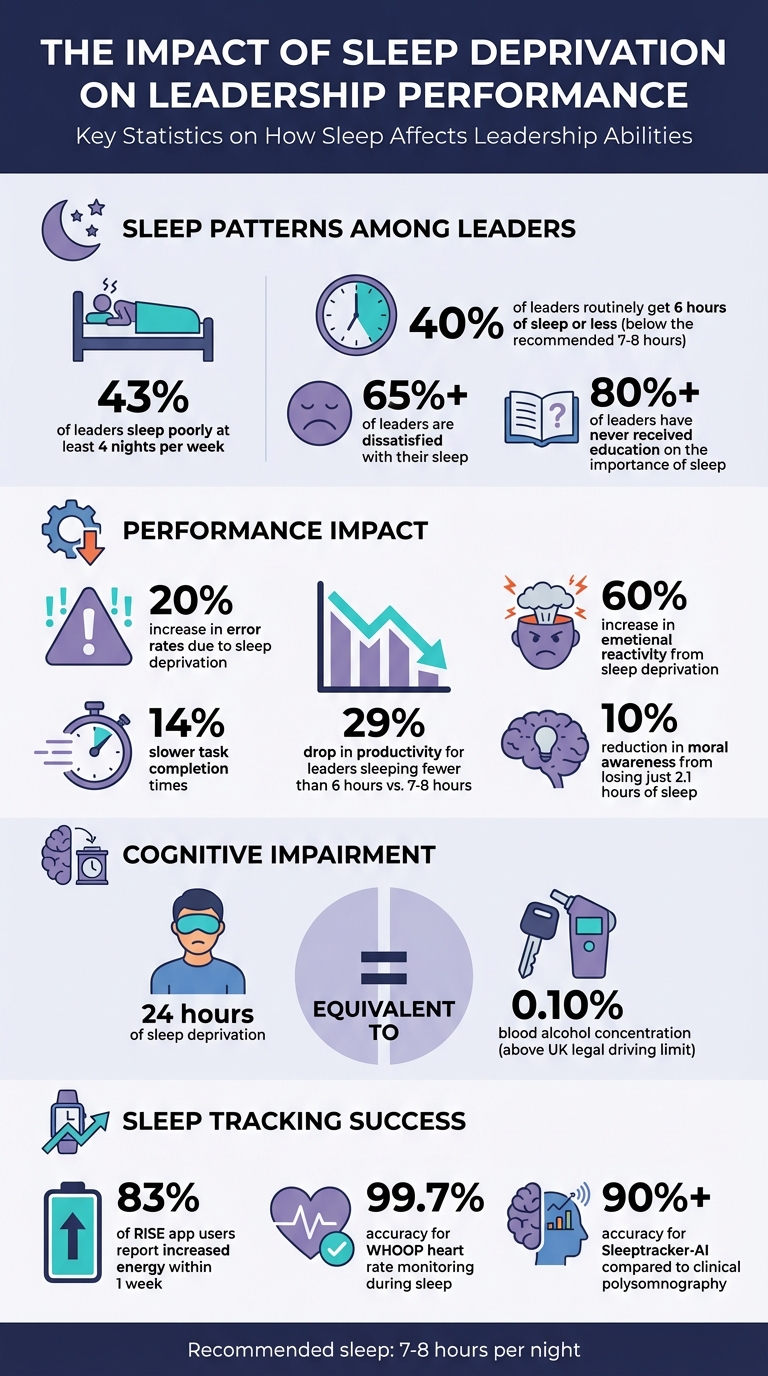
How Sleep Deprivation Impacts Leadership Performance: Key Statistics
How Poor Sleep Damages Leadership Ability
Impaired Thinking and Decision-Making
Sleep plays a crucial role in maintaining sharp thinking, but without enough rest, leaders’ cognitive abilities take a hit. Sleep deprivation disrupts mental processing, leading to poorer judgement, weaker strategic planning, and struggles with solving complex problems. The results? Slower reaction times, shorter attention spans, and less self-control, all of which are critical for effective leadership.
Research shows that sleep deprivation increases error rates by 20% and task completion times by 14%. Even more striking, staying awake for 24 hours can impair cognitive function to the same degree as having a blood alcohol concentration of 0.10% - well above the legal drink-driving limit in the UK. Despite these risks, around 40% of leaders routinely get six hours of sleep or less, falling short of the recommended seven to eight hours.
Loss of Emotional Control Under Pressure
A lack of sleep also undermines a leader’s ability to regulate emotions. From a neurological perspective, insufficient sleep weakens the connection between the medial prefrontal cortex (the brain’s control centre) and the amygdala (responsible for emotional responses). This disruption leaves the amygdala hyper-sensitive to negative triggers, making leaders more prone to impulsive or punitive reactions - often at moments when calmness is most critical.
"Sleep-deprived leaders are less inspiring, less charismatic and... more likely to be abusive towards their teams." – Stefan Volk, Professor of Management, University of Sydney
This emotional instability doesn’t just affect the leader; it ripples through the team. Studies reveal that losing just 2.1 hours of sleep can reduce a leader’s moral awareness by 10%. Leaders running on empty are more likely to use sharper tones, show less patience, and even display hostility - behaviours that harm team morale and productivity.
The Stress-Sleep Cycle
The relationship between poor sleep and stress is a vicious loop. Sleep-deprived leaders often engage in confrontational interactions, which in turn heighten stress levels and further disrupt sleep. This ongoing cycle erodes resilience over time, making it harder for leaders to perform under pressure.
Sleep acts as a reset button for the brain, helping to moderate emotional responses and restore balance. Without this reset, stress builds up, impairing a leader’s ability to think rationally and maintain social awareness. Alarmingly, more than 65% of leaders report being dissatisfied with their sleep, and over 80% admit they’ve never received proper education on the importance of rest during their professional development. This lack of awareness perpetuates the stress-sleep cycle, gradually chipping away at the essential skills needed to lead effectively. Breaking this cycle requires deliberate strategies to improve sleep, ensuring leaders can rebuild their resilience and stay effective even in high-pressure situations.
sbb-itb-ce676ec
Improving Sleep for Better Leadership Recovery
Maintaining a Regular Sleep Schedule
Sleep plays a crucial role in maintaining sharp decision-making and resilience, especially for leaders navigating high-pressure environments. Establishing a consistent sleep schedule is a key step. Leaders are encouraged to treat sleep as a non-negotiable priority by setting firm boundaries around their workday and bedtime. For instance, working backwards from a required wake-up time can help ensure sufficient rest. If a leader needs to wake at 06:00, a bedtime between 21:00 and 23:00 - allowing for a 60-minute wind-down - can create a reliable routine.
Microsoft's CEO, Satya Nadella, has publicly highlighted the importance of sleep, noting that his effectiveness as a leader hinges on consistently achieving eight hours of sleep. This underscores the idea that maintaining regular sleep patterns is far more beneficial than relying on "catch-up" sleep during weekends.
To combat work-related rumination, leaders can set strict digital cut-off times, such as no work communication after 20:00. For those working remotely, incorporating a clear end-of-day ritual - like taking a short walk or engaging in a relaxation exercise - can signal the transition from work to personal time. Once these habits are in place, the next step is to prepare the mind for rest with a tailored wind-down routine.
Building a Pre-Sleep Routine
Creating a gradual transition to sleep is essential for disengaging from the stresses of the day. Experts recommend a consistent 60–90 minute wind-down period to help the body shift from cortisol production to melatonin release, which promotes sleep. This routine might include dimming lights, enjoying a cup of herbal tea, or reading a calming book.
"The gold standard is a 60–90 minute wind-down window. But it's less about the clock and more about building a familiar sequence that the body learns to associate with rest." – Bailey Sleep Coach
Journaling can also be an effective tool. Writing down unfinished thoughts or to-do lists before bed can provide mental closure, easing anxiety and allowing the mind to relax. This "brain dump" creates a sense of resolution, paving the way for smoother sleep.
Managing stimulants like caffeine and alcohol is equally important. Caffeine consumed after 14:00 can disrupt sleep, as its effects last up to seven hours. Alcohol, while initially sedating, can fragment REM sleep and cause a rebound effect, leading to elevated cortisol levels. Leaders should also implement a "digital sunset", avoiding screens 30–60 minutes before bed. Blue light emitted from devices suppresses melatonin, tricking the brain into thinking it's still daytime.
With a pre-sleep routine in place, the next focus is on creating an environment that supports restful sleep.
Improving Your Sleep Environment
The physical environment of the bedroom plays a pivotal role in determining whether the brain feels secure enough to initiate sleep. Temperature is a key factor - keeping the room between 16–18°C helps lower core body temperature, a necessary step for falling asleep. Opting for breathable bedding materials can also prevent heat buildup, improving overall comfort.
Light management is another critical element. Blackout blinds or a high-quality sleep mask can block ambient light, which otherwise suppresses melatonin production. About 60–90 minutes before bed, switching off overhead lights and using a warm-toned bedside lamp can signal the end of the day. To reinforce the circadian rhythm, exposure to natural light within 30 minutes of waking is recommended.
A clutter-free bedroom can further enhance relaxation. Limiting bedside items to essentials - such as a lamp, a glass of water, and a calming book - reduces cognitive distractions. Keeping screens and work materials out of the bedroom is equally important, as the brain quickly associates environmental cues with specific activities. Ensuring your immediate surroundings are calm - like an empty wall or soothing artwork - can help create a peaceful atmosphere for sleep.
Measuring Sleep Improvements and Leadership Benefits
Sleep Tracking Tools and Devices
Advancements in sleep-tracking technology offer leaders precise methods to monitor and improve their sleep quality. Wearable devices like the Oura Ring, WHOOP, and Apple Watch (paired with the Pillow app) measure critical data such as heart rate, heart rate variability (HRV), and sleep stages (light, deep, and REM). Among these, WHOOP demonstrates an impressive 99.7% accuracy for heart rate monitoring during sleep and 99% for HRV measurements. For those averse to wearing a device, Sleeptracker-AI provides a contactless option. This under-mattress sensor tracks respiratory rate, arousal index, and environmental factors such as air quality, achieving over 90% accuracy when compared to gold-standard polysomnography.
Sleep-focused apps also play a pivotal role. For instance, RISE employs metrics like "Sleep Debt" and circadian rhythm patterns to help users optimise their rest. Notably, 83% of RISE users report increased energy levels within a week of managing their sleep debt. The app has been downloaded over 1 million times and holds a 4.4/5-star rating on Google Play from 9,400 reviews. Similarly, the Pillow app has garnered over 100,000 five-star ratings on the App Store. Its standout feature, a smart alarm, wakes users during their lightest sleep phase to minimise grogginess.
Leadership Performance Metrics Linked to Sleep
Tracking sleep data does more than validate rest quality - it directly correlates with improved leadership capabilities. Heart Rate Variability (HRV) is a prime indicator of recovery and readiness. Leaders can monitor their HRV and sleep scores each morning to assess their capacity for high-pressure tasks. Higher scores suggest readiness for demanding work, while lower scores indicate the need for recovery strategies, such as prioritising earlier bedtimes.
Another key measure is sleep efficiency, which gauges the percentage of time spent asleep relative to time in bed. Research indicates that this metric predicts cognitive performance more accurately than total sleep duration. Leaders sleeping fewer than six hours per night may experience up to a 29% drop in productivity compared to those achieving seven to eight hours. Additionally, sleep deprivation increases emotional reactivity by approximately 60%, which can hinder patience and conflict resolution skills.
Combining sleep data with focus metrics allows leaders to pinpoint their optimal performance thresholds - identifying the precise amount of sleep required to sustain sharp decision-making and emotional stability.
At House of Birch, these sleep metrics are integrated into leadership advisory services. By aligning sleep data with leadership performance indicators, the organisation equips leaders with customised strategies to enhance resilience and make well-informed decisions under pressure. This approach enables leaders to refine their strategies and thrive in high-stakes environments.
The Corporate Athlete: Sleep, Stress & Sustainable Performance
Conclusion: Making Sleep a Priority for Leadership Resilience
Sleep is not a luxury - it is a non-negotiable foundation for effective leadership, particularly in demanding environments. Research consistently shows that insufficient sleep has a profound negative impact on leadership capabilities, from decision-making to emotional regulation.
Leaders who prioritise sleep send a powerful message throughout their organisations. For instance, Mark Bertolini, CEO of Aetna, introduced a £500 annual incentive for employees who achieved seven hours of sleep for 20 consecutive nights, recognising the link between well-rested individuals and overall company performance. Similarly, Satya Nadella, CEO of Microsoft, publicly emphasises his commitment to eight hours of sleep each night, highlighting the importance of cognitive clarity over the exhaustion often associated with high-stakes roles.
Incorporating better sleep practices into leadership routines is essential. This might include setting clear digital boundaries, aligning work patterns with natural circadian rhythms, and fostering a workplace culture that values rest. Leaders operating on insufficient sleep are more likely to make impulsive decisions and struggle with emotional regulation, which can ripple through teams and affect organisational outcomes.
Organisations like House of Birch are helping leaders integrate sleep strategies into their routines. By combining sleep data with leadership performance metrics, they create personalised frameworks aimed at improving decision-making, emotional stability, and overall resilience. This approach ensures that sleep is viewed as a strategic tool rather than an afterthought.
Making sleep a priority is not about reducing productivity - it is about building the stamina and clarity needed for strong, effective leadership in high-pressure situations.
FAQs
How can I tell if poor sleep is hurting my leadership?
Poor sleep has the potential to weaken leadership by disrupting decision-making, emotional control, and overall behaviour. Common indicators include a dip in creativity, heightened emotional reactivity, or challenges in inspiring and motivating a team. Leaders might also experience impatience, irritability, or find it harder to make clear and strategic decisions. Paying attention to shifts in mood, focus, and the quality of interactions can provide useful insights into whether sleep problems are impacting performance.
What’s the quickest way to break the stress–sleep cycle?
To interrupt the stress–sleep cycle effectively, keep daytime naps short - around 20–30 minutes - to prevent interference with your regular sleep routine. Incorporating relaxation methods such as meditation or deep breathing can further aid in managing stress. Additionally, maintaining a consistent sleep schedule by going to bed and waking up at the same time every day can enhance sleep quality and help restore balance.
Which sleep metrics matter most for performance under pressure?
Key indicators of sleep's impact on performance include decision-making ability, mood stability, and mental clarity. These critical functions are closely tied to both the quality and length of sleep. Ensuring a regular pattern of restorative sleep enables leaders to stay focused and maintain their composure in demanding, high-pressure scenarios.

