Real-Time Feedback: Solving Stakeholder Misalignment
When stakeholders operate with conflicting information, projects slow, decisions are revisited, and trust erodes. By 2026, reports of misalignment in organisations have risen sharply, with measurable impacts such as 30% more project restarts and decision timelines stretching from 7–10 days to an average of 31 days.
Real-time feedback offers a practical solution. Unlike periodic reviews, it enables leaders to detect alignment issues early, reducing delays, misunderstandings, and financial risks. The approach involves continuous communication, tailored messaging, and tools like pulse surveys and AI-powered sentiment analysis. However, success depends on leaders’ ability to interpret feedback effectively and act with clarity.
Key takeaways:
- Misalignment stems from communication gaps, conflicting priorities, and cognitive biases.
- Real-time feedback identifies emerging risks early, preventing escalation.
- Tools like shared dashboards and sentiment analysis improve transparency.
- Leaders must close feedback loops and integrate insights into decision-making.
Organisations should consider embedding real-time feedback into daily operations to improve coordination, minimise delays, and strengthen decision-making processes.
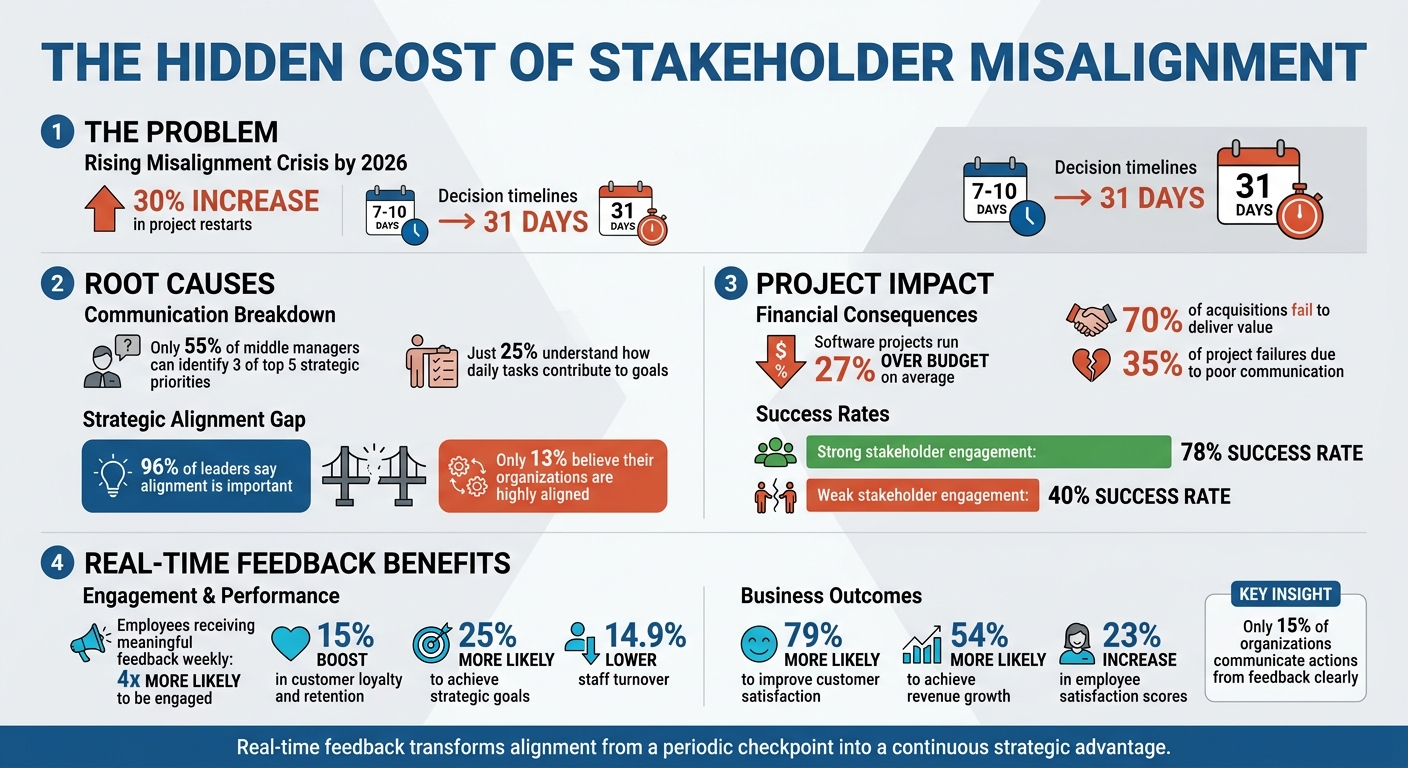
The Cost of Stakeholder Misalignment: Key Statistics and Impact Metrics
The Power of Stakeholder Engagement & Scalable Feedback (#CollabTalk Podcast Ep.160)
sbb-itb-ce676ec
Common Causes of Stakeholder Misalignment
Understanding the reasons behind stakeholder misalignment is crucial for addressing it effectively. Often, the issue stems less from deliberate resistance and more from structural communication breakdowns, conflicting objectives, and cognitive biases. By identifying these root causes, leaders can take steps to foster alignment.
Communication Gaps and Misunderstandings
A lack of clarity in communication is a frequent source of misalignment. Leaders often rely on vague statements, such as "become market leader", without outlining actionable steps for different teams. As a result, fewer than 55% of middle managers can identify even three of their company's top five strategic priorities, and only 25% understand how their daily tasks contribute to these goals.
Take Google's attempt to promote Google+ (2011–2019) as an example. Leadership directed teams to integrate social features into the platform but failed to provide clear priorities or success metrics. This ambiguity led to uneven execution and internal frustration, which ultimately played a role in the platform's downfall.
Another challenge comes from generic, one-size-fits-all communication. Effective messaging needs to be tailored to its audience. For instance, executives require insights about risks and trade-offs, while partner teams need detailed information on dependencies and timelines. When messaging isn't customised, it can lead to "subtle communication breakdowns", where teams leave meetings with differing interpretations of the same decisions.
| Early Warning Signal | What It Suggests |
|---|---|
| "I didn’t know about this" comments | A failure in the communication distribution system |
| Relitigating resolved decisions | Lack of clarity or commitment during the decision-making process |
| Success in one team causes frustration in another | Conflicting incentives or goal structures |
| Circular discussions | Inability to reach consensus in discussions |
Conflicting Incentives and Priorities
Misaligned performance metrics often exacerbate the problem. Different functions within an organisation may pursue conflicting goals, leading to friction. For example, while marketing might focus on generating leads, sales prioritises closing deals, and product teams concentrate on releasing new features.
In one mid-sized technology company, such misalignment became evident when three departments launched competing customer retention initiatives. Marketing offered discounts that clashed with the company’s premium positioning, while customer success removed support tiers essential to a new onboarding process. Despite their efforts, retention rates declined for key customer groups due to the lack of coordination.
Jason Bollinger, PMP and Enterprise Support Leader, highlights the importance of understanding these dynamics:
"Stakeholders aren't obstacles. They're owners of constraints you need to understand."
Each stakeholder brings their own priorities - be it cost, schedule, compliance, or workforce impact. Without recognising and addressing these competing constraints, achieving alignment becomes an uphill battle. While 96% of leaders acknowledge the importance of strategic alignment, only 13% believe their organisations are highly aligned.
Cognitive and Behavioural Biases
Even with aligned communication and incentives, cognitive biases can derail progress. Leaders often fall prey to "Glass Head Syndrome", assuming their strategies are self-evident to others. This can lead them to misinterpret silence or a lack of objections as genuine agreement, while stakeholders fill in the gaps with their own assumptions.
Other biases also play a role. Confirmation bias drives teams to focus only on evidence that supports their existing beliefs, increasing the risk of poor decisions. The sunk cost fallacy can keep failing projects alive simply because of prior investments. Similarly, the anchoring effect can cause early information - such as a previous failure or an initial price estimate - to disproportionately influence later decisions.
Jane Mitchell, an Independent Consultant and NED at JL&M Ltd, underscores this challenge:
"Leaders also need the humility and awareness to understand that what’s going on in their world is not necessarily what’s understood by everyone else."
These biases are particularly dangerous in high-pressure environments where quick decisions are required. For instance, software projects, on average, run 27% over budget due to overconfidence in estimates, and 70% of acquisitions fail to deliver value, often because of unrealistic integration assumptions. Additionally, the cumulative impact of avoiding difficult conversations - what experts term "conversation debt" - can undermine alignment long before problems become visible.
How Real-Time Feedback Resolves Misalignment
Misalignment among stakeholders often stems from communication breakdowns, conflicting priorities, and inherent biases - factors that thrive when information is shared infrequently or inconsistently. Real-time feedback disrupts this pattern by ensuring a continuous flow of information about stakeholder concerns, priorities, and sentiment. This enables organisations to address issues as they arise, rather than waiting for periodic reviews.
By providing an ongoing stream of insights, real-time feedback identifies declining satisfaction and emerging risks early, preventing them from escalating into larger problems. For instance, employees who strongly agree they received meaningful feedback in the past week are nearly four times more likely to be engaged compared to their peers. Similarly, organisations that act swiftly on real-time feedback report a 15% boost in customer loyalty and retention.
This approach also eliminates strategic blind spots by gathering diverse perspectives continuously, ensuring that organisational plans align with actual needs rather than assumptions. Furthermore, it counters recency bias by capturing a broader, more accurate picture of stakeholder sentiment over time. The adoption of specialised tools for real-time insights naturally complements this monitoring process.
Key Features of Real-Time Feedback
Effective real-time feedback systems rely on multiple interconnected tools. Pulse surveys and shared dashboards deliver timely, context-rich insights, providing all teams with a unified view of key metrics. This minimises misunderstandings and ensures consistent data across the organisation . Additionally, AI-powered sentiment analysis, utilising Natural Language Understanding (NLU), identifies hidden patterns and emerging themes in open-text feedback, emails, and chat messages.
Such tools significantly contribute to organisational success. Research shows that companies using real-time feedback tools are 25% more likely to achieve their strategic goals, while those with regular feedback processes report 14.9% lower staff turnover.
Anonymous feedback options further enhance these systems by encouraging honest input on sensitive topics without fear of consequences. Automated alerts also play a critical role, notifying leaders of significant trends in real time. Together, these features ensure that organisations maintain alignment with stakeholder expectations.
Benefits of Continuous Feedback Loops
Continuous feedback goes beyond detecting problems early - it delivers measurable performance improvements. By fostering two-way transparency, it helps stakeholders feel recognised and builds the trust necessary for long-term collaboration.
Regular feedback enables quicker issue resolution and stronger outcomes. Teams receiving consistent feedback report 14.9% higher engagement, while organisations using these approaches are 79% more likely to see improvements in customer satisfaction and 54% more likely to achieve revenue growth. Establishing regular touchpoints also prevents "conversation debt" - a situation where unresolved minor issues grow into major conflicts. However, feedback only drives engagement when it is acted upon .
These continuous loops not only improve engagement but also streamline decision-making, ensuring that organisations remain adaptable and aligned.
House of Birch's Role in Facilitating Feedback Processes

To address misalignment effectively, leaders must integrate real-time feedback into their practices. However, success requires more than just the right tools - it demands leaders who can listen constructively and interpret feedback with strategic clarity. House of Birch offers tailored advisory services to help leaders develop these essential skills.
Through personalised engagements, House of Birch equips leaders to handle feedback in high-pressure situations. By focusing on emotional discipline, they help leaders manage their reactions and create the psychological safety necessary for honest dialogue. Their emphasis on strategic intelligence enables leaders to sift through feedback data, prioritise competing demands, and craft responses that align with stakeholder priorities.
For leaders navigating complex organisational dynamics or high-stakes negotiations, House of Birch also emphasises social influence. This ensures that feedback processes strengthen relationships rather than strain them. By addressing concerns, demonstrating responsiveness, and maintaining credibility during difficult decisions, leaders can transform real-time feedback into a tool that enhances their influence and leadership effectiveness.
Steps to Implement Real-Time Feedback in Your Organisation
Introducing real-time feedback isn’t just about adopting new technology - it’s about creating a structured system that aligns people, builds leadership skills, and integrates feedback into daily operations. Here’s a practical guide for leaders aiming to transform how their organisations gather and act on input.
Step 1: Map Stakeholders and Define Success Metrics
Start by identifying key stakeholders and setting clear success metrics. Focus on their influence on decisions rather than their job titles. For example, Atlassian product managers treat stakeholder maps as evolving documents, updating them as projects progress. This approach ensures that stakeholders who may initially seem less critical are brought into focus when their importance grows.
To organise stakeholders effectively, use the Mendelow Power-Interest Matrix, which categorises them into four groups: Manage Closely (High Power/High Interest), Keep Satisfied (High Power/Low Interest), Keep Informed (Low Power/High Interest), and Monitor (Low Power/Low Interest). This ensures resources are allocated where they’ll have the most impact.
Assign stakeholders a persistent ID from the outset to avoid the "Unattributed Voice Problem", where fragmented feedback consumes analysts' time - up to 60–80% - in reconciling data. Define metrics like "Decision Velocity" (time taken to make decisions) and "Message Consistency" (alignment across teams) to measure success. As reStruggle notes:
"Stakeholder alignment isn't about getting everyone to agree with you. It's about ensuring everyone understands what you're building, why you're building it, and what success looks like." – reStruggle
Evidence shows that projects with strong stakeholder engagement succeed 78% of the time, compared to just 40% for those with weak engagement. Poor communication and lack of stakeholder involvement contribute to 35% of project failures.
Step 2: Select and Integrate Feedback Tools
Choose tools that integrate with your organisation’s existing systems to avoid creating data silos. With only 21% of employees globally fully engaged in their roles, it’s essential to prioritise accessible, asynchronous feedback methods like mobile-friendly widgets, AI-powered chatbots, or Slack channels.
Before selecting a platform, define your objectives - whether it’s reducing churn, improving engagement, or identifying gaps. Involve HR, IT, and analytics teams early to clarify their roles in collecting and analysing feedback. Ensure the platform can segment data (e.g., by department or demographic) during collection to avoid bottlenecks later. Tools with AI-native capabilities can theme and analyse feedback in real time, shifting the focus from traditional surveys to continuous, pulse-based insights.
Step 3: Train Leaders to Interpret and Act on Feedback
Technology alone won’t create alignment - leaders need the skills to interpret feedback and act on it. Training should focus on triangulating data from diverse groups to capture a complete picture. Frameworks like the Impact/Effort Matrix can help leaders prioritise actions, distinguishing between "Quick Wins" and "Strategic Initiatives".
One critical competency is closing the feedback loop. While 95% of organisations collect feedback, only 15% communicate the resulting actions clearly. This gap can erode trust and discourage future participation. Employees who receive daily feedback are nearly four times more likely to feel motivated to excel.
For leaders managing complex dynamics, external advisory services - like those from House of Birch - can provide tailored support. These services focus on building the emotional and strategic skills leaders need to turn feedback into a tool for influence rather than a source of stress.
Step 4: Monitor Progress and Iterate
Real-time feedback systems require ongoing refinement. Create scenario-based playbooks for key events to ensure timely responses to critical feedback. Use platforms with automated workflows to trigger actions when certain thresholds (e.g., low engagement scores) are met, ensuring accountability.
Pulse checks at key moments - such as after onboarding, major project reviews, or during organisational changes - can capture timely insights. Keep these surveys short (two to three questions) to maintain high response rates. Regular feedback protocols can increase employee satisfaction scores by up to 23%.
Organisations with consistent feedback processes report 14.9% lower turnover rates. Those using real-time feedback strategies are 79% more likely to see improved customer satisfaction and 54% more likely to experience revenue growth.
Step 5: Embed Feedback into Organisational Governance
To maintain momentum, embed feedback into your organisation’s governance structures. Establish stakeholder councils where leaders meet regularly with key groups to address specific strategic questions. Assign clear ownership and deadlines to prioritised feedback to ensure it translates into action.
Decision frameworks like RAPID or RACI can clarify roles and prevent conflicts over ownership. Feedback should be treated as a continuous process rather than a one-off task. By embedding it into governance, organisations can make it a core discipline.
Organisations that act quickly on real-time feedback report a 15% boost in customer loyalty and retention. By integrating feedback into decision-making processes, leaders can turn alignment into a measurable advantage.
Conclusion
Misalignment among stakeholders goes beyond simple communication breakdowns; it represents a strategic risk that undermines trust, delays decisions, and leads to expensive last-minute conflicts. Real-time feedback offers a direct solution by addressing "visibility debt" - a situation where stakeholders fill in gaps with assumptions, often resulting in emotional and operational challenges later on. By adopting continuous feedback mechanisms, leaders can spot and address issues early, preventing them from escalating into major risks.
The effectiveness of such systems hinges on leaders who can analyse data with both emotional composure and strategic focus. This becomes even more critical in high-pressure environments, where stress can cloud judgement and increase the likelihood of impulsive, risky decisions.
Given the complexity of managing stakeholder relationships, expert support can make a significant difference. For leaders dealing with challenges such as mergers and acquisitions, investor relations, or large-scale organisational change, House of Birch offers tailored advisory services. These services draw on neuroscience, behavioural psychology, and strategic planning to equip leaders with the resilience and influence needed to turn feedback into a competitive advantage. Rather than treating feedback as a mere reporting tool, this approach helps leaders use it as a strategic resource.
This represents a broader cultural shift - from relying on annual surveys to embedding continuous listening into organisational practice. For high-performing organisations, real-time feedback is no longer a luxury - it is a necessity.
FAQs
What counts as real-time feedback in practice?
Real-time feedback involves delivering immediate and relevant insights to individuals or teams as events occur. This approach often utilises tools such as pulse surveys or instant communication platforms, allowing swift adjustments and ensuring alignment among stakeholders. By tackling challenges as they arise, real-time feedback enhances collaboration and supports more effective decision-making.
How do we act on feedback without creating constant disruption?
To respond effectively to feedback without creating unnecessary turbulence, it's essential to have a well-defined and straightforward process. Opt for quick and simple feedback channels, such as shared team messaging platforms or in-app tools, to tackle immediate concerns as they arise. Start by focusing on fast, actionable signals to pinpoint the most pressing issues. Once these are addressed, you can follow up with more detailed, structured research to dig deeper into underlying trends. This approach allows for prompt action while avoiding information overload, enabling teams to stay aligned through steady, manageable adjustments.
How can leaders spot and reduce bias in stakeholder decisions?
Leaders can reduce bias in stakeholder decisions by promoting awareness of cognitive biases and employing strategies grounded in research. Encouraging structured feedback loops, defining clear roles, and fostering open communication can help reveal hidden assumptions or inconsistencies. Additionally, using centralised tools to monitor stakeholder input and providing regular training on recognising biases ensures decisions remain objective and informed by data, limiting the influence of unconscious biases.

