Public Speaking Techniques for High-Stakes Leaders
Hook: Public speaking under pressure is a challenge even for seasoned leaders - 70% of executives admit they struggle to command a room.
Value Summary: Effective communication in high-stakes scenarios, such as investor pitches or crisis briefings, demands more than expertise. Leaders must balance authority, clarity, and emotional resilience to influence decisions and maintain credibility. This guide covers how to craft clear messages, use non-verbal cues to project confidence, and manage stress during critical moments.
Quick Overview:
- Start Strong: Lead with your objective in the first six seconds to capture attention.
- Structured Messaging: Use frameworks like "Problem – Insight – Recommendation" for clarity.
- Blend Data with Stories: Pair statistics with narratives to make your message memorable.
- Command Attention: Master tone, posture, and eye contact for authority.
- Handle Tough Questions: Use structured responses to stay composed under scrutiny.
Bridge: Mastering these techniques can help leaders thrive in high-pressure situations, turning communication into a powerful tool for influence.
Executive Speaking Skills That Always Earn You $$$ & Reputation [WORKSHOP]
sbb-itb-ce676ec
Crafting Messages for High-Impact Delivery
Once you've established your leadership presence, the next step is creating a message that resonates with high-stakes audiences. This requires precision, clarity, and a structured approach.
Lead with the Decision or Objective
Senior executives expect clarity upfront. Nancy Duarte, CEO of Duarte Inc., notes that executives won’t sit through lengthy presentations waiting for the punchline - they’ll interrupt before you get there. Research suggests you have just six seconds to grab their attention before it starts slipping. This makes it essential to open with the core decision or objective immediately, skipping unnecessary background.
Paul Gaffney, a former technology executive at Home Depot, learned this through experience. During a major transformation initiative, he avoided vague language like "agile transformation", which led to confusion. Instead, he clearly articulated:
"We are going to deliver smaller software releases faster with real-user feedback and adjust accordingly."
This direct approach ensured that his team understood the mission and rallied behind it. A simple yet effective template for such openings is: "We are going to [specific action] to achieve [specific outcome]". By eliminating ambiguity, you command attention and set a clear direction from the outset.
Once your objective is established, the next step is to structure your supporting details for clarity and impact.
Use Proven Structures for Clarity
After presenting your objective, organise your supporting points using frameworks that align with how senior audiences process information. The Rule of Three - a favourite of leaders like Bill Gates and Richard Branson - helps make key messages more memorable. Popular frameworks include "Problem – Insight – Recommendation" or "Context – Insight – Implication – Action", both of which help keep your message focused and digestible.
Keep your sentences concise, ideally between 5–10 words, to ensure your message is easy to absorb under pressure. This isn’t about oversimplifying; it’s about making complex ideas accessible. As Benjamin Ball, founder of Benjamin Ball Associates, puts it:
"The real art of leadership communication is to use simple words to explain complex ideas"
. Tailor your approach to your audience: senior leaders want clear decisions, boards expect balanced risk assessments, investors look for commercial logic, and technical teams prioritise evidence over hype. Regardless of the audience, clarity should always trump cleverness.
Once your structure is clear, the next step is to bring your message to life by blending data with compelling storytelling.
Combine Data with Narrative
Numbers alone rarely inspire action. Neuroscience shows that our brains are wired to remember stories - those with a beginning, middle, and end - far more effectively than disjointed data points. To make your message stick, use Aristotle’s three pillars of persuasion: Logos (logic), Pathos (emotion), and Ethos (credibility).
A powerful example comes from Lord Coe’s four-minute speech to the International Olympic Committee in July 2005, which secured London’s bid for the 2012 Olympics. Despite being the underdog against Paris, Coe opened with a personal story:
"My heroes were Olympians. My children's heroes change by the month"
. This emotional connection, paired with a strong commercial case, played a pivotal role in winning the bid. To emulate this approach, pair each key data point with a short anecdote that humanises the numbers, translate statistics into tangible outcomes for the business, and use cautionary tales to highlight the stakes. These narrative elements are what audiences remember long after the data fades.
Projecting Authority and Composure Under Pressure
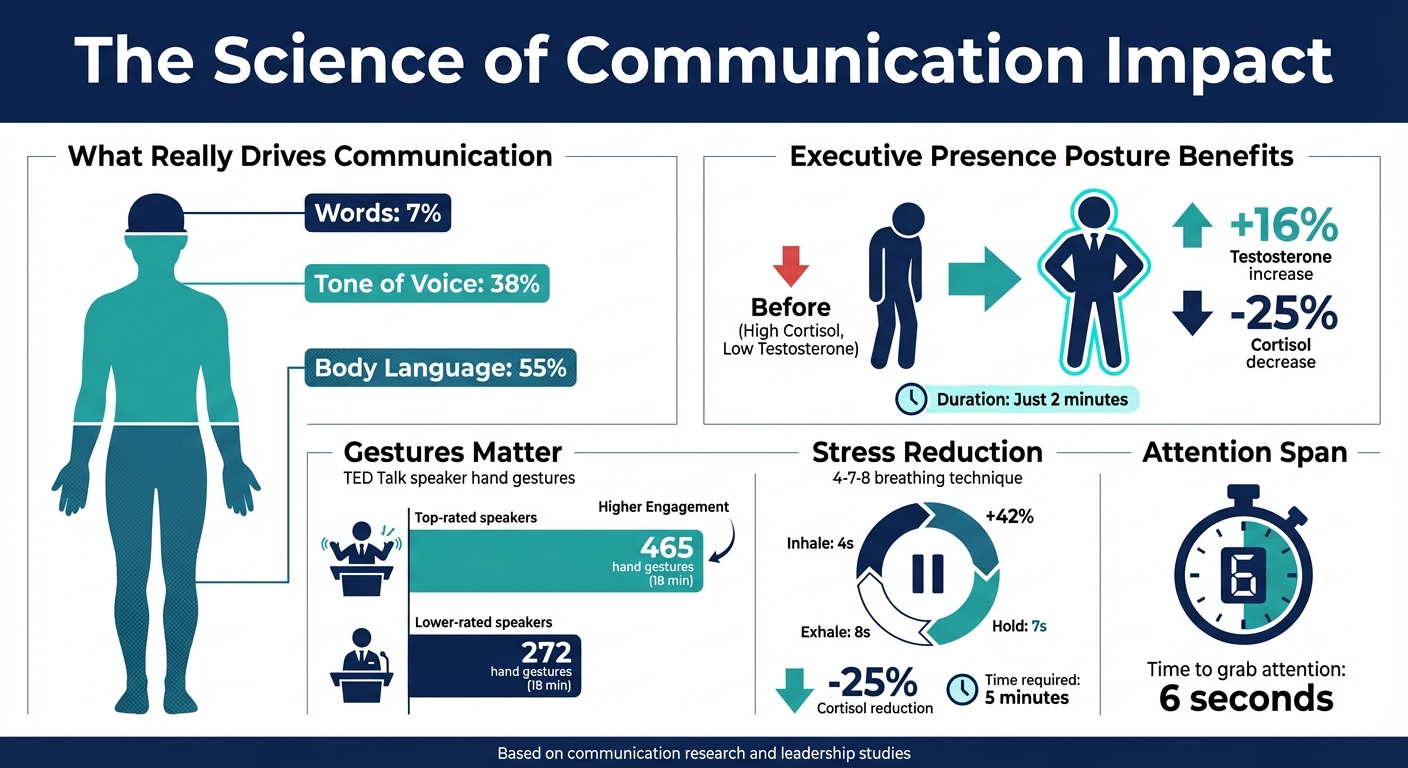
Public Speaking Statistics: Communication Impact and Performance Data
A well-crafted message can fall flat if your delivery conveys doubt. Studies reveal that only 7% of communication relies on words, while 38% comes from tone and 55% from body language. For leaders in high-stakes situations, projecting authority starts with mastering the physical and vocal cues that exude confidence. These foundational elements pave the way for effective communication techniques.
Non-Verbal Communication for Leadership Presence
Start by adopting a strong, grounded posture: stand with feet hip-width apart, keep your spine straight, and level your chin. Holding this "executive presence posture" for just two minutes can prime your body for success. Research shows it can boost testosterone by 16% and lower cortisol by 25%. When addressing an audience, avoid restless pacing. Stay still to emphasise a point, and move intentionally during transitions to maintain focus.
Eye contact is key to building trust, but it should be purposeful. Try the "Z" formation: look at someone in the back-left for four seconds, then back-right, front-left, and finally front-right. This approach makes the entire audience feel engaged without singling anyone out. Gestures also matter - top-rated TED speakers average 465 hand gestures in an 18-minute talk, compared to 272 for lower-rated speakers. Align your gestures with your message: spread your hands wide to convey a "big idea" or bring them together to focus attention. Synchronising your movements with your words enhances credibility and impact.
Vocal Techniques to Command Attention
Your voice carries authority beyond the words you say. Speaking 10–15% slower than your usual pace can help you sound more deliberate and confident. Professor Connson Locke of the London School of Economics highlights the power of silence:
"Replace filler words with silence to enhance engagement".
Strategic pauses can transform your delivery. Use a two-second pause to signal a shift in ideas, and a four-second pause to build anticipation. These pauses can improve message retention by up to 38% and increase perceived credibility by 42%.
Breathing techniques also play a crucial role in vocal control. In 1968, breathing coach Carl Stough trained U.S. Olympic athletes for high-altitude conditions in Mexico City, introducing the "exhale first" method. This technique, later adapted for leaders, helps maintain vocal steadiness under pressure. When stressed, focus on a long exhale - it signals calm to your nervous system. Short, shallow inhales, on the other hand, can trigger a fight-or-flight response. Incorporating these breathing strategies can stabilise your voice and enhance your composure.
Managing Stress and Performance Anxiety
To sustain a commanding presence, managing stress is just as important as perfecting your delivery. Your nervous system can be a tool for performance if used wisely. The 4-7-8 breathing technique - inhaling for 4 counts, holding for 7, and exhaling for 8 - activates the parasympathetic response, reducing cortisol levels by up to 25% in five minutes.
If anxiety strikes mid-speech, try the 5-4-3-2-1 grounding technique: name five things you see, four you can touch, three you hear, two you smell, and one you taste. This exercise refocuses your mind on the present. Additionally, reframe nervousness as excitement. Both states share similar physical symptoms, such as a racing heart and heightened alertness, but telling yourself "I am excited" can shift your mindset into performance mode. Concentrating on factors within your control - like preparation, delivery, and energy - further enhances your authority and mental clarity.
Handling Difficult Questions and Hostile Audiences
Delivering a polished presentation is only half the battle - what truly tests your composure is handling difficult questions. A single challenging query can throw even the most prepared speaker off course. The solution? Preparation. Before stepping into any high-stakes setting, take the time to anticipate objections and opposing views. Rehearse calm, measured responses to these scenarios. A practical way to do this is to engage in "devil's advocate" sessions with a colleague who can push you with tough questions. This kind of preparation shifts uncertainty into confidence.
This groundwork is especially critical in environments where even minor missteps can influence decisions.
Anticipate Tough Questions
Difficult questions often fall into predictable categories: data reliability, methodology, resource limitations, timing, risk management, and doubts stemming from past failures. For each, prepare responses that acknowledge the concern without appearing defensive. For instance, if you're likely to face questions about missed targets from the previous year, have a clear explanation ready about how those experiences have informed your current strategy. The aim is to walk into the room knowing you’ve already considered the most challenging perspectives.
Respond with Structured Frameworks
When confronted with a tough question, take a brief pause - just three seconds - to collect your thoughts. This moment of composure reinforces your authority. A helpful approach is the FRAME technique, which structures your response as follows:
- Focus: Pinpoint the core concern behind the question, ignoring any hostile tone.
- Reflect: Restate the question to confirm your understanding.
- Acknowledge: Recognise the legitimate context or concern behind the query.
- Map: Align your response with the concern being raised.
- Explain: Detail the impact, trade-offs, or contingency plans.
For example, if someone challenges your forecast as overly optimistic, you could respond:
"Just to clarify, you're asking whether this forecast is realistic given last year's performance. That’s a valid question, especially since we missed targets previously. This time, we’ve incorporated those learnings into our model and are monitoring indicators weekly. If trends start to dip, we have measures in place to pause the launch and reallocate resources."
Another technique is bridging, which allows you to acknowledge a disruptive or irrelevant question and smoothly steer the conversation back to your main point. For vague or aggressive questions, request clarification with phrases like, "Just to ensure I understand…" This reframing shifts the tone from confrontational to collaborative. As noted by Speaker Agency:
"Admitting limits whilst offering to follow up makes your message stronger, not weaker".
If you don’t have an immediate answer, acknowledge the gap and commit to providing a follow-up. This transparency can enhance your credibility.
Stay Professional in Hostile Situations
When faced with hostility, address the broader audience rather than the individual attacker. This approach not only maintains your composure but also earns the trust of the room. Use neutral language like "clear concern" or "passion" to acknowledge emotions without escalating tensions.
If you find yourself feeling overwhelmed, grounding techniques can help. Focus on the physical sensation of your feet on the ground or locate a friendly face in the audience to anchor yourself. Breathing exercises, such as the 7-11 method - inhale for seven counts and exhale for eleven - can help restore calm and focus, whether before or during a high-pressure exchange.
These strategies ensure you remain professional and composed, even when the atmosphere becomes challenging.
Building a Long-Term High-Stakes Speaking Practice
Becoming proficient in high-stakes speaking isn't about nailing a single presentation - it’s about cultivating a consistent practice over time. Leaders who approach public speaking as a continuous skill, rather than a one-off event, develop the adaptability and confidence needed for reliable performance. Achieving this involves deliberate rehearsal, honest self-reflection, and embedding these skills into broader leadership development.
Rehearse for Realistic Scenarios
Effective practice goes beyond simply reading through notes. Simulating real-world conditions is key: practise in the actual venue or a similar space that mirrors its size, acoustics, and potential distractions. This helps reduce anxiety caused by unfamiliar environments. Likewise, working with the actual equipment - microphones, slide clickers, or video displays - can prevent technical mishaps.
Speaking aloud during rehearsals is non-negotiable. Silent reading doesn’t prepare you for the timing and pacing of live delivery. Use a timer to ensure your content fits the allocated time, and simulate interruptions or challenging questions. A particularly effective strategy is crafting a Micro-Statement - a concise, 10-second summary of your presentation that keeps your key message sharp, even if you're thrown off track. Executive coach Graham Davies explains:
"Your Micro-Statement is what you would say if you had just 10 seconds to deliver your whole presentation. It's the crown jewel that sparkles with such intensity that it cannot possibly be ignored".
Once rehearsals are complete, seeking direct feedback is essential to refining your delivery.
Use Feedback and Self-Assessment
Feedback and self-assessment are critical to improving after rehearsals. Recording your sessions on a smartphone can help identify nervous habits, such as fidgeting, swaying, or avoiding eye contact, which can undermine your authority. When reviewing footage, focus on vocal variety and ensure your body language aligns with your message. Practising in front of trusted colleagues or family members can also provide valuable insights - ask them for specific, actionable feedback.
During live presentations, pay attention to audience reactions. Signs like laughter, nodding, or focused silence indicate that your message is resonating. After the event, gather feedback through surveys or direct conversations to understand what worked. Measuring tangible outcomes - such as securing a pitch, winning a contract, or being invited back - offers a more reliable gauge of progress than subjective impressions.
Integrate Techniques into Broader Leadership Development
High-stakes speaking isn’t an isolated skill - it complements other leadership abilities, such as narrative control, emotional regulation, and influence. Interestingly, while 96% of business professionals express an interest in improving their presentation skills, only 9% believe they meet the “gold standard” often associated with TED talks. This gap underscores the importance of structured development.
Incorporating small daily practices can build confidence over time. For example, a five-minute morning routine of vocal exercises, two minutes of power posing (which research shows can increase testosterone levels by 16% and reduce cortisol by 25%), and positive visualisation can strengthen composure under pressure. Eliminating filler words in favour of purposeful pauses also enhances authority and gives your audience time to absorb key points. Public speaking expert Rich Watts emphasises:
"Practice and rehearsal is the cornerstone of a successful... presentation. When you've rehearsed your content aloud, simulated the environment, and refined your delivery, you'll be ready to deliver a powerful message".
Conclusion: From Techniques to Transformation
Becoming a confident and effective public speaker isn’t just about nailing one presentation - it’s about reshaping how you communicate overall. The strategies discussed in this guide - whether it’s crafting clear messages, projecting authority under pressure, or managing challenging audiences - are skills anyone can develop with practice. Excellence, as always, is rooted in consistent effort and intentional improvement.
A crucial mindset shift underpins this transformation: moving away from obsessing over outcomes, like audience judgement or the stakes at hand, and instead focusing on the delivery process itself. By concentrating on elements within your control - such as vocal tone, body language, and the structure of your message - you can naturally build confidence. As Dr. James Hewitt, Human Performance Scientist, aptly puts it:
"Don't practise until you get it right; practise until you can't get it wrong".
This process-oriented approach aligns with the earlier emphasis on managing delivery under pressure.
To make this transformation stick, consistency is key. Small, daily habits can make a big difference. For instance, two minutes of power posing - shown to boost testosterone by 16% and lower cortisol by 25% - or a quick morning vocal warm-up can help reinforce confident delivery. After each presentation, take a moment to reflect using the "3 Good, 3 to Work On" method: identify three things that went well and three areas to improve. This ensures continuous growth and refinement.
Elite leaders develop what’s often called "meta-confidence" - the ability to adapt their speaking style to meet different challenges. Building this capability takes time and structure. A 90-day plan can help: dedicate the first 30 days to laying a strong foundation, the next 30 to refining techniques, and the final 30 to applying those skills in high-pressure situations.
It’s worth noting that around 80% of people with social phobias experience anxiety around public speaking. However, with the right strategies and mindset, anyone can transform their speaking abilities into a powerful leadership tool. The techniques shared here aren’t just about getting through high-stakes moments - they’re about thriving in them, delivering messages that inspire, persuade, and establish authority.
FAQs
What are the best ways to manage stress when speaking in high-pressure situations?
Managing stress during high-pressure speaking situations isn’t about trying to eliminate nerves altogether - it’s about channelling that energy in a positive way. A certain level of stress can sharpen your focus and enhance your performance, but when it becomes overwhelming, it can derail both your delivery and your audience’s attention. The goal is to strike a balance: staying calm yet alert.
Here are a few strategies to help keep your stress under control:
- Turn nerves into excitement: Instead of dreading the adrenaline rush, see it as a boost that can energise your delivery.
- Practise mindful breathing: Use a simple technique: breathe in for four counts, hold for two, and exhale for six. This can help steady your heart rate and calm your nerves.
- Visualise a successful outcome: Imagine yourself speaking with confidence and receiving a positive response from your audience.
- Be thoroughly prepared: Know your material inside out and think through potential questions. Preparation reduces uncertainty, which is often a major source of anxiety.
By making these techniques part of your pre-presentation routine, you can turn nervous energy into confidence. This not only helps you feel more in control but also ensures your message connects effectively with your audience.
How can I handle challenging questions from a difficult or confrontational audience?
When dealing with challenging questions from a confrontational audience, preparation makes all the difference. Think ahead about the types of questions you might face and practise delivering clear, composed responses. If someone raises a valid concern, acknowledge it respectfully, offering a brief summary of both sides of the issue before guiding the conversation back to your main message.
In the case of personal attacks, it's crucial to remain calm. You can either address the comment briefly and professionally or redirect the focus back to the topic at hand. Avoid getting pulled into heated debates or emotional exchanges; instead, use these moments to reinforce your key points with logic and evidence.
Throughout the interaction, steady body language, a calm tone, and confident eye contact can help you project control and professionalism, ensuring your message remains the focus.
How can I make data more engaging and memorable through storytelling?
Combining data with storytelling can turn otherwise dry statistics into an engaging and memorable narrative. Stories create an emotional connection, helping audiences grasp complex information more easily while making your message more persuasive.
To craft an effective story, structure your data around a straightforward narrative arc. Begin by setting the scene - introduce the context and the problem, such as a 12% rise in customer churn. Then, move to the turning point, which could be a key insight or proposed solution, and wrap up with the resolution, like achieving a £2.5 million cost-saving target. Use analogies that resonate with your audience, round off figures for clarity (e.g., 1,200 instead of 1,198), and support your story with simple visuals, such as bar graphs, to make your point visually striking.
When presenting, emphasise key figures by pausing for effect, vary your tone to maintain interest, and conclude with a takeaway that aligns the data with your audience’s goals. Treating data as part of a narrative rather than isolated facts ensures your message is not just understood but remembered.

