The psychology of the high-achiever
High-achievers excel by leveraging psychological, social, and ethical strengths, but their drive often comes with risks like burnout and impaired decision-making. This article explores the mindset, habits, and challenges of high-performing leaders, offering strategies grounded in behavioural science to sustain their success. Key takeaways include:
- Core Traits: Growth mindset, grit, conscientiousness, and resilience underpin long-term success.
- Burnout Risks: Overwork, perfectionism, and stress can erode performance and well-being.
- Decision-Making: Tools like mental models and techniques to manage cognitive biases improve clarity under pressure.
- Emotional Regulation: Stress management and relational health are crucial for sustainable leadership.
- Practical Tools: Structured routines, deliberate practice, and executive coaching enhance performance and resilience.
Leaders should reflect on balancing ambition with recovery, fostering clarity in values, and building environments that support both personal and organisational growth.
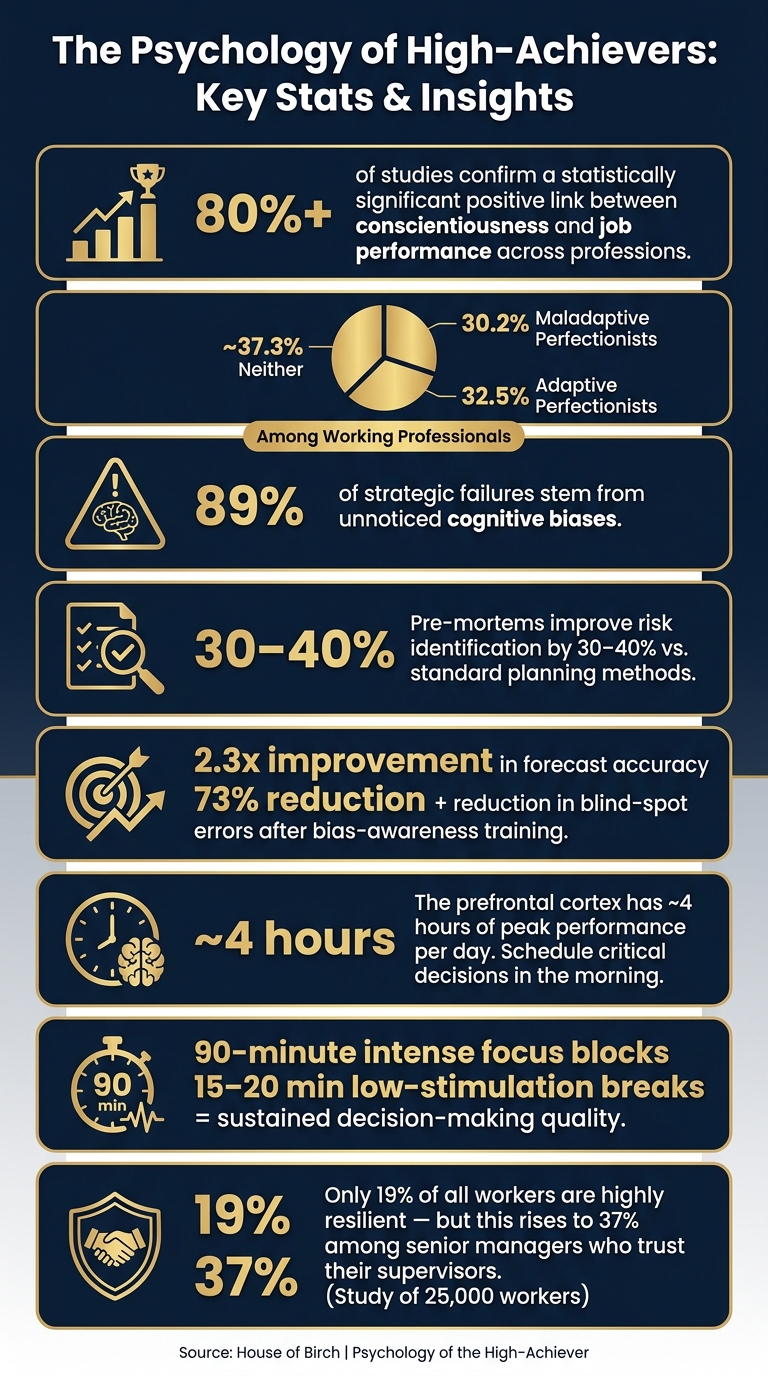
The Psychology of High-Achievers: Key Stats & Insights
Key Psychological Traits of High-Achievers
Growth Mindset and Mastery Orientation
High-achievers operate with the belief that abilities are not fixed but can be cultivated through effort, constructive feedback, and experience. This belief aligns with mastery orientation, a focus on improving one’s competence rather than simply outperforming others.
Recent research challenges the idea of personality traits as static qualities. Instead, there is growing interest in capabilities like learning agility - the skill of drawing lessons from past experiences and applying them to future challenges. This ability bridges the gap between personality traits and effective leadership behaviours. For instance, leaders who are high in openness and conscientiousness may falter if they fail to adapt and learn from setbacks, ultimately limiting their growth.
This relentless pursuit of personal development often fosters traits such as grit, conscientiousness, and self-discipline, which are essential for sustained success.
Grit, Conscientiousness, and Self-Discipline
The foundation of a growth mindset is reinforced by grit, conscientiousness, and self-discipline - traits that allow high-achievers to maintain focus and performance, even under pressure. Research consistently confirms the link between conscientiousness and superior job performance, with over 80% of studies demonstrating a statistically significant positive relationship across various professions. This trait reflects dependability, persistence, and the ability to prioritise long-term objectives over immediate distractions.
Grit and self-discipline complement conscientiousness. These traits are supported by brain regions such as the prefrontal cortex (PFC), which manages focus and risk evaluation, and the anterior cingulate cortex (ACC), which monitors effort and flags errors. However, when these systems are overworked without sufficient recovery, cognitive resources can become depleted. This can lead to impulsive decision-making and reduced emotional regulation.
"Functioning well doesn't always mean things are under control. High achievers often wait for a crisis, assuming they'll recognize the right moment to act."
- Ryan C. Warner Ph.D., Licensed Clinical Psychologist
Despite their resilience, high-achievers often normalise excessive workloads and delay seeking support, leaving them vulnerable to burnout.
Perfectionism: Healthy Standards vs Harmful Patterns
Perfectionism is another trait that plays a complex role in the lives of high-achievers. It is important to distinguish between healthy perfectionism, often called excellencism, and harmful perfectionism. Healthy perfectionism is driven by a genuine desire for mastery, characterised by setting high yet adaptable standards. Harmful perfectionism, on the other hand, stems from a fear of failure and imposes rigid expectations, where even minor mistakes feel like personal failures. This often leads to anxiety, procrastination, or burnout.
From a neurological perspective, the brain responds differently to these two types of perfectionism. High standards activate the prefrontal cortex’s goal-monitoring circuits, while harmful perfectionism engages the brain’s threat-appraisal systems. This means that even small errors are perceived as significant threats, leading to chronic stress and elevated cortisol levels. As Dr. Sydney Ceruto of MindLAB Neuroscience explains:
"Perfectionism is neurologically distinct from high standards because it recruits threat-appraisal networks even in the absence of objective failure, sustaining chronic cortisol elevation."
In a study of working professionals, 30.2% were identified as maladaptive perfectionists, while 32.5% exhibited adaptive perfectionism. The key difference between these groups lies not in their talent but in how they relate to their own standards. Tomas Chamorro-Premuzic, Chief Science Officer at Russell Reynolds, highlights this distinction:
"The real leadership task is not to eliminate high standards, but to prevent standards from hardening into self-punishment or control over others."
To manage harmful perfectionism, one effective strategy is to define clear criteria for task completion before starting. Setting 3–5 specific goals creates an objective endpoint, replacing the subjective feeling of "not quite there yet" with a concrete finish line. This approach allows leaders to maintain their high standards while safeguarding their well-being, enabling them to lead effectively under pressure.
sbb-itb-ce676ec
How High-Achievers Make Decisions Under Pressure
Mental Models and Clear Thinking
High-achievers often rely on structured thinking tools to handle complex decisions effectively. These tools, known as mental models, offer repeatable frameworks that help simplify challenges. By combining instinct with these structured approaches, they enhance clarity and precision.
One widely used model is second-order thinking, which encourages leaders to ask not just "what happens next?" but also "and then what?" - considering the ripple effects of their decisions. Another valuable approach is the pre-mortem, where a leader imagines a project has already failed and works backwards to identify potential causes. Studies show that pre-mortems can improve risk identification by 30–40% compared to standard planning methods. As Charlie Munger, Vice Chairman of Berkshire Hathaway, aptly stated:
"It is remarkable how much long-term advantage people like us have gotten by trying to be consistently not stupid, instead of trying to be very intelligent."
Jeff Bezos introduced another useful framework in his 2015 Amazon shareholder letter: the distinction between one-way and two-way door decisions. One-way doors represent irreversible choices, such as selling a business unit, while two-way doors are reversible, like testing a small pilot programme. By treating these decisions differently, organisations like Amazon balance speed with careful consideration for high-stakes choices. These frameworks not only simplify decision-making but also help leaders identify and counteract biases that arise under pressure.
Spotting and Managing Cognitive Biases
Even the most disciplined leaders are susceptible to cognitive biases, which can undermine strategic decisions. Research highlights that 89% of strategic failures stem from biases that went unnoticed by decision-makers. Under stress, the brain often defaults to fast and automatic thinking, known as System 1. While quick, this mode of thinking can amplify biases.
Some common biases include confirmation bias (seeking evidence that supports existing beliefs), overconfidence, and availability bias, where recent or vivid events distort risk perception. A striking example of availability bias occurred after the 9/11 attacks, when heightened fear of flying led many in the United States to drive instead, resulting in an estimated 1,595 additional road deaths within a year.
To counteract these tendencies, high-achievers actively create environments that encourage dissent and diverse perspectives. Techniques such as appointing devil’s advocates, conducting red team exercises, or seeking disconfirming evidence are particularly effective. Leaders trained in these methods report a 2.3x improvement in forecast accuracy and a 73% reduction in blind-spot errors. By institutionalising these practices, they reduce the likelihood of biases derailing decisions.
Managing Focus and Cognitive Load
Clear thinking depends on managing cognitive resources effectively. Research suggests that the prefrontal cortex - the brain’s decision-making hub - has about four hours of peak performance per day. High-achievers maximise this window by scheduling critical tasks in the morning, before distractions accumulate. They also use external tools like checklists to reduce what is known as extraneous load, freeing up mental capacity for complex problem-solving.
Timing also plays a role. Irreversible decisions are best avoided after mid-afternoon (e.g., 15:00), unless the decision criteria were set earlier in the day. Recovery, however, is just as vital as focus. Working in 90-minute intense blocks followed by 15–20 minute low-stimulation breaks aligns with the brain's natural rhythms, preserving decision-making quality throughout the day. As AJ Keller, CEO of Neurosity, explains:
"Your productivity isn't limited by the hours in your day. It's limited by the metabolic budget of a specific brain region."
Emotional Challenges and Resilience in Leadership
Common Emotional Challenges for High-Achievers
High-achievers often face intense emotional demands that can quietly undermine their leadership over time. Among these challenges is identity fusion, where a leader's sense of self becomes deeply tied to their work. This can make stepping back feel like a threat to their very identity. It's not about lack of effort or strength; it's a psychological pattern where work and self become inseparable. Another common issue is the so-called "stoic mask", where leaders suppress emotions as a coping mechanism rather than addressing them. As Matthew Ferry, an author and coach, explains:
"The strong, calm, unreadable leader model is not a performance advantage. It is creating an invisible internal cost with no outlet."
Burnout is another pervasive issue among leaders, and recent studies highlight its prevalence. It's important to understand that burnout is not simply about feeling tired. Unlike ordinary exhaustion, burnout represents a neurological state where rest no longer restores energy.
A key distinction here is that burnout is specific to work, meaning symptoms often improve when away from the job. In contrast, clinical depression affects all aspects of life, regardless of workload. Identifying which condition is at play is critical for determining the right approach to recovery.
Early signs of burnout can be subtle but revealing. For instance, waking up at odd hours, such as 3 AM, without clear cause; showing irritability at home while maintaining composure at work; or finding that accomplishments feel less like triumphs and more like the avoidance of failure. That last one, in particular, is a significant warning signal. Recognising these patterns is the first step towards building the resilience needed for sustainable leadership.
Building Resilience and Emotional Regulation
Resilience in leadership often comes down to managing the nervous system effectively. Chronic stress triggers the amygdala, the brain's threat detection centre, which floods the body with cortisol. This not only feels unpleasant but also impairs the prefrontal cortex, the part of the brain responsible for decision-making and critical thinking. As neuroleadership coach Sahar Andrade puts it:
"Leadership doesn't fail - nervous systems do."
Simple, actionable techniques can help leaders regain control. One effective method is naming the stressor out loud. For example, saying, "My amygdala is treating this like a threat. What is the actual risk?" can engage the prefrontal cortex, which helps shift the brain's chemistry. Another quick tool is a breathing exercise: inhale for four counts and exhale for six. This activates the vagus nerve, which calms the nervous system and promotes a sense of control. Both strategies are quick, taking less than two minutes, and can be applied during a workday without disruption.
In addition to these immediate tools, setting aside at least one uninterrupted hour each day - free from meetings and emails - is crucial. This downtime allows cortisol levels to drop, giving the hippocampus, the brain's memory centre, time to recover and consolidate learning.
Relational Health and Overcoming Isolation
While personal strategies are essential, maintaining strong connections with others is equally important in combating stress. High-achievers often view handling pressure alone as a sign of strength, but this can lead to a dangerous blind spot: internal struggles hidden behind outward performance.
Burnout, in many cases, stems less from excessive workloads and more from a lack of connection. Leaders who lose touch with their teams or the broader purpose of their work are more vulnerable to burnout. The tendency to rely solely on oneself can compound the issue. The longer a leader normalises chronic stress without seeking support, the harder it becomes to recognise how far they've drifted from a healthy state.
Trust within organisations plays a critical role here. A study involving 25,000 workers found that only 19% of employees are highly resilient overall. However, this number jumps to 37% among senior managers, particularly when they trust their supervisors. Trusted relationships - whether with peers, mentors, or advisors - provide a buffer against burnout. These connections not only offer emotional support but also distribute the pressures of leadership, creating a more sustainable framework for resilience.
Practical Techniques for Long-Term High Performance
Clarifying Values and Long-Term Goals
Leaders often articulate their values, but their actions under pressure can tell a different story. Economist Paul Samuelson captured this disconnect succinctly:
"Preferences are revealed by choices, not by statements."
To bridge this gap, an effective first step is conducting a straightforward audit of your calendar and bank statements from the past 30 days. This exercise highlights how time and money have been allocated, offering a clear picture of what truly matters in practice. From these insights, translate abstract values into specific, actionable behaviours. For instance, instead of simply valuing "integrity", reframe it into a tangible commitment like "address difficult issues early." This makes values operational rather than ornamental.
When under acute stress, the prefrontal cortex - responsible for complex decision-making - tends to narrow its capacity. Predefined and prioritised values serve as cognitive anchors, enabling leaders to make decisions aligned with their principles even when working memory is strained. A practical approach is to use a simple decision filter: Does this choice align with my values? Am I compromising a core value for short-term benefits? If two values conflict, which one takes precedence? Philosopher Ruth Chang offers a helpful perspective:
"Hard choices are not hard because you lack information. They are hard because the alternatives are on a par... the deciding factor is internal: which option better serves who you are trying to become?"
This clarity in values becomes the foundation for building targeted skills and improving decision-making.
Deliberate Practice and Continuous Learning
Once values are clarified, the next step to advancing leadership skills is through deliberate practice. Repeating tasks without challenge maintains the status quo but doesn’t lead to improvement. True progress comes from deliberate practice - working at the edge of your current abilities, with clear goals and immediate feedback.
The science behind this lies in myelination, a process where focused repetition strengthens the myelin sheath around neural pathways, enhancing the speed and accuracy of signal transmission. However, this only occurs when the brain remains actively engaged. Once a skill becomes routine, the brain disengages, and performance plateaus. Research indicates that even expert performers can sustain only four to five hours of deliberate practice per day before cognitive performance begins to decline.
The key is to isolate subskills rather than practising broad concepts. For instance, if the goal is to improve difficult conversations, focus on specific elements like the first 60 seconds - refining your opening tone, clarity of intent, and framing. Define measurable benchmarks for success; without these, progress stagnates. This kind of focused training is essential for maintaining leadership resilience and making effective high-stakes decisions.
Using Executive Coaching and Advisory Support
While personal development is crucial, executive coaching offers a structured way to turn leadership potential into consistent performance. Many leaders already understand what effective leadership looks like, but the challenge lies in applying these principles consistently under pressure. This is where coaching excels, as it addresses behavioural change rather than just knowledge acquisition. Meta-analyses show that executive coaching significantly enhances performance behaviours, goal-setting, and self-regulation, along with modest but meaningful improvements in resilience and self-efficacy.
One often overlooked benefit of coaching is what researchers term reflected autonomy - the ability to shift from reactive behaviour to consciously choosing how to respond to challenges. Dr Sharon Chirban, an executive coach and performance psychologist, highlights this dynamic:
"The variable that predicts whether someone burns out isn't how much they're doing - it's how much agency they feel in the doing of it."
An example of this approach is House of Birch, which supports senior leaders through its biopsychosocial diagnostic framework (BPSC™). This framework examines biological, psychological, and social factors that influence performance. Rather than treating coaching as a remedial tool, it acts as a developmental catalyst, helping leaders expand their behavioural repertoire and maintain peak performance in environments defined by power dynamics and high-stakes decisions. These engagements are tailored and discreet, designed to meet the unique complexities of senior leadership roles.
Conclusion: Turning Psychology into Leadership Performance
Key Takeaways for High-Achieving Leaders
Bringing together ideas on mindset, decision-making, and emotional regulation, a clear framework for achieving sustained leadership excellence emerges. Exceptional leadership combines psychological strengths, mental discipline, emotional self-control, and intentional practice. Leaders who consistently perform at a high level are those who understand their mental habits and actively work to manage them.
The foundation lies in key principles: adopting a growth mindset and cultivating perseverance. These are further strengthened by aligning actions with clear values, building emotional resilience, and engaging in deliberate practice - practice that is focused, informed by feedback, and aimed at specific goals.
Connecting Inner Growth to Outer Leadership
A leader’s internal development has a direct impact on their external behaviour. Heather Wright of Advance Performance encapsulates this idea:
"Leadership is not judged by intent - it is experienced through behaviour."
Unchecked stress and inadequate recovery can undermine decision-making and erode team confidence. Leaders who prioritise their inner growth create environments where their teams can think more clearly, make thoughtful decisions, and perform at their best.
As discussed earlier, behavioural intelligence - choosing the right response instead of defaulting to instinctive reactions - plays a pivotal role in maintaining composure during high-pressure situations. Tommy Birch of House of Birch highlights this focus:
"House of Birch focuses on behaviour that holds in the environments where power is actually exercised."
By focusing on internal development, leaders pave the way for meaningful external impact.
House of Birch: Support for Leadership Transformation

House of Birch offers tailored support to leaders, helping them apply psychological principles to thrive under pressure. Their bespoke biopsychosocial diagnostic framework (BPSC™) examines the biological, psychological, and social dimensions that influence leadership performance in demanding environments.
"Leadership is not a trait. It is a context-dependent system output." - House of Birch
For leaders ready to commit to meaningful change, the journey begins from within.
High Achievers and The Tools To Keep Calm with Dr. Mary Anderson
FAQs
How can I tell burnout from depression?
Burnout and depression share some similarities, but they are distinct conditions with important differences. Burnout is typically linked to work-related stress and is characterised by emotional exhaustion, detachment, and irritability. These symptoms often improve when work pressures decrease. In contrast, depression tends to be more pervasive, affecting multiple areas of life. It may involve a persistent low mood, loss of interest in activities, heightened self-criticism, and noticeable changes in sleep patterns or appetite. If symptoms continue or intensify, seeking professional help is crucial.
How do I spot my blind spots in big decisions?
To minimise blind spots in significant decisions, it’s crucial not to overly depend on intuition, as it can often conceal underlying biases. Instead, adopt structured approaches to test your assumptions. For example, invite someone to steelman opposing perspectives - this involves presenting the strongest possible version of an opposing argument to stress-test your position. Additionally, gathering anonymous input before group discussions can help surface diverse viewpoints without the influence of group dynamics.
Another practical step is to track the gap between your expected and actual outcomes. This can reveal patterns of overconfidence or misjudgement over time. Finally, set aside time each week to reflect on decisions you’ve delayed or feedback you’ve dismissed. These moments of self-review can highlight areas where biases or blind spots may have influenced your judgement.
How can I keep high standards without perfectionism?
To uphold high standards without slipping into perfectionism, aim for purpose-driven excellence instead of letting a fear of errors dominate. Tailor your expectations to match the importance of the task - there’s a clear difference between a polished final presentation and a rough draft. Shift your perspective on mistakes, viewing them as chances to grow rather than as failures. By setting clear and achievable goals that reflect the true significance of the task, you can deliver quality work without unnecessary overexertion.

