5 Psychological Traps That Harm Leadership Reputation
Leaders often unknowingly fall into psychological traps that damage their reputation and effectiveness. These traps - rooted in cognitive biases and emotional blind spots - distort judgement, erode trust, and hinder decision-making. Research reveals that 70–80% of managerial decisions are influenced by biases, with 90% of executives admitting to acting under these influences without realising it. Addressing these traps is critical for leaders to maintain credibility and avoid career setbacks.
The five key traps are:
- Ego Trap: Overconfidence and resistance to feedback create blind spots and toxic work environments.
- Conflict Avoidance Trap: Dodging difficult conversations weakens accountability and team morale.
- Micromanagement Trap: Excessive control signals distrust, stifling innovation and reducing employee engagement.
- Blame Culture Trap: Shifting responsibility fosters fear, silences voices, and undermines collaboration.
- Hero Leader Trap: Over-reliance on one leader creates dependency and burnout, harming both the individual and the organisation.
Quick Summary of Solutions:
- Ego Trap: Encourage diverse perspectives and appoint a "devil's advocate."
- Conflict Avoidance: Promote open dialogue and address issues directly.
- Micromanagement: Delegate tasks and focus on outcomes, not processes.
- Blame Culture: Replace blame with shared accountability and a "fail fast" mindset.
- Hero Leader: Build systems that function independently of one individual.
Leaders must reflect on their behaviour, seek external perspectives, and implement these strategies to safeguard their reputation and influence. Preventing these traps is not just about avoiding mistakes - it’s about creating environments where trust, collaboration, and sound decision-making thrive.
4 Traps to Avoid as You Transition into a Leadership Role
sbb-itb-ce676ec
1. The Ego Trap
A leader's unchecked ego can quietly dismantle their credibility and effectiveness. When self-importance takes the reins, it often leads to egocentric bias - a mental shortcut where leaders become fixated on their own perspective, actively avoiding situations that might challenge their worldview. This bias doesn’t just cloud judgement; it reshapes team dynamics and undermines collaboration.
The signs of this ego-driven behaviour can be subtle but are rarely invisible. Leaders ensnared in this trap often take credit for team successes while shifting blame for failures onto others. They dominate discussions, reject constructive feedback, and project an image of perfection, which steadily erodes trust. Benjamin White of Birmingham City University highlights the central issue:
Ego is the enemy of good leadership because it obstructs the qualities essential for effective leadership... it prevents leaders from acknowledging gaps in their knowledge.
A notable example of this occurred in November 2018 when Cees 't Hart, CEO of the Carlsberg Group, was given an exclusive key card to his 20th-floor corner office. This seemingly small gesture became a symbol of detachment and inflated self-importance.
The fallout from ego-driven leadership can be profound. While over 80% of CEOs acknowledge the importance of empathy, an ego-centric approach fosters a toxic work culture that stifles innovation and undermines team morale. Grace Lordan, Associate Professor at the London School of Economics, cautions:
What better way to preserve a fragile ego than to surround yourself with people who think just like you? This may be good for your ego, but it is bad for business.
This behaviour often leads to what researchers call a mirrortocracy - a workplace where leaders hire and promote individuals who mirror their own backgrounds and beliefs, sidelining merit in the process. Such a system weakens objective decision-making and erodes the trust needed for effective leadership. Over time, these missteps not only harm the leader's reputation but also pave the way for further psychological pitfalls.
2. The Conflict Avoidance Trap
Leaders often dodge difficult conversations, thinking it will maintain team harmony. However, this approach tends to backfire, leading to neglect and a culture that tolerates underperformance. Similar to unchecked ego, avoiding conflict undermines a leader’s credibility by creating an environment where accountability becomes rare.
When issues are left unaddressed, they don’t vanish - they shift into informal, unproductive spaces. Instead of open dialogue, teams resort to side conversations or gossip. Sandeep Kashyap, Founder of ProofHub, explains the dangers:
When conflict is consistently sidestepped, [high performers] read it as a signal that standards are negotiable and problems will be tolerated.
This avoidance fosters a sense of learned helplessness within organisations. Employees stop voicing concerns, knowing leadership is unlikely to act. High performers, frustrated by the lack of directness, may seek roles in organisations where accountability is prioritised. Others might adopt passive-aggressive behaviours to cope with the absence of clear leadership. What could have been resolved with professional feedback often escalates into emotionally charged criticism.
The Influence Journal offers a sharp reminder:
Avoidance is not kindness - it's neglect.
Leaders also bear the weight of unresolved tensions. They may find themselves overcompensating by softening decisions or over-explaining expectations, a pattern that drains energy and increases the risk of burnout. This not only weakens communication but also damages their reputation, a critical asset for any leader. Tackling conflict directly is essential to preserving trust and maintaining credibility.
3. The Micromanagement Trap
Micromanagement often stems from a desire to maintain control, but it can send a clear message of distrust to employees. This approach not only slows progress but also dampens the creativity and initiative that organisations rely on to stay competitive. Like avoiding conflict or letting ego dominate, micromanagement undermines leadership credibility. Instead of empowering teams, it creates a workforce that simply echoes the leader's instructions, offering little in the way of independent thought or innovation.
The consequences of micromanagement are stark. Research shows that 71% of employees report a drop in job performance, and 69% have considered leaving their roles due to being micromanaged. These statistics highlight how this behaviour threatens both team morale and retention. Over time, talented team members may stop sharing ideas or taking risks, knowing their decisions will likely be second-guessed.
A well-documented example comes from Microsoft during Steve Ballmer's tenure as CEO (2000–2014). His reluctance to delegate and rigid management style led to missed opportunities, such as dismissing the potential of smartphones and cloud computing. Ballmer even publicly mocked the iPhone. It was only after Satya Nadella took over in 2014, prioritising trust and empowerment, that Microsoft regained its competitive edge.
Micromanagement often becomes a self-perpetuating cycle. Constant oversight pushes employees to escalate even minor decisions to higher-ups. This, in turn, overwhelms leaders with small-scale decisions, prompting them to tighten their grip further. As Management Today aptly warns:
a senior leader wanting every decision to be sent their way will make employees abdicate responsibility.
What starts as an effort to ensure quality can ultimately lead to operational paralysis.
Breaking free from this trap requires a shift in focus. Leaders should prioritise outcomes over methods, setting clear goals and quality benchmarks while stepping back from the details. Carlos Royo from Esade emphasises:
The ability to influence is based on trust, not on cold strategy.
Without trust, oversight cannot foster a strong leadership reputation. Instead, it stifles innovation and leaves organisations vulnerable to reputational and operational risks.
4. The Blame Culture Trap
Blame culture, much like unchecked ego and conflict avoidance, erodes trust and accountability within teams. When leaders shift responsibility onto others, they encourage self-interest over collaboration. This "us versus them" mindset frames differing opinions as threats rather than opportunities, creating a defensive environment that saps team morale. Instead of fostering open communication, blame culture silences employees, discouraging them from admitting mistakes or raising concerns.
The repercussions of such an approach can be severe. Take Uber, for instance, during Travis Kalanick's tenure as CEO. The company’s culture, marked by fear and aggression, stifled employees from voicing legitimate concerns. This toxic environment eventually led to internal chaos, employee protests, and legal battles, culminating in Kalanick's removal to protect Uber's reputation. This case highlights how leadership driven by blame can destabilise an organisation.
A significant element of blame culture is the reluctance to admit uncertainty or mistakes, often perceived by leaders as a sign of weakness. Yet, as Lectera points out:
A leader who can doubt out loud reduces toxic pressure for everyone.
When leaders prioritise projecting confidence over honesty, they inadvertently encourage teams to seek out "convenient experts" who affirm existing biases, rather than challenging flawed ideas.
Breaking free from blame culture requires a conscious shift in both language and mindset. Phrasing decisions as "we're choosing" instead of "I've decided" and asking questions like "What could go wrong?" can promote collective risk assessment and shared accountability. These subtle changes reinforce the idea that accountability, not blame, is what drives progress.
The consequences of ignoring this shift can be catastrophic. Enron’s infamous collapse serves as a stark reminder. Leadership that prioritised deception over transparency led to a £74 billion loss, wiping out employee pensions and destroying livelihoods. When leaders create environments where mistakes are hidden instead of treated as learning opportunities, they not only harm morale but also jeopardise the organisation’s very survival.
5. The Hero Leader Trap
The "hero leader" mindset is another common pitfall that weakens a leader's effectiveness and the organisation's overall resilience. This approach stems from the belief that leaders must personally tackle every challenge to demonstrate their value. However, such behaviour creates a fragile system reliant on one individual, rather than fostering a collaborative and empowered team. Leadership consultant Justine Massaba describes this phenomenon:
The hero leader syndrome is a state of mind in which leaders rely heavily on their heroic instincts and feel the need to act alone to solve their team's problems.
When decision-making is centralised in this way, team members can feel excluded, untrusted, and undervalued. This fosters a dependency culture, where growth is stifled because every decision or task must pass through a single bottleneck. As Vistage aptly summarises:
If the business can't function without you being there, you have a problem.
Craig Fletcher, founder of the gaming company Multiplay, offers a real-world example of this trap. Prior to 2018, Fletcher was spending 43 hours per week managing finances in addition to running the business. As the company expanded, this approach became unsustainable, leading to significant stress. Seeking guidance through Vistage, Fletcher embraced a "post-heroic" leadership style, learning to delegate effectively. By doing so, he enabled the business to grow without his constant involvement.
This over-reliance on personal heroics isn't just an organisational issue - it has serious health implications. Prolonged "superleader" behaviours, such as working excessive hours, replying to emails at 2 AM, and refusing to delegate, increase cortisol levels. Over time, this can contribute to conditions like type 2 diabetes and heart disease. Beyond health risks, such habits can damage a leader's reputation, signalling unsustainable and ineffective management.
Addressing this requires intentional change. Leaders can start by asking themselves: "What am I doing today that someone else should own within the next six months?". Genuine delegation begins with small tasks and progresses to assigning entire processes. The aim isn't to work harder but to create systems that operate independently. By delegating effectively, leaders not only protect their own well-being but also build a culture of shared accountability - critical for long-term organisational success.
How to Avoid These Psychological Traps
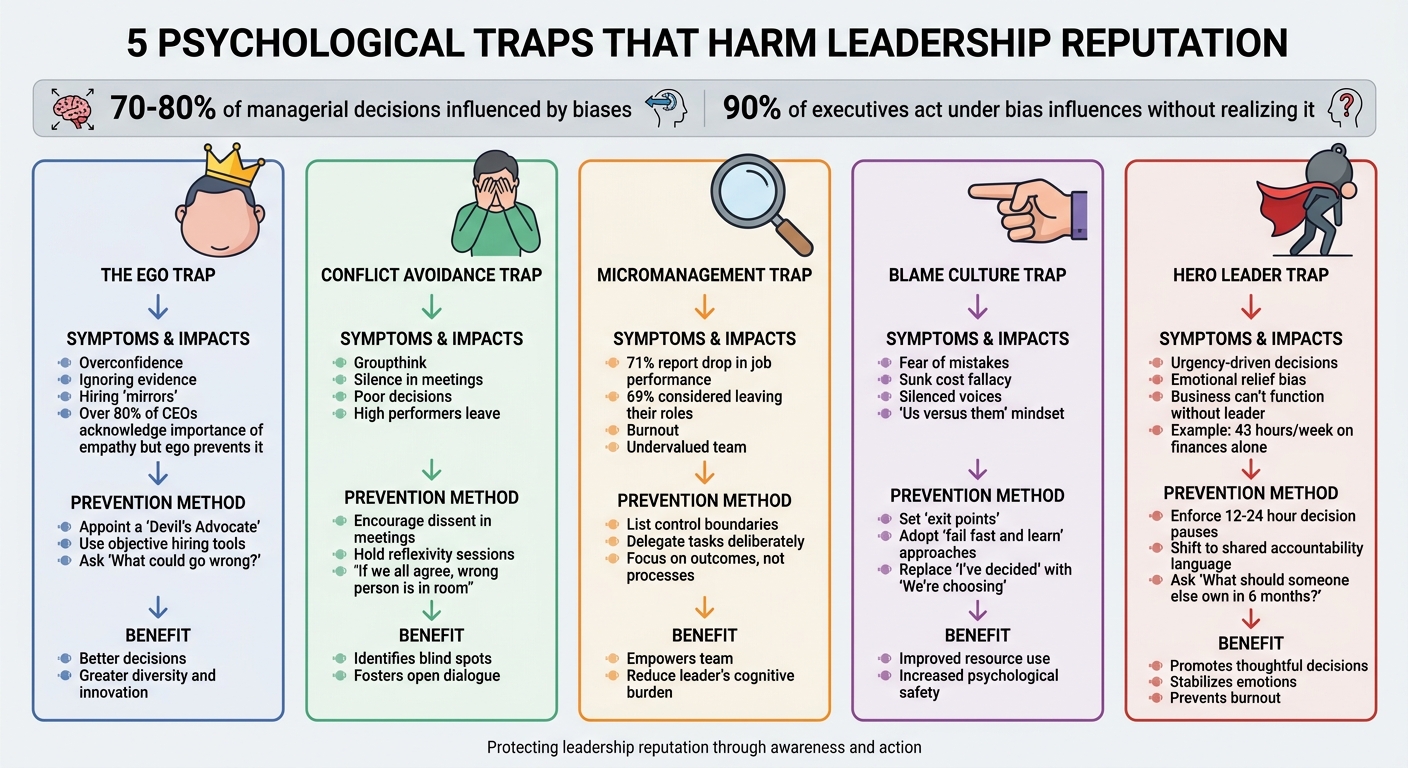
5 Leadership Psychological Traps: Symptoms, Prevention Methods and Benefits
Protecting your leadership reputation means staying alert to these psychological traps and taking deliberate steps to counter them. A core skill for effective leaders is the ability to reflect on their own thinking - this self-awareness helps to avoid "autopilot" decision-making. Research shows that biases influence many managerial decisions, making it essential to address these traps with practical strategies.
For the Ego Trap, having a "devil's advocate" on your team can be transformative. Their role is to challenge assumptions and offer alternative perspectives, ensuring decisions are grounded in reality. Instead of asking, "Do you agree?", try asking, "What could go wrong here?" to encourage critical feedback. Additionally, using objective recruitment tools can prevent hiring individuals who simply reflect your own views.
To tackle Conflict Avoidance, set the tone for open discussion by starting meetings with statements like, "If we all agree, the wrong person is in the room". This creates space for dissenting opinions and reduces groupthink. Regular team reflexivity sessions - where processes and dynamics are openly discussed - can further ensure that everyone’s voice is included.
The Micromanagement Trap can be addressed by visually separating what you can control from what you cannot. A simple two-column list can clarify these boundaries and help you let go of unnecessary control. Delegating tasks not only lightens your load but also empowers your team and strengthens their confidence.
To escape the Blame Culture Trap, shift your perspective by asking, "If we started today, would we still choose this path?". Pre-setting "exit points" - clear criteria for when to halt a project - can help avoid the sunk cost fallacy. This approach encourages a "fail fast and learn" mindset, improving both resource use and team morale.
Lastly, the Hero Leader Trap can be defused by building in a mandatory 12–24 hour pause before making major decisions. This delay reduces emotional impulses and allows for a more measured response. Reframing your language from "I've decided" to "We're choosing" also promotes shared accountability and reduces the pressure of individual responsibility.
Below is a summary of the key traps, their symptoms, how to prevent them, and the benefits of taking action:
| Trap | Symptoms & Impacts | Prevention Method | Benefit |
|---|---|---|---|
| The Ego Trap | Overconfidence; ignoring evidence; hiring "mirrors" | Appoint a "Devil's Advocate" and use objective hiring tools | Better decisions; greater diversity and innovation |
| Conflict Avoidance | Groupthink; silence in meetings; poor decisions | Encourage dissent in meetings; hold reflexivity sessions | Identifies blind spots; fosters open dialogue |
| Micromanagement | Burnout; illusion of control; undervalued team | List control boundaries; delegate tasks deliberately | Empowers team; reduces leader’s cognitive burden |
| Blame Culture | Fear of mistakes; sunk cost fallacy | Set "exit points"; adopt "fail fast and learn" approaches | Improved resource use; increased psychological safety |
| Hero Leader | Urgency-driven decisions; emotional relief bias | Enforce decision pauses; shift to shared accountability language | Promotes thoughtful decisions; stabilises emotions |
These strategies not only mitigate the risks of these traps but also build stronger, more resilient leadership practices. By addressing each trap head-on, leaders can create an environment where transparency, collaboration, and thoughtful decision-making thrive.
Building Leadership Reputation with House of Birch
Navigating high-pressure environments without falling into psychological traps requires more than just self-awareness - it calls for a structured, evidence-based strategy. House of Birch offers tailored advisory services for leaders operating in high-stakes scenarios, where decisions influenced by ego or emotional reactions can have far-reaching consequences. Their approach centres on three core principles: Clarity (strategic foresight), Control (emotional discipline), and Connection (influence and trust). By integrating insights from neuroscience, behavioural psychology, and cognitive science, this multidisciplinary framework equips leaders to stay composed and effective when it matters most. These methods complement the strategies discussed earlier, preparing leaders for the most challenging moments.
Tommy Birch, founder of House of Birch, summarises the firm's mission:
I build individuals who are emotionally disciplined, strategically intelligent, and socially dominant - ensuring they command rooms and control narratives with authenticity.
This emphasis on emotional discipline is key to countering traps like the Ego and Hero Leader pitfalls. By honing decision-making skills and strengthening narrative control, House of Birch helps leaders maintain authenticity and trustworthiness.
The firm's principles have been successfully applied in various high-stakes scenarios. For example, during a project titled "Building Executive Alignment During M&A" in London, House of Birch guided senior leaders through the psychological challenges of merger negotiations - an environment often plagued by conflict avoidance and blame-shifting. Similarly, in another case titled "Stabilising Executive Composure in Investor Relations," the firm supported leaders in Herzliya, Israel and Silicon Valley as they navigated high-pressure financial discussions, where tendencies like micromanagement and the Hero Leader Trap are common.
Every engagement is discreet and tailored to the unique needs of each leader. As Birch explains:
I ensure you control narratives and excel where most cannot, while remaining trusted, deliberate, and authentic.
This confidential advisory service is designed for those shaping organisations, industries, or even nations - leaders whose decisions carry immense weight.
Research shows that between 70% and 80% of complex managerial decisions are influenced by cognitive and emotional biases rather than pure analysis. Partnering with a specialist like House of Birch can be pivotal in avoiding reputational missteps and maintaining long-term influence. By eliminating these psychological traps, the firm ensures leaders remain deliberate and composed under pressure, transforming potential into measurable performance. In doing so, House of Birch not only enhances leadership reputation but also strengthens the defensive strategies discussed throughout this article.
Conclusion
Psychological traps, as outlined earlier, have the potential to undermine a leader's credibility, making it crucial to address them proactively. A leader's reputation is built more on their behaviour than their accolades. As Dr Richard G. Ford succinctly puts it:
Reputation... is a consequence of everything you say or do, it is what people say about you in your absence.
The five traps discussed - ego, conflict avoidance, micromanagement, blame culture, and the hero leader mindset - stem from cognitive and emotional biases that often distort judgement.
However, these pitfalls are not insurmountable. Leaders can counteract these tendencies by adopting the strategies mentioned earlier. Through deliberate efforts and external support, they can cultivate metacognition, or reflective thinking, enabling them to interrupt automatic, bias-driven responses. Practical steps such as appointing a devil’s advocate, deferring personal opinions until others have spoken, and creating structured exit plans for underperforming projects can significantly mitigate reputational risks.
This challenge extends beyond personal introspection. Self-assessment alone rarely suffices. Many senior leaders experience career setbacks due to these biases. Engaging with professional advisors offers an impartial perspective, helping to identify and address these patterns before they escalate into critical liabilities.
For leaders operating in high-pressure environments, seeking guidance from experts in emotional discipline and strategic intelligence is a prudent step. Such investments can safeguard their influence and prevent the erosion of their reputation.
FAQs
How can I tell which trap I’m most prone to?
Reflecting on personal behaviours, thought patterns, and decision-making habits can uncover psychological traps that may influence actions. For example, self-assessment tools can highlight areas of vulnerability, such as resistance to new ideas or a tendency to prioritise self-promotion. Leaders can also gain valuable insights by critically evaluating their leadership approach, inviting feedback from trusted colleagues, and examining their reactions to challenges. These practices can help pinpoint specific tendencies or biases, offering an opportunity to address them constructively.
What’s one habit that improves decision-making under pressure?
Cognitive frameworks can play a pivotal role in refining decision-making under pressure. Rooted in psychological research and strategies employed by elite military units, these tools are designed to help leaders navigate biases and manage emotional responses effectively. By relying on such frameworks, individuals can maintain focus and approach high-stakes decisions with clarity and rationality.
When should a leader seek support from House of Birch?
Leaders encountering challenges that could jeopardise their reputation - particularly during high-stakes moments demanding decisive action, emotional control, or strategic persuasion - should consider seeking guidance from House of Birch. Their tailored services are crafted to assist leaders in managing such situations with precision and effectiveness.

