How Power Dynamics Shape Negotiation Outcomes
Power dynamics in negotiation revolve around three key dimensions - potential power, perceived power, and realised power. These influence not only the strategies negotiators use but also the outcomes they achieve. Here’s a quick breakdown:
- Potential power: The tangible resources or options (like a strong alternative deal or exclusive knowledge) a negotiator brings to the table.
- Perceived power: The subjective sense of influence, which may not align with actual leverage but shapes behaviour and expectations.
- Realised power: The influence effectively exercised, reflected in the final agreement.
Research shows that power affects confidence, decision-making, and behaviour. For instance:
- A strong fallback option (BATNA) leads to assertiveness and higher goals.
- Low power triggers anxiety, but acting dominantly can help counter this.
- Equal-power negotiations often lead to better joint outcomes, while imbalances can create competition or complacency.
Leaders must understand how to use power effectively, whether through expertise, authority, or negotiation tactics like rational persuasion. Misusing power - such as through excessive anger or coercion - can backfire, damaging trust and relationships. Instead, strategies like controlled emotional displays, careful anchoring, and focusing on shared goals can improve results.
For high-stakes scenarios, leaders should consider how power influences not just immediate gains but long-term relationships and outcomes. By aligning tactics with power dynamics, they can navigate negotiations with clarity and purpose.
Types of Power and How They Affect Negotiations
How Different Power Types Shape Negotiation Behaviour
Power in negotiations doesn’t operate as a single, uniform force. Researchers have identified five distinct types - reward, expert, legitimate, referent, and coercive power - that shape behaviour in unique ways.
Reward power arises from control over valued resources. This often enables negotiators to make aggressive opening offers, leading to improved individual outcomes. Similarly, expert power, based on superior knowledge or expertise, helps negotiators secure favourable deals and avoid pitfalls such as being misled by precise but misleading first offers.
Legitimate power, tied to formal authority or position, often works well alongside referent power, which comes from interpersonal qualities that inspire respect or admiration. Negotiators with high status often see counterparts concede more readily, either in expectation of future reciprocity or due to perceptions of greater competence.
Coercive power, which relies on the ability to punish or threaten, can help negotiators claim more value for themselves. However, it carries risks - such tactics may backfire if seen as inauthentic, potentially leading to retaliation, deception, or a breakdown in trust.
Interestingly, anger as a coercive tactic follows a U-shaped effect. While moderate anger can push counterparts towards favourable concessions, excessive anger may lower perceived status and escalate conflicts. Studies suggest that anger can signal a negotiator is nearing their reservation price, evoking fear in the counterpart.
Each type of power not only affects strategic decisions but also triggers distinct responses in the brain, offering further insight into their impact.
What Neuroscience Reveals About Power in the Brain
The influence of power extends beyond behaviour, shaping neurological responses that drive negotiation dynamics.
At a neurological level, power activates different brain systems. High power - regardless of its source - stimulates the brain's Behavioural Approach System (BAS), which promotes assertiveness and action-oriented behaviour. This explains why high-power negotiators are more likely to make the first offer, anchoring the negotiation in their favour. On the other hand, low power activates the Behavioural Inhibition System (BIS), which heightens social caution, anxiety, and vigilance.
This distinction has practical consequences. Low-power negotiators often feel anxious and eager to exit negotiations, leading to quicker concessions. However, research by Wiltermuth and colleagues highlights a potential remedy:
Low-power negotiators attained a greater percentage of the value available when they received instructions to act dominantly than they did when they did not receive dominance instructions
. Encouraging dominance can help low-power negotiators overcome inhibition and improve their ability to claim value. Meanwhile, for high-power negotiators, dominance tends to foster value creation, effectively increasing the overall benefits for all parties involved.
sbb-itb-ce676ec
Power's Effect on Individual and Shared Negotiation Results
How Power Affects Individual Negotiation Performance
Negotiators with greater power often gain a larger share of the deal by taking control of the process early - most notably by making the first offer. This tactic, known as anchoring, sets the tone for the negotiation, with counterparts frequently adjusting their expectations based on that initial figure. However, if the powerful negotiator’s BATNA (Best Alternative to a Negotiated Agreement) is weak, their ability to set a strong anchor diminishes, potentially limiting their advantage.
A study involving 279 participants revealed a striking behavioural difference: those in positions of power were more likely to employ collaborative strategies, while less powerful negotiators leaned towards competitive tactics, often driven by a heightened sense of vulnerability. Interestingly, low-power negotiators with ambitious goals can sometimes uncover integrative solutions that their more dominant counterparts might overlook.
With these insights into individual performance, it’s essential to understand how power dynamics shape collaborative outcomes.
How Power Distribution Affects Collaborative Negotiations
While power influences individual success, the balance - or imbalance - of power between negotiating parties plays a pivotal role in shaping collective outcomes. These dynamics reflect broader behavioural patterns triggered by varying levels of power.
Equal-power negotiations often yield better joint outcomes compared to those where one party holds a clear advantage. When both sides perceive their positions as relatively equal, trust tends to grow, information is shared more openly, and creative solutions are more likely to emerge - ultimately increasing the total value of the deal.
However, perceived power imbalances, even when actual alternatives are comparable, can undermine cooperation. The less powerful party may feel threatened, adopting a defensive and competitive stance, while the more powerful side might become complacent, focusing less on value creation. Paradoxically, having no viable alternatives at all can sometimes liberate low-power negotiators from the constraints of weak anchors, enabling them to achieve better results than those with a poor BATNA.
For leaders navigating complex negotiations, understanding these dynamics is crucial. Tailored advisory services - such as those provided by House of Birch - offer practical strategies to leverage power effectively and maximise outcomes in high-stakes scenarios.
How Do I Negotiate When the Other Side Has More Power? | Negotiation 101 with Bob Bordone
Common Power Tactics and When They Work
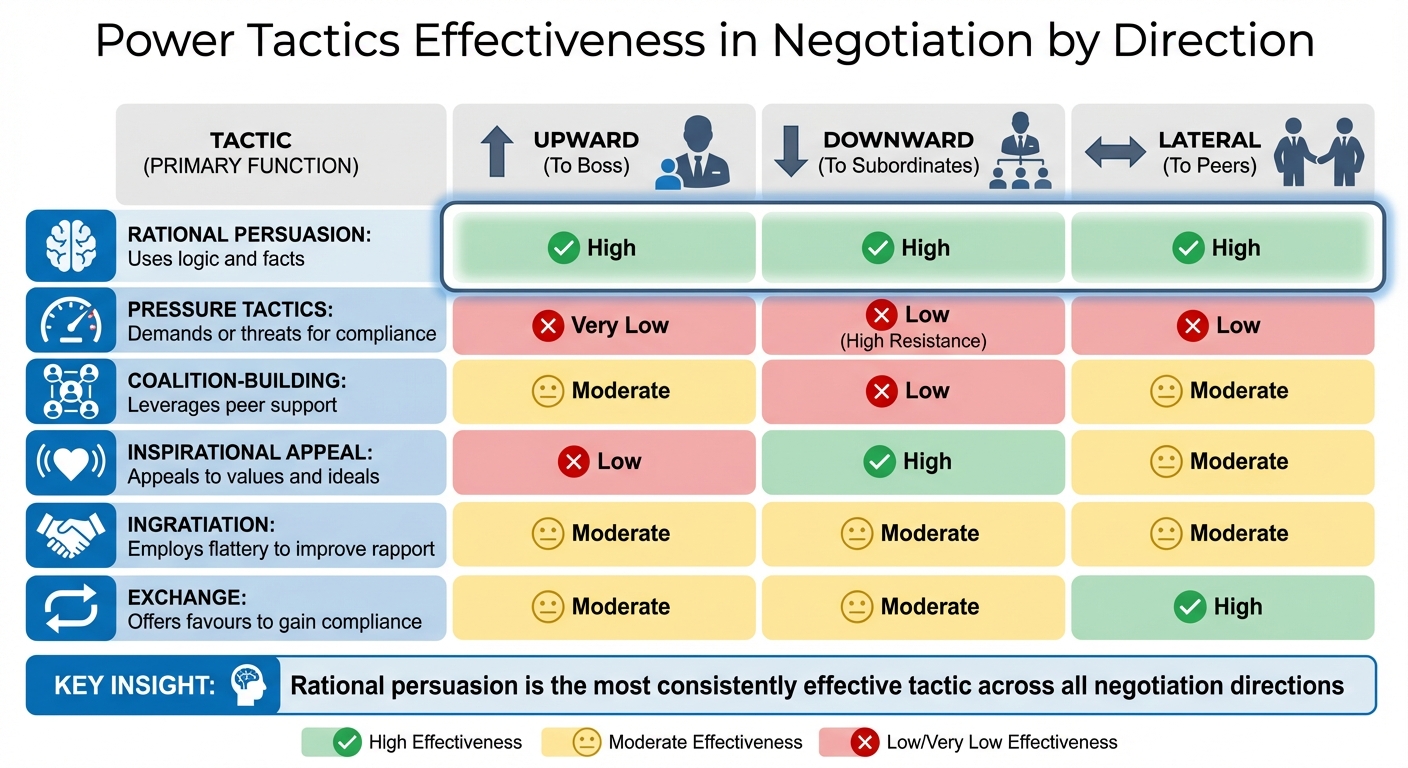
Power Tactics Effectiveness in Negotiation by Direction
Negotiators often choose influence tactics that align with their power dynamics to maximise their leverage. One of the most versatile approaches is rational persuasion, which uses logic and factual evidence to demonstrate feasibility. This tactic proves effective across all negotiation directions - whether dealing with superiors, subordinates, or peers - because it relies on objective standards rather than force or coercion.
On the other hand, pressure tactics, such as demands, threats, or persistent reminders, tend to deliver only short-term results. These methods can strain relationships and are particularly ineffective when aimed upwards, as senior decision-makers are generally resistant to intimidation.
Coalition-building - gathering support from others to strengthen one's position - is most effective in upward and lateral negotiations. By pooling influence, negotiators can offset individual power imbalances. However, this approach is less impactful in downward negotiations, where structural authority already provides sufficient leverage.
Using strategic emotion, such as controlled expressions of disappointment, can secure concessions while minimising relational damage. In contrast, overt anger may indicate a negotiator's limits but often erodes trust.
Hard-bargaining tactics, including extreme demands, ultimatums, or "good cop, bad cop" routines, signal a competitive, win–lose mindset. While they may yield results in distributive negotiations, they also risk provoking defensive reactions. Successful negotiators tend to combine their power with perspective-taking, recognising that neglecting a counterpart's interests - even from a position of strength - can lead to unfavourable outcomes.
The effectiveness of these tactics varies depending on the negotiation context, as summarised below.
Comparing Power Tactics by Direction and Success Rate
The table below highlights how different tactics perform when negotiating upwards, downwards, or laterally, based on organisational research:
| Tactic | Primary Function | Upward Effectiveness | Downward Effectiveness | Lateral Effectiveness |
|---|---|---|---|---|
| Rational Persuasion | Uses logic and facts | High | High | High |
| Pressure Tactics | Demands or threats for compliance | Very Low | Low (High Resistance) | Low |
| Coalition-Building | Leverages peer support | Moderate | Low | Moderate |
| Inspirational Appeal | Appeals to values and ideals | Low | High | Moderate |
| Ingratiation | Employs flattery to improve rapport | Moderate | Moderate | Moderate |
| Exchange | Offers favours to gain compliance | Moderate | Moderate | High |
Rational persuasion emerges as a standout tactic, consistently effective across all negotiation directions and particularly useful for leaders in high-stakes scenarios. In contrast, pressure tactics rarely secure meaningful commitment, especially in upward negotiations where power imbalances make coercion ineffective. Coalition-building and exchange tactics, meanwhile, are better suited to lateral negotiations, where influence often hinges on reciprocity and shared goals rather than formal authority. Aligning tactics with the underlying power dynamics ensures negotiators can optimise their influence when it counts.
Using Power Dynamics in Leadership and Negotiation
Understanding the mechanics of power is one thing; applying that understanding in the heat of high-pressure situations is another. Leaders operating in high-stakes environments must juggle assertiveness with collaboration, secure value without jeopardising relationships, and make disciplined, strategic decisions. Negotiation success hinges not only on recognising the sources of power but also on understanding how tactics and outcomes interconnect.
Adjusting assertiveness to align with one's power position can significantly enhance negotiation outcomes. For instance, when negotiating from a position of strength, showing dominance can help expand opportunities for all parties involved. On the other hand, when operating from a weaker position, carefully calibrated assertiveness can help overcome hesitation and improve the ability to secure individual gains.
Maintaining emotional discipline is another critical factor. Low-power negotiators can benefit from "if-then" planning. For example, setting a rule like, "If my counterpart makes an unfavourable offer, then I will reject it", helps automate responses and reduces the mental strain of managing emotions on the spot. This approach allows negotiators to stay focused on their goals. Research also shows that setting ambitious objectives ahead of time leads to better outcomes, even when power dynamics might otherwise lower expectations.
These principles provide a foundation for practical, actionable strategies.
Practical Guidance for High-Stakes Leaders
Translating these insights into effective action can be challenging. Here are three strategies that leaders can apply immediately:
- Control emotional displays: Expressing disappointment rather than anger can lead to concessions by evoking guilt, all while preserving relationships.
- Reframe discussions: Shifting the focus from hierarchical positions to shared tasks encourages collaboration. When lower-power participants see the negotiation as task-oriented, they are less likely to adopt a defensive, competitive stance.
- Handle anchoring carefully: While making the first offer can set the tone for the negotiation, avoid over-explaining your position if you anticipate a counteroffer. Over-justifying can weaken your leverage.
For leaders facing particularly complex negotiations, external advisory services can offer the clarity and detachment needed to navigate power dynamics effectively. Organisations like House of Birch specialise in helping leaders decode these dynamics, predict counterpart behaviour, and execute strategies with precision during critical moments.
Conclusion: What Leaders Should Know About Power in Negotiation
Power in negotiation can be broken down into four key components: potential power (the resources and alternatives at hand), perceived power (how others view your position), power tactics (the behaviours you use), and realised power (the outcomes achieved). By understanding this framework, leaders can better identify the origins of their influence and use it effectively.
Interestingly, research highlights that joint value is maximised only when the more powerful negotiator demonstrates dominance. This underscores the nuanced role of power in shaping negotiation outcomes.
For leaders operating in high-stakes scenarios, the Economic Relevance of Relational Outcomes (ERRO) framework offers valuable guidance. In situations where the long-term value of a deal hinges on the post-negotiation relationship - such as hiring a service provider or forming a strategic alliance - overly aggressive tactics can be counterproductive. In these high ERRO contexts, negotiators who prioritise building strong relationships often achieve better economic results, as their counterparts are more likely to invest effort in the partnership after the agreement is reached. This reinforces the idea that managing power strategically is about more than securing immediate wins; it’s about fostering relationships that yield sustained benefits.
Leaders must focus not only on achieving favourable outcomes but also on the approaches they use to get there. By recognising the source of their power - whether it comes from strong alternatives, expertise, or social standing - they can tailor their strategies to fit the situation. Failing to distinguish between value claiming (maximising immediate gains) and value creation (focusing on mutual, long-term benefits) risks undermining both the negotiation and the relationship.
Successfully navigating power dynamics requires a disciplined and adaptable approach, especially in high-pressure environments. Leaders who can interpret these dynamics, anticipate the behaviour of their counterparts, and adjust their tactics accordingly are better positioned to achieve outcomes that align with both short-term goals and long-term strategic priorities.
For leaders seeking to sharpen these skills, House of Birch provides tailored leadership advisory services. These services are designed to enhance decision-making, emotional control, strategic foresight, and influence during critical moments.
FAQs
How can I quickly assess my BATNA and power before a negotiation?
To evaluate your BATNA (Best Alternative to a Negotiated Agreement) and your negotiation power, start by identifying the strongest alternative you could pursue if the current deal fails. This involves listing all possible alternatives, assessing how practical and beneficial each one is, and determining which offers the most security or advantage.
Next, consider your influence within the negotiation. This includes both the actual power you hold - such as resources, knowledge, or leverage - and the power others perceive you to have. Both are crucial in shaping outcomes.
By thoroughly understanding your alternatives and influence, you can make better decisions and adopt strategies that enhance your position. Recognising where your power lies and using effective tactics can help you approach negotiations with greater confidence and clarity.
What can I do if I feel low power but still need to be assertive?
If you're feeling less confident or influential during negotiations, employing self-regulation techniques can make a difference. Start by setting clear, specific goals and preparing if-then plans ahead of time. For example, decide in advance how you'll respond to certain offers or objections. These strategies can help you remain focused and composed under pressure.
Another approach is to manage your early concessions carefully. Avoid giving in too quickly, as this can exacerbate power imbalances. Instead, stick to your objectives and make concessions only when necessary. This approach can help you stay assertive and increase the likelihood of securing more favourable results.
When does showing anger help, and when does it backfire?
Strategically expressing anger during negotiations can communicate firmness, encouraging concessions and collaboration. However, if anger is seen as overbearing or aggressive, it risks triggering defensiveness, retaliation, or strained relationships. The impact of anger hinges on factors such as the situation, balance of power, and how others perceive it, highlighting the importance of managing emotions carefully in critical negotiation settings.

