Case Study: Overconfidence in High-Stakes Leadership
Overconfidence in leadership can quietly erode decision-making, particularly in high-stakes environments. While confidence is essential for effective leadership, excessive self-belief often blinds leaders to risks, feedback, and necessary adjustments. This article examines the behavioural science behind overconfidence bias and its impact on leadership, using the collapse of Barings Bank in 1995 as a cautionary example.
Key points include:
- What is overconfidence bias? It’s the tendency to overestimate one’s abilities or judgements, often leading to resistance to feedback and flawed decisions.
- Why are high-stakes leaders vulnerable? Power, prior successes, and pressure amplify overconfidence, fostering poor governance and decision-making.
- Case study: Barings Bank collapse. Nicholas Leeson’s unchecked authority, coupled with management’s dismissal of warnings, led to £927 million in trading losses, revealing systemic failures driven by overconfidence.
- Lessons for leaders: Effective governance, openness to feedback, and structured self-reflection are critical to mitigating overconfidence risks.
Leaders should reflect on their confidence levels, seeking alignment with evidence and fostering an environment where challenges and dissent are encouraged. The Barings case serves as a powerful reminder of how unchecked overconfidence can lead to catastrophic outcomes.
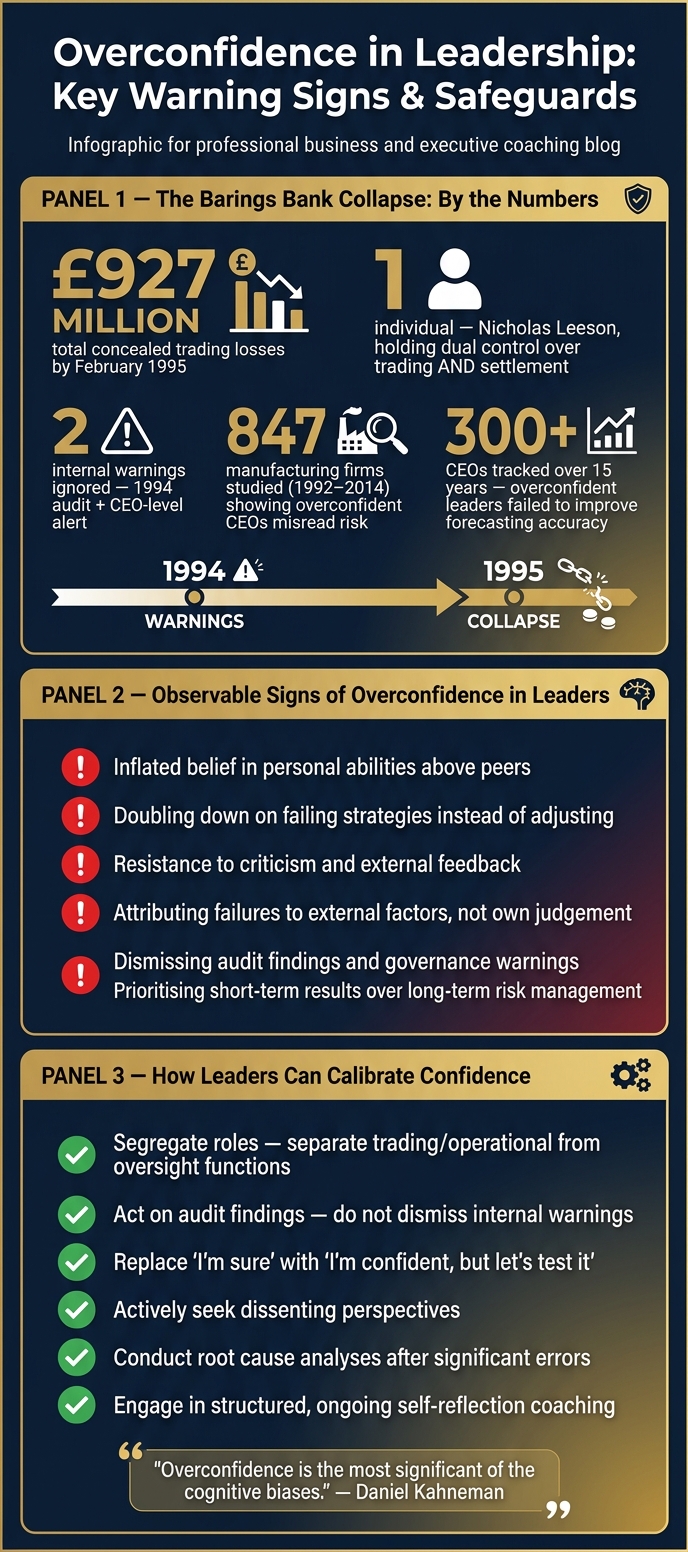
Overconfidence in Leadership: Key Warning Signs & Safeguards
The Illusion of Control: How Overconfident Leaders Make Fatal Mistakes
sbb-itb-ce676ec
The Leadership Context and Decision Environment
This section explores how structural flaws and cultural dynamics allowed overconfidence to skew critical decision-making processes.
Leadership Role and Scope of Responsibility
At Barings Futures Singapore, Nicholas Leeson held an unusually wide-ranging mandate, overseeing both trading operations and back-office settlement functions. This arrangement created a structural weakness by removing the necessary checks and balances that financial institutions typically rely on. When one person holds both operational and oversight responsibilities, accountability becomes compromised. Despite a 1994 internal audit highlighting this conflict of interest, senior management chose to maintain the status quo, prioritising Leeson’s impressive short-term results over sound governance. This decision reflected a broader organisational failure, where immediate gains were valued above long-term risk management. External market dynamics and an internal culture that fixated on results further exacerbated these vulnerabilities.
External and Internal Pressures
Barings operated in a high-pressure environment during the early 1990s, driven by the rapid growth of derivatives trading in Asia. This expansion fuelled fierce competition to deliver exceptional returns, and Leeson’s performance appeared to meet these expectations, concealing the significant risks beneath the surface. Within the organisation, the culture heavily rewarded success while sidelining caution. As journalist James Bloodworth aptly described similar financial settings:
"In such an environment caution was treated as synonymous with weakness. The only direction that seemed to make sense was up."
This mindset created a workplace where voicing concerns came with social and professional risks, leading to a disregard for warning signs that might have prevented disaster.
Key Decision Points in the Case
The interplay of external pressures and internal priorities amplified overconfidence at critical decision points. In 1994, management dismissed the audit’s warning about Leeson’s dual responsibilities, prioritising short-term profits over robust governance. This choice directly paved the way for Barings Bank’s eventual collapse. Even after a subsequent internal warning reached the CEO, no action was taken. These missed opportunities to address governance flaws allowed minor issues to escalate into devastating losses, illustrating how overconfidence at the leadership level can have catastrophic consequences.
Identifying Overconfidence in Leadership
Observable Signs of Overconfidence
Nick Leeson's actions at Barings Bank displayed clear indicators of overconfidence. Most notably, he exhibited an inflated belief in his own abilities, convinced that his trading instincts surpassed those of his peers. According to Professor Eugene Sadler-Smith of Surrey Business School, leaders with hubris tend to overestimate their skills, leading to overly ambitious and risky decisions.
This overconfidence was evident in Leeson's decision to take increasingly large, unsupported positions in the Nikkei futures market. Rather than interpreting early losses as a warning to adjust his strategy, he chose to double down - a behaviour aligned with what researchers identify as a tendency to persist with failing strategies.
Another telling sign was his resistance to scrutiny. The structural flaw that granted him unchecked authority over both trading and settlement functions enabled his overconfidence to go unchallenged. Sadler-Smith highlights this dynamic, stating:
"The fact that hubristic leaders tend to be resistant to criticism, and invulnerable to and contemptuous of the advice of others further compounds the problem."
These behaviours illustrate how excessive confidence can erode sound decision-making, creating blind spots that undermine leadership effectiveness.
When Confidence Becomes a Liability
The shift from confidence to liability often occurs subtly, as demonstrated by Leeson's trajectory. His early successes - genuine profits that earned him recognition in London - laid the groundwork for increasingly reckless decision-making. These achievements fostered a false sense of security, driving the very behaviours that ultimately led to Barings' downfall.
Overconfidence is often referred to as "the mother of all decision-making biases", largely because it reinforces itself. Leaders attribute successes to their own abilities while blaming failures on external factors. Professor Guoli Chen, an expert in strategy, explains this phenomenon:
"CEOs who don't listen to the feedback, those who refuse to believe an error was the result of something they had control over and instead see it as the consequence of external or accidental forces, are likely to keep making the same mistakes again and again."
For Leeson, this attribution bias meant he viewed mounting losses as temporary setbacks to be hidden and rectified, rather than as evidence of flawed judgement. By the time the scale of the problem could no longer be concealed, Barings had incurred losses exceeding £800 million. What initially set Leeson apart - his confidence - ultimately became the organisation's undoing.
Consequences of Overconfidence: Lessons from the Case
Decision Errors and Organisational Fallout
The collapse of Barings Bank was not the result of one catastrophic misstep but rather a series of interconnected failures, all rooted in unchecked overconfidence. A glaring issue was Nick Leeson’s dual control over trading and settlement - an arrangement that bypassed basic risk management principles. Incentive structures, such as bonus schemes, further discouraged oversight. Despite repeated warnings, including alerts from the Singapore International Monetary Exchange about Leeson’s unusually high trading volumes and funding needs, senior management dismissed these risks. By the time the concealed losses surfaced, they had spiralled to £927 million by February 1995.
The 1995 report by the Board of Banking Supervision highlighted these failures starkly:
"Barings' collapse was due to the unauthorised and ultimately catastrophic activities of... one individual (Leeson) that went undetected as a consequence of a failure of management and other internal controls of the most basic kind."
These cascading errors provide a cautionary tale for leadership, particularly regarding governance and accountability.
Core Lessons for High-Stakes Leaders
The Barings case underscores how even seemingly straightforward governance lapses can destabilise an organisation. The failures were not due to obscure technical errors but rather to fundamental oversights that any leader under pressure might encounter. One of the key takeaways is the necessity of embedding structural safeguards into organisational frameworks. Measures like segregating roles, ensuring independent risk oversight, and acting on audit findings are indispensable for mitigating overconfidence.
Early successes often breed a sense of invincibility, which can blind leaders to mounting risks. This dynamic was evident at Barings, where management misjudged the source of their apparent success. Leaders must distinguish between outcomes driven by sound decisions and those influenced by external factors beyond their control. The Barings case illustrates how unchecked confidence can escalate into significant organisational vulnerabilities.
Calibrating Confidence for Better Judgment
To avoid the pitfalls of overconfidence, leaders must strive to align their confidence with reality. Effective leadership requires confidence tempered by evidence. One practical strategy is to formalise dissent. Leaders who replace definitive statements like "I'm sure" with "I'm confident, but let’s test it" not only maintain decisiveness but also encourage constructive challenges to their thinking. Actively seeking alternative perspectives counters the natural bias toward confirmatory information. As a researcher from Practice Business explains:
"The goal is not to discard confidence but to remain open to revision."
Additionally, conducting root cause analyses after significant errors can be transformative. A study tracking over 300 CEOs across 15 years revealed that overconfident leaders often failed to improve their forecasting accuracy, primarily because they neglected to integrate corrective feedback. For leaders operating in high-stakes environments, structured self-reflection can determine whether confidence becomes a strength or a liability.
House of Birch collaborates with executives to develop these critical habits, offering tailored coaching to enhance self-awareness and improve decision-making under pressure.
Conclusion: Moving Beyond Overconfidence in Leadership
Overconfidence can grow unnoticed, fuelled by unchecked assumptions and ignored warnings. This subtlety makes it especially risky: the same cognitive tendencies that have led to major organisational failures in the past still appear in leadership teams today.
Research highlights this danger. Daniel Kahneman has referred to overconfidence as "the most significant of the cognitive biases". Supporting this, a study of 847 American manufacturing firms from 1992 to 2014 found that overconfident CEOs often misjudge risks and misinterpret performance feedback. Leaders who attribute failures to external factors, such as bad luck, rather than examining their own judgement, are less likely to learn from their mistakes. These findings point to the critical need for leaders to reassess and fine-tune their confidence levels.
Truly effective leaders find a balance between confidence and self-critique. This means inviting constructive challenges, implementing systems that counter overconfidence even when personal conviction feels justified, and cultivating habits that reveal blind spots before they lead to costly errors.
Because overconfidence tends to persist, isolated efforts rarely bring about meaningful change. Instead, ongoing, tailored engagement is required to reshape behaviour in a lasting way. House of Birch collaborates with executives to help them separate true expertise from cognitive bias, fostering the self-awareness needed to navigate high-stakes decisions effectively.
"It is thus crucial that managers are clearly aware of how their interpretations and reactions to feedback are affected by their own deeply held personal beliefs and dispositions." - Christian Schumacher, Steffen Keck, and Wenjie Tang
For leaders operating in high-pressure environments, confidence must not only be present - it must also be dependable. The aim is to build confidence that is grounded and trustworthy.
FAQs
How can I tell if I’m becoming overconfident as a leader?
Overconfidence in leadership often manifests in behaviours such as disregarding feedback, undervaluing the contributions of others, or overestimating personal judgement. Leaders exhibiting this trait may also downplay potential risks or develop a belief that failure simply doesn’t apply to them. Addressing this requires actively pursuing honest feedback, engaging in regular self-reflection, and maintaining a willingness to accept criticism. Spotting these patterns early can enhance emotional control and lead to better decision-making, ultimately supporting more effective leadership.
What safeguards stop one person having unchecked power?
Safeguards against unchecked power rely on organisational structures and behaviours that promote accountability and transparency. Tools such as 360-degree feedback systems, independent oversight committees, and well-defined decision-making processes are critical in this regard. Encouraging an environment of humility and a commitment to ongoing learning can also mitigate the risks of overconfidence bias. Additionally, practices like regular peer reviews and external audits introduce diverse viewpoints, reducing the likelihood of any one person wielding disproportionate influence. This is particularly crucial in high-stakes settings where flawed decisions could lead to severe outcomes.
How do leaders build a culture where people challenge decisions?
Leaders have the ability to cultivate an environment where decisions are openly questioned by prioritising psychological safety. This involves promoting honest conversations, appreciating varied viewpoints, and creating a space where team members feel secure sharing their thoughts without worrying about negative consequences. Tools such as regular feedback systems, including 360-degree reviews, can strengthen trust and openness. When leaders demonstrate humility, admit their own limitations, and recognise the value of constructive criticism, they reduce the risks of overconfidence bias and encourage ethical, well-informed decision-making within their teams.

