The Neuroscience Behind Storytelling Influence
Stories don’t just entertain - they influence how people think, feel, and act. Research in neuroscience shows that storytelling activates emotional and memory-related brain regions, making it far more effective than data alone for building trust, improving retention, and inspiring action. Leaders who use narratives can align their teams’ thinking, reduce resistance, and drive meaningful decisions, particularly during high-stakes situations.
Key insights include:
- Neural Coupling: Listeners’ brain activity mirrors the storyteller’s, fostering shared understanding.
- Oxytocin Release: Emotional stories trigger trust and empathy, crucial for connection.
- Dopamine Impact: Surprises and resolutions sustain attention and improve memory.
- Mirror Neurons: Stories allow audiences to emotionally experience events as if they were their own.
Neural Coupling: How Stories Synchronise Brains
Research on Brain Synchrony
A pivotal study by Uri Hasson's team explored how storytelling shapes brain activity. They recorded a spontaneous 15-minute narrative and observed that listeners' brain activity mirrored the speaker's, with a slight delay of 1–3 seconds. Interestingly, listeners with stronger comprehension could even anticipate the speaker's next words (correlation coefficient = 0.75). This highlights why narratives, rather than raw data, are more effective in fostering unified responses within teams.
In a follow-up experiment, the story was played in Russian to individuals who did not understand the language. Neural synchrony was limited to basic auditory processing regions, showing that shared understanding is crucial for deeper brain alignment. However, when the same narrative was translated for native speakers, higher-order brain regions, such as those in the Default Mode Network (DMN), displayed similar activity across language groups. These findings underline the role of shared comprehension in creating neural alignment, offering valuable insights for leadership practices.
Using Neural Coupling in Leadership
The concept of neural synchronisation has practical applications for leadership, particularly in aligning team dynamics. Research led by Claire H. C. Chang introduced the "herding effect", where listeners' brain activity begins to align with the speaker's patterns, often within 1.5 to 15 seconds of the message. Chang explains:
"The more closely listeners follow the speaker's prior brain activity patterns... the more tightly they cluster together."
This phenomenon highlights the importance of establishing shared understanding early in communication. For instance, researchers could predict a listener's interpretation of a story with about 85% accuracy based on the similarity of their neural responses to those of others who shared the same perspective. Leaders can utilise this insight by framing discussions with clear and relatable narratives. Presenting organisational challenges as stories, rather than overwhelming teams with data-driven arguments, activates both cognitive and emotional engagement. This approach encourages high-level integration of ideas and fosters true commitment.
sbb-itb-ce676ec
Karen Eber: How your brain responds to stories -- and why they're crucial for leaders | TED
Neurochemicals: Oxytocin and Dopamine in Storytelling
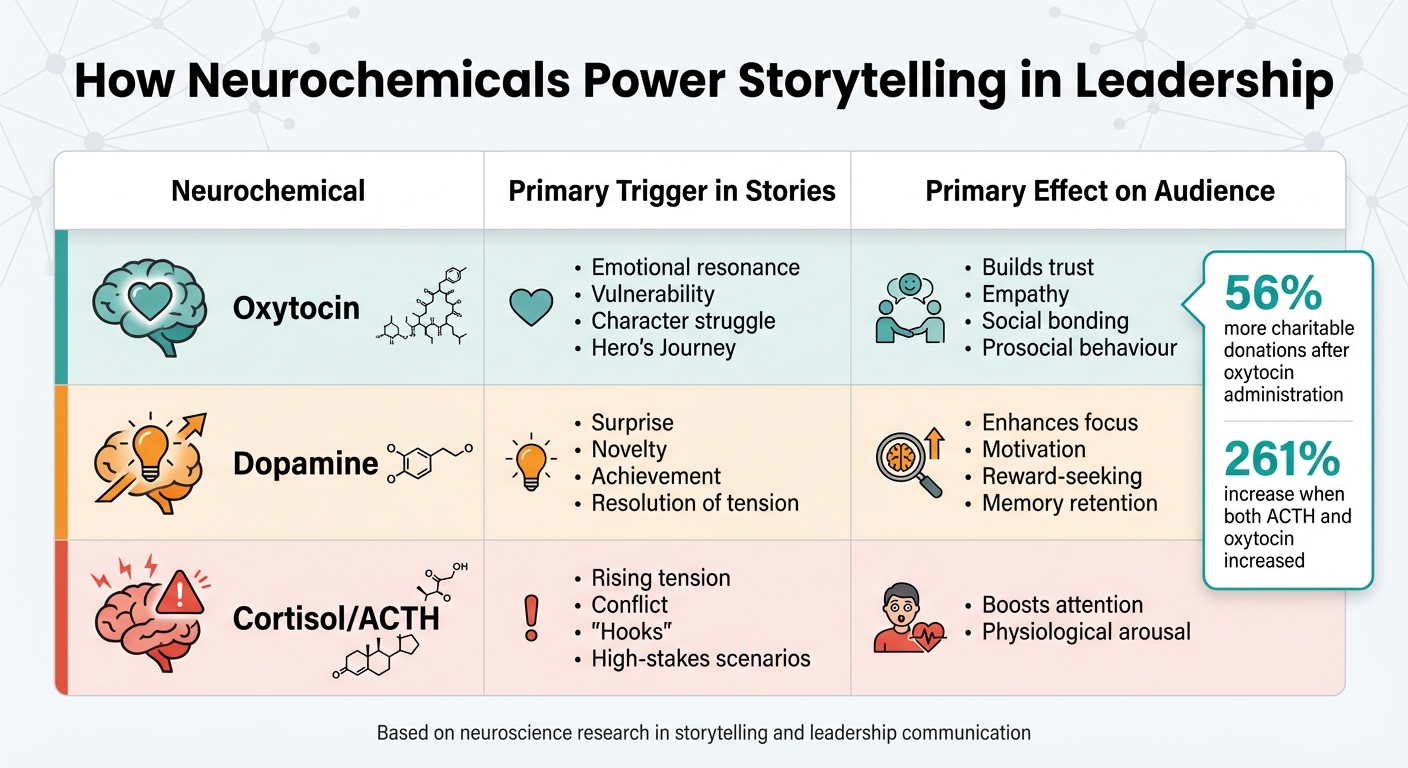
Neurochemicals in Storytelling: Oxytocin vs Dopamine Effects on Leadership Communication
Oxytocin: The Trust Hormone
The effectiveness of storytelling in leadership goes beyond words - it’s deeply rooted in brain chemistry. Neurochemicals like oxytocin and dopamine play a pivotal role in this process. When leaders share emotionally engaging stories with a clear dramatic arc, they capture attention and create what researchers call narrative transportation. This process triggers the release of oxytocin, a neurochemical associated with feelings of safety and familiarity.
The impact of oxytocin is striking. A 2013 study led by Dr Paul J. Zak at Claremont Graduate University demonstrated this vividly. Participants who received 40 IU of synthetic oxytocin intranasally donated 56% more of their experiment earnings to charities after watching emotionally charged public service announcements from the UK. Even more compelling, when a story increased both ACTH (a marker of attention) and oxytocin (linked to empathy), donations soared by 261% compared to instances where these biomarkers remained unchanged. As Dr Zak explains:
"Oxytocin is the neurologic substrate for the Golden Rule: If you treat me well, in most cases my brain will synthesise oxytocin and this will motivate me to treat you well in return."
However, for oxytocin to influence behaviour, the story must hold the audience’s attention. Without a dramatic arc or emotional tension, the brain fails to release oxytocin or cortisol, leading to reduced empathy and lower information retention. While oxytocin builds trust and connection, dopamine plays an equally important role in sustaining engagement and memory.
Dopamine: The Reward Mechanism
If oxytocin creates emotional bonds, dopamine ensures the story sticks. This neurochemical is released in response to surprise, novelty, achievement, or the resolution of conflict. As part of the brain’s reward system, dopamine not only enhances focus but also improves memory retention. By weaving unexpected twists or moments of resolution into a narrative, storytellers can "reset" the audience’s emotional state, making them more open to new ideas and breaking negative thought patterns.
The interplay between oxytocin and dopamine reveals their complementary roles in storytelling, particularly for leaders aiming to engage and inspire:
| Neurochemical | Primary Trigger in Stories | Primary Effect on Audience |
|---|---|---|
| Oxytocin | Emotional resonance, vulnerability, character struggle, "Hero’s Journey" | Builds trust, empathy, social bonding, and prosocial behaviour |
| Dopamine | Surprise, novelty, achievement, resolution of tension | Enhances focus, motivation, reward-seeking, and memory retention |
| Cortisol/ACTH | Rising tension, conflict, "hooks", and high-stakes scenarios | Boosts attention and physiological arousal |
Mirror Neurons and Empathy Through Stories
The Science of Mirror Neurons
Mirror neurons, a type of brain cell, play a key role in explaining how stories connect with people on a biological level. These neurons activate not only when we perform an action but also when we observe someone else performing it. For leaders, this means that sharing stories can allow listeners to emotionally experience the narrative as if it were their own.
Research by Uri Hasson at Princeton University highlights this phenomenon. In an experiment, a speaker told an unrehearsed, real-life story while listeners' brains were scanned using fMRI. The results showed that the listeners' brain activity synchronised with the speaker's, both spatially and temporally. Those who understood the story well even showed anticipatory neural coupling - predicting what the speaker might say next. As Hasson summarises:
The greater the anticipatory speaker–listener coupling, the greater the understanding.
This neural mirroring is not just about comprehension - it taps into a mechanism essential for shared learning. Neuroscientist V.S. Ramachandran explains its broader significance:
By hyper-developing the mirror-neuron system, evolution in effect turned culture into the new genome. Armed with culture, humans could adapt to hostile new environments... in just one or two generations.
By activating mirror neurons, leaders can strengthen understanding and foster a sense of unity within their teams.
Building Psychological Safety and Belonging
Neural mirroring also provides a foundation for creating psychological safety and a sense of belonging. Leaders can achieve this by sharing stories that reflect challenges, shared goals, or personal experiences. Such storytelling helps ease tension and shift team dynamics from resistance to curiosity.
A practical example of this comes from Dr Mónica Feliú-Mójer and her team at the Journal of Neuroscience. In 2018, they launched the "Background to Breakthrough" film series, which highlighted the personal and cultural stories of underrepresented scientists. Instead of focusing solely on academic achievements, the series explored how their backgrounds shaped their innovative thinking and problem-solving skills. This approach made complex scientific ideas more engaging and accessible to communities often excluded from such discussions. Professor Rachel Yehuda of the Icahn School of Medicine at Mount Sinai emphasises the impact of such storytelling:
Engaging listeners in the scientific journey creates a stronger, more meaningful transfer of knowledge because it elicits participation and creates an intellectual investment and emotional bond.
Stories also act as "social surrogates", helping to reduce feelings of isolation and improve mood and self-esteem. In high-pressure environments, this sense of connection and trust can significantly enhance decision-making. When leaders share the personal context behind their decisions or data, they activate neural pathways that turn information into a shared experience. This not only deepens understanding but also fosters emotional investment in the team's mission.
How Leaders Apply Storytelling for Influence
Storytelling vs. Data-Driven Communication
The way the brain processes stories compared to raw data reveals a stark contrast. When leaders present statistics or spreadsheets, only the language-processing parts of the brain - Broca’s area and Wernicke’s area - are engaged. In contrast, storytelling activates a much broader network, including the Default Mode Network (involved in imagination and self-reflection), the amygdala (the brain’s emotional centre), as well as motor and sensory regions.
This distinction is critical because stories evoke neurochemical reactions that data alone cannot. Narratives prompt the release of oxytocin, which fosters trust and empathy, and dopamine, which enhances memory and engagement. By comparison, data-driven communication often fails to produce such responses, making it less effective at influencing behaviour or inspiring action.
| Feature | Data-Driven Communication | Storytelling Communication |
|---|---|---|
| Brain Activation | Primarily language-processing areas (Broca’s and Wernicke’s areas) | Engages language, sensory, motor, emotional centres (amygdala), and the Default Mode Network |
| Neurochemical Response | Minimal, focused on logical reasoning | Releases oxytocin (trust) and dopamine (memory/engagement) |
| Retention Rates | Low; facts are often quickly forgotten | High; stories resonate emotionally, aiding memory |
| Influence Outcome | Can provoke scepticism or resistance | Builds empathy and trust, encouraging collaboration |
The most effective leaders don’t choose between data and storytelling - they combine them. Data provides the logical foundation, but stories give it emotional weight. This dual approach allows leaders to explain the "what" and "how" with facts, while the narrative delivers the "why" that inspires action. As the Disrupts Editorial Board succinctly states:
The human brain is fundamentally wired for stories, not spreadsheets.
Understanding these neurological differences highlights why storytelling is such a powerful tool in leadership.
Leadership Scenarios Using Storytelling
The neural and emotional power of storytelling offers leaders practical ways to address challenges. By tapping into the brain’s natural response to narratives, leaders can build trust, foster engagement, and navigate difficult situations with greater ease.
For example, during periods of organisational change or crisis, framing challenges as a journey - complete with obstacles, tension, and resolution - can activate the brain’s trust and empathy pathways. Instead of presenting quarterly targets as dry figures, leaders can craft a story where employees become protagonists overcoming hurdles to achieve success.
Direct commands often trigger resistance, but storytelling bypasses this defensive instinct. Melanie Green, a Communication Professor at the University at Buffalo, notes:
A vivid, emotional story 'can give that extra push to make it feel more real or more important.' If you look at the times somebody's beliefs have been changed, it's often because of a story that 'hits them in the heart'.
Stories feel personal and relatable, making them more effective than data or directives in shifting beliefs and behaviours.
In high-stakes situations - like announcing redundancies, pivoting strategies, or managing a public relations crisis - leaders should consider using video rather than written communication. Videos are more neurologically engaging, sustaining attention and fostering emotional connection more effectively than text. Sharing stories of vulnerability or past failures can also build trust, as these narratives trigger oxytocin release and create a sense of psychological safety. By using storytelling in these ways, leaders can align teams and make better decisions during critical moments, translating neuroscience into practical leadership outcomes.
House of Birch: Storytelling Frameworks for Leaders

Narrative Control for High-Stakes Leaders
House of Birch takes insights from neuroscience, such as neural coupling and neurochemical responses, and transforms them into practical tools for leadership. Their approach isn't about generic communication tips but focuses on helping leaders craft and deliver stories that resonate deeply with audiences. By fostering neural coupling - where a leader's brain activity aligns with their audience's in real-time - leaders can synchronise ideas and emotions effectively, creating a powerful connection.
A key element of this framework is the use of a dramatic arc structure, a proven method for impactful storytelling. Leaders are trained to tap into specific neurochemical responses: oxytocin to build trust, dopamine to enhance memory and motivation, and cortisol to heighten focus. This isn't about manipulation; rather, it aligns with how the brain naturally processes and retains information.
Each programme is tailored to the leader's unique challenges, whether they are steering an organisation through transformation, managing a crisis, or building influence in their field. The emphasis lies on strategic intelligence and social influence, equipping leaders to shape perceptions and drive decisions during pivotal moments. Alongside storytelling, leaders are guided on maintaining internal composure, which is crucial for high-stakes communication.
Emotional Discipline and Presence
House of Birch also focuses on the leader's internal state, drawing from neuroscience concepts like the Theory of Constructed Emotion. This theory posits that emotions aren’t hardwired responses but are actively created by the brain based on context, predictions, and sensory input. With this understanding, leaders can learn to reframe their emotional responses in high-pressure scenarios, enabling them to remain composed when it matters most.
One practical strategy involves using surprise to "reset" the emotional state. By introducing unexpected elements into a narrative or situation, leaders can disrupt negative thought patterns and make audiences more open to new perspectives. This technique is particularly effective in overcoming resistance or scepticism within organisations. Through its focus on emotional discipline, House of Birch ensures leaders not only tell compelling stories but also deliver them with authenticity and control, enhancing their credibility and influence.
Conclusion
Research highlights a compelling truth: the human brain is naturally attuned to stories, not data points or spreadsheets. When leaders understand the neuroscience behind storytelling - such as neural coupling, neurochemical triggers, and mirror neuron activation - they gain a powerful tool for influencing decisions, building trust, and driving change. Studies have shown that synthetic oxytocin, for instance, enhances prosocial behaviours, further underscoring the connection between storytelling and human interaction.
The effectiveness of storytelling lies not just in its neurological roots but also in its structure and authenticity. Narratives that incorporate tension, vulnerability, and resolution do more than hold attention - they synchronise brain activity between speaker and listener, creating a state of neural alignment. This builds on earlier findings about neural coupling and the role of mirror neurons, illustrating how stories foster connection on a deeply biological level. As Melanie Green aptly observes, emotionally charged stories have the power to shift beliefs.
For leaders, these insights are far from abstract - they offer actionable strategies for high-stakes environments. Storytelling is not a "nice-to-have" skill; it is a strategic tool. Whether guiding an organisation through change, responding to a crisis, or establishing influence, a well-crafted narrative can significantly amplify a leader’s impact. Even after the story ends, the brain's Default Mode Network continues to process it, allowing the message to shape thoughts and inspire action long after delivery.
The science is clear: by framing challenges as heroic journeys, embracing vulnerability, and using tension to sustain focus, leaders can align their communication with the brain’s natural tendencies. These approaches provide a practical and effective edge in moments that matter most.
FAQs
How can I use stories to align a team quickly?
Stories have the power to bring teams together by directing focus, building emotional connections, and establishing a common understanding. Research in neuroscience reveals that storytelling triggers neural coupling, a process that helps make messages stick and leaves a stronger impression. By crafting stories that feel genuine and relatable, and that align with the team’s core values and objectives, leaders can create a sense of shared purpose. When stories are tailored to address specific audience priorities - such as fairness or autonomy - they foster trust and emotional bonds, boosting alignment and energising collective drive.
What makes a story trigger trust and empathy?
Stories have a unique ability to build trust and empathy by engaging the brain's neural coupling and mirroring processes. These mechanisms allow us to grasp others' motives and viewpoints more effectively. When a narrative follows a dramatic arc, it can evoke strong emotional reactions, prompting the release of oxytocin - a neurochemical linked to trust and bonding. This combination deepens emotional connections and improves mutual understanding.
How do I combine data and storytelling without losing credibility?
To bring data and storytelling together successfully, weave factual information into compelling narratives that resonate emotionally and stimulate the senses. Research in neuroscience highlights that genuine stories foster trust and enhance memory retention, amplifying the impact of data. By anchoring your data in relatable scenarios and employing storytelling methods, you can improve comprehension, strengthen credibility, and ensure your message remains both memorable and persuasive.

