Top 5 Neuroscience Insights on Persuasion
Persuasion isn’t just about logic or charisma - it’s deeply rooted in how our brains process information. Neuroscience has revealed key insights into what makes messages resonate and influence behaviour. Here are five evidence-backed findings:
- Value Drives Decisions: The ventromedial prefrontal cortex (vmPFC) evaluates the personal worth of a message, often predicting behaviour more accurately than self-reported intentions. Persuasion works by shifting perceptions of value, not just presenting logical arguments.
- Social Conformity is Reward-Based: When opinions conflict with group norms, the brain’s reward system flags this as an error, pushing individuals to align with the majority. This process, driven by regions like the nucleus accumbens, explains why group consensus often overrides personal judgement.
- Empathy Builds Trust: Mirror neurons synchronise emotional and neural activity between individuals, fostering understanding and connection. This mechanism makes emotional alignment a powerful tool for influencing others.
- Neurochemicals Fuel Influence: Dopamine motivates action, while oxytocin strengthens trust and social bonds. Together, they amplify the impact of persuasive messages, especially when personal and social relevance are combined.
- Two Processing Routes: The brain processes messages via the central route (logical, evidence-based) or peripheral route (quick, emotional cues). Tailoring messages to the audience’s motivation and focus determines their effectiveness.
Key Takeaway: Leaders can apply these findings by framing messages that highlight value, align with group dynamics, evoke trust, and match the audience’s cognitive state. Tools like visuals and emotional cues can enhance impact, particularly in high-pressure situations.
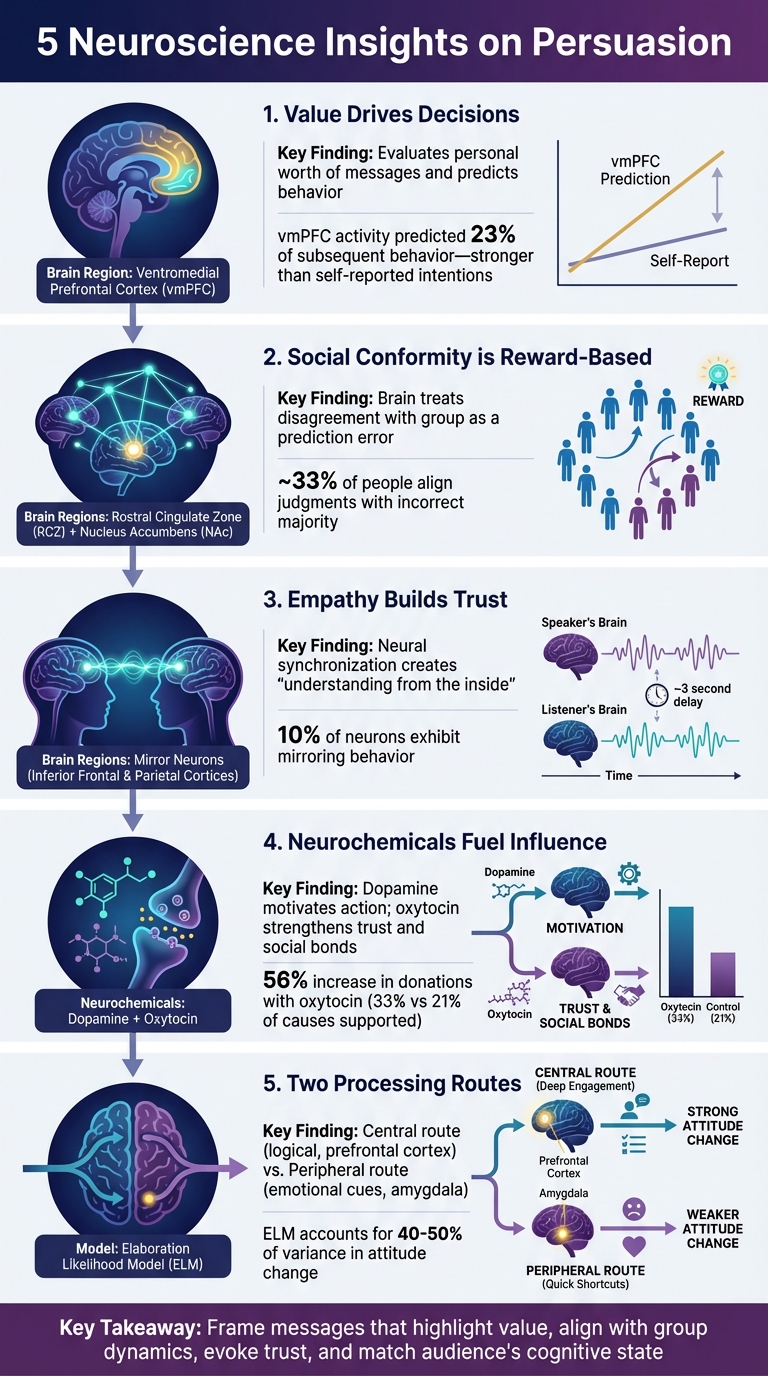
5 Neuroscience Insights on Persuasion: Brain Regions and Key Findings
Neuroscience of Persuasion + Strategies for Changing Minds and Behaviors (The Social Brain ep 27)
sbb-itb-ce676ec
1. The Ventromedial Prefrontal Cortex Processes Value and Drives Attitude Change
The ventromedial prefrontal cortex (vmPFC) acts as the brain's "common currency" system, translating various inputs - such as costs, benefits, social rewards, and personal preferences - into a single subjective value signal. This signal plays a key role in guiding decisions. When a person encounters a persuasive message, the vmPFC evaluates the offer by weighing its perceived value against what is being requested, determining whether the proposition feels worthwhile.
This highlights a critical insight about persuasion: it is less about logical arguments and more about altering perceptions of value. As Emily Falk and Christin Scholz from the University of Pennsylvania point out, "The persuasive impact of argument quality... is much less about logic than it is about valence. That is, persuasion is more about suggesting good rather than bad consequences (valence) for the message recipient than it is about creating perfectly logical arguments".
A 2010 UCLA fMRI study involving 20 participants demonstrated the vmPFC's predictive power. When participants were exposed to persuasive messages promoting sunscreen use, activity in the vmPFC predicted 23% of their subsequent sunscreen use - a stronger indicator than their self-reported intentions. This suggests the brain's value computations can be more reliable than conscious verbal commitments.
The vmPFC also processes what researchers call "person-invariant value", allowing it to evaluate rewards for oneself and others on a comparable scale. For instance, in one study, participants valued £1.26 given to someone else as equivalent to £1.00 given to themselves. This ability makes the vmPFC especially relevant for persuasive messages that aim to balance individual benefits with collective outcomes, a challenge often faced by organisational leaders.
Unlike the dorsolateral prefrontal cortex, which is responsible for effortful cognitive control, the vmPFC influences decisions by activating personal preferences and internal representations of utility. Remarkably, it can predict behavioural changes even without the individual’s conscious awareness. This makes it a potent focus for those aiming to influence decisions in high-pressure or high-stakes contexts. In the next section, we will examine how reward prediction errors further shape persuasive behaviour.
2. Reward Prediction Errors Trigger Conformity Through Reinforcement Learning
The brain is constantly comparing what it expects to happen with what actually happens. When reality doesn’t match expectations - whether it’s an unexpected pay rise or a differing opinion - this generates what neuroscientists call a reward prediction error (RPE). This discrepancy between expectation and outcome isn’t limited to personal experiences; it also occurs in social situations, where deviations from group norms can trigger the same neural process.
In social contexts, the brain interprets disagreement with the group as a prediction error. When someone realises their opinion differs from the group, two key brain regions react immediately. The Rostral Cingulate Zone (RCZ) signals the need for an adjustment, while the Nucleus Accumbens (NAc) deactivates, treating the disagreement as a negative outcome. Professor Vasily Klucharev summarised this phenomenon:
Conflict with group opinion triggered a neuronal response in the rostral cingulate zone and the ventral striatum similar to the 'prediction error' signal suggested by neuroscientific models of reinforcement learning.
A study led by Klucharev’s team at Radboud University Nijmegen in January 2009 demonstrated this process in action. During the experiment, 24 female participants rated the attractiveness of 222 faces while undergoing fMRI scans. After providing their ratings, they were shown what they believed to be the "average European rating." When their opinions differed from this supposed group consensus, neural responses in the RCZ and NAc were observed. Notably, the strength of these signals predicted whether participants would adjust their ratings 30 minutes later (F(2,20) = 31.1, p = 0.0001). Specifically, the level of NAc deactivation could reliably indicate whether someone would conform to the group.
This research highlights how reward prediction errors play a central role in conformity. It sheds light on why, in classic experiments on social conformity, around one-third of participants align their judgements with an obviously incorrect majority. The brain’s reinforcement learning system treats social alignment as rewarding, while deviation is flagged as an error needing correction. Interestingly, individuals who conform more readily exhibit stronger deactivation in the Nucleus Accumbens during moments of conflict, suggesting that sensitivity to social prediction errors differs from person to person, even though the underlying mechanism is universal.
These findings offer valuable insights for leaders operating in high-stakes environments. By understanding how social alignment is processed in the brain, leaders can craft messages and strategies that resonate more effectively within group dynamics.
3. Mirror Neurons Create Empathy and Trust via Neural Synchronisation
When you witness someone smile, a fascinating process unfolds in your brain: mirror neurons activate, replicating the action internally. These specialised neurons, identified in the 1980s and 1990s by researchers at the University of Parma, fire both when you perform an action and when you observe someone else doing it. Studies reveal that approximately 10% of neurons in the monkey's inferior frontal and parietal cortices exhibit this mirroring behaviour.
Giacomo Rizzolatti describes this phenomenon as "understanding from the inside", where sensory input translates into corresponding motor responses. This mechanism isn't limited to physical actions - it extends to emotions as well. For instance, observing someone in pain or disgust activates the same brain regions in the insula and anterior cingulate cortex responsible for processing these emotions. As Pier Francesco Ferrari and Giacomo Rizzolatti succinctly put it:
Your pain is my pain.
In human communication, this mirroring effect enables neural synchronisation between individuals. Research led by Uri Hasson at Princeton University demonstrates that a listener’s brain activity mirrors the speaker’s, typically with a delay of about three seconds. This synchrony fosters a deeper understanding between the speaker and listener. Marco Iacoboni of UCLA highlights the importance of this process, stating:
Neural mirroring solves the 'problem of other minds' (how we can access and understand the minds of others) and makes intersubjectivity possible, thus facilitating social behaviour.
This neural connection creates what researchers refer to as a "we-mode", allowing people to share a common perception of their environment. Even without conscious effort, this process operates through the "chameleon effect", where individuals automatically mimic each other’s postures and expressions, enhancing rapport and encouraging cooperative behaviour. This synchronisation not only strengthens empathy but also provides a foundation for leaders aiming to influence others effectively.
For leaders in high-pressure situations, understanding the role of mirror neurons offers practical advantages. These neurons respond to both visual and auditory cues, enabling communication that engages multiple sensory channels simultaneously. The emotional state a leader projects - whether confidence, calmness, or anxiety - does more than inform the audience intellectually. It resonates on a neural level, shaping the audience's internal emotional experience and, ultimately, their behaviour.
4. Dopamine and Oxytocin Strengthen Persuasive Connections
Two key neurochemicals, dopamine and oxytocin, play complementary roles in turning persuasive messages into powerful motivators. While dopamine fuels the drive to act, oxytocin fosters the trust and social connection that make messages resonate on a personal level.
Dopamine functions within the brain's mesocorticolimbic pathway, which is responsible for coding "wanting" - the motivation to achieve goals. Importantly, dopamine doesn’t create feelings of pleasure; instead, it generates the internal drive to pursue rewards. When a persuasive message triggers dopamine release in areas like the ventral tegmental area and nucleus accumbens, it assigns incentive salience to the idea, making the audience more likely to take action. This motivational boost works hand-in-hand with the social influence provided by oxytocin.
Oxytocin, a neuropeptide, enhances sensitivity to social information, helping people perceive messages as more engaging and meaningful. For example, a 2013 study led by Paul J. Zak at the Centre for Neuroeconomics Studies revealed oxytocin's impact on charitable behaviour. Forty male participants were given either 40 IU of synthetic oxytocin or a placebo before watching 16 public service announcements. The oxytocin group donated to 33% of the featured causes, compared to only 21% in the placebo group - resulting in a 56% increase in donations to organisations such as the American Cancer Society and Greenpeace.
These two systems don’t just operate independently - they interact directly. Oxytocin neurons in the hypothalamus project to the ventral tegmental area, where they stimulate dopamine release. This interplay integrates reward-driven motivation with social cues, amplifying the overall persuasive effect. As Tiffany M. Love, PhD, from the University of Michigan, explains:
Oxytocin appears to impact dopaminergic activity within the mesocorticolimbic dopamine system, which is crucial not only for reward and motivated behavior but also for the expression of affiliative behaviors.
This synergy forms the biological basis for building trust and fostering long-term connections. Messages that activate both dopamine and oxytocin systems - by highlighting personal value while reinforcing social relevance - engage the brain's valuation network, including the ventromedial prefrontal cortex and ventral striatum. Research has shown that activity in these regions predicts which New York Times articles are most likely to be shared on social media.
5. The Elaboration Likelihood Model Shows How the Brain Processes Persuasive Messages
The Elaboration Likelihood Model (ELM), introduced by Richard E. Petty and John T. Cacioppo in the 1980s, provides a framework for understanding how the brain processes persuasive messages. It identifies two distinct pathways: the central route and the peripheral route, with the choice between them depending on an individual's motivation and cognitive capacity.
The central route is activated when a person is both motivated and able to engage deeply with a message. This involves careful analysis of evidence and logical reasoning, a process linked to activity in the prefrontal cortex. Attitudes formed through this route tend to be long-lasting, resistant to counterarguments, and predictive of actual behaviour. In contrast, the peripheral route comes into play when motivation or cognitive resources are limited. Here, the brain relies on shortcuts, such as the speaker's appeal, perceived credibility, or the number of arguments presented, rather than the content itself. This type of processing, associated with amygdala responses, often results in temporary attitude changes that are less stable over time.
A 1983 study illustrated this distinction: participants with low involvement were influenced by celebrity endorsements, while those with high involvement required strong, logical evidence to be persuaded. These findings align with earlier research, offering a quantifiable understanding of how attitudes shift and providing practical guidance for persuasive strategies. In fact, meta-analyses suggest that the ELM accounts for 40–50% of the variance in attitude change.
For leaders aiming to inspire lasting commitment, it is essential to engage the central route. This requires ensuring the audience has both the motivation - by presenting the issue as personally relevant - and the ability - by eliminating distractions and offering clear, compelling evidence. As Saul McLeod, PhD, explains:
The central route is logic-driven and uses data and facts to convince people of an argument's worthiness.
In contexts where engagement is brief, such as social media interactions, the peripheral route is more effective. Here, leveraging cues like credible endorsers or polished visuals can quickly capture attention. For leaders, understanding and applying these pathways can enhance communication strategies, particularly in moments where influence is critical.
Application for High-Stakes Leaders
For leaders navigating high-pressure scenarios, neuroscience offers a compelling insight: persuasion starts from the bottom up. Before logic takes hold, the primal brain evaluates messages for their value, safety, and relevance. Christophe Morin, CEO of SalesBrain, puts it succinctly:
The primal brain dominates persuasive message processing!
This understanding provides a practical framework for leadership. The first step is diagnosing your audience's concerns. What are their fears? What drives their decisions? Once identified, frame your message with clear contrasts - before versus after, risky versus safe, with versus without. The primal brain thrives on clarity, and ambiguity can lead to hesitation or inaction. To keep your message effective, limit your argument to no more than three key points.
Visual communication plays a pivotal role in persuasion. The optic nerve transmits information to the primal brain 25 times faster than the auditory nerve, making visuals a powerful tool for influencing decisions. Combine this with gain-framed messages - highlighting potential benefits rather than losses - to engage the medial prefrontal cortex and encourage behavioural change. As UCLA Professor Matthew D. Lieberman explains:
Neural signals can predict behavioral changes that are not predicted from self‐reported attitudes and intentions alone.
Leaders can also apply these principles to their own behaviour during critical moments. Before engaging in high-stakes discussions, managing your internal state is essential. Mirror neurons mean that your emotional state is often reflected by your team. Simple techniques, such as slow, deliberate breathing, can help calm your nervous system. Adopting a curious and open approach - asking questions like "What would happen if we tried this?" - can reduce resistance and foster collaboration. Research suggests that up to 80% of influence stems from non-verbal cues such as tone, pace, posture, and eye contact.
For leaders seeking tailored support in applying these neuroscience-backed strategies, House of Birch offers bespoke advisory services. Their discreet, personalised programmes help leaders refine their social influence, emotional regulation, and strategic thinking to enhance their impact during pivotal moments.
Conclusion
Persuasion operates on a foundation deeply embedded in neuroscience. The five insights explored in this article highlight how the brain evaluates and reacts to influence, often without our conscious awareness. From the ventromedial prefrontal cortex assessing personal value to the mentalising networks that enable understanding, these neural processes underpin our responses to persuasive messaging. Together, they provide leaders, negotiators, and communicators with a scientifically informed edge in high-pressure environments.
Research shows that neural signals, such as activity in the medial prefrontal cortex predicting 23% of future behaviour, often surpass the accuracy of self-reported intentions. By crafting messages that engage the right neural systems - those linked to valuation and mentalising - outcomes can be influenced in ways that traditional methods may fail to achieve. This evidence offers a solid foundation for practical and effective strategies.
To apply these principles, focus on identifying your audience’s primary concerns, framing messages with clear contrasts (ideally limiting to three key points), and using gain-framed language alongside visuals to maximise engagement. These tactics are grounded in rigorous fMRI research, making them reliable tools for influencing behaviour.
For leaders navigating critical decisions, neuroscience offers a dependable guide. Whether the goal is to build trust, resolve conflict, or drive organisational change, the brain’s response to persuasive communication follows predictable patterns. The real challenge lies not in whether these insights are effective, but in consistently applying them. Leaders aiming to turn these findings into actionable strategies may consider services like those offered by House of Birch, which specialise in enhancing decision-making, emotional control, and strategic influence. By leveraging these principles, leaders can transform persuasion into a powerful strategic tool.
FAQs
How can I increase the perceived value of my message?
To make your message more impactful, consider tapping into emotional and contextual elements. Craft your message in a way that appeals to the brain's reward systems - using emotionally charged language or compelling stories can engage the amygdala, the part of the brain tied to emotions. Emphasise distinct advantages, incorporate social proof (like testimonials or endorsements), or introduce a sense of scarcity to trigger social and reward-related neural responses. These strategies can greatly influence how effectively your message resonates with your audience.
How do I use group dynamics without causing backlash?
To make the most of group dynamics, prioritise building consensus and coordinating behaviours. Research in neuroscience highlights that encouraging open discussions and aligning group members' perspectives with common objectives can boost collaboration while lowering resistance.
Promoting respectful interactions and fostering a sense of collaborative influence is key. When this process feels supportive rather than forceful, it helps to solidify group unity, avoid pushback, and create a more harmonious environment by subtly aligning with shared norms and social cues.
When should I use logic vs emotional cues to persuade?
When decisions call for thorough analysis and rational thinking, logic should take the lead. On the other hand, emotional cues are more effective in scenarios tied to personal values, social dynamics, or instinctive responses. Research in neuroscience highlights that an individual's preference for logical or emotional persuasion is influenced by their brain’s unique wiring. Therefore, it’s crucial to tailor your approach to fit both the context and the audience.

