Neuroscience of Goal-Setting in Leadership
Leaders often overlook how the brain drives goal-setting success. Neuroscience shows that effective goals influence motivation, planning, and habit formation by leveraging brain functions like dopamine-driven anticipation, the prefrontal cortex’s planning capacity, and neuroplasticity. Here’s what leaders need to know:
- Dopamine fuels motivation: It rewards progress, not just outcomes. Breaking big goals into smaller milestones provides frequent dopamine boosts, keeping teams engaged.
- The brain’s focus is limited: The prefrontal cortex handles planning but can only manage 2–3 goals at a time. Overloading it reduces performance.
- Habits form through repetition: Neuroplasticity helps turn effort into automatic behaviours, shifting control from deliberate brain regions to efficient ones.
- SMART goals align with brain function: Specific, measurable, and time-bound objectives activate attention and improve outcomes by up to 18%.
- Visualisation strengthens commitment: Imagining success and process-focused steps engages neural pathways, reinforcing goals.
Leaders should prioritise clarity, celebrate small wins, and structure goals to align with how the brain naturally works. These strategies not only improve individual performance but also enhance team dynamics. Organisations may wish to explore how neuroscience-informed practices can drive better outcomes.
The Neuroscience of Goal Setting 🧠
sbb-itb-ce676ec
How the Brain Processes Goals: Core Neural Mechanisms
The brain's ability to manage and achieve goals relies on three interconnected systems: the dopamine-driven motivation network, the planning functions of the prefrontal cortex (PFC), and the brain's neuroplasticity, which enables habit formation. Together, these systems convert abstract intentions into tangible results.
How Dopamine Fuels Motivation
Dopamine plays a central role in anticipation - it signals the potential for a positive outcome. As Dan Docherty, CEO of Braintrust Growth, explains:
"Dopamine is less about pleasure and more about anticipation. It's the brain's way of saying, 'Something good is coming - keep going'".
Produced in the ventral tegmental area (VTA) and delivered to the nucleus accumbens, dopamine activity is strongest when rewards are unexpected or exceed expectations. This phenomenon, known as Reward Prediction Error (RPE), highlights how the brain’s reward system adjusts. When a reward becomes predictable, dopamine release shifts to the cue signalling the reward. Conversely, if an expected reward fails to materialise, dopamine levels drop below baseline, often causing demotivation.
This insight sheds light on why large, long-term goals can sometimes feel demotivating. Breaking big objectives into smaller, measurable milestones creates frequent dopamine boosts with each step achieved. For example, instead of relying solely on annual targets, implementing short-term checkpoints - such as 12-day intervals - can sustain engagement. Similarly, visualising success can stimulate dopamine release, making progress feel more immediate and achievable.
Interestingly, dopamine governs "wanting" - the drive to act - rather than "liking", which is tied to pleasure. This distinction explains why individuals can stay focused on challenging tasks despite the absence of immediate enjoyment. Leaders often rely on this mechanism to maintain motivation during demanding projects, reserving other brain systems for the satisfaction experienced in moments of celebration.
Dopamine's role in motivation sets the stage for the prefrontal cortex to handle the complex planning required to achieve goals.
The Prefrontal Cortex: Planning and Focus in Action
The prefrontal cortex (PFC) acts as the brain's control centre, managing tasks such as planning, decision-making, and sustained attention. Different regions within the PFC handle specific responsibilities: the dorsolateral PFC focuses on strategy and filtering distractions, the anterior cingulate cortex supports task switching and emotional regulation, and the orbitofrontal cortex helps inhibit impulsive reactions to prioritise long-term objectives.
However, the PFC has finite capacity, which is why experts, like those at the NeuroLeadership Institute, recommend focusing on just two or three key goals at a time. This part of the brain is particularly suited to tackling novel challenges rather than routine tasks. It also evaluates the "opportunity cost" of attention, signalling when the effort devoted to one goal might outweigh its benefits relative to other priorities.
Leaders can strengthen PFC function through practices such as mindfulness, meditation, learning new skills, and regular physical activity. These activities enhance the brain's ability to stay focused and make decisions under pressure.
Neuroplasticity: Turning Effort into Habit
Neuroplasticity refers to the brain's capacity to rewire itself by creating and reinforcing neural connections. This process allows effortful behaviours to become automatic habits over time. Initially, goal-directed actions are governed by the dorsomedial striatum, but with repetition, control shifts to the dorsolateral striatum, which handles habitual behaviours. As G.R. Stahl explains:
"The brain's ability to adapt and rewire itself in response to goal-oriented behaviour is known as neuroplasticity, which allows the brain to form new neural connections and strengthen existing ones".
Repeated practice can enable the brain to anticipate challenges rather than merely react to them, moving control from the PFC to more efficient brain regions. This shift reduces cognitive strain and allows leaders to focus on higher-level tasks.
To accelerate neuroplasticity, leaders can tie goals to their evolving identity rather than just specific actions. For instance, framing an objective as "I am a leader who prioritises team development" engages the brain's reward system more effectively than transactional goals. Breaking large objectives into micro-steps further eases cognitive demands, while frequent dopamine boosts reinforce new neural pathways. Adding visual reminders in the environment can help the ventromedial prefrontal cortex maintain the perceived value of long-term goals over time.
Goal-Setting Methods That Work With Your Brain
Understanding how the brain processes goals is just one piece of the puzzle - leaders also need to apply methods that align with these mechanisms. The best strategies blend structure with adaptability, creating an environment where motivation and focus thrive. These approaches build on the neural principles discussed earlier, ensuring goals engage both cognitive focus and drive.
SMART Goals and Brain Function
The SMART framework (Specific, Measurable, Achievable, Relevant, Time-bound) aligns well with how the brain operates. Research shows that specific, challenging goals can boost performance by over 18% compared to vague instructions like "do your best". This clarity activates the reticular activating system (RAS), a part of the brainstem that filters attention towards opportunities and resources tied to the goal.
Moderately challenging goals - those set at about 70–80% difficulty - are particularly effective. They strike a balance: demanding enough to sustain focus but achievable enough to maintain confidence. Vague objectives, on the other hand, fail to stimulate the amygdala, which plays a role in maintaining attention and effort.
Writing goals down also significantly improves outcomes. Studies suggest that individuals who write their goals are 42% more likely to achieve them compared to those who don’t, and this figure jumps to 76% when combined with public accountability. Handwriting specifically seems to deepen encoding in the brain’s memory systems compared to typing.
Given the prefrontal cortex’s limited capacity, leaders should focus on managing no more than five to seven active goals at a time. Exceeding this limit risks impairing performance as the brain struggles to juggle competing priorities. As Alfred North Whitehead aptly put it:
"Operations of thought are like cavalry charges in a battle - they are strictly limited in number, they require fresh horses, and must only be made at decisive moments".
Additionally, "if-then" plans, known as implementation intentions, can improve goal achievement rates by 20% to 30%, and up to 50% for particularly tough goals. Shifting focus from annual objectives to shorter 12-week cycles also helps sustain motivation by keeping deadlines immediate and engaging.
Strengthening Goals with Visualisation and Purpose
The brain often treats vividly imagined scenarios as if they were real. Visualising a goal activates the same neural regions involved in actual execution, reinforcing commitment through the ventromedial prefrontal cortex (vmPFC), which evaluates a goal’s relevance to personal identity and rewards.
However, visualisation works best when it focuses on the process rather than just the outcome. Imagining the steps and challenges involved primes the motor cortex and strengthens the neural pathways needed for action. Leaders can amplify this effect by using physical reminders - such as sticky notes or images representing their goals - to maintain long-term focus.
Negative visualisation, where one imagines the disappointment of not achieving a goal, can also be a powerful motivator. This technique engages the amygdala’s emotional circuits, providing an extra push. Framing goals in terms of identity - shifting from "I want to achieve X" to "I am becoming a leader who values X" - further deepens engagement at a neurobiological level.
Before tackling high-pressure tasks, a brief focus exercise - staring at a single point for 30 to 60 seconds - can activate neural circuits that prepare the body for action. This practice, combined with vivid goal imagery, helps break down complex objectives into actionable steps.
Breaking Down Large Goals
Big goals can overwhelm the brain, triggering the amygdala’s threat response and creating a sense of helplessness. Dividing these objectives into smaller, manageable steps reduces cognitive strain and creates frequent opportunities for dopamine release, which sustains motivation during the process. Interestingly, dopamine is released more during the pursuit of a reward than upon achieving it, making it crucial to celebrate small victories along the way.
Using 12-day checkpoints or weekly milestones can provide regular dopamine boosts, maintaining momentum. These small wins also help transition goal-directed actions from the prefrontal cortex (responsible for deliberate effort) to the striatum, the brain’s habit centre. Over time, this shift makes actions more automatic and efficient.
For teams, limiting members to two or three key goals ensures focus and prevents cognitive overload. Establishing rituals to recognise incremental progress - whether through verbal praise or other forms of acknowledgement - further activates the brain’s reward system, reinforcing productive behaviours.
Applying Neuroscience-Based Goals to Team Leadership
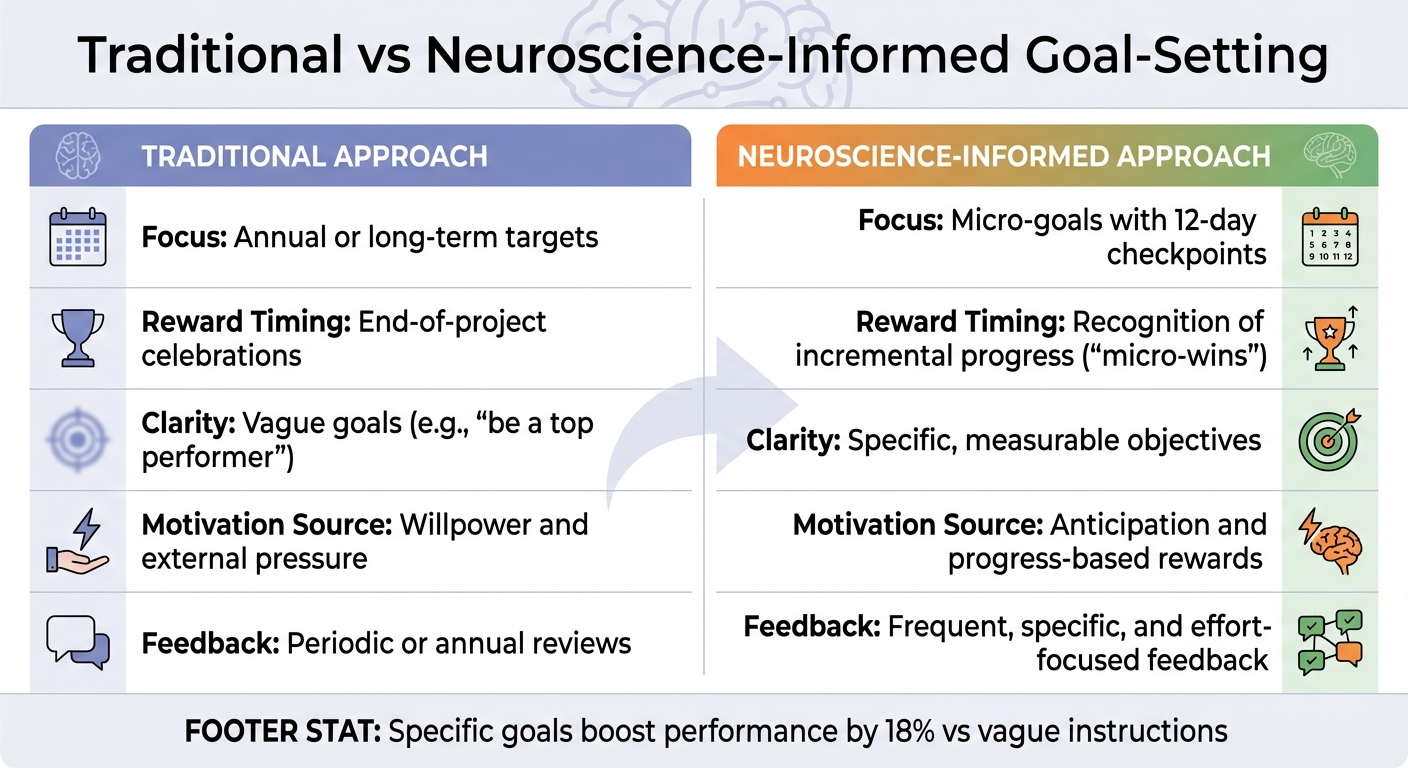
Traditional vs Neuroscience-Informed Goal-Setting Approaches for Leaders
Team leadership, when informed by neuroscience, taps into the brain's natural systems to enhance group performance. The goal is to create environments that align with neural mechanisms, scaling concepts like dopamine-driven motivation, managing cognitive load, and fostering effective habits across a team. Achieving this balance requires careful structuring to maintain both progress and focus.
Using Dopamine to Motivate Teams
Dopamine, often associated with motivation, plays a critical role in sustaining effort and enthusiasm. Interestingly, this neurochemical is most active during the anticipation and pursuit of goals rather than upon their completion. Dr. Sydney Ceruto, Founder & CEO of MindLAB Neuroscience, highlights this dynamic:
"Dopamine is less about pleasure and much more about anticipation; the brain itself is wired to reward progress, optimism, and meaningful effort rather than simply final achievements".
For teams, this means that motivation is better maintained by recognising incremental progress rather than waiting for end-of-project celebrations. Simple practices, such as 12-day checkpoints, can provide regular dopamine boosts. Even small actions, like marking a task as "Completed" on a Kanban board, can trigger this reward system.
However, leaders must also guard against cognitive overload. The prefrontal cortex, responsible for decision-making and focus, has finite resources. Research shows that 78% of executives experience chronic mental fatigue, which can impair judgement. A quick diagnostic involves asking team members to recall their core goals during a meeting; if they struggle, it may indicate their cognitive load is too high.
Providing effort-based feedback, which focuses on recognising persistence and process rather than just outcomes, reinforces motivation over time. For example, starting one-to-one meetings by asking team members to share recent accomplishments can raise dopamine levels and set a positive tone. This type of feedback aligns with the brain's reward systems and fosters sustained engagement.
A potential pitfall, however, is the "dopamine trap" - mistaking busyness for actual progress. Celebrating activity without ensuring it aligns with meaningful goals can lead to teams prioritising new projects over completing existing ones. Leaders should ensure that micro-wins genuinely contribute to broader objectives.
| Feature | Traditional Approach | Neuroscience-Informed Approach |
|---|---|---|
| Focus | Annual or long-term targets | Micro-goals with 12-day checkpoints |
| Reward Timing | End-of-project celebrations | Recognition of incremental progress ("micro-wins") |
| Clarity | Vague goals (e.g., "be a top performer") | Specific, measurable objectives |
| Motivation Source | Willpower and external pressure | Anticipation and progress-based rewards |
| Feedback | Periodic or annual reviews | Frequent, specific, and effort-focused feedback |
Creating Work Environments That Support Brain Function
Beyond motivation, optimising the work environment plays a key role in enhancing team performance. These strategies, grounded in neuroscience, help maintain focus and manage cognitive resources effectively.
Flow states, where individuals achieve deep concentration and peak performance, are particularly valuable. Research suggests that tasks should be calibrated to be about 4% beyond a person's current skill level to maintain engagement without overwhelming them. Assignments that are too easy lead to disengagement, while overly challenging tasks trigger anxiety, shutting down the prefrontal cortex.
Leaders can also preserve their team's cognitive resources through decision batching. This involves grouping routine tasks together and reserving high-energy periods, such as mornings, for complex decision-making. With CEOs reportedly making around 50 high-stakes decisions daily, managing mental energy is crucial.
Environmental adjustments, such as focus zones with minimal distractions and optimal ambient conditions, further support working memory and productivity. Incorporating movement, such as "walk-and-talk" meetings, stimulates dopamine and helps maintain stamina during discussions.
Psychological safety also has a measurable neurochemical impact. Environments that promote fairness and autonomy increase oxytocin levels, which reduce cortisol (the stress hormone) and keep the prefrontal cortex open for creative problem-solving. Teams with high psychological safety report a 53% increase in idea sharing and 22% higher creativity when leaders balance external rewards with opportunities for personal growth. Conversely, elevated cortisol levels can impair decision-making for up to 48 hours following a stressful event.
Simple interventions can help maintain the neurochemical balance needed for clear thinking and consistent performance. For instance, five-minute breathing exercises can reduce cortisol levels by 19%, while structured progress discussions can lower cortisol by up to 34%. These practices create the conditions for teams to function at their best.
For leaders operating in demanding environments, understanding these neuroscience principles is essential. House of Birch, for example, integrates such insights into its leadership advisory services, helping leaders improve decision-making, emotional regulation, and team dynamics. Their tailored frameworks focus on managing cognitive load and enhancing strategic foresight in high-pressure situations.
Finally, leaders can adopt solution-focused questioning to encourage self-insight within their teams. Asking questions that prompt reflection triggers neurotransmitter activity, strengthening neural connections. This approach not only develops team capability but also reduces the leader's decision-making burden, preserving their mental resources for critical moments.
Conclusion: Using Neuroscience to Improve Leadership Performance
Understanding how the brain processes goals can significantly boost leadership effectiveness. Research indicates that setting specific goals enhances performance by over 18% compared to giving vague instructions. Writing those goals down further increases the likelihood of achieving them - from 43% to an impressive 76%. These improvements arise from aligning leadership practices with the natural functioning of the brain, which can distinguish high-performing teams from those that struggle.
Practical application is where these insights truly shine. For instance, breaking annual objectives into smaller, 12-day milestones taps into the brain's dopamine-driven anticipation, maintaining motivation through frequent progress markers. Leaders must also guard against cognitive fatigue, which can impair judgement by as much as 15%. Techniques like decision batching and focusing on solution-oriented questions not only protect mental energy but also empower teams to solve problems independently.
The importance of forming practical habits cannot be overstated. Alfred North Whitehead captured this well when he said:
"Operations of thought are like cavalry charges in a battle - they are strictly limited in number, they require fresh horses, and must only be made at decisive moments".
In high-pressure environments, these principles are indispensable. Leaders who maintain sharp neural focus are shown to make 20% fewer critical errors. Organisations like House of Birch translate these neuroscience insights into tailored leadership strategies, helping executives refine decision-making, emotional control, and strategic thinking. Their bespoke services address the unique cognitive challenges faced by leaders in sectors where precision and performance are non-negotiable.
FAQs
How do I pick the 2–3 goals that matter most?
To identify the 2–3 most important goals, emphasise clarity and prioritisation. Clear and specific goals engage the brain’s prefrontal cortex, which supports strategic decision-making. Focus on objectives that offer the greatest impact or align closely with your core values and long-term aims. Clarity also triggers the brain’s reticular activating system (RAS), enhancing focus and helping to spot relevant opportunities. By concentrating on fewer priorities, you strengthen both motivation and persistence, driving progress towards outcomes that truly matter.
How often should we set milestones to keep motivation high?
The frequency of setting milestones can vary based on the objective and personal preferences, but research in neuroscience underscores the importance of regular, attainable milestones. Dividing larger goals into smaller, manageable steps fosters a sense of progress, which stimulates dopamine release - a key factor in sustaining motivation. Evaluating milestones on a weekly or monthly basis provides an opportunity for reflection, adjustments, and recognising small successes. This approach helps maintain focus and engagement while ensuring the balance between challenge and feasibility.
How can I build goal habits without burning out the team?
To establish effective goal-setting habits while avoiding burnout, consider strategies grounded in neuroscience. Start by setting stretch goals - targets that push boundaries but remain within reach. Ensure goals are clear and focused, avoiding unnecessary complexity. Recognising and celebrating small achievements can stimulate the brain’s reward system, reinforcing motivation.
It’s also essential to align objectives with the team’s capacity, steering clear of overwhelming demands. Incorporate regular feedback to refine goals and maintain balance. This method not only sustains motivation but also helps prevent cognitive strain, encouraging long-term commitment and preserving overall well-being.

