How Neuroscience Explains Intuition in Decisions
Intuition is not magic. In decision-making, it is usually the brain making a fast judgement from past experience, pattern learning, memory and body signals.
For leaders, the research points to three plain ideas:
- Fast judgement can work well when someone has deep experience in a stable setting.
- Stress can distort judgement by narrowing attention and pushing people towards familiar responses.
- A strong gut feeling is not proof. It is better treated as an early signal to check, not a final answer.
The article shows how brain regions linked to value, memory, salience and bodily awareness work together when time is short. It also explains why intuition can be sharp in one case and misleading in another, especially when pressure is high or experience is thin.
The short version: intuition tends to be strongest when it comes from repeated exposure and steady feedback, and weakest when fear, overconfidence or changed conditions get in the way. Leaders may wish to use it as a starting point, then test it with one or two hard questions before acting.
The Science Of Intuition: Interoception & Better Decision Making - Norman Farb
Brain systems that support intuitive judgement
Intuition does not come from a single “gut instinct” centre. It appears to arise from several brain systems working at the same time, each adding something different: value judgements, stored memory, pattern matching, and bodily signals. Under pressure, these systems help turn past experience into fast, partial judgements.
Prefrontal regions and value integration
The orbitofrontal cortex (OFC) and ventromedial prefrontal cortex (vmPFC) play a central part in decision-making when time is short. They help combine value, goals, and prior beliefs, while also factoring in socially charged concerns such as fairness and reputation. In plain terms, these regions compare what is happening now with what a person already believes, then lean towards the signal that seems most reliable.
For a senior leader, that may show up in a hiring or negotiation decision. A candidate may look strong on paper, yet something about the interaction clashes with the decision-maker’s sense of fit or trust. That early judgement is not magic. It may reflect fast value integration shaped by past experience and social cues.
Basal ganglia, hippocampus and learned patterns
The striatum, part of the basal ganglia, supports implicit learning. That means learning that happens through repeated exposure rather than step-by-step reasoning. It also helps produce fast responses under pressure, especially in stable settings with low complexity.
The hippocampus does something different. It stores task-specific declarative knowledge, or knowledge that can be represented mentally and recalled. These stored representations help the brain simulate possible scenarios and judge what looks typical in a given situation.
This matters in day-to-day work. An experienced manager may walk into a board meeting, hear the first few exchanges, and sense that a familiar pattern is developing: perhaps a coalition is forming, or a risk is being downplayed. The person may not yet have a full argument. Still, the judgement can emerge quickly because the brain is matching the scene to stored patterns from past events.
Insula, anterior cingulate and salience detection
The insula tracks interoceptive signals, meaning internal bodily cues such as tension, unease, or calm. It contributes to early feelings of confidence or doubt, often before deliberate analysis starts. The dorsal anterior cingulate cortex (dACC) works with it by monitoring uncertainty and possible error, while also helping regulate responses to fairness and unfairness.
Together, these regions can produce that immediate sense that something is off. They also help the brain rebalance prior beliefs against new sensory input. In a public-facing role, for instance, a spokesperson may sense in the middle of a live interview that a line of questioning is turning hostile before there is time to spell out why. That feeling may reflect salience detection at work rather than simple nerves.
In practice, these systems split the work of fast judgement:
| Brain Region | Decision Function | Type of Intuitive Signal |
|---|---|---|
| Prefrontal (vmPFC/OFC) | Value integration; top-down control; prior beliefs | "This choice aligns with my values or goals." |
| Basal Ganglia (Striatum) | Implicit learning; habit formation; pattern recognition | "This feels automatic or familiar." |
| Hippocampus | Stored mental representations; scenario simulation; typicality recognition | "I recognise this scenario from past experience." |
| Anterior Cingulate (dACC) | Uncertainty monitoring; fairness regulation; error signalling | "Something is wrong or unfair here." |
| Insula | Interoception; feelings of confidence or doubt | "I feel certain or uncertain about this." |
What makes intuition seem smooth is that these systems work in parallel, not one after another. That helps explain why an intuitive judgement can feel complete even when the evidence is thin.
These neural systems also interact with emotion and bodily cues, shaping the conditions in which intuition helps and the moments in which it can mislead.
How emotion and body signals shape intuitive decisions
Emotional arousal and bodily state can sharpen or distort fast judgement. The key point is simple: stress changes how reliably those earlier brain systems combine value, memory and salience.
Somatic markers and interoception
Bodily signals can provide an early read on confidence, threat and fit. This is the felt side of the insula and dACC activity described in the previous section. It is not a separate mechanism. It is the same salience detection, but experienced from the inside. When people notice these signals, judgement can improve. When they suppress them, they may lose information that would have helped them decide.
In practice, this can look quite ordinary. A senior manager may feel a knot in the stomach during a pitch that appears sound on paper. That sensation does not prove the proposal is wrong. But it may signal that something has not been addressed, perhaps a hidden risk, a mismatch with timing, or a gap in trust.
Amygdala-prefrontal interaction under pressure
Under pressure, the relationship between the amygdala and the prefrontal cortex becomes central. The amygdala can narrow attention and push people back towards familiar responses. In organisations, that can restrict information flow and pull control into the centre. When unresolved emotional patterns hijack the prefrontal cortex under stress, executives can be left unable to think clearly. The result can be decision paralysis.
Recent replications find little support for “decision fatigue”. Acute stress, rather than depleted willpower, is what most reliably impairs judgement under pressure. That is an important distinction. It shifts the focus from rationing decisions to managing the stress response itself.
Intensity, then, is not proof of accuracy.
When a gut feeling is a signal and when it is noise
Not every strong feeling is informative. The brain can mistake familiarity for insight, especially when priming or prior exposure makes a pattern feel true. Intelligence does not prevent bias. If anything, it can make rationalisation look more polished and harder to spot.
| Condition | Valid Intuition (Signal) | Emotional Noise |
|---|---|---|
| Source | Expertise and repeated exposure to patterns | Priming, familiarity, or emotional intensity |
| Emotional state | Regulated arousal; calm under pressure | High intensity, acute stress, or decision paralysis |
| Cognitive effect | Efficient forecasting and scenario evaluation | Narrowing of attention and reduced cognitive flexibility |
| Reliability | High in stable environments or areas of deep expertise | Low under conditions of fatigue, fear bias, or social risk |
For leaders, the practical move is not to distrust every gut feeling. It is to treat a strong emotional pull as a cue to test the decision rather than commit on impulse. A disconfirming check matters here: what evidence would show the instinct is wrong?
The next section looks at how repeated exposure and prediction help produce these fast judgements.
sbb-itb-ce676ec
Intuition as implicit learning and predictive processing
Implicit learning and predictive processing help explain how experience becomes fast judgement. One tells the story of storage; the other explains use under pressure. In plain terms, the brain picks up patterns over time, then leans on those patterns when a decision has to be made fast.
Implicit learning from repeated exposure
The brain can learn regularities without direct teaching. Implicit learning refers to the non-conscious extraction of patterns through repeated exposure. A person may not be able to state the rule out loud, yet still act on it. After enough exposure, they may simply sense that something is off, or that something fits, even if they cannot explain why.
This is especially relevant when cues are faint, social, or hard to describe. In a meeting, for example, a manager may notice a shift in tone, hesitation, or timing long before turning that impression into words. Repeated exposure leaves a usable trace, even when no rule was ever stated. Intuition formed this way is best understood as a compressed read-out of stored evidence.
Predictive processing and fast scenario evaluation
If implicit learning explains how patterns are stored, predictive processing explains how the brain puts them to work in real time. The brain does not sit back and wait for full sensory input before reaching a view. It forms expectations first, then checks those expectations against incoming signals and updates them as needed.
That helps explain why experienced leaders can size up situations so fast. By the time a discussion is fully under way, the brain has often already run a rough version of the scenario using its internal model. What feels like instant judgement is, in effect, the output of a continuous and largely unconscious forecasting process.
Predictive processing also sheds light on emotional intuition. The brain predicts internal bodily states, including heart rate and blood pressure, and those predictions can appear as valence - a felt sense that something seems good or bad, safe or risky. That account fits closely with body-based signals discussed earlier, where a judgement may first appear as tension, ease, or unease rather than a clear thought.
What these models explain best
Taken together, these models help explain why the same intuitive response can be sharp in one setting and misleading in another. Implicit learning points to where the pattern came from; predictive processing shows how the brain applies it in the moment. Both can go wrong when experience is limited, when the setting has changed, or when old patterns no longer match current demands.
For leaders, that distinction matters. A fast judgement may reflect deep experience. It may also reflect bias dressed up as certainty. The task is not to dismiss intuition, but to judge when it rests on learned pattern recognition and when it may be running ahead of the evidence.
What the research means for high-stakes leadership decisions
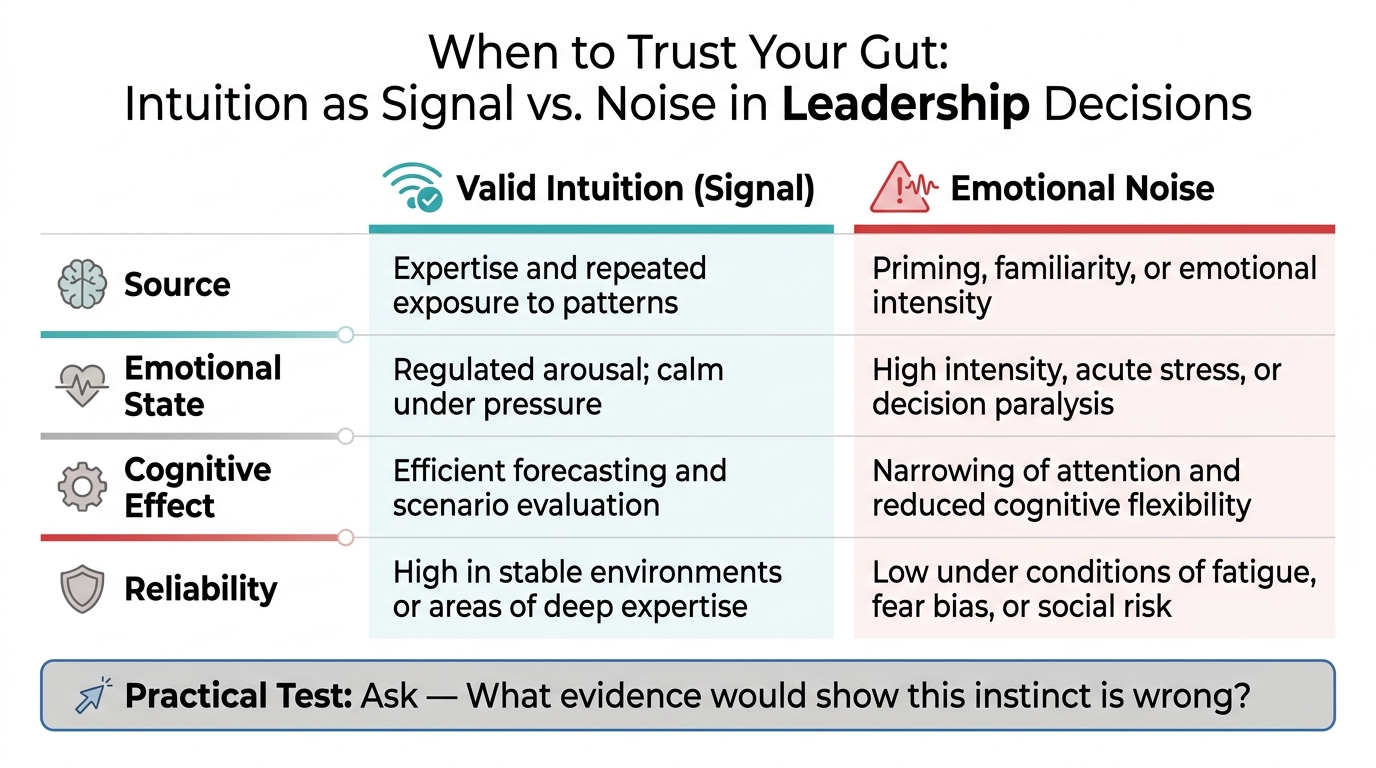
When to Trust Your Gut: Intuition as Signal vs. Noise in Leadership Decisions
The main issue for leaders is not whether intuition works. It is when it can be trusted, and when stress, bias or thin experience make it shaky. The processes discussed earlier - pattern recognition, value integration and somatic signalling - do not perform the same way in every setting. Their usefulness depends heavily on context.
Where intuition tends to be most reliable
Intuitive judgement tends to work best when it rests on deep domain experience. If a leader has spent years in one field and has seen similar situations again and again, the brain can draw on patterns and heuristics to move fast without much conscious effort. In plain terms, this is the sort of judgement that can look like instinct from the outside, but is often built on long exposure and repeated feedback.
Research on small and medium-sized enterprises reported a statistically significant positive link between an intuitive decision style and both current and later financial performance. That does not mean instinct is magic, or that it beats analysis in every case. It does suggest that, in familiar terrain, experienced leaders may spot signals early and act before a slower process catches up.
A managing director who has led pricing discussions for a decade may sense within minutes that a deal is drifting off course. That reaction can stem from many earlier encounters with similar client behaviour, margin pressure and negotiation patterns, rather than from guesswork alone.
Where intuition is most vulnerable to bias
The picture changes when pressure rises, the setting is new, or the social stakes are high. The same fast pattern-matching that helps in familiar situations can become brittle. Under acute stress, leaders may slip into threat rigidity - a well-studied response in which people narrow the information they take in and pull control towards the centre. That can feel decisive in the moment, but it may leave a team blind to other options.
There is another wrinkle. High intelligence does not protect people from bias. In some cases, it can help them defend a view they already want to hold. Research on motivated reasoning suggests that bright people may become better at justifying pre-formed conclusions, not better at questioning them. That is why strong certainty should often act as a warning sign. If a leader feels unusually sure, that may be the point to slow down, not speed up.
A senior executive facing a public board decision may interpret unease as a cue to clamp down, ask for less dissent and back the first answer that feels clean. The behaviour can look calm and firm, while the decision process underneath has become narrower.
Applied leadership development and conclusion
A useful way to treat intuition is as a hypothesis, not a verdict. When a strong hunch appears, the better question is not simply whether to trust it. It is where it came from, what experience may be feeding it, and whether the available evidence points in the same direction. Asking “What would make this fail?” is one practical way to test pattern recognition against reality without dragging out the decision process.
Emotional cues matter as well. In high-stakes settings, discomfort, tension or unease are often pushed aside in the name of composure. The research points in a different direction: leaders may think more clearly when they process those signals and treat them as data rather than noise. That does not mean every feeling is right. It means feelings can flag issues that deserve inspection.
Taken together, the evidence suggests that intuition is shaped by identifiable neural and emotional processes. It tends to improve with experience, weaken under poorly managed stress, and serve leaders best when paired with disciplined analysis in weighty decisions. Leaders may wish to reflect on whether their current decision routines do enough to separate seasoned judgement from pressured certainty.
FAQs
Can intuition be trained?
Yes. Intuition can be trained.
Research in psychology and neuroscience suggests that intuition is not a fixed gift that some people simply have and others do not. It is better understood as the brain’s automatic pattern-recognition system: a fast, often non-conscious way of drawing on past experience, emotional cues and learned associations.
That matters for leaders, because intuitive judgement is often treated as either magic or guesswork. In practice, it is neither. It tends to work best when a person has deep experience in a given setting and has learned to read both the situation and their own internal signals with some accuracy.
Emotional awareness plays a central part here. Studies in decision-making and organisational behaviour indicate that people who can identify and interpret their emotional responses are often better placed to use those responses well, rather than being pushed around by them. A senior manager, for example, may notice a feeling of unease during a deal discussion. That feeling does not prove the deal is bad. But it can act as a prompt to slow down, ask sharper questions and test whether something in the room is being missed.
By building that kind of emotional awareness and folding it into decision-making, people can sharpen strategic judgement and improve the accuracy of intuitive signals.
How can I test a gut feeling quickly?
Pause and examine the source of that certainty. When a decision feels instantly right or wrong, the first impression may reflect pattern recognition rather than a clear reading of the situation.
A more useful test is to ask: what, exactly, does this resemble? Is the response tied to evidence, or to the force of the feeling itself? When the stakes seem hard to judge, it may help to consider whether a preferred story is shaping the interpretation, or whether the impulse is less about values and more about avoiding discomfort.
Why does stress make intuition less reliable?
Stress can make intuition less reliable because it sets off automatic physical and mental responses that can override judgement. Under pressure, the brain often moves away from careful, strategic thought and towards blunt shortcuts or familiar habits.
In practice, that matters. A senior manager facing a tense board discussion may feel a strong “gut sense” to shut down debate or back the safest option, not because it is the best call, but because stress has narrowed attention and pushed the mind towards habit.
Short bursts of stress can also disrupt normal brain function, which makes clear thinking harder. As House of Birch recognises, if an internal regulatory system cannot hold under day-to-day pressure, sound intuitive judgement can start to give way.

