Micro-Behaviours Shaping Leadership Presence
Leadership presence is built on small, consistent actions. These micro-behaviours - like steady eye contact, a calm tone, and composed posture - shape how others perceive a leader’s authority and reliability. Research shows that 89% of leadership failures stem from interpersonal skill gaps, not technical expertise. This highlights the importance of subtle, non-verbal cues in high-pressure situations, such as crisis management or negotiations.
Key insights include:
- Micro-behaviours: Unconscious actions (e.g., pauses in speech, body language) that influence trust and confidence.
- Non-verbal signals: Gestures and tone impact how teams interpret leadership intentions.
- Consistency matters: Predictable behaviours align teams and build long-term trust.
- Calm under pressure: Leaders who regulate emotions stabilise team responses.
Small, deliberate changes - like pausing before responding or maintaining eye contact - can significantly improve leadership presence. Organisations should reflect on how these behaviours influence team dynamics and trust.
Research Findings: Behavioural Psychology and Neuroscience
How Micro-Behaviours Influence Leadership Presence
Leadership presence is closely tied to the subtle interplay of micro-behaviours during interactions. A 2026 study involving 158 participants highlighted that interactional synchrony and behaviour matching are strong indicators of rapport between individuals.
"Interpersonal coordination... is defined as 'the degree to which the behaviors in an interaction are non-random, patterned, or synchronized in both timing and form'." - Bernieri & Rosenthal
When leaders unconsciously align their rhythms, gestures, or posture with those of their team members, they send powerful relational signals. These micro-behaviours, deeply embedded in human social instincts, foster a sense of mutual attentiveness and connection.
The Role of Non-Verbal Communication
Expanding on the concept of behavioural coordination, non-verbal communication plays an equally critical role in shaping leadership presence. Neuroscience shows that non-verbal cues - processed in parts of the brain such as the orbitofrontal cortex and the limbic system - heavily influence how others perceive a leader. When a leader's body language and verbal communication are misaligned, it creates a disconnect that can erode trust and credibility.
The choice of gestures is particularly impactful. Studies reveal that interactive gestures, such as open-handed movements or deliberate pointing, enhance inter-brain synchronisation between leaders and their teams. This synchronisation has been positively associated with team creativity, showing correlations with originality (r = 0.513) and creative fluency (r = 0.439) in group settings. On the other hand, self-directed gestures - those used for personal cognitive processing - do not contribute to group cohesion in the same way.
Managing Cognitive Load for Consistent Micro-Behaviours
The ability to maintain consistent micro-behaviours under pressure is also influenced by a leader's cognitive load. Research indicates a strong negative correlation (−0.787) between leadership experience and cognitive load, suggesting that seasoned leaders are more adept at staying composed and deliberate in high-pressure situations.
"Seasoned leaders exhibit superior capabilities in managing cognitive load during complex decision-making scenarios and proposes physiological arousal as a potential indicator of cognitive load during leadership decision-making tasks." - Arnisa Aliqkaj and Ruben Carvajal
Physiological indicators, such as elevated skin conductance measured through Galvanic Skin Response, can signal when cognitive load begins to interfere with a leader's behaviour. By recognising these internal cues and consciously shifting towards analytical thinking during critical moments, leaders can maintain the steady micro-behaviours that are essential for a confident and commanding presence. These findings underscore the intricate role of micro-behaviours in reinforcing effective leadership.
sbb-itb-ce676ec
Key Micro-Behaviours That Build Leadership Presence
Eye Contact and Gaze Stability
Steady eye contact is a subtle yet powerful way to project confidence. Research shows that people process eye contact quickly, associating it with trust and assurance. On the other hand, an evasive or inconsistent gaze can quietly diminish a leader's credibility, even when their words are well-chosen.
"Confidence is reinforced through body language and tone: maintaining eye contact, actively listening, and communicating clearly all convey assurance and authority without overstatement." - MIT Sloan Executive Education
Listening Posture and Managing Interruptions
The way a leader listens can leave as lasting an impression as their words. Facing forward with an open posture signals genuine interest and attentiveness. Asking thoughtful, forward-focused questions demonstrates a commitment to collaboration rather than control. As highlighted by MIT Sloan Executive Education, executive presence is rooted in building trust rather than asserting dominance. Interruptions, however, can quickly erode that trust, making it harder to regain during the same interaction. A leadership presence that prioritises active listening strengthens team cohesion and mutual respect.
Voice Modulation: Pace, Volume, and Cadence
A leader's voice conveys more than just words - it carries emotional cues that influence how their message is received. Speaking too quickly can come across as nervousness, while speaking too slowly risks losing the audience’s attention. Striking the right balance with deliberate pacing, controlled volume, and a steady cadence creates an impression of poise and clarity. When paired with effective non-verbal communication, these vocal techniques help establish a strong, authoritative presence.
Acknowledgment and Reflective Language
Taking a moment to reflect on and acknowledge a speaker's point before responding demonstrates genuine engagement. This small habit fosters trust over time, as it shows team members that their input is valued. Regularly recognising contributions helps to create an inclusive environment where individuals feel heard. By using reflective language, leaders reinforce the sense of mutual respect and collaboration within their teams.
Calm Responses Under Pressure
A leader’s ability to remain composed during high-stakes situations is critical. Calmness under pressure not only enhances their credibility but also has a stabilising effect on the team. Dr Kinga Mnich, PhD, explains:
"Your nervous system either escalates or de-escalates the collective stress response. Emotionally regulated leaders can reduce their team's cortisol levels significantly during high-pressure situations." - Dr. Kinga Mnich, PhD
Teams instinctively look to their leaders for cues about how to respond to challenges. A measured, steady reaction can reassure the group and maintain focus, even in tense moments. One of the simplest yet most impactful tools a leader can use is a deliberate pause before responding, allowing both themselves and their team to regain composure and clarity. This habit, while often overlooked, is a cornerstone of effective leadership behaviour during crises.
How Micro-Behaviours Affect Team Dynamics
Building Psychological Safety Through Relational Signals
Psychological safety within teams often stems from the subtle, consistent signals leaders send through their daily actions. For instance, when leaders openly admit mistakes, share vital information, and align their behaviours with their stated values, they foster an environment where team members feel secure and valued.
"Relational transparency means to share honestly and openly. This includes admitting mistakes and being clear with your team while staying true to your values." - Dr Kinga Mnich, Leadership Development Expert
These everyday actions, often expressed through micro-behaviours, create a sense of predictability and fairness. This, in turn, encourages team members to engage more fully, knowing they are operating in a safe and supportive environment.
How Teams Read Micro-Behaviours
A leader’s every move is under constant observation by their team. The brain’s amygdala - the part responsible for processing emotions - reacts to non-verbal cues like posture, facial expressions, and tone of voice in milliseconds. These snap judgements significantly influence whether team members perceive their leader as trustworthy and approachable. This perception directly impacts how openly team members communicate concerns and how committed they feel to their work.
The table below illustrates how specific leadership behaviours can shape team dynamics:
| If a leader… | Team members… | Resulting outcome |
|---|---|---|
| Listens well | Are more honest | Improved transparency |
| Asks questions with interest | Reveal the real issues | Faster problem resolution |
| Includes people | Share more | Higher collaboration |
| Inspires people | Generate more ideas | Increased innovation |
| Shouts people down | Feel afraid and withdraw | Stifled creativity |
These micro-behaviours don’t just influence individual interactions; they have a ripple effect across the team. When leaders demonstrate curiosity, compassion, and openness, these behaviours set a positive tone that spreads throughout the group. Conversely, dismissive or reactive actions can create a toxic cycle, eroding trust and collaboration. The predictability of these micro-behaviours plays a crucial role in reinforcing team trust.
Micro-Behaviours and Predictability in Leadership
Beyond the immediate impact of micro-behaviours, a leader’s consistency in actions is key to building long-term trust. Predictable behaviour - where words and actions align consistently - reduces uncertainty and reassures teams. This reliability allows team members to focus on their work without the distraction of second-guessing their leader’s intentions.
"People… don't follow what they can't see put in action." - Nisaa Hawa, Political Correspondent, Immigration Advice Service
Inconsistencies, even in minor actions, can quietly undermine a leader’s credibility. For example, a leader who advocates for openness but dismisses dissenting opinions sends mixed signals that can erode trust over time. It is the steady, dependable alignment of words and actions that ultimately strengthens a leader’s reputation and fosters a cohesive, high-performing team.
5 Everyday Micro Behaviors That Instantly Boost Your Credibility
Assessing and Applying Micro-Behaviours in Leadership Practice
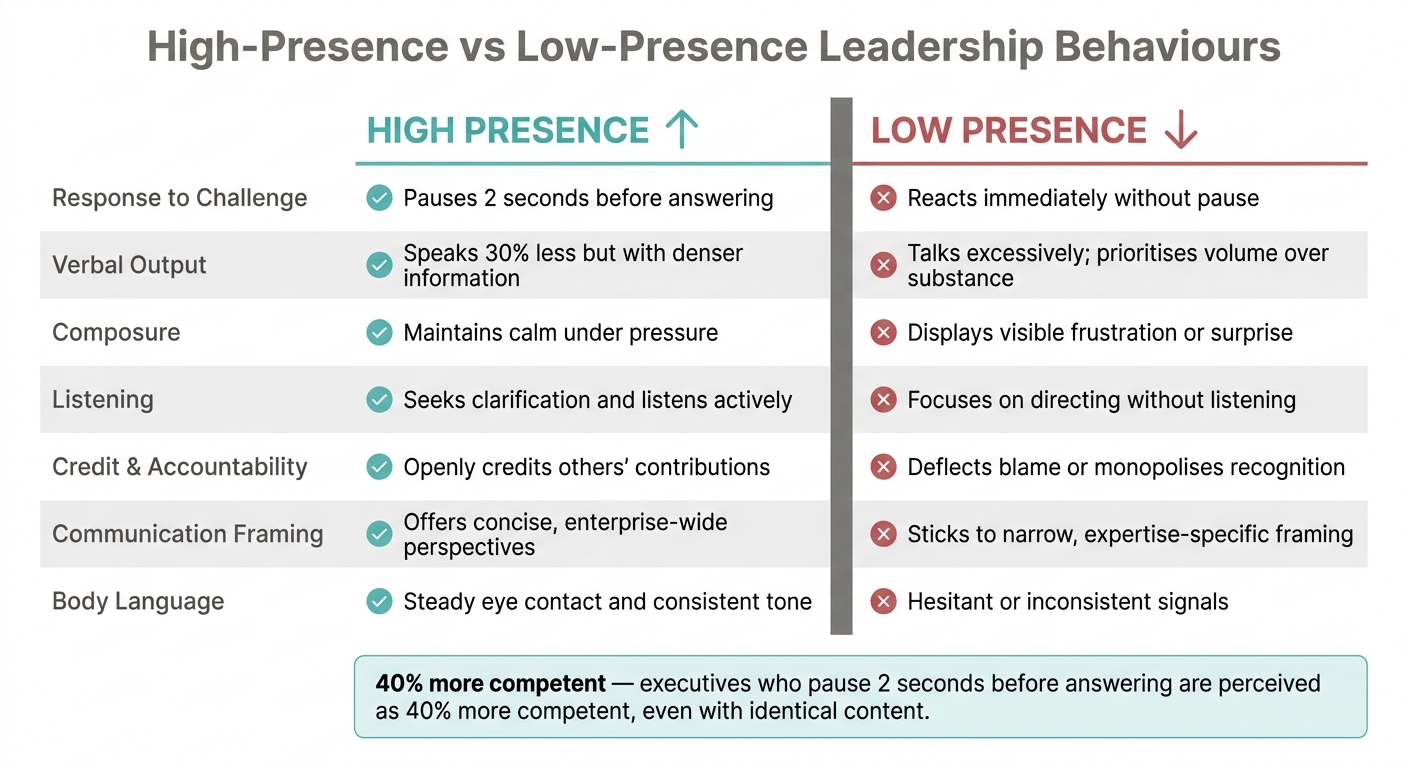
High-Presence vs Low-Presence Leadership Behaviours
This section delves into how leaders can evaluate and refine micro-behaviours - those subtle actions that significantly influence leadership presence.
How to Assess Micro-Behaviours in Leaders
Identifying which micro-behaviours enhance or undermine a leader's presence demands a structured approach. A reliable method is multi-source feedback, which gathers input from peers, direct reports, and senior stakeholders. This approach helps determine whether a leader's behaviour remains consistent across various settings. For instance, discrepancies between how a leader acts in formal meetings versus one-on-one interactions can pinpoint areas for improvement.
Another effective tool is video analysis of rehearsals for critical presentations. This process can highlight unnoticed habits, such as overusing filler words, inconsistent pacing, or vocal hesitations. AI-driven tools are particularly adept at clustering these behaviours into categories like vocal authority, composure, and brevity.
Even written communication provides valuable insights. Examining emails for clarity and brevity can reveal whether a leader's strategic thinking is being communicated effectively or lost in overly complex language.
Once gaps in micro-behaviours are identified, targeted strategies can help leaders make meaningful improvements.
Practical Steps for Behavioural Development
With assessment insights in hand, leaders can work on refining their micro-behaviours through deliberate practice.
"This approach adds specific, practised behaviours to your existing repertoire." - SpeechMirror
One evidence-based technique is the Three-Beat Response Protocol: take a breath, make deliberate eye contact, and then speak. This method engages the prefrontal cortex, fostering calm and thoughtful responses instead of reactive ones. Research highlights that executives who pause for two seconds before answering difficult questions are perceived as 40% more competent than those who respond immediately, even when the content of their answers is identical.
Another critical practice is strategic brevity. Leaders who reduce their speaking time by about 30% in group settings but deliver more concise, information-rich messages are often seen as having a stronger presence. Interestingly, speaking too much can sometimes signal nervousness rather than confidence. To practise these adjustments, leaders can use low-stakes environments, such as peer feedback sessions or executive workshops, before applying them in high-pressure situations.
High-Presence vs Low-Presence Behaviours: A Comparison
The table below outlines the key differences between behaviours that project high versus low leadership presence.
| Behaviour Area | High-Presence | Low-Presence |
|---|---|---|
| Response to challenge | Pauses for 2 seconds before answering | Reacts immediately without pause |
| Verbal output | Speaks 30% less but with denser information | Talks excessively; prioritises volume over substance |
| Composure | Maintains calm under pressure | Displays visible frustration or surprise |
| Listening | Seeks clarification and listens actively | Focuses on directing without listening |
| Credit and accountability | Openly credits others’ contributions | Deflects blame or monopolises recognition |
| Communication framing | Offers concise, enterprise-wide perspectives | Sticks to narrow, expertise-specific framing |
| Body language | Maintains steady eye contact and consistent tone | Displays hesitant or inconsistent signals |
Shifting from low- to high-presence behaviours doesn’t require a complete personality shift. Instead, it involves practising specific, measurable actions until they become second nature. By focusing on these micro-adjustments, leaders can enhance their presence without losing their authenticity.
House of Birch: Developing Leadership Presence Through Micro-Behaviours
Micro-Behaviour Analysis in Advisory Practice
Spotting micro-behaviours that can be adjusted is just the beginning; the real challenge lies in ensuring these changes stick, especially under pressure. House of Birch integrates micro-behaviour analysis into its advisory work by treating these behavioural nuances as quantifiable data rather than subjective impressions. This approach involves closely observing how leaders react when faced with challenges, their level of attentiveness in conversations, and the subtleties of unspoken communication - all of which can subtly erode a leader's authority if left unchecked. By meticulously tracking these patterns, House of Birch identifies blind spots that leaders might overlook through self-assessment alone. These insights form the basis for development plans tailored to each leader's needs.
Bespoke Development for High-Stakes Leaders
House of Birch collaborates with leaders operating in high-pressure environments across a variety of sectors and regions. For these individuals, mistakes come with hefty costs, and a weakened presence can have far-reaching implications. The advisory process is discreet and customised, avoiding one-size-fits-all solutions. By leveraging data from micro-behaviour analysis, House of Birch designs interventions that address the specific challenges leaders face. Key areas of focus include decision-making, emotional regulation, and social influence - all tied to the micro-behaviours that carry the most weight in critical situations. For instance, leaders who consistently acknowledge team contributions, own up to mistakes, and adapt calmly are often perceived as more credible and effective by their teams. These are skills that can be developed and honed through structured guidance.
"Leadership... is about influencing, developing, coaching, guiding and inspiring others." - Personio
The tailored nature of these programmes not only sharpens these behaviours but also delivers meaningful improvements in leadership effectiveness.
The Benefits of Mastering Micro-Behaviours
The power of mastering micro-behaviours lies in the ripple effect of small, deliberate actions performed consistently. Johanna Beresford, Founder of FabricShift, emphasises this point:
"Leadership is not defined by the courses people attend, but by the behaviours they practise repeatedly when it matters most." - Johanna Beresford, Founder of FabricShift
When such behaviours become second nature, leaders are better equipped to make sound decisions under stress, exude a calmness that mitigates team burnout, and build trust within their organisations - trust that can enhance both performance and risk management. Furthermore, prioritising open communication, practising active listening, and delivering clear feedback are considered pivotal, accounting for nearly 90% of what it takes to lead effectively.
Conclusion: The Power of Micro-Behaviours in Leadership
Leadership presence is not defined by grand gestures but by subtle, consistent behaviours that influence how leaders are perceived and trusted. These micro-actions, grounded in behavioural and neuroscientific insights, shape impressions moment by moment, forming the foundation of leadership effectiveness.
Consistency plays a pivotal role. As highlighted by MIT Sloan Executive Education, "Consistency matters: colleagues begin to associate a leader's presence with sound judgment, steadiness, and clarity of thought." Over time, this reliability becomes the cornerstone of a leader's reputation.
However, negative micro-behaviours can extend beyond individual relationships, creating broader repercussions. Nisaa Hawa, Political Correspondent at Immigration Advice Service, explains, "Essentially, employees who do not receive safety from leaders are highly likely to express their views on other platforms... the impact of unhealthy behavioural treatment can form a repeat pattern of fear in the minds of your people." This underscores how seemingly small actions can significantly affect organisational culture and trust.
FAQs
Which micro-behaviours most affect leadership presence?
Micro-behaviours that play a crucial role in shaping leadership presence often originate from underlying psychological factors. Examples include displaying self-efficacy, managing emotional contagion, and conveying cognitive authority. Leaders who can regulate their emotions under stress, exhibit authentic confidence through subtle cues like micro-expressions and posture, and remain firmly anchored in their core values tend to build trust and exert influence effectively. These nuanced actions help leaders form meaningful connections, strengthening their presence and capacity to motivate others.
How can I stay calm and consistent under pressure?
To remain steady and composed under pressure, concentrate on cultivating micro-behaviours that support emotional control and resilience. These include practising self-awareness, staying composed in difficult moments, and aligning your actions with your core values.
In addition, employing proactive communication and emotional regulation strategies can help you handle stress effectively. Creating an environment of psychological safety within your team encourages open conversations, which can ease tension and enable you to respond to challenges with greater clarity and calmness.
How can I objectively assess my micro-behaviours?
To evaluate your micro-behaviours with precision, concentrate on observable actions such as your tone of voice, ability to stay calm in high-pressure moments, and how succinctly you convey information. Recording yourself during practice situations, like mock presentations, can be particularly useful. Pay attention to elements such as intentional pauses, consistent pacing, and clear articulation. Through regular self-assessment and focused practice, you can fine-tune these behaviours, providing a tangible way to enhance your leadership presence.

