How Leadership Navigates Organisational Politics
Organisational politics is an unavoidable reality in the workplace. For leaders, understanding and managing these informal power dynamics is essential to achieving goals, building influence, and maintaining authority. This article explores how leaders can assess political environments, identify key stakeholders, and develop the skills needed to navigate complex organisational landscapes effectively. It also highlights practical strategies, such as stakeholder mapping, managing informal networks, and balancing authority with trust, to help leaders succeed in politically charged environments.
Key insights include:
- Organisational politics shapes decisions and outcomes beyond formal structures.
- Leaders must assess informal networks, cultural norms, and hidden power centres.
- Political awareness is a critical skill for aligning teams and avoiding leadership pitfalls.
- Practical tools like stakeholder maps and POWER frameworks can clarify influence dynamics.
- Emotional discipline and strategic thinking enable leaders to respond effectively under pressure.
Office Politics - 6 Crucial Ways To Successfully Navigate Workplace Politics
sbb-itb-ce676ec
Assessing the Political Landscape
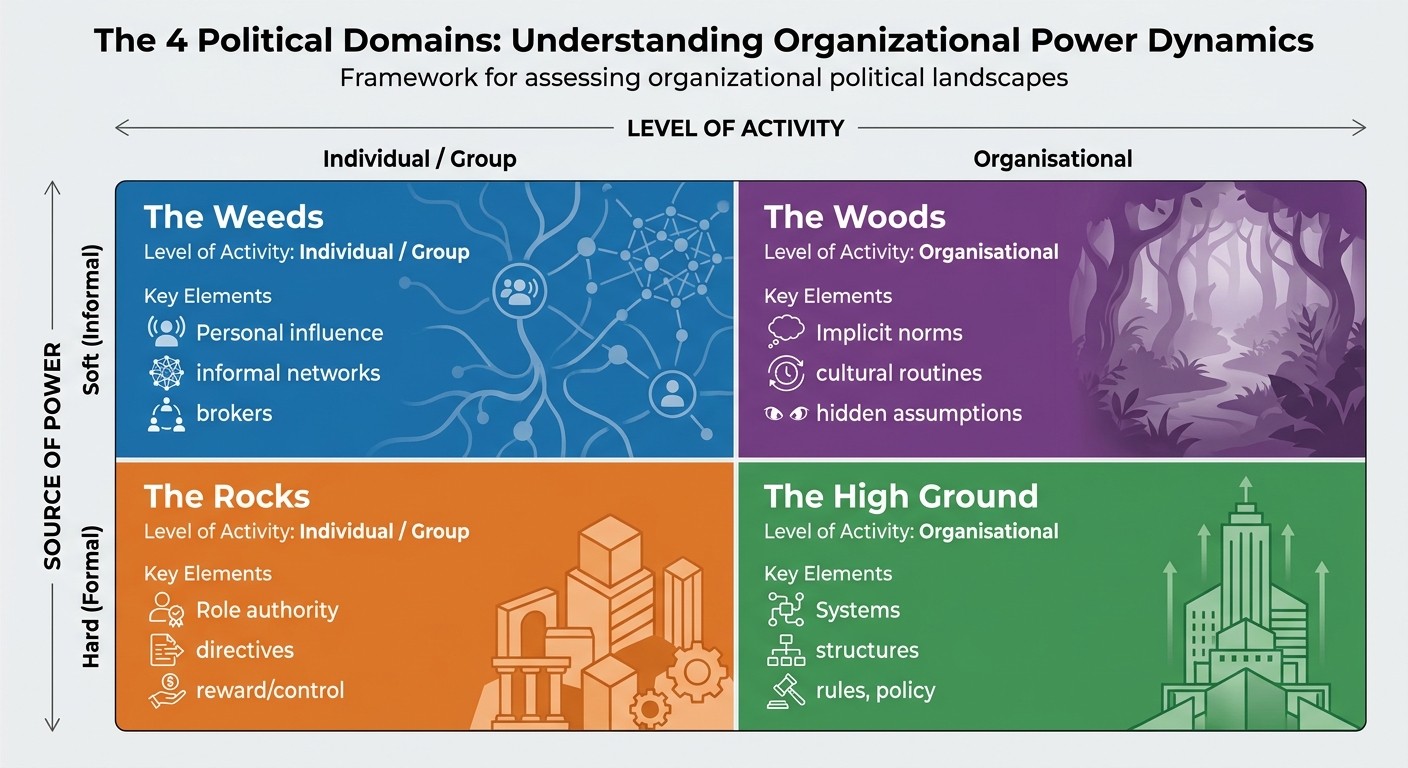
The 4 Political Domains Framework for Organizational Leadership
Understanding organisational politics begins with a careful assessment of the environment. Leaders must evaluate both the levels of activity and the sources of power within their organisations. Without this foundational understanding, even experienced leaders may misinterpret where influence lies or how decisions are made.
The political landscape is rarely straightforward. While formal structures like organisational charts provide a basic outline, much of the real activity happens in informal spaces. As Andy J. Yap, Associate Professor of Organisational Behaviour at INSEAD, aptly puts it:
"Power resides where men believe it resides".
This insight underscores the importance of looking beyond official titles to uncover the informal networks and cultural norms that often dictate how work is accomplished. A thorough understanding of these dynamics is essential for navigating the four key political domains.
Mapping the 4 Political Domains
Organisational politics can be divided into four distinct domains, each requiring a tailored approach:
- The Weeds: This domain is driven by personal relationships and informal networks. Influence here depends on social capital, with key brokers - those who connect different teams or individuals - holding significant sway, regardless of their formal roles.
- The Rocks: In this domain, power is tied to formal authority and role-based control. Leaders exert influence through directives, control mechanisms, or reward systems. However, an overreliance on this approach can lead to rigid, authoritarian leadership that stifles creativity.
- The High Ground: Combining formal authority with structured organisational systems, this domain relies on policies, governance frameworks, and official processes. While these structures provide stability, they can also hinder progress if applied too rigidly.
- The Woods: This domain is shaped by unwritten rules, cultural assumptions, and implicit norms. These invisible forces often have a stronger impact on behaviour than formal policies, yet they can be difficult to identify for those embedded in the organisation.
| Political Domain | Level of Activity | Source of Power | Key Elements |
|---|---|---|---|
| The Weeds | Individual / Group | Soft (Informal) | Personal influence, informal networks, brokers |
| The Rocks | Individual / Group | Hard (Formal) | Role authority, directives, reward/control |
| The High Ground | Organisational | Hard (Formal) | Systems, structures, rules, policy |
| The Woods | Organisational | Soft (Informal) | Implicit norms, cultural routines, hidden assumptions |
Identifying Stakeholders and Power Centres
The dynamics of organisational politics are always shaped by specific goals. Whether the aim is a promotion, strategic change, or crisis management, leaders must identify the key players relevant to their objective. Importantly, organisational charts alone cannot reveal the true centres of influence.
Consider the example of Victor, a project leader at a consultancy firm. In June 2020, Victor successfully navigated a partnership vote by leveraging informal networks. He recognised that the Head of HR, despite lacking voting authority, had significant social capital. Additionally, he identified a power imbalance between banking and oil & gas partners, which allowed him to form a coalition that ultimately secured his promotion.
To navigate such dynamics, leaders can use a POWER map, which involves:
- Players: Identifying everyone who can impact the goal.
- Objectives: Understanding what each player aims to achieve.
- Weight: Assessing the extent of each player's influence.
- Enemies and allies: Determining who supports or opposes your goals.
- Relationships: Mapping connections between players.
Visual tools such as colour coding (e.g., green for allies, amber for neutral, red for opponents) and line thickness to indicate relationship strength can make these dynamics clearer. This approach mirrors advice on safeguarding team priorities through strategic alliances.
Influence is not always tied to seniority. It can arise from proximity to decision-makers, specialised expertise, or the ability to bridge disconnected groups. For example, executive assistants with access to senior leaders, technical experts with niche knowledge, or individuals with broad networks often wield significant influence, even without formal authority.
By creating a detailed stakeholder map, leaders can uncover the informal networks that drive decision-making within their organisations.
Recognising Informal Networks
To identify hidden routines and norms, leaders should ask questions that challenge the status quo. Fresh perspectives - whether from new hires, contractors, or external clients - can also help uncover patterns that long-time employees might overlook.
One striking example comes from a public agency that bypassed slow bureaucratic processes by forming a task force. This team operated outside formal structures, enabling them to recover millions in lost tax revenues. Within two years, they reduced revenue losses by 50% and achieved a 95% recovery rate, prompting the agency to revise its official processes to reflect the task force's methods.
Leaders should also observe patterns of exclusion. Noticing who is consistently left out of informal discussions, brainstorming sessions, or social gatherings can reveal hidden power structures and bottlenecks. Once identified, leaders can either bridge these gaps themselves or collaborate with established brokers to enhance their influence.
Building Core Political Skills
In today’s complex environments, leaders must refine their political skills, which include navigating power dynamics, maintaining emotional discipline, and cultivating strategic intelligence. These abilities equip leaders to act with clarity, self-control, and connection - key elements for wielding influence in high-pressure scenarios.
Understanding Power Dynamics
The most effective leaders strike a balance between formal authority and relational trust. This means combining their positional power with the ability to foster alliances and build rapport. By blending assertiveness with authenticity, leaders can command respect while maintaining trust, enabling them to lead decisively without alienating others.
Developing Emotional Discipline
Political challenges often provoke instinctive emotional reactions, but leaders who respond impulsively risk damaging their credibility. Instead, engaging higher-order thinking allows for measured, thoughtful responses. Staying composed under pressure - whether during investor crises, major organisational changes, or internal disputes - is a critical skill. As House of Birch puts it:
"Control: Emotional discipline, composure, and command in high-stakes environments".
This level of self-regulation not only preserves a leader’s influence but also strengthens their ability to guide others through turbulent times.
Strengthening Intelligence and Foresight
Political intelligence involves understanding both the visible structures of power and the hidden, informal networks that drive decision-making. Leaders must also pay attention to non-verbal signals, such as body language and eye contact, to gauge the true dynamics at play. Testing ideas with influential stakeholders helps to refine strategies while securing buy-in. As Jeffrey Pfeffer aptly states:
"What differentiates people is their political skill and savvy".
Leaders who develop this foresight are better equipped to anticipate shifts in their environment and prepare contingency plans for unexpected developments. Leadership consultancies, like House of Birch, emphasise the importance of tailored approaches to navigating these challenges in high-stakes settings.
Mastering these political skills provides leaders with the tools to effectively steer organisational dynamics and maintain influence in even the most challenging environments.
Practical Strategies for Navigating Organisational Politics
Building on a solid understanding of political skills, leaders can employ practical strategies to navigate and influence internal power dynamics. Once they grasp the underlying dynamics and cultivate emotional discipline, they can focus on actionable methods to redirect unproductive behaviour, foster cross-team alliances, and adapt their approach to each unique scenario.
Redirecting Dysfunctional Authority
Dealing with dysfunctional authority - particularly in environments where formal power dominates - requires a subtle approach. Direct confrontation rarely yields results. Instead, leaders should focus on reframing their proposals to align with what matters most to the authority figure, such as their professional legacy, reputation, or critical performance metrics.
Michael Jarrett, Senior Affiliate Professor of Organisational Behaviour at INSEAD, advises:
"Your best bet is to redirect the energy of a dysfunctional leader, either through reasoned argument or by appealing to their interests".
This approach involves using stakeholder maps to identify key psychological drivers, ensuring that proposals resonate with the outcomes stakeholders prioritise. Additionally, external feedback, such as data from clients or end-users, can serve as objective evidence to highlight inefficiencies in current processes. This neutral perspective often helps to overcome internal resistance and realign authority towards shared organisational goals.
Once authority is redirected, the focus shifts to fostering collaboration across teams.
Building Collaboration Across Teams
Breaking down silos that hinder collaboration requires more than goodwill - it demands structural change. Teams often operate under conflicting performance metrics, which can lead to friction. Leaders can address this by establishing cross-functional initiatives, such as "innovation labs", that bring together diverse expertise to work on shared objectives outside of routine structures.
Recognising and rewarding collaborative efforts is critical to reinforcing this cultural shift. Given that 47% of professionals believe office politics significantly influences career advancement, leaders must actively create environments where collaboration, rather than competition, drives success.
Choosing the Right Engagement Tactics
To complement efforts in redirection and collaboration, leaders must adopt responsive engagement strategies tailored to the unique power dynamics of each situation. A decision-making framework can help determine when to assert dominance, collaborate, or step back. This decision depends on the balance of power and the alignment of goals among stakeholders.
Strategic communication plays a pivotal role here. Delivering the right message to the right person at the right time is essential. Some stakeholders respond best to compelling narratives, while others prefer data-driven arguments. Gaurav Jain highlights the importance of this nuanced approach:
"Navigating office politics effectively is not about manipulation or playing dirty. It's about understanding relationships and power dynamics and aligning your efforts with the organisational goals".
In informal political environments - what Jarrett describes as "the woods" - leaders can reduce ambiguity by making implicit assumptions explicit. This creates opportunities for open dialogue and genuine collaboration.
Using Bespoke Advisory Services for Political Mastery
For leaders operating in high-stakes environments, internal political awareness is important but often insufficient. The complexities of power dynamics at the top demand external expertise. Bespoke advisory services provide a confidential partnership that enhances decision-making, strengthens emotional resilience, and supports leaders in maintaining authority when every decision carries weight. These services act as a bridge between a leader's internal skills and the sophisticated demands of navigating high-pressure leadership roles.
Tailored Support for High-Stakes Leadership
Customised leadership advisory services leverage insights from neuroscience, behavioural psychology, and cognitive science. Tommy Birch of House of Birch describes his approach as:
"I build individuals who are emotionally disciplined, strategically intelligent, socially dominant, and unshakeable under pressure".
This methodology is built around three core principles: Clarity, Control, and Connection.
Even the most accomplished executives can falter in the face of internal political manoeuvring without the right tools. Bespoke advisory equips leaders with the skills to command attention, shape narratives, and maintain authenticity and trust. Each engagement is confidential and tailored to the leader's unique political environment - whether they are navigating investor relations, mergers and acquisitions, or restructuring at the executive level. By complementing the political skills leaders develop internally, these services prepare them to face external pressures and make critical decisions with confidence.
Examples of Leadership Transformation
Real-world examples highlight the impact of tailored advisory services. In London, House of Birch supported executives during a complex merger and acquisition process, fostering alignment across leadership teams to ensure cohesion during a pivotal transition. Similarly, in Herzliya, Israel, and Silicon Valley, advisory interventions helped leaders maintain composure and clarity during high-pressure investor relations meetings.
Such interventions help leaders avoid costly political missteps by enabling them to control narratives and maintain emotional discipline. Instead of reacting to shifting dynamics, leaders learn to proactively shape organisational stories. As House of Birch explains:
"Every engagement is bespoke and discreet, designed to sharpen your decision-making, amplify your presence, and maximise your influence".
Sustaining Influence Through Continuous Adaptation
Reframing Politics as a Leadership Tool
Leaders who can navigate organisational politics effectively often turn power dynamics into strategic advantages. By viewing politics as a reflection of the organisation's underlying mood rather than a problem to be eradicated, leaders can better address its root causes. Paul Aladenika, host of the 11th Thing Podcast, provides a sharp insight into this idea:
"Politics is the attempt to apply leverage over others to enforce 'order' and ensure compliance, usually to undermine business systems, structures and processes".
This understanding enables leaders to focus on the sentiments and behaviours driving political activity, rather than just its surface-level manifestations.
Transparency plays a critical role here. By creating open communication channels, leaders can reduce the chances of opportunistic behaviour and ensure greater accountability. As Aladenika highlights, openness makes it significantly harder for individuals to operate in secrecy. With clear organisational values in place, teams are better equipped to navigate uncertainty and remain aligned with strategic priorities. This shift in perspective transforms politics from a potential obstacle into a tool for achieving organisational goals.
Once politics is reframed as a strategic asset, leaders must remain vigilant to avoid the pitfalls of stagnant power structures.
Preventing Power Hoarding and Political Stagnation
Stagnation in organisational politics occurs when leaders fail to adjust to changing dynamics. As Danny Denhard, a coach and consultant, succinctly puts it:
"The game keeps playing even when you declare you are out and often you declare it will be fodder".
This underscores the importance of continuous engagement. Leaders must actively shape the political environment to avoid the concentration of power and ensure it remains dynamic and constructive.
Practical steps include aligning team efforts with the organisation's overarching goals and maintaining strong relationships with key figures, such as finance directors, to gain insights into resource distribution. Building trust through cross-functional achievements can also foster a more collaborative environment. Furthermore, leaders should stay informed about political undercurrents without becoming embroiled in gossip or unproductive discussions. This balanced approach allows for measured and proportionate responses to political developments, ensuring that decisions are based on their actual impact and risks.
FAQs
How can I tell where real power sits in my organisation?
To uncover genuine power within an organisation, it’s essential to look past formal structures like organisational charts, which can often mislead. True influence rarely aligns perfectly with job titles or hierarchy. Instead, it emerges from relationships, trust, and a kind of social dominance. Pay attention to those who shape key decisions, earn widespread trust, and steer narratives. These individuals typically exhibit traits such as social influence, emotional discipline, and strategic authority - qualities that often reveal power more accurately than formal roles ever could.
What’s the quickest way to map stakeholders and influence?
A power map is an efficient tool for identifying stakeholders and understanding their influence. It involves three main steps: identifying key individuals, examining their interests, and evaluating how they can affect your goals. Key actions include:
- Identifying influential individuals: Determine who holds sway within the organisation or project.
- Examining relationships and power structures: Analyse how these individuals interact and where power is concentrated.
- Adapting strategies based on insights: Use this understanding to customise your approach.
By creating a clear power map, you can prioritise relationships and focus your efforts on engaging the right people, leading to more precise and impactful influence within your organisation.
How do I stay politically savvy without losing trust?
To handle organisational politics effectively while keeping trust intact, it’s essential to prioritise honesty and integrity. Build real connections with colleagues, steering clear of manipulative tactics, and ensure your actions always reflect your personal values. When influencing others, adopt a transparent and thoughtful approach, making sure your efforts align with your ethical standards. By combining sincerity with a strategic mindset, you can navigate workplace dynamics skilfully without compromising your credibility or the trust others place in you.

