How Leaders Regain Trust After a Crisis
When trust is broken during a crisis, rebuilding it is challenging but essential for leaders. Research highlights that 80% of trust-damaging events stem from internal errors, and only 24% of organisations regain trust within three years. The stakes are high: disengaged employees, loss of top talent, and increased scrutiny from stakeholders. Restoring trust requires leaders to:
- Diagnose the breakdown: Identify whether the issue relates to competence (e.g., operational failures) or integrity (e.g., dishonesty), and understand stakeholder perceptions through direct feedback and data.
- Communicate transparently: Share honest updates, invite feedback, and align actions with words to rebuild credibility.
- Take decisive action: Fulfil small, consistent commitments, address systemic issues, and align decisions with organisational values.
- Learn from the crisis: Conduct thorough reviews, update processes to prevent repeat failures, and foster trust through openness and accountability.
Leaders who approach trust recovery with clarity and consistency can mitigate damage and rebuild stronger relationships. By addressing root causes and prioritising transparency, organisations can create a path to long-term stability and resilience.
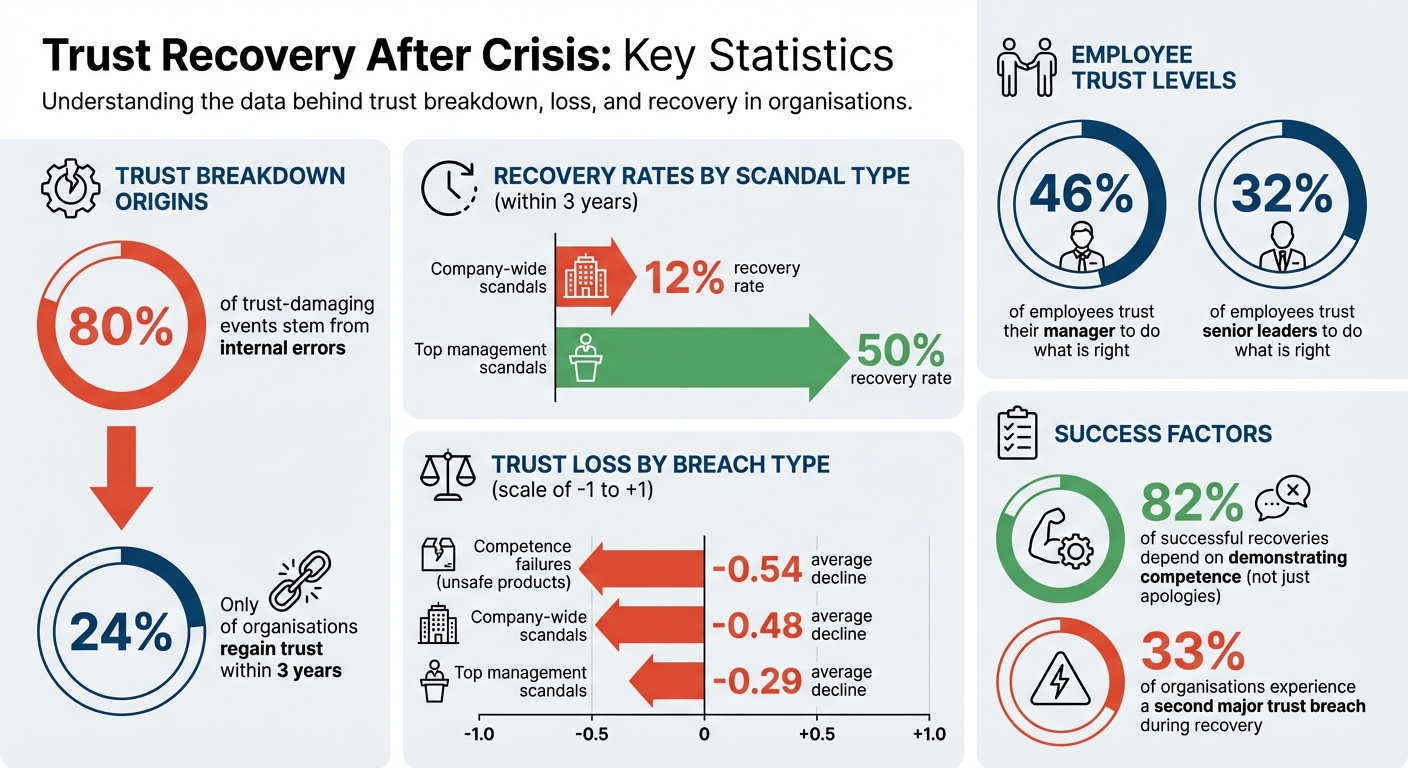
Trust Recovery Statistics: Key Data on Rebuilding Organizational Trust After Crisis
How Leaders Can Rebuild Trust After Crisis – Leah Brown
sbb-itb-ce676ec
Diagnosing the Trust Breakdown
Rebuilding trust starts with understanding exactly how and why it was lost. Leaders must move past assumptions and gather concrete evidence to identify the root causes of the breakdown and assess how stakeholders now perceive the organisation. Below, we outline the steps to diagnose and address these challenges.
Finding the Root Causes
The first step is to use sense-making - a process of openly examining what went wrong without assigning blame or deflecting responsibility. Independent investigations are often the most credible way to achieve this, as they minimise perceptions of bias or self-interest.
Leaders need to determine whether the crisis stemmed from competence failures (e.g., product safety issues or data breaches), integrity failures (e.g., fraud or dishonesty), or a combination of both. Competence issues can often be addressed through procedural changes, whereas integrity failures demand a deeper cultural overhaul.
"Once a trust failure has occurred, denying it is effectively a second violation which undermines trust further and makes it harder to recover." - Nicole Gillespie, Associate Professor, UQ Business School
The nature of the failure also influences recovery prospects. For example, organisations recover from company-wide scandals at a rate of just 12% within three years, while scandals involving top management recover at 50%, as the organisation can distance itself from the individuals involved.
Understanding What Stakeholders Think
To measure the extent of trust damage, leaders must look beyond superficial feedback. Research shows that only 46% of employees trust their manager to do what is right, dropping to just 32% for senior leaders. After a crisis, trust levels often fall even further, as stakeholders shift from giving leaders the benefit of the doubt to scrutinising every action with suspicion.
Key behavioural indicators can reveal the depth of a trust breakdown. Warning signs include employees withholding bad news, shifting from active commitment to mere compliance, and ceasing to bring forward problems or ideas. High voluntary turnover, especially among top performers with other opportunities, is another red flag. A lack of dissent or challenge in meetings may indicate employees no longer feel safe to express concerns.
"Trust indicators include employees bringing problems and ideas to you proactively, expressing disagreement or concern without fear, taking appropriate risks in their work, and demonstrating high engagement." - Laura Bouttell, Author
Anonymous surveys using validated tools can help assess trust levels across three key dimensions: competence (logic), benevolence (empathy), and integrity (authenticity). Additionally, natural language processing tools can analyse news and social media sentiment to track shifts in public perception following a crisis. Leaders should also seek direct, candid feedback by asking questions like: "What are you still seeing that concerns you?" and "What would help you trust me more?".
Identifying Obstacles to Recovery
Different types of trust breaches create unique challenges for recovery. For example, events tied to competence - such as unsafe products - result in the most severe trust losses, with an average decline of 0.54 on a scale of -1 to +1. Company-wide scandals lead to an average trust loss of 0.48, while top-management scandals cause a smaller decline of 0.29, as blame is typically confined to individuals.
After a crisis, stakeholders often shift their focus from a company’s profitability or value proposition to its resilience and adherence to regulations. Leaders must demonstrate not only competence in their core operations but also their ability to recover and prevent future failures. Complicating matters, trust breaches activate the brain’s amygdala, triggering hypervigilance and causing stakeholders to focus more on potential risks than positive actions.
Leaders should evaluate obstacles across four key attributes: Competence (delivering on commitments), Fairness (ensuring equitable treatment), Transparency (maintaining open decision-making), and Resilience (responding effectively to setbacks). By monitoring early warning signs - such as employee feedback patterns, top-performer turnover, and the frequency of dissent in meetings - leaders can identify trust issues before they worsen. These insights lay the groundwork for transparent communication and decisive action, which are critical for rebuilding trust. In the next step, leaders must focus on clear and honest communication to begin the repair process.
Communicating with Transparency
When trust has eroded, leaders must shift focus to transparent communication. This openness acts as a remedy to the suspicion created by broken trust, requiring candid honesty and meaningful dialogue.
Creating Two-Way Communication
Rebuilding trust begins with establishing channels that allow stakeholders to ask questions and express concerns. Inviting feedback not only demonstrates accountability but also signals humility. Leaders can ask pointed questions like, "What concerns do you still have?" or "What would help rebuild your trust in me?"
A striking example comes from 2004, when Jeff K. Bills became CEO of a struggling hospital within the Scripps system in San Diego. Trust had collapsed due to integrity issues, but Bills prioritised transparency and personal engagement. By directly addressing these challenges with a small team, the hospital turned its finances around, moving from significant losses to earning $1 million per month within a year. It also achieved the highest national employee survey score at the time.
"Trust comes from being open, honest, straightforward, and treating people with dignity and respect." – Jeff K. Bills, former President and CEO of Saint Mary's Health
To foster honest feedback, leaders should offer multiple avenues for stakeholders to voice concerns. This could include private conversations, direct emails, or anonymous reporting tools. Tailored check-ins for different stakeholder groups further support this process. Over time, such open dialogue helps rebuild confidence and creates a foundation for consistent, honest communication.
Maintaining Honest and Consistent Messages
Effective communication after a trust breach requires an uncomfortable level of honesty. Leaders should avoid vague statements and instead use direct "I" statements to take ownership of past failures and the actions that led to them.
A phased communication strategy can help:
- Phase 1 (Week 1): Provide a clear account of specific changes being implemented to prevent future issues.
- Phase 2 (Weeks 2–8): Rebuild reliability by making and keeping small promises.
- Phase 3 (Months 2–3): Seek feedback on whether trust-building efforts are effective and what concerns remain.
During the initial recovery period, leaders should over-communicate by sharing the reasoning behind decisions and offering visibility into their priorities and schedules. Crucially, actions must align with words. For instance, if trust was damaged due to absence, the leader should become the first to respond to new challenges. This consistency not only rebuilds trust but also directly addresses lingering uncertainties.
Handling Uncertainty
In situations where not all answers are immediately available, leaders should acknowledge gaps in knowledge while keeping stakeholders updated on efforts to address the crisis. This approach preserves credibility and prevents further damage to trust.
The focus should remain on the team’s collective impact rather than individual concerns. High-performing team members, who are particularly susceptible to disengagement after a breach, need to see swift and tangible improvements. In cases involving severe personal harm or confidentiality breaches, transparent communication might even extend to supporting a stakeholder’s transition to another role or department.
However, systemic issues must be addressed before attempting to repair trust through communication. If the root cause of the breach remains unresolved, even the most transparent dialogue will fall short. By consistently practising transparency, leaders create the groundwork for decisive actions in the next phase of trust recovery.
Taking Action to Rebuild Credibility
Transparent communication lays the groundwork for recovery, but actions are what truly rebuild trust. Words alone cannot mend broken credibility - leaders need to back them up with consistent, meaningful behaviour. For stakeholders who are sceptical, these actions must be clear and deliberate, showing genuine change. Once trust is damaged, its ripple effects can be severe: employees may disengage, talented staff might leave, and teams could withhold critical feedback or concerns. This makes it impossible for leaders to simply revert to old habits; instead, they must actively demonstrate the behaviours they now expect, offering a sharp contrast to previous mistakes.
Delivering on Commitments
Rebuilding credibility starts with keeping promises. When a major commitment has been broken, attempting to fix trust by making another sweeping promise often does more harm than good. A more effective strategy is to start small - make manageable commitments and follow through on them consistently. This step-by-step approach builds a track record of reliability, showing stakeholders that the leader is capable of sustained improvement.
For instance, if a leader was absent during a critical time, they need to show up proactively in future situations. If the issue stemmed from failing to advocate for their team, they must step up as a visible champion for them. Each fulfilled promise adds weight to the leader’s credibility, proving that their behaviour is not just performative but genuinely transformed.
Leaders should also make their priorities transparent. Sharing how they allocate their time, explaining decision-making processes, and providing context for key actions reduces ambiguity, which is often a breeding ground for mistrust. This level of openness reassures stakeholders that changes are not superficial but are receiving genuine attention.
Upholding Organisational Values
Beyond delivering on promises, leaders need to align their actions with the organisation’s core values. Trust failures often highlight discrepancies between what an organisation claims to stand for and how it actually operates. Addressing this gap requires more than introducing new policies - leaders must personally embody the ethical standards they expect from others. As Associate Professor Nicole Gillespie from UQ Business School explains:
"Removing a few senior people from office is a simple and cheap solution. While a 'changing of the guard' may be necessary to repair trust, it will not work if it's only done to avoid tackling the underlying issues".
Genuine recovery requires that every decision aligns with the organisation's stated values. Leaders should engage directly with affected stakeholders to identify remedies that address the root of the problem, rather than imposing top-down fixes. This collaborative approach not only leads to better solutions but also signals a sincere respect for those impacted by the crisis.
Voluntary adoption of internal standards can be more impactful than compliance with external regulations. By proactively implementing accountability measures and controls, leaders demonstrate a commitment to meaningful change. This self-discipline carries more weight than reforms imposed under external pressure.
Working Across Departments
Rebuilding trust is not just a leadership task - it requires organisation-wide collaboration. Departments need to avoid pursuing short-term wins that could undermine long-term goals or values. For example, aggressive cost-cutting by finance teams during a trust crisis could sabotage recovery efforts if it affects promised improvements or employee support.
Leaders should establish robust feedback loops across departments to ensure alignment. Regular cross-functional meetings can help identify potential conflicts early and reinforce the message that trust recovery is a collective effort, not just a directive from the top. This collaborative approach strengthens internal cohesion while demonstrating that the organisation is genuinely committed to repairing relationships and restoring credibility.
Ultimately, trust cannot be rebuilt while continuing the same behaviours that caused the damage. Every action must visibly reflect lessons learned and a commitment to lasting change. When these efforts are supported by tailored advisory guidance, such as that offered by House of Birch, leaders can navigate the path to trust recovery effectively and sustainably.
Learning from the Crisis
Rebuilding trust after a crisis starts with understanding what went wrong. Without a clear analysis, organisations risk falling into the same patterns, further damaging their credibility. Crises often highlight deeper, long-standing vulnerabilities, and leaders who fail to address these miss the chance to drive meaningful change. The process involves honest reflection, practical reforms, and fostering a culture where learning from mistakes becomes second nature.
Reviewing What Happened
The first step in recovery is to pinpoint exactly what occurred, moving beyond surface-level explanations to identify the root causes. This requires a thorough sense-making process, free from finger-pointing or attempts to sanitise the narrative. As Associate Professor Nicole Gillespie from UQ Business School explains:
"Sense-making is essential but it can be a dynamic process."
Leaders must actively seek input from those directly affected by the crisis. Asking questions like, "What felt challenging during that situation?" or "What could have made you feel more supported?" can uncover insights often overlooked in formal reviews. The aim is to create a clear and honest account of the failure - one that avoids shifting blame or downplaying the impact. Identifying "sentinel events" - key incidents that signal deeper issues within the organisation - can also help prevent future crises. Clarity is crucial here; vague language undermines recovery efforts. As The Influence Journal notes:
"Naming the harm - without minimising or justifying - restores dignity to those impacted."
These findings should guide the necessary updates to policies and practices.
Updating Processes and Policies
Once the weaknesses are identified, organisations must revise their processes to address them effectively. Removing senior leaders alone won’t solve systemic problems. Instead, implementing voluntary internal controls often proves more effective than external regulations, as it demonstrates a genuine commitment to improvement. Leaders should engage with colleagues and stakeholders to explore practical solutions, asking directly, "What changes would prevent this from happening again?" This collaborative approach ensures that reforms address the real issues.
However, it’s important to strike a balance. Overly restrictive policies can stifle innovation, so efforts should focus on refining controls around competence failures while tackling integrity issues through broader cultural adjustments. Transparency during this phase is essential. Regular updates, clear communication about decision-making, and visible prioritisation of reforms reassure stakeholders that the changes are genuine and enduring.
Building a Culture of Learning
With updated processes in place, the next step is embedding a culture of continuous learning. Long-term recovery depends on viewing mistakes as opportunities for growth. A crisis often sharpens stakeholders’ focus on risks, making it vital to move from "predictive trust" - simply relying on individuals to perform as expected - to trust based on openness. This involves creating an environment where team members feel safe to admit mistakes without fear of retaliation. Leaders must shift from defending their intentions to acknowledging the actual impact of the crisis. As The Influence Journal states:
"You don't earn back trust by defending your intent - you earn it by owning the impact."
Encouraging honest feedback in the months following reforms helps gauge their effectiveness and address lingering concerns. Embedding ethical considerations into daily routines, rather than limiting them to policy documents, reinforces a learning mindset across the organisation. The Dutch proverb captures this challenge aptly:
"Trust arrives on foot, but leaves on horseback."
Rebuilding trust is a slow process, but organisations that genuinely learn from their crises can emerge stronger and more prepared for future challenges.
Working with House of Birch

House of Birch provides tailored support for leaders aiming to rebuild trust following a crisis, complementing strategies like transparent communication and decisive action. Their specialised advisory services are designed to help leaders navigate high-pressure situations with resilience and strategic focus. By integrating insights from neuroscience, behavioural psychology, and cognitive science, House of Birch centres its approach on three key pillars: Clarity (strategic foresight), Control (emotional discipline), and Connection (influence and trust). These bespoke services are particularly suited for leaders making critical decisions under intense scrutiny.
Developing Emotional Control and Foresight
Research in neuroscience highlights how crises activate the amygdala, the brain’s threat-processing centre, leading to heightened vigilance and defensive reactions. Leaders who respond defensively risk exacerbating the situation. House of Birch helps leaders transform these instinctive reactions into calm, measured responses, ensuring they remain focused and strategic under pressure.
For example, in 2026, the advisory supported a client managing volatile investor relations across Herzliya, Israel, and Silicon Valley, US. The focus was on maintaining executive composure and strategic leadership during high-stakes interactions. By applying cognitive science techniques, House of Birch equips leaders with the tools to avoid reactive behaviours and take accountability for the crisis's impact, fostering organisational stability in challenging times.
Strengthening Leadership Presence
Once emotional control is established, leaders must also project a commanding and genuine presence. Rebuilding trust goes beyond words - it requires leaders to shape narratives and demonstrate authenticity through their actions. House of Birch works with leaders to amplify their presence, ensuring they project strength and reliability during and after crises.
In 2026, the advisory played a key role in aligning executives during a complex merger and acquisition in London, UK. This engagement focused on building strategic foresight and fostering clear, decisive leadership within the team. Leaders in crisis often operate under what House of Birch refers to as a "stronger microscope", where every action and decision is closely scrutinised. By cultivating social dominance and an unshakeable presence, leaders can not only repair trust but also use the recovery process as an opportunity to enhance their influence.
Customised Support for High-Pressure Leaders
Generic advice often falls short in high-stakes environments. House of Birch’s bespoke engagements cater to leaders who view trust recovery as an opportunity to emerge stronger, rather than merely damage control. High-performing teams are particularly sensitive to trust breaches, making consistent, transparent actions essential for rebuilding credibility.
The advisory emphasises micro-consistency - making and keeping small promises to rebuild a sense of safety - and encourages "uncomfortably honest" communication to signal genuine change. One of their specialised tools, Misread, analyses leadership communications for subtle patterns or manipulative tendencies that could undermine trust. For leaders managing organisations where every decision carries weight, House of Birch provides the strategic insight and emotional discipline needed to rebuild trust and maintain influence in even the most challenging circumstances.
Conclusion
Restoring trust requires a blend of transparency, decisive leadership, and a willingness to learn from mistakes. Data reveals a striking insight: 80% of trust-damaging incidents result from internal errors rather than external pressures. This places the responsibility for recovery squarely on the actions taken by leaders in the aftermath.
The process of rebuilding trust can be broken into three critical steps: acknowledge the issue without denial, demonstrate competence through consistent actions, and address underlying causes with a focus on systemic change. Stakeholders are more likely to respond positively when they see evidence of capability. In fact, 82% of successful recoveries hinge on demonstrating competence rather than relying on apologies alone.
"Trust is earned through action and behaviour, not just good communications." - Kate Hartley, Co-founder, Polpeo
As highlighted throughout this guide, a combination of clear communication and meaningful reform is essential for repairing trust. Leaders navigating such situations must maintain emotional discipline and strategic focus. Tailored support, such as that provided by House of Birch, can help transform impulsive reactions into deliberate, measured actions, strengthening leadership presence in the process.
It is important to note that rebuilding trust is rarely straightforward or quick. Research shows that one-third of organisations experience a second major trust breach during their recovery phase. Long-term accountability and consistent follow-through not only repair trust but also prepare leaders to face future challenges with greater resilience.
FAQs
How can I tell if trust was broken due to competence or integrity?
To understand whether a breach of trust is due to competence or integrity, it’s essential to examine the underlying cause. If the failure arises from an inability to achieve results or demonstrate the necessary skills, the issue likely lies with competence. On the other hand, if the breach involves dishonesty or a lapse in moral principles, it points to a problem with integrity. Analysing the nature of the failure provides clarity on its origin.
What should I say when I don’t have all the answers yet?
When faced with uncertainty, it’s important to be upfront and clear. Admit what you don’t know, take ownership of the situation, and promise to keep others informed. For instance, you might say: “I don’t have all the answers right now, but I’m working to gather the necessary information and will update you as soon as I can.” This kind of response shows integrity, responsibility, and a dedication to restoring trust.
How can I prove change without making big promises?
Proving change doesn’t require grand promises - it relies on steady, consistent actions that show genuine progress. Start by recognising previous mistakes and clearly explaining their consequences. Then, detail the specific steps you’ve implemented to address those issues. Prioritise openness and ensure you deliver on what you’ve committed to over time. Trust is rebuilt through actions that consistently reflect your intentions, rather than relying solely on words.

