Why Leaders Escalate Commitment to Failing Strategies
Leaders often continue investing in failing strategies due to psychological biases and organisational pressures. These behaviours - rooted in emotions like fear of loss and the need to protect reputation - can lead to wasted resources, delayed decisions, and reputational damage. For example, Meta spent approximately $70–77 billion (£55–60 billion) on its metaverse strategy between 2021 and 2024 despite mounting losses, only reducing its budget in late 2024. Similarly, Berlin Brandenburg Airport exceeded its budget by €6.5 billion, opening a decade late.
Key reasons include:
- Sunk Cost Fallacy: Decisions are influenced by past investments, even when future prospects are poor.
- Ego Protection: Leaders avoid admitting failure to maintain credibility.
- Overconfidence: Belief in personal ability to reverse negative trends, despite evidence.
- Groupthink: Organisational cultures suppress dissent, reinforcing poor decisions.
Preventing Escalation
To avoid these traps, leaders can adopt strategies like:
- Zero-Based Thinking: Reassess decisions as if starting fresh, ignoring sunk costs.
- Pre-Mortem Analysis: Identify potential failure points before committing further.
- Exit Criteria: Define clear benchmarks for when to abandon a project.
- Independent Reviews: Use external perspectives to reduce bias and self-justification.
Leaders should reflect on how psychological and organisational factors influence their decisions and implement structured processes to prioritise rational choices over emotional or reputational concerns.
Psychological Reasons Leaders Persist with Failing Strategies
Sunk Cost Fallacy and Loss Aversion
The sunk cost fallacy arises when leaders let previous investments influence their decisions, even when future prospects are bleak. Instead of assessing potential outcomes rationally, they view abandoning the investment as a loss, which triggers a strong emotional response. This behaviour is tied to Prospect Theory, which shows that the pain of losing is roughly twice as intense as the pleasure of gaining.
Neuroscience highlights how this dynamic unfolds in the brain. High sunk costs reduce activity in the ventromedial prefrontal cortex, which is involved in rational decision-making, while increasing activity in the amygdala and insula, areas linked to emotional processing and conflict. As a result, leaders perceive halting a project as a "certain loss", driving them to persist irrationally, hoping to recoup their losses. Experimental studies reinforce this: when participants were made aware of previous investments, 85% chose to continue a failing project, compared to only 10% when no such information was provided.
A striking example is the FBI’s Virtual Case File initiative (2000–2005). Despite being labelled "poorly designed" and "unusable", the project consumed US$170 million. Congress, influenced by the sunk costs, approved an additional US$123 million in 2002, only for the project to be abandoned in 2005 without delivering any usable results.
Hal Arkes and Catherine Blumer, researchers in this area, argue that the sunk cost effect is deeply rooted in the social norm of avoiding wastefulness - something ingrained from a young age.
Protecting Ego and Justifying Past Decisions
Beyond financial considerations, leaders often persist with failing strategies to protect their reputations and self-image. When they are personally responsible for an initial decision, admitting failure can feel like a public acknowledgement of incompetence. To avoid this, they may "double down", intertwining their identity with their decisions to safeguard their professional standing.
A notable case is Bayer CEO Werner Baumann's acquisition of Monsanto for US$63 billion in 2018. Despite widespread concerns over litigation risks, Baumann pushed ahead with the deal. Bayer later faced 125,000 lawsuits related to Roundup, costing up to US$10.9 billion in settlements. Baumann continued to defend the acquisition publicly, illustrating how leaders may escalate their commitment to protect their credibility.
Similarly, Robert Campeau’s aggressive bidding for Federated Department Stores in the late 1980s saw him overpay by an estimated US$600 million. The Wall Street Journal described this as a battle of "egos" rather than economics. Campeau’s refusal to retreat ultimately led to bankruptcy in 1992.
Overconfidence and False Sense of Control
Overconfidence can exacerbate escalation of commitment. Leaders with high self-belief often assume they can reverse negative trends through sheer ability, ignoring external factors beyond their control. This overconfidence fosters "retrospective rationality", where they inflate minor positive signs while minimising significant negative data to fit their narrative. These distortions allow them to rationalise their decisions, even when evidence strongly suggests otherwise.
| Determinant | Influence on Escalation |
|---|---|
| Personal Responsibility | Greater responsibility amplifies the tendency to persist |
| Proximity to Completion | Nearing completion increases the likelihood of ignoring setbacks |
| Agreeableness | Highly agreeable individuals (r = 0.51) are more prone to follow social norms |
| Cognitive Ability | Intelligence alone offers no protection, but "cognitive reflection" does |
These cognitive and emotional biases create fertile ground for organisational dynamics that further reinforce commitment to failing strategies.
sbb-itb-ce676ec
Building a Culture of Agility by Addressing Sunk Costs
How Organisations Reinforce Escalating Commitment
Organisational dynamics often intensify the psychological biases that lead to escalating commitment. Structures, cultures, and internal politics can amplify these tendencies, making it difficult for organisations to reverse course - even when failure becomes evident.
Groupthink and Silencing Dissent
When organisational culture prioritises harmony over critical evaluation, groupthink can take hold. In such environments, dissenting opinions are often suppressed, discouraging open debate about alternative strategies.
One example is Pan American World Airways during the deregulation of the airline industry in the 1970s and 1980s. With its leadership deeply attached to the airline's identity as a luxury brand, the company sold off its most profitable assets in a bid to maintain its image. Barry M. Staw highlighted this phenomenon:
On occasion, a project, product, or policy can become so closely tied to the values and purposes of the organization that it becomes almost unthinkable to consider withdrawal.
This issue can be exacerbated by "vicarious entrapment", where new leaders inherit failing projects and feel compelled to justify past decisions. Psychological factors such as perspective-taking and interdependence make it harder for leaders to reassess failing initiatives objectively. Meanwhile, internal politics and communication delays often obstruct dissenting voices.
A historical example illustrates this dynamic. In July 1965, U.S. diplomat George Ball warned President Lyndon Johnson:
Once large numbers of U.S. troops are committed to direct combat... Our involvement will be so great that we cannot - without national humiliation - stop short of achieving our complete objectives.
This highlights how organisational momentum can push leaders to persist with failing strategies, even when rational analysis suggests otherwise.
Confirmation Bias in Decision-Making
Organisations frequently reward confirmation bias, where decision-makers prioritise evidence that supports their prior choices while dismissing contrary information. When projects fail, leaders often attribute the failure to external factors rather than flawed strategies.
The Denver International Airport baggage handling system in the 1990s is a case in point. Despite clear signs of technical failure, the project continued to receive funding, ultimately finishing two years late and $2 billion over budget. Research suggests that 30% to 40% of software projects fall into this trap due to their inherent complexity.
An even more extreme example is the Berlin Brandenburg Airport project. By 2019, it was running €6.5 billion over budget and was a decade behind schedule. Yet, the project persisted because it was deemed "too expensive to fail." Staw observed:
Organizations have very imperfect sensory systems, making them relatively impervious to changes in their environments.
These flawed decision-making processes make it easier for organisations to rationalise continued investment in failing initiatives.
Pressure to Appear Consistent
Organisational pressures to maintain consistency further reinforce escalating commitment. Consistency is often equated with strong leadership, while changing course can be viewed as a sign of weakness or incompetence. Leaders may persist with failing initiatives to avoid personal embarrassment or the reputational damage associated with an abrupt reversal.
| Organisational Factor | Impact on Escalation |
|---|---|
| Groupthink Pressure | Stifles dissent and enforces uniform decision-making |
| Communication Barriers | Delays feedback, limiting leaders' ability to pivot |
| Identity Attachment | Ties initiatives to organisational values, blocking exit |
| Consistency Expectations | Discourages course correction to maintain appearances |
These factors, when combined with individual psychological biases, create a powerful feedback loop. Organisational structures and cultures magnify the challenges of reversing failing strategies, making escalation the default response even in the face of overwhelming evidence to the contrary.
Practical Methods to Prevent Escalating Commitment
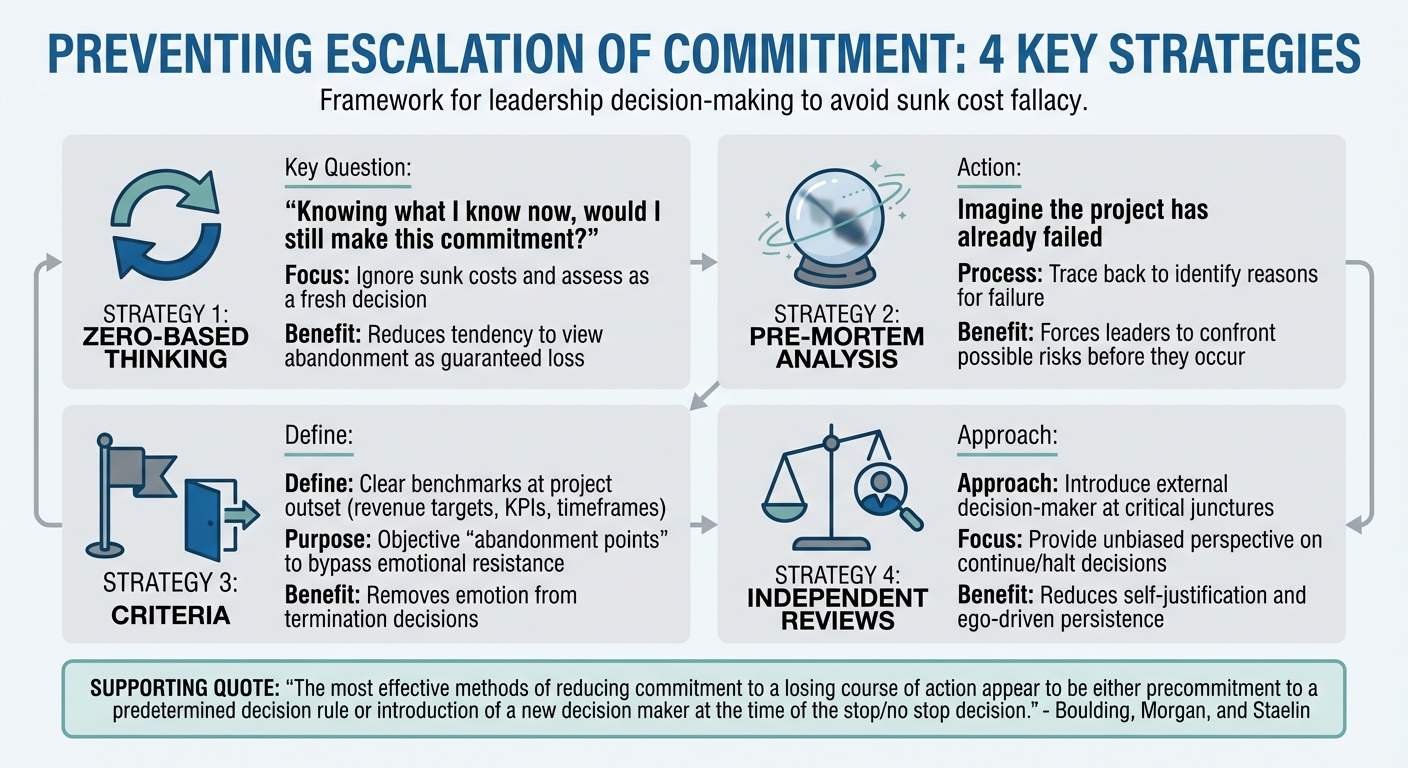
4 Strategies to Prevent Escalation of Commitment in Leadership
To counteract the biases and organisational pressures that fuel escalating commitment, leaders need structured approaches that prioritise future outcomes over past investments. This shift in focus enables decisions to be made based on present evidence rather than emotional or historical attachments.
Zero-Based Thinking for Clearer Decision-Making
Zero-based thinking offers a way to reframe decisions by ignoring sunk costs - those irretrievable investments of time, money, or effort - and assessing the situation as if it were a fresh decision. A critical question to ask is: "Knowing what I know now, would I still make this commitment?" This approach moves the focus away from past expenditures and towards the present situation, reducing the tendency to view abandoning a project as a guaranteed loss. Additionally, anticipating potential failure before it occurs can further enhance decision-making.
Pre-Mortem Analysis and Defining Exit Criteria
A pre-mortem analysis involves imagining that a project has already failed and then tracing back to identify the reasons for its failure. This method forces leaders to confront possible risks and counteracts biases like the availability heuristic. Another effective strategy is to set clear exit criteria at the outset of a project. These criteria - such as specific revenue targets, KPIs, or timeframes - serve as objective benchmarks for deciding when to terminate a project. By adhering to these pre-established "abandonment points", leaders can bypass the emotional resistance often associated with acknowledging failure. Beyond these pre-planned measures, continuous evaluation is essential to adjust decisions as new data emerges.
Feedback Loops and Independent Reviews
Introducing an independent decision-maker at critical junctures, such as when evaluating whether to continue or halt a project, can help mitigate self-justification and ego-driven persistence. External reviews provide an unbiased perspective, reducing the risk of leaders becoming overly attached to failing strategies. However, it is vital that the external reviewer remains impartial to avoid what researchers call "vicarious entrapment".
Studies involving senior executives reveal that incorporating a new decision-maker at the stop/no-stop stage results in slightly lower levels of commitment compared to relying solely on pre-set decision rules. Feedback systems that focus on future costs and benefits, rather than past investments, can also guide leaders towards more rational choices. As noted by William Boulding, Ruskin Morgan, and Richard Staelin:
The most effective methods of reducing commitment to a losing course of action appear to be either precommitment to a predetermined decision rule or introduction of a new decision maker at the time of the stop/no stop decision.
Regularly scheduled review checkpoints provide structured opportunities to reassess ongoing strategies. These intervals allow leaders to evaluate progress without the stigma of admitting failure, making adjustments a normal part of strategic oversight. By embedding these practices into their decision-making processes, leaders can ensure that their actions remain aligned with current data and objectives.
How House of Birch Helps Leaders Break Escalation Cycles

Expanding on the cognitive and organisational challenges discussed earlier, this section highlights how targeted interventions can disrupt these patterns. Breaking the cycle of escalating commitment requires more than just awareness - it calls for tailored strategies that address the specific psychological tendencies of each leader. House of Birch offers personalised leadership advisory services designed to help leaders identify and dismantle these behaviours, safeguarding both strategic outcomes and organisational resources.
Tailored Advisory for High-Stakes Leaders
House of Birch’s process starts by identifying leaders who may be more susceptible to escalation of commitment. Traits such as extraversion, sensation-seeking, and hubris can make individuals more likely to dismiss negative feedback due to overconfidence. Through one-on-one advisory sessions, leaders are guided to recognise these tendencies and develop emotional discipline, enabling them to process feedback more objectively rather than through a lens of self-justification.
The advisory also tackles emotional dysregulation - when heightened emotions impair decision-making. By implementing structured self-awareness practices, leaders are taught to separate their personal identity from their decisions. This approach helps them abandon failing strategies without internalising the change as a personal failure.
Strengthening Decision-Making and Strategic Influence
House of Birch provides leaders with actionable techniques to counteract escalation biases. A key strategy involves shifting focus towards growth and innovation, which broadens their view of alternative approaches and diminishes the need for self-justification.
Another critical area is addressing vicarious entrapment, where new decision-makers inherit escalation traps due to a psychological attachment to the decisions of their predecessors. House of Birch’s advisory helps leaders maintain objectivity while ensuring continuity in strategic oversight.
By combining personalised guidance with strategic reframing, leaders are empowered to break free from escalation cycles with clarity and confidence.
Case Studies: Transforming Leadership Outcomes
House of Birch has successfully helped leaders navigate escalation traps by guiding them through de-escalation of commitment - the intentional process of reducing or withdrawing support from failing initiatives. These interventions are carefully designed to help leaders maintain their credibility and influence while aligning decisions with current organisational goals. Through tailored frameworks and enhanced foresight, leaders are able to reverse counterproductive patterns and steer their organisations towards more sustainable outcomes.
Conclusion
The escalation of commitment remains one of the most avoidable yet damaging pitfalls in leadership. When leaders double down on failing strategies - whether due to ego, sunk cost bias, or organisational pressures - the consequences often ripple far beyond wasted resources. High-profile examples, such as massive overinvestments that have led to bankruptcies, highlight the heavy toll of such decisions. In some cases, organisations have even sold profitable assets in a bid to salvage their reputation, only to face disastrous outcomes. These are not isolated incidents; for instance, Berlin Brandenburg Airport exceeded its budget by €6.5 billion by 2019, showcasing the scale of mismanagement.
Avoiding these costly errors requires deliberate action. Leaders need to adopt structured tools like zero-based thinking, pre-mortem analysis, and clearly defined exit strategies. Equally important is the ability to detach personal identity from strategic decisions, fostering the emotional discipline necessary for clear-headed leadership. As U.S. diplomat George Ball cautioned in 1965:
Once we suffer large casualties, we will have started a well-nigh irreversible process. Our involvement will be so great that we cannot - without national humiliation - stop short of achieving our complete objectives.
This psychological trap remains as relevant today as it was decades ago. Studies show that leaders who can admit mistakes and shift their focus from rescuing past investments to pursuing future opportunities are better positioned to enhance team performance and organisational resilience. Adjusting course is not a sign of weakness but rather a hallmark of strategic acumen.
To break these cycles, leaders operating in high-stakes environments must seek objective perspectives and establish systems of accountability. These measures can prevent escalation before it begins. For instance, House of Birch offers tailored solutions to help leaders identify psychological biases, apply rigorous decision-making frameworks, and maintain clarity under pressure. When the cost of persistence outweighs the potential benefits of change, external expertise can often be the critical factor that determines whether an organisation evolves or collapses.
Ultimately, the challenge is not whether leaders will encounter failing strategies, but whether they will recognise and address them in time.
FAQs
How can I tell if I’m trapped by sunk costs?
Continuing to invest in a failing strategy despite clear evidence of negative outcomes might indicate you're falling into the sunk cost trap. This behaviour is often driven by psychological factors such as loss aversion - the tendency to fear losses more than valuing equivalent gains - or self-justification, where admitting a past mistake feels too uncomfortable to confront. Identifying these patterns is crucial for breaking free from this cycle and shifting towards more rational, future-oriented decision-making.
What exit criteria should we set before starting a project?
Clear exit criteria play a key role in preventing prolonged investment in strategies that are not delivering results. These criteria - such as defined performance metrics, budget thresholds, or deadlines - act as signals for when a project requires reassessment or termination. By establishing these benchmarks, organisations can mitigate cognitive biases like the sunk cost fallacy, which often leads to throwing good money after bad. To be effective, these criteria must be specific, measurable, and closely tied to the project's objectives. This approach ensures more disciplined decision-making and helps avoid wasting resources on initiatives that fail to meet expectations.
How do independent reviews stop leaders doubling down?
Independent reviews offer leaders a chance to spot early warning signs of potential failure and question their own assumptions. These reviews bring an external, impartial perspective, which can break the cycle of doubling down on flawed strategies. This approach promotes more measured and well-informed decision-making.

