Ultimate Guide to Incentive Design for High-Stakes Leaders
Designing effective incentives for leaders is about more than just rewards - it's about aligning behaviour with organisational goals. Leaders in high-stakes roles face unique challenges, where decisions impact jobs, strategy, and millions in revenue. Misaligned incentives can lead to risk-averse behaviour, short-term thinking, or even unethical practices. The key is to create systems that balance financial rewards with intrinsic motivators like purpose and mastery.
Key insights include:
- Behavioural principles matter: Concepts like loss aversion and present bias influence how leaders respond to incentives.
- Long-term focus: Equity-based rewards and ESG metrics are increasingly used to promote sustainable decision-making.
- Simplicity and clarity: Overcomplicated systems can backfire, while clear, measurable KPIs (2–4 per role) ensure focus.
- Avoid common pitfalls: Examples like Microsoft's "stack ranking" show how poorly designed systems can harm collaboration and culture.
- Regular audits: Annual reviews and guardrails like clawback provisions help maintain fairness and prevent gaming.
Organisations should prioritise transparent, well-structured incentives that drive meaningful outcomes while avoiding unintended consequences. Leaders may wish to evaluate their current systems to ensure alignment with both immediate and long-term objectives.
Behavioural Economics Principles Behind Incentive Design
Key Behavioural Principles to Know
Understanding the principles of behavioural economics is essential for designing incentives that influence leadership decisions effectively. These principles often reveal how leaders respond to pressure, whether in boardrooms or during performance evaluations.
One of the most influential concepts is loss aversion. Studies indicate that losses are roughly 2.25 times more psychologically impactful than equivalent gains. This can lead senior leaders to stick with failing strategies, simply to avoid admitting a loss.
Present bias adds another layer of complexity. Leaders tend to prioritise immediate outcomes over long-term benefits. For example, long-term incentive plans that pay out in the distant future often struggle to compete with the allure of actions that deliver instant results. Compounding this is hedonic adaptation, where repeated bonuses quickly become viewed as standard pay. Over time, increasingly larger rewards are required to sustain the same level of motivation.
Overcomplicated incentive structures can also backfire. They may overwhelm leaders, causing them to disengage or rely on oversimplified decision-making shortcuts. Additionally, social comparison can sow discord, as leaders may focus more on their peers' rewards than on collaboration. As Allan Schweyer, Chief Academic Advisor at the Incentive Research Foundation, puts it:
"Cognitive pitfalls are not bugs in your employees; they are features of human decision-making."
These principles highlight the biases that influence decision-making and explain how incentives can shape leadership behaviour.
How Incentives Shape Leadership Behaviour
Behavioural insights into incentive design reveal their profound impact on leadership styles, particularly in areas like risk-taking, motivation, and ethical decision-making.
One significant concern is the crowding out of intrinsic motivation. A meta-analysis of 40 years of research found that performance-based incentives can reduce intrinsic motivation for engaging tasks. When rewards feel coercive rather than recognising genuine achievement, leaders may shift their focus from pursuing mastery or purpose to simply chasing the reward. Worse still, if those incentives are withdrawn, performance can fall below its original level.
Incentive design also influences how leaders perceive risk and act ethically. Leaders who fear losing bonuses or status may avoid long-term strategies, focusing instead on short-term stability. This cautious approach can be particularly damaging in environments where calculated risks are crucial for success.
Ethical behaviour is another area shaped by reward structures. Systems like public rankings or "bottom 10%" policies can encourage leaders to conceal errors or withhold information, eroding transparency and trust. On the other hand, framing incentives as recognition for contributions, rather than as mechanisms for control, can enhance leaders' sense of purpose.
"If you overly control behavior with rewards, people can start working for the reward rather than for pride, purpose, or learning." - Allan Schweyer, Chief Academic Advisor, IRF
Ultimately, poorly designed incentives can undermine the very behaviours they aim to promote, leading to underperformance and unintended consequences. Leaders and organisations must consider these behavioural principles when crafting incentive systems to ensure they drive the desired outcomes.
sbb-itb-ce676ec
How to Design Incentives for High-Stakes Leadership Roles
Aligning Incentives with Organisational Goals
One frequent pitfall in designing executive incentives is focusing too heavily on past performance metrics, like quarterly revenue figures, rather than forward-looking indicators. While such metrics are easy to measure, they reflect past achievements and fail to capture the organisation's trajectory. More predictive metrics - such as customer satisfaction, product adoption rates, or reductions in technical debt - are better suited for aligning incentives with the long-term health of an organisation.
Equity-based rewards tied to long-term outcomes are particularly effective in encouraging sustainable decision-making. When leaders know their financial rewards depend on the company’s value three to five years down the line, they are less likely to prioritise short-term gains. This trend is reflected in the fact that 93% of leading US companies now use structured, performance-based annual incentive plans, a notable increase from 83% in 2019. Such plans reduce perceptions of bias and promote accountability.
For leadership roles not directly tied to revenue generation - such as those focusing on cultural shifts, environmental, social, and governance (ESG) objectives, or large-scale system changes - Management by Objectives (MBO) bonuses offer a compelling alternative. These incentives link rewards to achieving strategic milestones rather than financial outcomes. By 2023, 73% of S&P 500 companies had integrated ESG metrics into their executive incentive frameworks, highlighting the growing relevance of this approach.
"Incentive compensation is about rewarding results and also shaping them. The right plan creates clarity, ownership, and consistent performance across roles." - Bhushan Goel, Everstage
In addition to financial incentives, non-financial recognition plays a critical role in supporting leadership performance.
Balancing Intrinsic and Extrinsic Motivators
Effective incentive design goes beyond financial rewards, tapping into intrinsic motivators that drive sustained leadership performance. While extrinsic rewards, such as bonuses, can boost the quantity of output, they often fail to enhance the quality of work - a crucial factor in high-stakes leadership. Qualities like innovation, sound decision-making under pressure, and ethical leadership are more strongly influenced by intrinsic drivers, including autonomy, mastery, and purpose.
Financial incentives establish a baseline for motivation, but intrinsic motivators ensure long-term engagement. Research shows that for senior leaders, variable pay should constitute at least 50% of total target income to have a meaningful impact. However, non-financial recognition is equally important. For instance, a field experiment with public health agents found that non-financial recognition doubled performance outputs, underscoring the value of acknowledging contributions alongside financial rewards. Over-reliance on monetary incentives can risk undermining intrinsic motivation, so a balanced approach is essential.
Tailoring Incentives to Different Leadership Contexts
Leadership roles vary widely in their demands, and incentive systems should reflect these differences. The table below highlights how incentive mechanisms can be tailored to specific leadership challenges:
| Leadership Context | Primary Focus | Recommended Incentive Mechanism | Payout Cadence |
|---|---|---|---|
| Crisis Management | Resilience, stakeholder safety, business continuity | Milestone-based retention bonuses tied to recovery KPIs | Immediate or event-driven |
| Transformation | Change management, strategic delivery, new capability | MBOs tied to strategic milestones and equity (RSUs) | Quarterly or bi-annual |
| Steady-State | Efficiency, cost savings, consistent performance | Profit-sharing and annual performance bonuses | Annual |
For crisis scenarios, retention bonuses linked to recovery milestones help maintain continuity and preserve institutional knowledge. During transformations, combining MBOs with equity-based incentives ensures leaders remain focused on both immediate goals and long-term value creation. In steady-state contexts, profit-sharing and annual bonuses reward operational stability without creating unnecessary pressure.
Transparency is critical across all contexts. Leaders must be able to clearly articulate how their incentives are calculated; otherwise, unclear structures can erode trust - a cornerstone of effective leadership. These carefully designed incentives contribute to broader governance systems, which will be explored further in subsequent sections.
For leaders aiming to optimise their incentive structures, House of Birch offers tailored executive coaching and advisory services to ensure incentive plans are clear, fair, and aligned with long-term organisational objectives.
How to Design Incentives That Actually Work Using Behavioral Economics | Richard Mathera
Putting Incentive Systems into Practice
Implementing effective incentive systems requires translating design principles into actionable steps, with an emphasis on clear metrics and ongoing evaluation.
Setting Measurable Outcomes and Guardrails
One common misstep is overloading roles with too many metrics. Limiting each position to 2–4 key performance indicators (KPIs) ensures focus and prevents unnecessary administrative burden. These KPIs should be time-bound and relevant to the role's objectives.
Relying on a single metric is risky, as it rarely provides a complete view of performance. A combination of measures - such as revenue growth, client retention, and customer satisfaction - offers a more balanced perspective. As engineering leader Michał Poczwardowski aptly notes:
"You can't stop people from gaming incentives, but you can choose the game."
To mitigate short-term thinking, guardrails like clawback provisions can be introduced. These discourage quick fixes that may harm long-term goals. Additionally, using a tiered goal structure - such as Threshold, Target, and Stretch levels - provides a framework that rewards acceptable performance while offering incentives for exceeding expectations.
Before rollout, conducting a gaming audit is crucial. This process identifies potential loopholes and overlooked priorities, helping to pre-empt unintended behaviours that could undermine the system.
Testing and Refining Incentive Systems
Once the system is live, the focus should shift to continuous refinement. No incentive structure is perfect from the outset, so it’s essential to treat it as a dynamic framework, open to adjustments based on real-world performance.
Regular reviews, ideally conducted annually, should analyse 6–12 months of data. These reviews help recalibrate benchmarks and detect instances of metric gaming, where targets are achieved but broader objectives are compromised. Another red flag to watch for is cooperation breakdown, where individual rewards inadvertently harm team performance.
Marilyn Strathern’s observation remains relevant: "every measure which becomes a target ceases to be a good measure". This highlights the importance of testing systems in practice. Leaders should be encouraged to raise issues early without fear of penalty. If they are punished for flagging problems, the system may inadvertently promote counterproductive behaviours.
Involving a cross-functional group - including HR, Finance, department heads, and a sample of leaders - during reviews can uncover blind spots that raw data might miss. These diverse perspectives ensure the system supports organisational goals without unintended negative consequences.
"The real value of incentive compensation lies in its ability to reinforce strategy, shape executive behavior, and support long-term value creation." - Steven Hall, Principal, Pearl Meyer
For leaders seeking expert advice, House of Birch provides tailored consultancy services designed to meet the challenges of high-stakes leadership roles.
Common Pitfalls in Incentive Design and How to Avoid Them
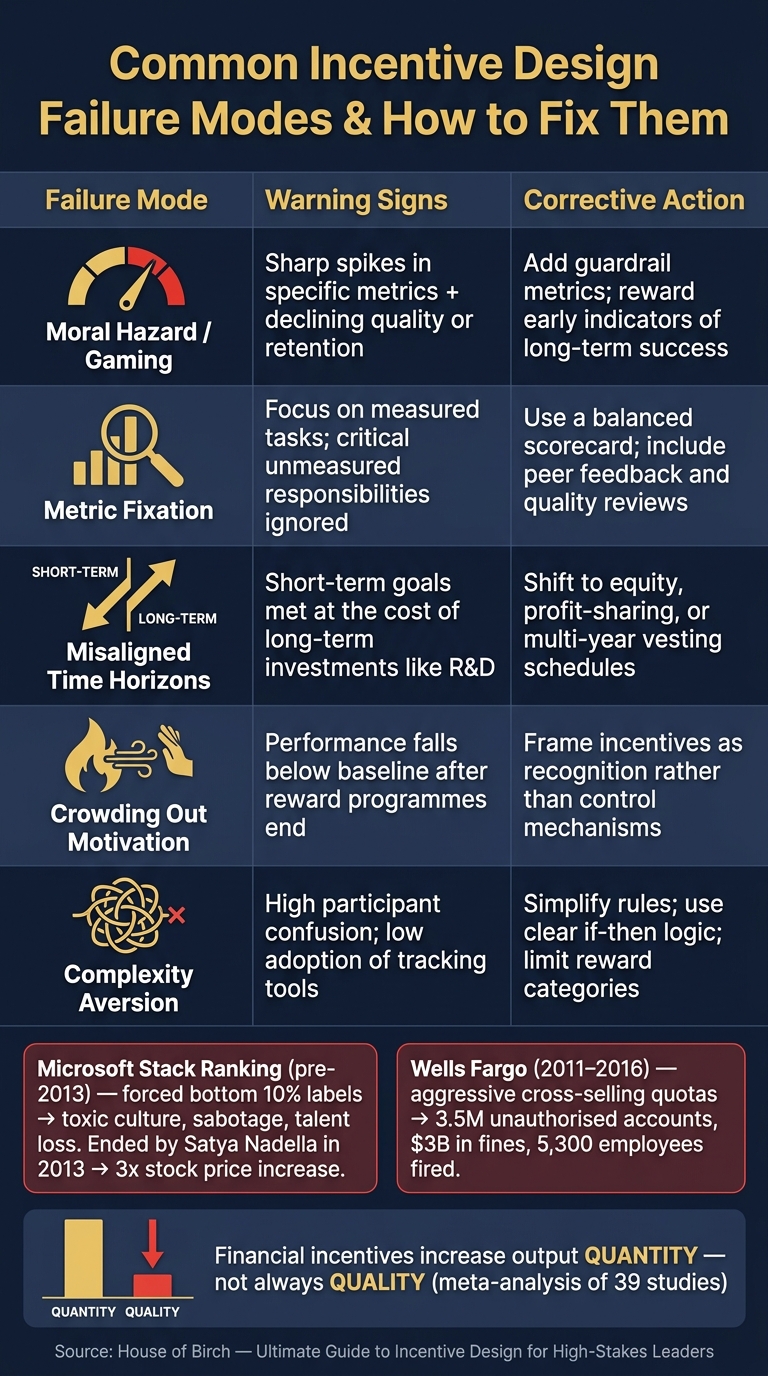
Incentive Design Failure Modes: Warning Signs & Fixes for Leaders
Incentive systems often fail when they overlook the nuances of human behaviour. The gap between what a system is intended to achieve and the outcomes it actually delivers is where most issues arise. For leaders, these failures can have far-reaching consequences, making it essential to identify and address potential pitfalls. Effective incentive systems must not only drive high performance but also uphold ethical standards.
Recognising and Fixing Failure Modes
A striking example of incentive misdesign is Microsoft's pre-2013 "stack ranking" system. This approach forced managers to label 10% of employees as underperformers during each review cycle. Instead of raising performance, it led to a toxic environment where employees avoided collaborating with high performers and, in some cases, sabotaged colleagues to protect their own rankings. When Satya Nadella became CEO and ended the system in 2013, the resulting cultural transformation helped drive a threefold increase in the company's stock price.
"Stack ranking was the most destructive process inside of Microsoft, something that drove out untold numbers of employees." - Kurt Eichenwald, Author/Journalist
This example highlights a recurring issue: incentive systems that prioritise competition over collaboration can undermine the very teamwork that leadership relies on. The table below outlines common failure modes, their warning signs, and practical solutions.
| Failure Mode | Warning Signs | Corrective Action |
|---|---|---|
| Moral Hazard / Gaming | Sharp increases in specific metrics coupled with declines in quality or retention | Add guardrail metrics; reward early indicators of long-term success |
| Metric Fixation | Focus on measured tasks while ignoring critical but unmeasured responsibilities | Use a balanced scorecard; include peer feedback or subjective quality reviews |
| Misaligned Time Horizons | Short-term goals achieved at the cost of long-term investments like R&D | Shift focus to equity, profit-sharing, or multi-year vesting schedules |
| Crowding Out Motivation | Performance falls below baseline after reward programmes end | Frame incentives as recognition rather than control |
| Complexity Aversion | High participant confusion or low adoption of tracking tools | Simplify rules; use clear "if-then" logic; limit the number of reward categories |
A meta-analysis of 39 studies revealed that financial incentives tend to increase output quantity rather than quality. For leaders, this distinction is critical, especially when sound judgement and balanced outcomes are as important as productivity.
With these lessons in mind, the next challenge lies in addressing reward excess and imbalances that can destabilise even the most carefully designed incentive systems.
Managing the Risks of Over-Reward and Imbalance
The Wells Fargo scandal (2011–2016) serves as a cautionary tale about the dangers of excessive rewards. Employees were pressured to meet aggressive cross-selling quotas, requiring them to open eight accounts per customer. This led to the creation of 3.5 million unauthorised accounts, £3 billion in fines, and the firing of 5,300 employees.
"The incentive structure at Wells Fargo was so aggressive that it essentially made fraud the rational choice for survival. That's not a few bad employees - that's a broken system." - Elizabeth Warren, US Senator
Over-rewarding doesn’t always result in fraud. More commonly, it leads to hedonic adaptation, where recurring bonuses are quickly perceived as part of base pay, diminishing their motivational effect within weeks. This leaves organisations spending more to achieve diminishing returns.
"Show me the incentive and I'll show you the outcome." - Charlie Munger, Vice Chairman, Berkshire Hathaway
To counteract these risks, leaders should balance financial incentives with non-financial recognition. Combining individual rewards with team-based outcomes can also help safeguard judgement, particularly when metrics alone fail to capture the full picture. By designing systems that account for these dynamics, organisations can create incentives that strengthen rather than erode their foundations.
Maintaining and Governing Incentive Systems Over Time
Once an incentive system is launched and refined, the challenge shifts to maintaining its relevance and governing it effectively. Over time, even well-designed systems can lose focus as organisational priorities, market conditions, and behaviours evolve. To ensure these systems remain effective, regular audits and flexible adjustments are essential to keep them aligned with strategic objectives.
Auditing and Updating Incentives
Conducting annual audits helps ensure that incentive metrics stay in step with strategic goals and that payout structures remain appropriate for both short-term and long-term roles. This process involves reviewing whether the metrics still reflect current priorities, assessing the health of payout distributions, and identifying any unintended loopholes. For example, the growing inclusion of ESG (Environmental, Social, and Governance) metrics and non-financial goals - such as employee engagement and customer satisfaction - into executive incentive plans demonstrates how deliberate, periodic reviews can adapt systems to meet evolving stakeholder expectations.
"If the short-term sales effort undermines [holistic goals] your whole culture can quickly unravel, so make sure all your players are playing into the bigger picture." - Innecto Reward Consulting
Incentive systems must also be flexible enough to respond to external shocks without requiring a complete overhaul. Once updates are made, effective governance becomes crucial to manage risks and uphold accountability.
"This is the silent killer of performance: poorly designed incentive plans." - Bhushan Goel, Everstage
Accountability and Governance in Incentive Design
Strong governance is what separates resilient incentive systems from those that fail under pressure. Oversight should involve a cross-functional team, typically including HR to ensure structural integrity, Finance to monitor costs and ROI, department heads to maintain operational alignment, and employee representatives to provide ground-level insights. No single department should control the system in isolation.
Clawback provisions are becoming a cornerstone of governance, particularly in sectors like financial services. U.S. regulators have led efforts to make executive compensation plans more risk-sensitive by incorporating clawback clauses, and this approach is gaining traction in the UK as well. These provisions allow organisations to recover rewards if the actions that earned them are later found to have caused harm, offering a critical safeguard in high-risk environments. Equally important is equipping managers with the tools and training needed to act as governance partners. This includes providing clear instructions on how to communicate incentive changes and spot early signs of metric manipulation or misalignment.
For leaders managing intricate or high-stakes incentive frameworks, external advisory services can offer valuable support. For instance, House of Birch specialises in discreet, customised guidance designed to enhance decision-making and maintain the emotional discipline required when systems face scrutiny or transition.
Conclusion: Key Takeaways for High-Stakes Leaders
The behavioural insights and strategies discussed earlier highlight the importance of thoughtful incentive design in leadership roles. Effective systems go beyond merely rewarding outcomes; they represent an ongoing effort to align incentives with strategy, maintain simplicity, and manage risks carefully. The strongest frameworks are aligned with strategy, transparent in execution, and managed with discipline. As Steven Hall, Principal at Pearl Meyer, aptly summarises:
"Executive compensation plans should do more than deliver pay. They should serve as deliberate extensions of corporate strategy."
Recent data shows a growing trend among S&P 500 companies, with nearly 75% now incorporating ESG (Environmental, Social, and Governance) metrics into executive compensation. Furthermore, 57% of these firms include non-financial objectives, such as employee engagement and customer satisfaction, compared to just 38% in 2020. This shift reflects a broader move towards recognising and rewarding not only the results but also the methods used to achieve them.
One of the simplest yet most overlooked principles in incentive design is clarity. A plan fails if participants cannot easily understand how their rewards are calculated. This is underscored by findings that 85% of employees who work on commission feel the need to manually verify their earnings due to a lack of trust in the system.
Governance remains the cornerstone of long-term success. Measures such as clawback provisions, cross-departmental oversight, and annual behavioural audits are critical to ensuring stability and fairness. Research suggests that having at least 8% of total target income genuinely at risk is a baseline requirement for driving meaningful behavioural change.
As previously discussed, regular system audits are essential to maintaining the integrity and effectiveness of incentive programmes. Leaders must ensure their systems encourage the right behaviours, discourage quick fixes, and withstand external pressures. Such systems are not the result of chance but of deliberate design, rigorous testing, and ongoing refinement.
FAQs
Which 2–4 KPIs should a leader be measured on?
Leaders are advised to prioritise 2–4 key performance indicators (KPIs) that directly reflect their strategic goals and promote the behaviours they aim to encourage. Examples of such KPIs might include productivity levels, progress towards key goals, and consistency in desired behaviours. Importantly, these KPIs should serve a dual purpose: not only measuring outcomes but also actively shaping behaviours to ensure they align with the organisation's broader objectives and support sound decision-making.
How do you stop leaders gaming the incentive plan?
To deter leaders from exploiting incentive plans, it’s essential to design these systems with an awareness of potential loopholes. Establishing clear and transparent guidelines is critical, alongside implementing robust checks and balances to monitor compliance. Aligning incentives with long-term organisational goals helps discourage behaviours driven by short-term gains.
Equally important is cultivating a workplace culture that prioritises integrity and fairness. Regularly reviewing incentive structures and providing ethical training can reinforce this approach, ensuring that rewards promote authentic performance rather than manipulative tactics.
When should you use equity, cash bonuses, or MBOs?
To align incentives with organisational goals, consider a mix of compensation strategies:
- Use equity to align long-term interests, fostering commitment and encouraging sustained performance over time.
- Opt for cash bonuses to boost short-term motivation and deliver immediate results, particularly for time-sensitive objectives.
- Implement MBOs (Management By Objectives) when success hinges on achieving specific, measurable targets.
Each method should be tailored to reflect the organisation's priorities and the desired outcomes, ensuring a balanced and effective approach.

