5 Ways Leaders Improve Focus Under Pressure
When pressure spikes, thinking can narrow in seconds. Research suggests acute stress can sharply reduce prefrontal cortex activity - the part linked with judgement, planning and impulse control - while pushing attention towards short-term relief.
In this piece, I would boil the evidence down to five moves leaders use to keep focus when stakes are high:
- Pause before replying to stop reflex from taking over
- Shift attention to what can still be controlled
- Cut mental clutter so working memory is not overloaded
- Read pressure as a signal, not an order
- Use short recovery breaks to stop one tense moment spilling into the next
These habits matter because stress does not just feel unpleasant; it changes behaviour. Under strain, teams often mirror the emotional tone of the person in charge. A brief pause, a clearer next step, or a one-minute reset can shape decision quality far more than a forceful speech.
| Approach | Best use | Main effect | Main limit |
|---|---|---|---|
| Regulate before reacting | Sudden stress spike | Slows impulsive replies | Needs self-awareness early |
| Focus on control | Overwhelm and uncertainty | Restores agency | Does not change outside events |
| Reduce cognitive load | Too many demands at once | Protects judgement | Hard to keep up in fast crises |
| Treat pressure as a signal | High-stakes uncertainty | Improves appraisal | Hard in panic or exhaustion |
| Use recovery routines | Repeated strain across the day | Helps attention recover | Often dropped when diaries fill up |
The broad point is simple: focus under pressure is not just temperament. It is a set of trained behaviours, shaped by psychology, neuroscience and the social signals leaders send to other people.
Why Calm Leaders Get Better Results Under Pressure
sbb-itb-ce676ec
1. Regulate Before You React
Under pressure, the first move is not action. It is regulation.
When stress spikes, leaders often feel pushed to respond at once. But that impulse can work against them. Acute stress can reduce activity in the prefrontal cortex - the part of the brain linked to judgement, planning and impulse control - which makes snap, reactive decisions more likely. A brief pause helps protect judgement at the point it is most at risk.
The practical step is straightforward: pause before responding.
One option is resonance breathing. Inhale through the nose for four counts, then exhale through the mouth for six. This pattern can steady breathing and lower physiological arousal. It gives the nervous system a chance to settle, which can help a leader move from reflex to judgement.
A second tool is affect labelling - putting the feeling into words. That might sound like: “I feel cornered” or “this is uncertainty.” Research suggests that naming an emotion can engage prefrontal regions and support clearer thinking under strain.
This matters in settings where pressure is public and immediate: a tense board meeting, a hard negotiation, a press interview, or a fast-moving crisis. In those moments, a leader who takes a short beat may look slower on the surface. In practice, that pause can help restore calm, judgement and empathy within seconds.
2. Focus on What You Can Control
Once a leader has steadied their own state, the next step is practical: put attention on what can still be influenced.
When attention locks onto things outside a leader’s reach, it tends to splinter. One part goes to market swings, another to funding pressure, another to restructuring, and another to a public crisis. That spread comes at a cost. Behavioural science has long shown that attention is limited; when it is pulled in too many directions, judgement and decision quality can suffer. The better move is narrower and more deliberate: bring attention back to what is under direct control.
One plain method is to separate fact from assumption. A FOG check can help:
- Facts: what is known to be true
- Opinions: how events are being interpreted
- Guesses: what people suspect might happen
This matters because leaders often have to act before they have full information. In that setting, the risk is not uncertainty alone. It is treating inference as if it were evidence. A written FOG list slows that drift. It gives leaders a way to cut through noise, test their own thinking, and make decisions based on what is known rather than what merely feels likely.
The shift is small, but the effect can be large. Instead of reacting to everything happening around them, leaders can ask three grounded questions: What is true? What can be influenced? What is the next useful move? That sequence moves behaviour away from reflex and towards intention.
In periods of high uncertainty, that sort of refocus can help restore a sense of agency. Research in psychology suggests that perceived control shapes stress responses and persistence, even when the broader situation remains unstable. In practice, a leader who works from their circle of control often appears calmer and more measured. Teams tend to read that calm realism as confidence, and confidence of that sort can help build trust.
The catch is that this stance is easy to lose when distractions pile up and cognitive load climbs. Without something concrete - even a short written FOG list - leaders can slide back into reactive thinking.
3. Cut Distractions and Reduce Cognitive Load
Once leaders know what matters, the next job is to protect the mental room needed to act on it. Clear priorities often still fail when attention is spread too thin. A flood of inputs, hard conversations left hanging, and too many competing demands can wear down the capacity needed for sound judgement.
This matters because working memory has limits. It can hold only a small amount of information at once, and when that space is full, clear thinking starts to slip. Acute stress can tighten that limit even more, weakening reasoning and impulse control.
A simple way to reduce the load is to sort decisions into three groups:
- Save slow, effortful thinking for decisions that are hard to reverse
- Use small tests for decisions that can be reversed
- Hand off low-impact choices straight away
If a new input does not shift a top priority, it can wait.
The harder part is behavioural, not procedural. Under pressure, leaders often fall back on habit and move into a kind of survival mode. In that state, they can forget the very tools that would help them most. That is why practice matters before pressure peaks, not during it. When the load is lighter, leaders are better placed to treat pressure as information rather than noise.
4. Treat Pressure as a Useful Signal
Once distractions drop, pressure becomes easier to read for what it is: information. It is data, not direction. When urgency spikes, the task for leaders is to ask what that signal is pointing to, rather than treat it as proof that something is about to go wrong.
Under acute stress, the amygdala can sharply reduce activity in the prefrontal cortex, the part of the brain linked to planning, judgement and impulse control. In practice, that matters because a leader in a tense board meeting or a fast-moving crisis may feel an urge to act at once, even when the facts are still patchy. Reframing pressure as a signal rather than a threat can help shift the response from reflex to evaluation. That gives more room to test assumptions before making a call.
Research also suggests that naming an emotion can interrupt the stress response within seconds. A leader who says, in effect, that the room is tense or that frustration is rising is not being soft. The move can help bring the reaction into awareness and stop it from running the meeting. This is often most useful in negotiations, restructures and crisis settings, where information is incomplete and tension can spread fast through a group.
Calm matters here not as a performance style, but as a social cue. Teams tend to read the emotional state of senior figures closely. If the leader signals panic, others often do the same. If the leader slows down and assesses the signal, the group is more likely to do likewise.
The point is not to remove pressure. It is to use it to sharpen judgement.
5. Protect Focus with Recovery Routines
Once pressure has been read properly, the next task is to clear what it leaves behind before the next call has to be made. Under acute stress, activity in the prefrontal cortex - the part of the brain linked with planning, judgement and impulse control - can drop sharply. That matters in plain terms: a leader may still be in the room, still speaking, still moving through the agenda, but the quality of thought may already be slipping.
This is why brief recovery routines matter between demanding moments. They are not about calm for its own sake. They are about getting back enough mental control, fast enough, to deal with what comes next.
A One-Minute Reset is one example: pause, box-breathe for one cycle, ask, "What is the most valuable decision right now?", then take one micro-action. That kind of reset is most useful at transition points, such as before a high-stakes meeting, after a tense exchange, or at the moment stress starts to show up in the body. A senior manager who notices a tight jaw, shallow breathing or a rush to reply may be seeing the first sign that stress is driving behaviour more than judgement.
The timing here matters. Breathing can settle the body within 60 to 90 seconds, while naming the feeling or the headline thought tends to take a little longer. Neither step is magic, but both can interrupt the stress response before it spills into the next interaction.
There is also a social effect. Leaders who model these short resets can lower tension across the team and build trust when pressure is high. If a leader pauses rather than snaps, or takes a breath rather than escalating a difficult conversation, others often follow suit. In practice, that can shape the tone of a meeting more than a polished speech ever could.
That said, these tools have limits. They may help with short-term stress, but they are not a fix for chronic exhaustion, poor workload design, or a work setting that keeps people in a near-constant state of strain.
How the Five Strategies Compare
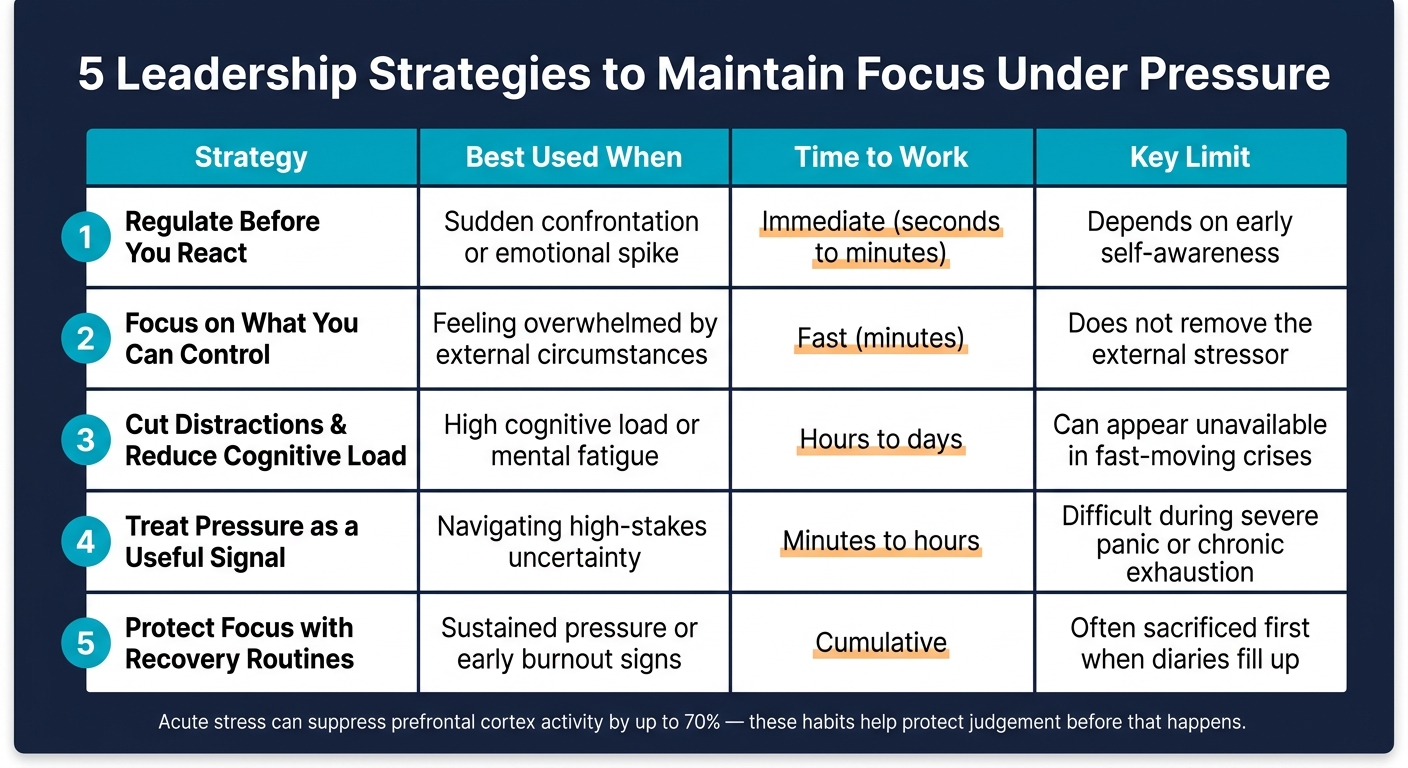
5 Leadership Strategies to Maintain Focus Under Pressure
Different kinds of pressure call for different responses. The method matters, but so does the moment. A tactic that helps in a sudden confrontation may do far less when a leader is already worn down by weeks of strain.
The table below sets out where each strategy tends to fit best.
| Strategy | Best Used When | Time to Work | Value | Limit |
|---|---|---|---|---|
| 1. Regulate Before You React | Sudden confrontation or emotional spike | Immediate (seconds to minutes) | Prevents reactive error | Depends on early self-awareness |
| 2. Focus on What You Can Control | Feeling overwhelmed by external circumstances | Fast (minutes) | Restores agency | Does not remove the external stressor |
| 3. Cut Distractions and Reduce Cognitive Load | High cognitive load or mental fatigue | Hours to days | Protects decision quality | Can be perceived as unavailable during a fast-moving crisis |
| 4. Treat Pressure as a Useful Signal | Navigating high-stakes uncertainty | Minutes to hours | Reframes pressure | Difficult to apply during severe panic or chronic exhaustion |
| 5. Protect Focus with Recovery Routines | Sustained pressure or early burnout signs | Cumulative | Supports sustained focus | Often the first thing busy leaders sacrifice for urgent tasks |
The pattern is fairly plain. Under acute stress, the first task is not deeper analysis. It is regulation. When stress sharpens, reasoning often narrows, and the risk of impulsive action rises. In practice, that means a leader facing an angry board member or a public challenge in a meeting is usually better served by pausing, breathing, and slowing the first response than by trying to “think harder” on the spot.
By contrast, when pressure is less explosive and more chronic, other tactics start to matter more. A chief executive dealing with a heavy week of investor calls, staffing gaps, and constant messages may gain more from reducing cognitive clutter, tightening priorities, and protecting recovery time. Those steps will not make the stress disappear, but they can help preserve attention and judgement.
Taken together, the five strategies form a sequence rather than a menu of isolated tips. They move from immediate emotional control towards longer-term protection of focus. For leaders working in tense, fast-moving settings, that distinction is not academic. It shapes whether pressure produces rash decisions, or steadier ones.
Conclusion
Under pressure, focus tends to fray when stress outpaces judgement. Focus in tense moments is not simply a fixed trait. Evidence suggests it can be trained through repeated practice. Research indicates that acute stress can suppress activity in the prefrontal cortex - the brain region linked to reasoning and impulse control - by as much as 70%. That is a biological response, not a moral failing.
The five habits outlined here matter because they disrupt the stress response before it shrinks judgement. They start with regulation, then move to control, simplicity, interpretation and recovery. In practice, that means slowing the initial surge, acting on what is still within reach, stripping out noise, treating pressure as data rather than drama, and making space to recover before strain builds further.
For leaders working under public, political or organisational scrutiny, the task is not to become calm by temperament alone. It is to rehearse steadier responses often enough that they hold when the stakes rise. In that context, organisations may wish to consider structured support. House of Birch offers bespoke executive coaching aimed at decision-making, emotional discipline and presence in critical moments.
The aim is not to remove pressure, but to meet it with deliberate action.
FAQs
How can I stay focused in a crisis?
Stay focused in a crisis by regulating the nervous system. That helps shift the brain and body from a reactive state towards calmer, more deliberate thinking.
A short strategic pause can help interrupt the first rush of stress. From there, steady breathing, such as the 4-7-8 method, may help slow the tempo of the moment: inhale for four seconds, hold for seven, then exhale for eight.
The next move is mental, not just physical. Reframe the situation around what can still be controlled. In practice, that might mean setting aside noise, narrowing attention to the facts at hand, and separating urgent signals from panic.
Then bring the focus down to one small, actionable step linked to core objectives. In a crisis, that could be as simple as confirming the next decision, calling the right person, or stabilising one part of the operation before moving to the next issue.
Which strategy helps most under sudden pressure?
Under sudden pressure, the most effective move is often the strategic pause. A brief stop can interrupt the brain’s fast survival response, creating a small but useful gap between trigger and action.
That gap matters. It gives a leader or speaker time to steady emotion, recover mental clarity and answer with precision rather than raw intensity.
What if stress affects my judgement?
If stress is affecting judgement, the brain may have shifted from deliberate thinking into a more reactive survival state. In plain terms, the mind starts to scan for danger instead of weighing options with care.
The aim is simple: interrupt that stress response and restore some mental clarity.
A few steps can help:
- Name the emotion being felt. Research in affective science suggests that putting feelings into words can reduce their intensity and make them easier to handle.
- Reframe the pressure as a challenge rather than a threat. That small mental shift can change how the situation is interpreted and may support steadier decision-making.
- Use grounding techniques, such as slow, mindful breathing or paying close attention to the immediate surroundings. These methods can help bring attention back to the present moment, which is often the first step towards calmer judgement.

