The Impact of Body Language on Leadership Effectiveness
Body language is a critical component of effective leadership, influencing how others perceive authority, trust, and competence. Research shows that non-verbal cues, such as posture, eye contact, gestures, and facial expressions, can carry more weight than spoken words. Leaders who align their body language with their message are more likely to build credibility and inspire confidence.
Key highlights include:
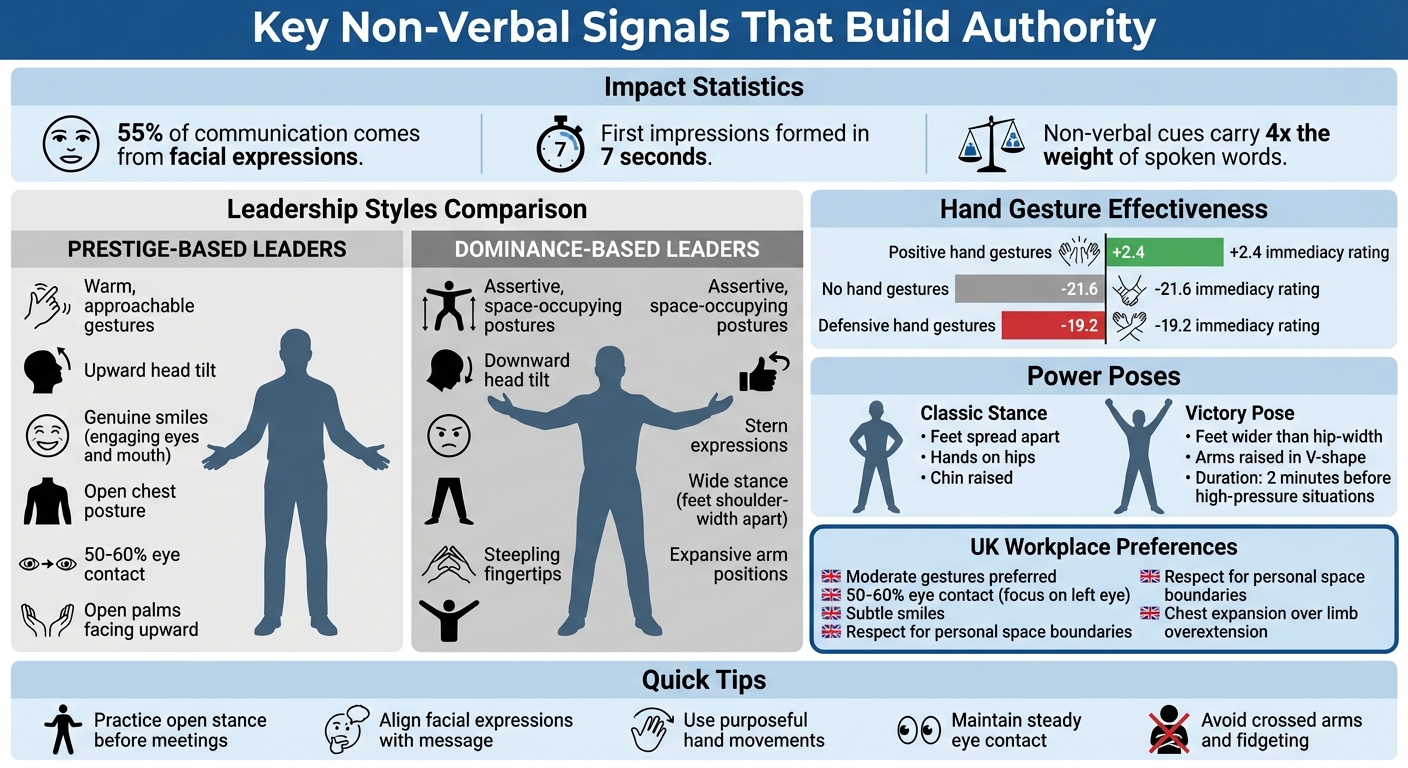
- Prestige vs. Dominance Styles: Prestige-based leaders use warm, approachable gestures, while dominance-based leaders rely on assertive, space-occupying postures.
- Cultural Sensitivity: In UK workplaces, moderate gestures, 50–60% eye contact, and subtle smiles are preferred for professionalism.
- Practical Techniques: Open postures, purposeful hand movements, and genuine facial expressions help project authority and approachability.
Simple adjustments, like practising an open stance or maintaining steady eye contact, can significantly enhance a leader's presence. By understanding and refining non-verbal communication, leaders can strengthen their impact in professional settings.
Body Language Leadership: Joe Navarro
Key Non-Verbal Signals That Build Authority
Body Language Signals for Leadership Authority and Trust
Posture and Physical Stance
An upright, open posture is essential for projecting a strong leadership presence. Poses that create an expansive stance - where arms and legs are positioned away from the torso - are universally associated with confidence and authority. Examples include the Classic stance, where feet are spread apart, hands rest on the hips, and the chin is raised, and the Victory pose, which involves standing with feet wider than hip-width and arms raised in a V-shape.
The way you expand your posture is key. Leaders aiming to establish authority through expertise should focus on chest expansion rather than overextending their limbs, which may inadvertently invade personal space, particularly in the UK where spatial boundaries are highly valued. A balanced stance with an open chest conveys confidence while respecting others' comfort zones.
A 2012 study from Harvard Business School highlighted the impact of preparatory posing. Participants who adopted expansive poses for just two minutes before delivering high-pressure speeches were rated higher in performance and "hireability" by evaluators. Interestingly, these positive impressions were not based on their words but on how they carried themselves. Before stepping into a critical meeting or presentation, taking a moment in private to practise an open stance can help set the tone for a more assured performance.
Your facial expressions play an equally vital role in reinforcing your authority.
Facial Expressions and Eye Contact
Your face communicates authority before you say a word. In fact, non-verbal cues such as facial expressions account for 55% of the message in any interaction. Leaders who wish to convey authority through approachability often use an upward head tilt and genuine smiles. These expressions signal warmth and accessibility, making them ideal for fostering collaboration. On the other hand, a downward head tilt and stern expressions can create distance, which might be useful in situations requiring a more formal or commanding presence.
In professional settings within the UK, maintaining steady eye contact - approximately 50–60% of the interaction - is crucial for building trust and engagement. To make this less intimidating, focus on one eye (the left is often recommended) rather than darting your gaze between both eyes, as this can overwhelm your listener.
"Social psychological research has shown that warmth is primary in impressions of others - it is judged first and is weighted more heavily in overall evaluations of people." - Amy J.C. Cuddy, Associate Professor, Harvard Business School
Authentic smiles, which engage both the mouth and eyes, are particularly effective in conveying sincerity. However, mismatched expressions - such as smiling while discussing a serious topic - can quickly undermine trust. It's also important to observe subtle cues in others. For instance, a rise in eye-blinking rates may indicate stress or discomfort, offering valuable insight into your team’s emotions.
Hand Gestures and Spatial Awareness
Hand gestures are another powerful tool for reinforcing authority and engaging your audience. Research into "immediacy" - a measure of how approachable and engaging a leader appears - found that leaders who used positive, purposeful hand gestures received significantly higher ratings (mean score of 2.4) compared to those who used defensive gestures (-19.2) or no gestures at all (-21.6). Open and deliberate hand movements signal confidence and attentiveness, while crossed arms or fidgeting hands can come across as defensive or uncertain.
"Participants perceived leaders with no hand gestures and defensive hand gestures to be distant or non-immediate and the leader with positive hand gestures to be more immediate or attractive." - Linda Talley & Samuel Temple, Leadership & Organisation Development Journal
Equally important is how you occupy space. Closed or defensive positions during pivotal moments can weaken your connection with an audience. However, overextending your limbs or invading personal space can be just as damaging, particularly in the UK, where maintaining respectful spatial boundaries is a cultural norm. The key lies in controlled and intentional movements that project confidence while ensuring others feel at ease. By combining thoughtful gestures with spatial awareness, leaders can create a commanding yet approachable presence.
Body Language in High-Pressure Leadership Situations
When the stakes are at their highest, the way you carry yourself speaks volumes. Whether it's during a crisis, a tough negotiation, or a challenging conversation, your posture, gestures, and facial expressions can either reinforce your leadership or weaken it.
Crisis Management and Emergency Response
In emergencies, teams instinctively look to their leader's non-verbal cues for reassurance. If your body language doesn't align with your words - like saying "everything is under control" while fidgeting or avoiding eye contact - your team is more likely to trust what they see over what they hear. Neuroscience backs this up, showing that when a leader's gestures clash with their speech, the brain generates a specific response (known as the N400 wave), causing confusion and disengagement among listeners.
"Good body language conveys both power and warmth to your team, letting them know that you're in charge, but also that they can trust you in a leadership role." - Heather Taynor, Chief Relationship Officer, End Zone Leadership
To project calm and authority in these moments, adopt a wide stance with your feet shoulder-width apart, knees relaxed, and your weight centred. This grounded posture exudes stability, which others will naturally pick up on. Lowering your vocal pitch can also help, as higher tones often signal nervousness. Another effective gesture is steepling - placing your fingertips together - which conveys confidence and control. Before stepping into a high-pressure situation, try power priming by recalling a previous success to help you exude natural confidence.
When inviting feedback or questions during a crisis, avoid crossing your arms. This closed-off gesture can make you appear defensive or unapproachable, creating uncertainty among your team. These same principles apply to calmer but equally high-stakes scenarios, such as boardroom discussions.
Boardroom and Investor Presentations
In structured professional settings, like boardroom meetings or investor presentations, precise body language is key to establishing credibility. First impressions count, and your posture and gestures play a big role. Stand tall with your shoulders back and maintain a straight posture. Engage with those in the room by using purposeful hand gestures, rather than appearing distracted by your phone or notes, which can signal a lack of focus.
| Non-Verbal Cue | Leadership Message | Potential Negative Interpretation |
|---|---|---|
| Steepling Fingertips | Confidence and Authority | Arrogance (if overdone) |
| Open Palms | Honesty and Transparency | Submission (in certain contexts) |
| Straight Posture | Confidence and Engagement | Rigidity |
| Consistent Eye Contact | Connection and Attention | Aggression (if perceived as staring) |
When discussing financial projections or addressing concerns, open palms facing upward can signal sincerity and transparency. Avoid distracting gestures like touching your face or fiddling with your clothing, as these can be seen as signs of nervousness or even dishonesty.
Facial expressions also matter. A mismatched expression - like a frown when delivering positive news - can undermine your credibility. Similarly, pay attention to your lower body. For instance, locking your ankles while sitting or standing can unintentionally signal nervousness to an attentive audience.
Handling Difficult Conversations
In situations like performance reviews or sensitive discussions, thoughtful body language can help to balance authority with empathy. A relaxed posture, with arms uncrossed, signals openness and helps to reduce defensiveness. Mirroring the other person's posture can further foster rapport and trust.
"Posture is such an important part of our communication process... the way that people perceive us is our posture." - Patrick Muñoz, Voice & Speech Coach
To convey trust, try slightly raising your eyebrows and giving a small, genuine smile. Research shows this combination is effective for projecting both friendliness and trustworthiness. Tilting your head slightly can also signal curiosity and attentiveness, while a Duchenne smile - one that engages both the eyes and mouth - appears more genuine than a smile that only involves the lips.
On the flip side, avoid intimidating postures like the "catapult" pose, where you sit with your hands behind your head and elbows out. This can come across as arrogant or confrontational. Instead, keep your hands visible with open palms to reduce any perceived threat, particularly in tense or emotional conversations.
sbb-itb-ce676ec
Building Body Language Skills and Self-Awareness
Improving your body language begins with self-awareness and making intentional adjustments. By applying the right techniques, you can identify areas to refine in your non-verbal communication and reinforce your leadership presence.
Using Feedback and Self-Observation
One of the most effective ways to uncover unconscious non-verbal habits is through video analysis. Recording yourself during rehearsals or presentations can reveal tendencies such as avoiding eye contact, adopting a closed posture, or making distracting hand gestures. A 2012 Harvard study found that leaders who used expansive, open postures before mock interviews were significantly more likely to be selected for hire. This wasn’t due to their words but rather the way they presented themselves. The quality of their presentation made all the difference, and you can only improve yours if you know what to address.
In addition to video analysis, seek feedback from colleagues or a professional coach. This 360-degree feedback can help you pinpoint and adjust non-verbal habits. Pay attention to whether your body language conveys prestige - signalling warmth, expertise, and approachability - or dominance, which can come across as intimidating or overly assertive. Both styles can be effective, but they need to align with your leadership goals.
These tools not only help you refine your non-verbal communication but also prepare you to manage stress in high-pressure moments.
Maintaining Composure Under Pressure
Stress often manifests physically before it shows in your words. Behaviours like rapid blinking, foot tapping, or touching your neck - known as pacifying behaviours - can signal nervousness. The key is to recognise these cues early and replace them with more composed habits. One simple yet powerful technique is controlled breathing. Slowing your breath can naturally calm your nervous system, helping you project a steady and confident presence.
Adjusting your posture is another effective strategy. Before facing a high-stakes situation, stand with a wide stance, centre your weight, and pull your shoulders back. This grounded posture not only makes you appear more stable to others but also reduces your own stress response. If seated, avoid crossing your arms or locking your ankles, as these closed-off positions can unintentionally convey discomfort or defensiveness.
Applying these techniques helps you maintain composure, even when the pressure is on.
Rehearsal Methods for Critical Moments
Once you’ve mastered stress management, rehearsing critical moments ensures you can deliver with poise. One method, known as power priming, involves adopting expansive, open postures in a private space - like an office or restroom - before an important event. Spend a few minutes standing tall with your hands on your hips or your arms open. The same 2012 Harvard study highlighted that this practice boosts performance, making leaders appear more confident and engaging.
"Fake it till you become it!" - Amy Cuddy, Social Psychologist
Incorporating these poses can foster a genuine sense of confidence.
Another effective technique is role-playing, especially for challenging conversations or high-pressure presentations. Practising with a colleague or coach allows you to receive real-time feedback on your posture, gestures, and facial expressions. Pay close attention to aligning your non-verbal cues with your message. For instance, delivering an inspiring vision while looking at the floor or hunching your shoulders creates a disconnect that can undermine your credibility. The more you practise, the more natural these adjustments will feel when it matters most.
Conclusion: Matching Body Language to Leadership Objectives
First impressions are formed in just seven seconds, with non-verbal cues carrying four times the weight of spoken words. This highlights how crucial it is for every gesture, posture, and expression to align with your leadership goals. Whether you're aiming to build trust with prestige signals like a warm smile and an open chest posture, or assert authority with dominance displays that take up space, your body language must reflect your intent.
The secret lies in consistent and intentional practice. Any mismatch between your non-verbal communication and your message can instantly damage your credibility. On the other hand, when your non-verbal cues consistently align with your words, they strengthen your overall impact as a leader.
"Personal space, physical gestures, posture, facial expressions, and eye contact communicate louder than words and, thus, can be used strategically to help leaders manage, motivate, lead global teams, and communicate clearly." - Carol Kinsey Goman, Ph.D.
For those ready to refine their leadership presence, House of Birch offers tailored 1:1 sessions. These focus on emotional discipline, strategic presence, and developing influence. Whether you choose to lead with prestige or dominance, deliberate practice will ensure your body language becomes a natural extension of your leadership style.
FAQs
How can leaders balance authority and approachability through body language?
Leaders can strike a balance between authority and approachability by using body language that thoughtfully combines cues of prestige and dominance. Prestige cues, such as maintaining relaxed, open postures, steady eye contact, and gestures like steepled hands or palms-up movements, help convey expertise and reliability. A calm facial expression paired with steady, measured hand movements further enhances a sense of approachability and confidence.
In scenarios where stronger authority is required - such as making critical decisions or resolving conflicts - leaders can temporarily adopt dominance cues. These might include standing with a slightly wider stance, using a firm and deliberate tone, or positioning their hands on their hips in an arms-akimbo posture. It’s crucial, however, to use such signals sparingly and transition back to a more collaborative style to avoid coming across as overly forceful or intimidating.
By thoughtfully blending these non-verbal signals and adjusting them to suit different contexts, leaders can build trust while projecting a sense of command. This ensures their body language supports their leadership objectives effectively.
What are the best body language tips for handling high-pressure leadership situations?
In situations where the stakes are high, leaders can radiate confidence and authority by using deliberate body language. Here are some practical ways to achieve this:
- Stand with an open and grounded posture – Position your feet shoulder-width apart, keep your shoulders relaxed, and open your chest. Avoid crossing your arms or legs, as this can seem closed off, and subtly lean forward to signal attentiveness.
- Make your gestures calm and deliberate – Move your hands in a smooth, controlled manner, keeping your palms visible. This conveys both openness and trustworthiness.
- Maintain steady eye contact – A calm and focused gaze can exude confidence without coming across as intimidating. Avoid letting your eyes dart around or holding a stare for too long.
- Relax your facial expressions and control your breathing – A composed face, perhaps with a gentle smile, coupled with slow, deep breaths can help you manage stress while projecting a sense of calm.
By mastering these techniques, leaders can strengthen their presence and foster confidence, even when navigating the toughest situations.
How does cultural awareness shape the use of body language in leadership across different regions?
Cultural awareness is essential for leaders aiming to use body language effectively across different regions. The meaning of gestures, eye contact, posture, and personal space can vary widely depending on cultural norms. For instance, in the UAE, where high power distance is common, an authoritative stance may be expected. In contrast, in the UK, a more balanced and approachable posture typically conveys confidence without appearing overly dominant. Similarly, while direct eye contact is often interpreted as a sign of honesty in many Western cultures, it can be perceived as confrontational in parts of East Asia.
To navigate these cultural differences, leaders can focus on building trust and demonstrating respect through thoughtful adjustments. For example, mirroring local greeting customs, being mindful of hand gestures, and maintaining a balance between warmth and authority with open body language and an upright posture can make a significant difference. Such awareness not only boosts credibility but also nurtures stronger relationships and fosters better team dynamics in diverse environments.

