How Leaders Stay Calm Under Pressure
When leaders face high-stress situations, their ability to remain composed can determine success or failure. Stress impacts the brain's decision-making processes, often leading to reactive rather than rational choices. However, research highlights practical techniques to help leaders manage pressure effectively:
- Understand stress responses: Stress disrupts the prefrontal cortex, impairing judgement and focus.
- Regulate emotions: Techniques like labelling emotions and practising mindfulness improve clarity.
- Use breathing exercises: Methods such as diaphragmatic or box breathing calm the nervous system.
- Reframe challenges: Viewing pressure as an opportunity rather than a threat reduces stress.
- Focus on control: Prioritising manageable tasks prevents overwhelm.
Emotional Regulation For Leaders: Staying Calm Under Pressure
The Science Behind Calm Leadership
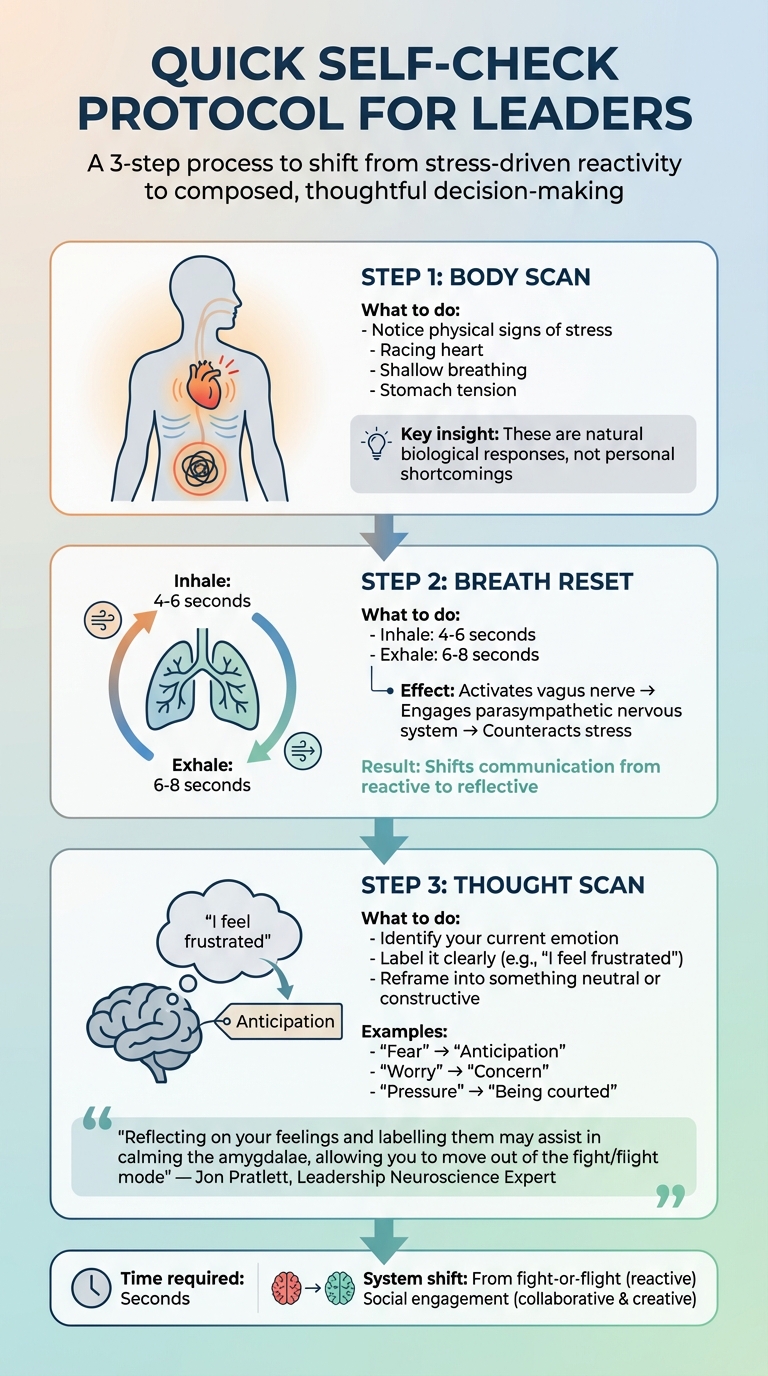
3-Step Self-Check Protocol for Leaders Under Pressure
How Stress Affects Decision-Making
When under pressure, the body reacts almost instantly. Two key systems kick into gear: the Sympathetic-Adrenal-Medullary (SAM) axis, which triggers the fight-or-flight response, and the Hypothalamic-Pituitary-Adrenal (HPA) axis, which releases cortisol to boost energy reserves. Cortisol levels can spike within minutes and remain elevated for 40–60 minutes after the stressor has subsided.
The prefrontal cortex, responsible for planning, judgement, and self-control, is particularly sensitive to stress - even mild levels can disrupt its functioning. Under stress, increased norepinephrine and dopamine levels weaken synaptic connections in the prefrontal cortex, impairing its ability to regulate behaviour. At the same time, the amygdala, the brain's emotional alarm centre, takes over. This shift narrows focus, prompting reactive, survival-based decisions instead of thoughtful, strategic ones. Acknowledging these changes enables leaders to make conscious, deliberate choices rather than falling back on instinct.
"The prefrontal cortex acts as a control centre that keeps our baser emotions and impulses in check. Acute, uncontrollable stress sets off a series of chemical events that weaken the influence of the prefrontal cortex whilst strengthening the dominance of older parts of the brain." – Amy Arnsten, Professor of Neurobiology, Yale School of Medicine
This shift has real-world consequences. Research involving university students found that higher cortisol levels were associated with poorer decision-making and an increased sense of time pressure, regardless of the task's complexity. Chronic stress can even reshape the brain itself - dendrites in the prefrontal cortex shrink, while those in the amygdala grow, further entrenching reactive patterns over flexible, reasoned responses. By understanding these physiological effects, leaders can begin to develop strategies for emotional control and better decision-making.
Emotional Regulation and Self-Awareness
Effective leadership under stress hinges on staying within the "window of tolerance" - a state where one remains calm, present, and able to think clearly. Falling outside this zone can lead to hyperarousal (manifesting as anxiety or anger) or hypoarousal (resulting in emotional detachment or mental fog).
The cornerstone of maintaining this balance is integrative awareness - the ability to connect internal signals with external cues. Leaders who can merge situational awareness with self-awareness are better equipped to spot early signs of stress before reacting impulsively. This requires metacognition, or the capacity to observe one’s own thoughts and emotions in the moment, creating a deliberate pause between stimulus and response.
Simple actions can make a big difference. For instance, labelling emotions - such as saying, "I feel frustrated" - has been shown to reduce emotional intensity and expand the window of tolerance. Studies on senior managers revealed that self-regulation training improved reaction times significantly during decision-making tasks, shifting responses from instinctive to deliberate.
A striking example of the consequences of poor emotional regulation occurred in March 2020. Dutch Minister for Medical Care Bruno Bruins collapsed in Parliament from exhaustion after weeks of relentless crisis management. This incident highlighted the dangers of "sacrifice syndrome", where a lack of self-awareness about emotional and physical limits leads to burnout and leadership failure. These lessons underscore the importance of self-regulation techniques for maintaining leadership effectiveness.
A Quick Self-Check Protocol for Leaders
To regain composure before making critical decisions, leaders can use a simple "body, breath, thought scan". This three-step process helps shift the mind from stress-driven reactivity to a more composed, thoughtful state.
- Body scan: Pay attention to physical signs of stress, such as a racing heart, shallow breathing, or tension in the stomach. These are natural biological responses, not personal shortcomings.
- Breath reset: Use controlled breathing to calm the nervous system. Inhale for 4–6 seconds, then exhale for 6–8 seconds. This activates the vagus nerve, engaging the parasympathetic nervous system to counteract stress. Even a brief pause can shift communication from reactive to reflective.
-
Thought scan: Identify and label your current emotion. As Jon Pratlett, a leadership neuroscience expert, explains:
"Reflecting on your feelings and labelling them may assist in calming the amygdalae, allowing you to move out of the fight/flight mode and free up energy allowing you to think more clearly about the issue at hand, rather than worrying".
Finally, try reframing the emotion into something neutral or constructive. For example, transform "fear" into "anticipation" or "worry" into "concern". This simple protocol, which takes only seconds, can shift your nervous system from a reactive state (fight-or-flight) to one of social engagement, where collaboration and creative thinking thrive.
Techniques for Staying Calm Under Pressure
Using Breathing Techniques to Reset Your Nervous System
Breathing exercises can play a crucial role in calming the body by activating the parasympathetic nervous system, which counters the fight-or-flight response through stimulation of the vagus nerve.
Diaphragmatic breathing, or belly breathing, involves taking slow, deep breaths that expand the abdomen rather than the chest. This signals the brain to move from a defensive state to one focused on connection and calm. Dr Esther Sternberg from the National Institute of Mental Health explains:
"Slow, deep breathing negates the fight-or-flight reaction by 'stimulating the opposing parasympathetic reaction–the one that calms us down'".
Another method, box breathing, is particularly effective in high-pressure scenarios. This technique involves a four-step cycle: inhale for a count of 4, hold for 4, exhale for 4, and hold again for 4. Similarly, the 4-7-8 technique involves inhaling through the nose for 4 seconds, holding for 7 seconds, and exhaling through the mouth for 8 seconds.
Practising alternate nostril breathing for 30 minutes daily has also been shown to significantly reduce stress levels. Moreover, deep breathing has been linked to increased melatonin production, which promotes relaxation and better sleep. Aiming for just 5 minutes of daily breathing exercises can help build resilience over time.
Next, let’s delve into how shifting your mindset can transform pressure into an opportunity for growth.
Reframing Pressure as a Challenge, Not a Threat
Cognitive reframing is a technique where you intentionally reinterpret a stressful situation as an opportunity for growth, learning, or innovation. This approach disrupts the fight-or-flight response in the brain’s amygdala, enabling a shift from a state of stress to one of engagement.
When faced with pressure, asking yourself specific questions can help shift your perspective. For example, "What can we learn from this?" or "How could this challenge make us stronger?". Other prompts, such as "What else could be true right now?" or "Will this matter in six months?" encourage a mindset that views challenges as manageable problems rather than overwhelming obstacles.
Re-labelling emotions is another powerful tool. For instance, consciously reframing feelings of pressure as a sign of being "courted" rather than overwhelmed can disrupt the brain's threat signals. This shift in perspective allows you to focus on what you can actively influence.
Focusing on What You Can Control
Building on these techniques, it’s essential to focus on what you can control. The "second arrow" framework offers a helpful way to manage stress by distinguishing between the unavoidable event (the first arrow) and your emotional reaction to it (the second arrow). While the first arrow is often beyond your control, the second arrow - your response - is where choice and mental discipline come into play. As Buddha observed:
"In life, we cannot always control the first arrow. However, the second arrow is our reaction to the first. And with this second arrow comes the possibility of choice".
Practising integrative awareness, which involves observing both external circumstances and internal reactions, helps avoid unnecessary overreactions. The 24-hour rule is another useful strategy, encouraging focus on what can be achieved today rather than spiralling into long-term "what-if" scenarios.
A powerful real-world example comes from March 2019, when New Zealand Prime Minister Jacinda Ardern demonstrated deliberate calm during the Christchurch mosque attacks. By focusing on controllable aspects, such as clear communication and compassionate leadership, she provided stability during a national crisis. As she put it:
"I refuse to believe that you cannot be both compassionate and strong".
Breaking tasks into smaller, manageable steps can also help regain a sense of progress when stress peaks. Starting each day by setting clear intentions for how you’ll respond emotionally to high-stakes issues can further reinforce a sense of control.
Using Effective Self-Talk
The words you say to yourself can significantly influence how you handle pressure. Simple self-talk phrases like "Focus on the next step" or "I've handled this before" can stabilise your emotions and behaviour during challenging moments.
Pairing self-talk with slow breathing can further calm the amygdala and reduce the threat response. For example, while practising deep breathing, acknowledge your feelings by saying, "I feel pressured", and then reframe it as, "I am being courted".
The 1-to-10 count technique offers another quick reset. Slowly count from 1 to 10 during inhalation and repeat during exhalation. This boosts oxygen intake and activates the parasympathetic nervous system, breaking the cycle of stress-induced emotional escalation.
In January 2021, a CEO leading a high-stakes technology project faced intense pressure from an investor threatening to withdraw board support. By using a self-regulation framework, she shifted from a reactive state to a more engaged and composed approach. By acknowledging her vulnerability and refocusing the discussion on the project’s purpose, she secured stronger board commitment and long-term funding.
sbb-itb-ce676ec
Building Long-Term Resilience for High-Pressure Leadership
While techniques like breath work and cognitive reframing can provide immediate relief during high-stress moments, true resilience for leaders requires daily habits that reinforce emotional regulation, focus, and recovery. Leaders facing ongoing high-stakes decisions benefit from practices that go beyond short-term fixes, building a foundation for sustained calm and effective decision-making.
Mindfulness and Attention Training
Mindfulness is a powerful tool for breaking the cycle of anxious thoughts that often distract leaders from the present. With 58% of employees reporting difficulty in maintaining focus at work, developing the ability to regulate attention is a crucial leadership skill.
Even dedicating just 10 minutes a day to mindfulness can help train the brain to shift from reactive to proactive thinking. Mindfulness encourages leaders to view stressful thoughts as fleeting "mental events" rather than indisputable truths requiring immediate action. A simple yet effective method is "naming", where a leader silently labels a stressful thought (e.g., "This is a thought that I might fail"). This approach creates emotional distance, reducing the thought’s intensity and impact.
The National Institute for Health and Care Excellence (NICE) advises organisations to offer mindfulness programmes to promote mental wellbeing across their workforce. For leaders, practising mindfulness strengthens their ability to notice unhelpful thought patterns and disengage from them before they influence decisions.
Pairing mindfulness with strong physical health habits further enhances long-term resilience against stress.
Physical and Cognitive Wellbeing
A leader’s physical health directly affects their ability to manage stress and maintain focus. Core habits such as getting 7 to 9 hours of restful sleep, engaging in regular physical activity like walking or yoga, and following a balanced diet are essential for stabilising mood and cognitive performance. When these routines are neglected, emotional regulation tends to falter.
In addition to physical health, cognitive habits like journalling and taking recovery breaks help leaders process complex emotions and avoid burnout. Another key practice is single-tasking. Unlike multitasking - which scatters focus, increases errors, and heightens stress - focusing on one task at a time conserves mental energy for critical decisions.
Setting Boundaries and Delegating Tasks
Without clear boundaries, leaders risk decision fatigue and burnout. When every issue ends up on their desk, their cognitive resources are depleted, leaving little room for strategic thinking.
The numbers are compelling: CEOs with strong delegation skills see a 112% higher growth rate over three years compared to their less-skilled counterparts and generate 33% more revenue. However, 41% of managers struggle to delegate effectively, often due to a belief that only they can handle key tasks.
| Boundary Type | Focus Area | Resilience Benefit |
|---|---|---|
| Decision-Making | Assigning decisions to appropriate levels | Reduces decision fatigue and empowers team autonomy |
| Time & Attention | Protecting time for strategic thinking | Prevents reactive leadership and preserves mental energy |
| Emotional | Supporting without absorbing team stress | Keeps the leader from becoming a source of stress |
| Role | Separating leadership from execution | Avoids micromanagement and encourages team growth |
Delegation works best when leaders practise "Smart Trust", which balances granting autonomy with appropriate oversight rather than relying on total control or blind trust. Practical tools like micro-scripts can help leaders protect their time. For instance, phrases such as "That decision is yours - what’s your current thinking?" or "I’m at capacity now, but I can revisit this next month" provide clarity while empowering others.
As leadership coach Leslie Rohonczy puts it:
"Boundaries don't restrict leadership; they enable it".
To prioritise effectively, leaders can use tools like the Eisenhower Matrix to categorise tasks by urgency and importance. Tasks that are urgent but not important (Quadrant 3) are ideal candidates for delegation. By freeing up their mental bandwidth, leaders can focus on the visionary and strategic work that only they can deliver.
Working with Leadership Advisers to Stay Calm Under Pressure
The Role of Expert Advisers and Coaches
Even seasoned leaders can struggle to navigate crises effectively. Stress often narrows their focus and triggers defensive behaviours, making it harder to identify solutions. This is where external advisers step in, offering an objective perspective to help leaders break free from reactive cycles. Many of these advisers draw on neuroscience-based frameworks, such as Polyvagal Theory, to guide leaders from a "fight-or-flight" response to a state of "engagement and connection." In this state, the body releases oxytocin, fostering collaboration and clearer thinking.
One key technique is co-regulation, where the adviser's composed presence helps stabilise the leader's nervous system. A compelling example comes from January 2021, when leadership adviser Robert E. Quinn worked with a CEO facing a crisis. The CEO's board members were withdrawing financial support due to pressure from a dominant investor. Quinn used a five-step self-regulation framework to shift both himself and the CEO from a defensive stance to one of openness. By acknowledging his own limited understanding of the situation, Quinn built trust, enabling the CEO to adopt a collaborative mindset. Within a month, they developed a strategy that restored the board's confidence and optimism. As Quinn explains:
"The more effectively you can self-regulate - particularly moving from the frequently occurring level two [fight or flight] to level three [engagement] - the better you can lead and help others".
These methods, reinforced by advisers, help leaders maintain clarity and avoid impulsive decisions, ensuring they stay focused on strategic priorities. Many leaders also turn to specialised firms for bespoke support tailored to their unique challenges.
House of Birch: Bespoke Support for High-Stakes Leaders
House of Birch offers tailored advisory services designed for leaders operating under intense pressure. Their expertise lies in developing emotional discipline, strategic foresight, and influence-building - skills that often determine whether a leader succeeds or struggles during critical moments. Through personalised sessions, House of Birch collaborates with leaders across different sectors and regions, helping them refine their decision-making processes and enhance their presence during pivotal situations.
One of the firm's standout approaches includes practical frameworks like paradoxical leadership, which balances intuition with data and risk-taking with thorough analysis. Another technique, defusion, helps leaders manage distractions by mentally "parking" urgent but non-critical issues - such as emails - until they can be addressed later. This method prevents cognitive overload during high-stakes scenarios, allowing leaders to focus on strategic decisions. Additionally, House of Birch supports leaders in creating a Personal Operating Model, which prioritises essentials like sleep, exercise, and meditation during prolonged periods of stress. By safeguarding these non-negotiables, leaders can sustain the mental and physical resilience needed to lead effectively.
Beyond individual coaching, House of Birch also works with leadership teams to embed calm and structured practices across organisations.
Embedding Calm Practices Across Leadership Teams
While individual resilience is vital, building organisational resilience requires calm practices to be integrated across leadership teams. Advisers assist leaders in moving beyond personal strategies to establish systems that manage volatile situations methodically. For instance, implementing weekly signal briefs that categorise updates as "noise", "prepare", or "act now" can help teams avoid knee-jerk reactions. These briefs also create a documented record of disruptions requiring strategic pivots.
Another important practice is protecting vision time - dedicated blocks for strategic planning that remain non-negotiable, even during crises. Without this, leaders risk burnout and diminished effectiveness. Advisers also encourage teams to adopt "Real Options" decision-making. This approach involves staged investments with periodic checkpoints, enabling organisations to adjust plans based on new information rather than committing to risky all-or-nothing decisions.
Conclusion
Calm leadership is about training your nervous system to respond rather than react. When stress sparks an amygdala hijack, techniques that interrupt the stress cycle allow your prefrontal cortex - the brain’s decision-making hub - to regain control. As Dr Jonathan Fisher aptly states:
"Calm doesn't mean moving slowly. It means thinking clearly".
While immediate stress-management techniques are helpful, they need to be complemented by consistent daily practices. Developing a Personal Operating Model and practising cognitive reframing can create lasting neural resilience. Research highlights how stress makes maintaining focus increasingly difficult, and for leaders, the stakes are even higher. Regular mindfulness and self-care routines strengthen the prefrontal cortex while reducing the reactivity of the amygdala, turning calmness into a habitual state rather than a fleeting one.
Leadership resilience also benefits from external support. Stress often narrows perspective and fosters isolation, which is why trusted advisers can be crucial. Co-regulation techniques, where another person helps stabilise your nervous system, and expert guidance can prevent cognitive pitfalls and sustain strategic focus. For example, organisations like House of Birch specialise in crafting bespoke strategies to help leaders maintain emotional discipline and clarity under pressure.
The wisdom of the Buddhist parable of the "second arrow" offers a fitting metaphor: while you cannot always control the first arrow - the crisis - you can control your response, the second arrow. Mastering calmness involves stopping that second arrow before it lands. Whether through mindful breathing, setting boundaries, or leaning on robust support systems, these practices enable leaders to not just endure stress but navigate it with clarity and purpose.
FAQs
How do leaders stay calm and focused under pressure?
Leaders can learn to keep their composure under pressure by understanding the brain's response to stress and practising techniques that encourage emotional control. When stress arises, the amygdala activates the fight-or-flight response, which can narrow focus and heighten anxiety. A straightforward way to counter this is by labelling emotions - simply naming feelings like fear or frustration can reduce their intensity and help regain a sense of control.
Incorporating mindfulness practices, such as focused breathing or brief meditations, strengthens the prefrontal cortex, which plays a crucial role in decision-making and maintaining resilience. Another helpful approach is cognitive reframing, which involves seeing challenges as opportunities for growth. This shift in perspective enables leaders to adopt a problem-solving mindset. Cultivating emotional intelligence - such as recognising personal triggers and managing reactions - further enhances the ability to lead calmly and effectively.
Resilience can also be bolstered by habits like regular self-reflection, deliberate planning, prioritising quality sleep, and staying physically active. At House of Birch, leaders can access personalised advisory services aimed at refining these skills, ensuring they remain composed and decisive when faced with critical situations.
What are effective ways for leaders to stay calm under pressure?
Staying composed in stressful situations is a key trait of effective leadership. To quickly regain focus, start with slow, deep breaths - this simple act can help calm your mind and reduce tension. Next, identify your emotions by mentally labelling what you're feeling. This practice can make it easier to process and manage your responses. Shift your perspective by reframing the situation - view it as a problem to solve rather than a crisis. Finally, pinpoint one immediate, actionable step to take control and move forward.
Consistently using these techniques can strengthen your emotional resilience, enabling you to think clearly even when the pressure is on.
How can viewing pressure as a challenge improve stress management?
Seeing pressure as a challenge can transform how you approach demanding situations. Instead of perceiving them as threats, you begin to recognise these moments as opportunities to develop and grow. This shift in mindset has a tangible effect, helping to minimise the body’s stress response and allowing you to concentrate on finding solutions rather than dwelling on problems.
For leaders, adopting this perspective can lead to sharper decision-making and a steadier emotional approach during pivotal moments. It’s an effective way to stay composed and turn high-pressure scenarios into chances to move forward with confidence and purpose.

