How Leaders Build Long-Term Vision
Effective leadership hinges on the ability to think beyond immediate challenges and shape a vision for the future. Leaders who can articulate a clear, forward-looking direction often make better decisions, avoid reactive pitfalls, and position their organisations for sustained growth. This article explores the key elements of long-term vision in leadership and offers practical approaches to developing it.
Key Takeaways:
- Vision guides decision-making: A clear vision sets a direction for the next 5–10 years, helping leaders prioritise and focus efforts.
- Different from mission and strategy: Vision defines the future, while missions, strategies, and goals address the present and the "how".
- Mental discipline matters: Leaders must resist short-term pressures and develop emotional resilience to stay on course.
- Practical frameworks: Tools like PESTLE analysis, the "1-10-100" framework, and structured reviews help leaders assess, plan, and adjust their vision.
By combining a clear vision with actionable steps, leaders can align their teams, navigate uncertainty, and create lasting impact.
Insightful Leaders: Long-Term Vision and Strategic Foresight
sbb-itb-ce676ec
The Foundations of Long-Term Vision
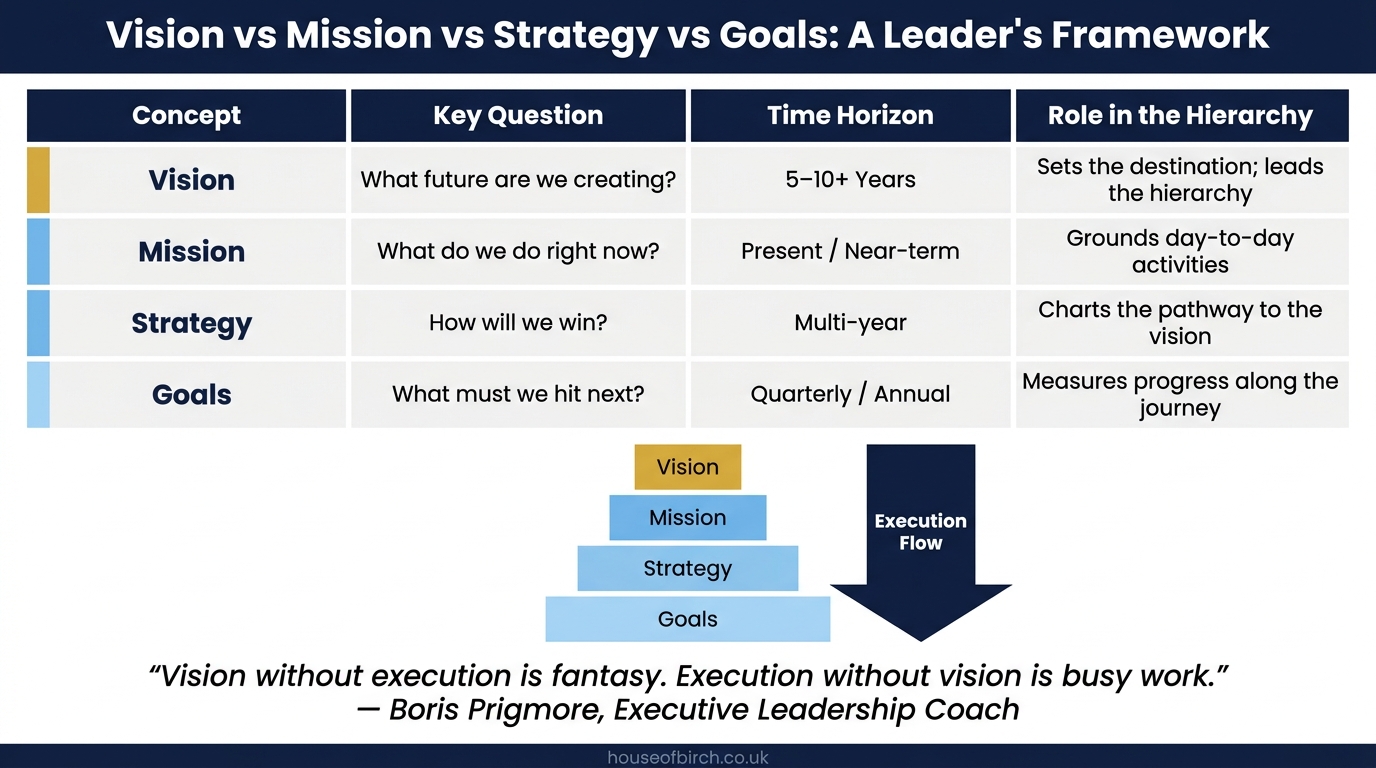
Vision vs Mission vs Strategy vs Goals: A Leader's Framework
What Long-Term Vision Means
A long-term vision provides a clear picture of where an organisation aims to be in the next 5–10 years. It essentially answers the question: What does success look like if our current efforts pay off?
Think of it as a leadership compass. While it doesn’t map out every step, it ensures you stay on course even as circumstances evolve, priorities shift, or short-term pressures arise. Daniel Goleman captures this idea succinctly:
"Vision articulates where a group is going, but not how it will get there - setting people free to innovate, experiment, take calculated risks."
However, vision isn’t just an abstract exercise in creativity. It operates as a decision-making framework, helping leaders identify what to prioritise, what to delay, and what to abandon entirely.
Grasping this definition highlights how vision stands apart from other organisational directives.
Vision vs Mission, Strategy, and Goals
These terms are often muddled, yet confusing them can undermine clarity - if everything is labelled as "vision", it risks becoming meaningless.
Here’s a simple breakdown to differentiate them:
| Concept | Key Question | Time Horizon |
|---|---|---|
| Vision | What future are we creating? | 5–10+ years |
| Mission | What do we do right now? | Present / near-term |
| Strategy | How will we win? | Multi-year |
| Goals | What must we hit next? | Quarterly / annual |
In this framework, vision leads the hierarchy. The mission grounds day-to-day activities, the strategy charts the pathway, and goals measure progress along the journey. Boris Prigmore, an Executive Leadership Coach, summarises the relationship well:
"Vision without execution is fantasy. Execution without vision is busy work."
This ordered structure explains why a well-defined vision has a distinct and critical role in guiding decisions.
What Makes a Vision Work
Not all visions are effective. Many organisations craft vision statements that fail to influence decision-making, often dismissed as irrelevant or overly generic.
A powerful vision is directional, specific, and distinctive. It sets a clear course for the future, describes success in concrete terms, and differentiates the organisation from others.
A useful litmus test is whether the opposite of your vision implies mediocrity. If it does, the vision is likely meaningful and directional. A strong vision also equips leaders and teams to reject distractions, misaligned initiatives, and opportunities that don’t align with long-term goals. This focus ensures everyday actions consistently support the broader vision, embedding strategic intent into the fabric of the organisation.
Leadership Capabilities That Support Visionary Thinking
A compelling long-term vision is only part of the equation; leaders also need to cultivate the mental and emotional skills to sustain and execute it effectively. These personal capabilities form the backbone of successful visionary leadership.
Building Strategic Awareness
Strategic awareness hinges on the ability to identify and act on critical signals before they become obvious. This transition from reactive to proactive leadership is key to anticipating and shaping emerging trends.
A good starting point is adopting structured approaches to environmental scanning. Tools like PESTLE (Political, Economic, Social, Technological, Legal, Environmental) help leaders gather insights across a wide range of domains, avoiding the trap of focusing too narrowly on a single sector. Additionally, monitoring capital flows within an industry can provide early clues about shifting strategic priorities, often months ahead of mainstream recognition.
Frontline insights are equally valuable. Subtle shifts, such as a niche technology gaining traction in a neighbouring market or nuanced changes in customer feedback, often serve as the earliest indicators of major developments.
"In a volatile environment, instinct without structure becomes reaction. Reaction might feel decisive, but it rarely builds long-term advantage." - Make Happy
To sharpen strategic thinking further, leaders can engage in "assumption busting." This involves challenging entrenched organisational beliefs by considering what might happen if the opposite were true.
Developing Emotional Discipline
Sustaining a long-term vision requires emotional resilience, especially when short-term pressures mount. Emotional discipline is a critical skill in this regard.
One common challenge is falling into the "certainty trap", where leaders, under stress, commit prematurely to a plan simply to escape the discomfort of uncertainty. As Faisal Hoque, Founder and CEO, observes:
"The leader who can't sit with not knowing will do almost anything to make the discomfort of uncertainty go away."
Cultivating the ability to tolerate ambiguity is essential. This involves treating emotional responses as data points rather than directives. When faced with strong instincts, leaders might ask themselves, "What am I trying to protect?" or "What would a fearless decision look like?".
House of Birch, a consultancy specialising in executive performance, addresses this challenge through its Biopsychosocial (BPSC™) framework. This approach evaluates leaders across biological (stress management), psychological (threat perception and decision-making), and social (power dynamics and incentives) dimensions, ensuring they can perform effectively under complex, high-pressure conditions.
By mastering emotional discipline, leaders can maintain focus on long-term objectives rather than being derailed by immediate challenges.
Thinking Across Longer Time Horizons
While many leaders excel in tactical execution, fewer sustain strategic thinking over extended periods. Henley Business School identifies this as a growing challenge for leaders, noting that tactical strengths often come at the expense of considering the broader, long-term impact of decisions.
This short-term bias can obscure gradual but significant issues, such as cultural decline or capability gaps, which often result from a series of individually rational decisions that collectively create unintended consequences.
To counter this, leaders can use the "1-10-100" framework to evaluate the impact of decisions over 1 week, 10 months, and 100 months. Combining this with second-order questioning - moving beyond "Will it work?" to "If this works, what does it enable next?" - fosters a mindset that distinguishes visionary leaders from those focused solely on execution.
"Long-horizon thinking reframes leadership from control to stewardship - a commitment to act decisively today while carrying responsibility for what those actions set in motion over time." - Rebecca Agent, Author and Strategist
How to Build a Long-Term Vision Framework
Learn how to turn ambitious goals into actionable strategies by grounding them in a structured framework.
Assessing Where You Are Now
Before setting a long-term direction, it’s crucial to understand your current position. Start by conducting an internal capability audit. This involves evaluating your organisation’s skills, technologies, and resources, and comparing them against emerging market trends. Pair this with a cultural health check, using tools like eNPS (Employee Net Promoter Score), engagement surveys, and retention metrics. These insights can reveal whether your organisational culture is an asset for long-term success or a potential obstacle.
To complement this internal analysis, perform a macro-environmental scan using models like PESTLE (Political, Economic, Social, Technological, Legal, and Environmental factors) and a competitive analysis with frameworks such as Porter’s Five Forces. These approaches help identify “no-regret moves” - decisions that remain effective across various potential future scenarios, not just the one you’re planning for.
"A plan built around a single expected future is only useful for the future it expects." - Kurt Graver, CEO, SGI Consultants
Equally important is establishing a financial baseline. Review your organisation’s cash reserves, capital structure, and operational expenditure. Without a clear understanding of these financial fundamentals, even the most ambitious vision will falter. Once these assessments are complete, you’ll have a solid foundation to craft a forward-looking vision.
Writing a Future-Focused Vision Statement
With a clear understanding of your current state, the next step is defining your desired future. A future-back approach can help: start by imagining a long-term success scenario, then work backwards to identify the steps needed to get there.
Your vision statement should be both specific enough to guide decisions and inspiring enough to energise the organisation. It’s not just about describing measurable outcomes; it’s about capturing what success feels like. For instance, research shows that strategic plans with fewer than 20 elements (including goals, measures, and milestones) are associated with a 68% rate of high performance.
Simplicity is key. The One-Page Strategic Plan (OPSP) is a useful tool, condensing your vision, mission, values, and goals into a single, accessible document. This ensures clarity and makes the vision easy to communicate across teams.
Aligning Vision with Strategy and Values
A long-term vision must seamlessly integrate with your organisation’s strategy and values. This means ensuring that every decision - from product development to revenue targets - aligns with your broader ambitions. A well-aligned vision directly informs medium-term goals, such as 3–5-year strategies, while also shaping day-to-day activities.
Your organisation’s core values should act as a compass for decision-making. For example, if integrity and sustainability are central to your values, but your vision prioritises short-term growth at any cost, this creates a conflict that could undermine credibility. Use values as decision filters to guide choices when the way forward isn’t clear.
Lastly, test your vision against a range of scenarios. Ask whether it holds up under conditions like losing a key customer, facing stricter regulations, or adapting to disruptive technologies. Organisations that incorporate this kind of foresight into their planning are better equipped to remain resilient in the face of uncertainty.
Putting Vision into Practice Across the Organisation
A vision that isn't shared or operationalised risks becoming irrelevant. Once leaders have defined the vision and assessed the organisation's capabilities, the next step is ensuring it permeates every level of the organisation, turning a conceptual idea into a tangible, day-to-day reality.
Breaking Vision Down into Actionable Goals
The bridge between a bold vision and its practical implementation lies in clear, actionable goals. Many strategic plans fail, not because the ideas are flawed, but because they lack effective execution. Studies indicate that 60% to 90% of strategic plans either stall or fall apart during implementation.
A structured approach - Vision → Strategic Bets → Measurable Outcomes → Team Scorecards → Weekly Decisions - ensures the vision translates into concrete actions. This step-by-step framework helps align daily decisions with overarching goals.
Leaders must also juggle three planning horizons: a long-term vision (spanning five or more years), a medium-term strategy (three to five years), and short-term 90-day execution cycles. These 90-day cycles maintain momentum and allow for adaptability while keeping the long-term vision in focus. Importantly, separating strategic planning from financial constraints - such as budget pressures - can lead to a 40% improvement in strategy quality.
"The essence of strategy is choosing what not to do." - Pinnacle Wellbeing Services
To avoid spreading efforts too thin, it's wise to focus on three to five strategic priorities per quarter. Treating everything as urgent dilutes focus and hampers execution.
Communicating Vision to Different Audiences
One of the most overlooked skills in leadership is maintaining consistency when communicating a vision. Whether addressing the boardroom, a company-wide meeting, or an individual team member, the vision must remain consistent. Mixed messages can create doubt, while a unified message reinforces confidence and strategic discipline.
However, while the core vision stays the same, the way it is framed should adapt to the audience. For instance:
- Boards need to hear about risk, succession planning, and long-term investments.
- Employees want clarity on how the vision impacts their roles and responsibilities.
- Investors seek a credible plan for sustainable growth.
"If people cannot articulate your vision, they cannot execute it." - Penny Strutton, Business Psychologist & Strategic Coach
Storytelling can make a vision more relatable and memorable. Abstract goals like "market leadership" or "transformational growth" often fail to inspire. Instead, sharing real-world challenges and outcomes brings the vision to life. Embedding the vision into onboarding programmes ensures new employees grasp its significance from the start, while linking decisions explicitly to the vision reinforces its role as a guiding principle.
Once the vision has been effectively communicated, the focus must shift to tracking progress and refining the vision as needed.
Tracking Progress and Updating the Vision
Achieving a long-term vision requires regular and structured reviews. A clear review cadence ensures that progress is monitored and adjustments are made when necessary:
| Review Level | Frequency | Focus |
|---|---|---|
| Delivery Rhythm | Weekly | Immediate priorities, progress, and addressing blockers |
| Steering/Alignment | Monthly | Reviewing key performance indicators (KPIs), customer feedback, and tactical adjustments |
| Strategic Review | Quarterly | Scenario testing, monitoring key milestones, and resetting goals |
| Strategic Refresh | Annual | Challenging assumptions and updating the long-term vision |
Leaders should focus on three to five KPIs that directly reflect progress towards the vision. Overloading with too many metrics risks losing sight of the bigger picture. Additionally, pre-determined triggers - such as a significant regulatory change or a notable market shift - should prompt a formal strategic review. Assigning specific C-level accountability for monitoring these external signals ensures readiness to act.
"Strategy doesn't fail because leaders stop caring. It fails because leaders stop meeting in the right rhythm." - Oak Consult
Adapting the vision over time is not a sign of failure but an indication of organisational maturity. As external conditions change, recalibrating the vision ensures it remains relevant and actionable. The aim is not to cling rigidly to the original vision but to preserve and refine its core ambition.
For leaders navigating these challenges, House of Birch offers tailored executive coaching and advisory services, designed to strengthen decision-making, enhance leadership presence, and expand influence in complex environments.
Conclusion: Keeping Long-Term Vision Alive in Leadership
Long-term vision operates as a dynamic framework, influencing decisions, recruitment, and organisational culture. Leaders who sustain it view vision not as a static declaration but as an ongoing practice that requires both consistency and flexibility.
The statistics are striking: 85% of leadership teams dedicate less than an hour each month to discussing strategy, and leaders often communicate their vision far less than they should - by a factor of ten. To maintain a meaningful long-term vision, leaders need regular reviews, open discussions about successes and failures, and the willingness to adjust tactics while staying true to overarching goals. This underscores the importance of weaving vision into every leadership dialogue.
"The long view doesn't eliminate urgency. It situates it. It reminds us that we're always shaping what becomes normal through the trade-offs we make." - Rebecca Agent, Strategic Consultant
Effective leaders adopt what could be called intelligent elasticity - staying committed to their core purpose and values while adapting strategies and execution to changing circumstances. They focus on distinguishing between irreversible decisions and those that can be revisited, enabling quicker adjustments without jeopardising long-term direction.
FAQs
How do I turn a long-term vision into weekly actions?
To translate a long-term vision into consistent weekly actions, think of it as a system rather than a standalone declaration. Begin by defining five-year goals and then break these down into clear, measurable objectives for the year, quarter, and month. From there, identify actionable steps for the next 90 days. Align your daily tasks by evaluating whether they actively contribute to these goals. For critical decisions, apply second-order questioning - considering the broader and longer-term consequences. Regularly incorporate your vision into weekly reviews to ensure focus and steady progress.
What are the best triggers to revisit or refresh our vision?
Leaders are encouraged to move away from rigid calendar-based reviews and instead adopt a signal-driven approach. This method focuses on reacting to specific triggers, such as:
- Increasing market or customer demands that fall outside your current strategic focus.
- Team members finding it difficult to align their work with the overarching strategy.
- Significant external events, like regulatory shifts or competitive moves.
- Ongoing internal disagreements about the scope or direction of key projects.
House of Birch provides bespoke advisory services designed to pinpoint these critical moments and help refine strategic vision with precision.
How can I keep a long-term vision credible under short-term pressure?
To maintain a credible long-term vision while navigating short-term pressures, leaders can adopt several practical strategies:
- Connect long-term goals with short-term outcomes by identifying measurable indicators that reflect progress and keep stakeholders engaged.
- Prioritise impactful decisions, steering clear of distractions caused by unnecessary urgency or reactive choices.
- Communicate openly about priorities and uncertainties to foster trust and credibility.
- Integrate the vision into everyday operations, ensuring it informs decision-making and resonates throughout the organisation.
House of Birch provides tailored support to help leaders sustain strategic focus, even under challenging conditions.

