Game Theory Tools for Complex Negotiations
Game theory offers a structured approach to understanding negotiations, particularly in situations where outcomes depend on the actions of others. By analysing key models like the Prisoner's Dilemma, Nash Bargaining Solution, Chicken Game, Stag Hunt, and Trust Game, negotiators can better predict behaviours, manage risks, and identify areas for cooperation or competition. These frameworks provide practical insights into fostering collaboration, handling brinkmanship, and navigating uncertainty in high-stakes scenarios.
Key takeaways include:
- Prisoner's Dilemma: Highlights risks of mistrust and mutual losses in competitive settings.
- Nash Bargaining Solution: Focuses on fairness and stability, assuming complete information.
- Chicken Game: Examines brinkmanship and the dangers of escalation.
- Stag Hunt: Emphasises trust and commitment for achieving shared goals.
- Trust Game: Explores reciprocity and long-term cooperation.
Each model has its strengths and limitations, making it essential to align the framework with the negotiation context. Whether managing supplier agreements, mergers, or international collaborations, these tools can help leaders make informed, rational decisions that balance risks and rewards.
Bargaining 101 (#2): Using Game Theory
sbb-itb-ce676ec
1. Prisoner's Dilemma
The Prisoner's Dilemma illustrates a key challenge in negotiations: when both parties act in their own self-interest, they can end up worse off than if they had worked together. The classic scenario involves two individuals deciding whether to cooperate or betray each other. If both choose to cooperate, they share a mutual benefit. If one betrays while the other cooperates, the betrayer gets the best outcome, while the cooperator suffers the "sucker's payoff." However, if both betray, neither benefits, and both face poor outcomes.
This dynamic often plays out in business. For instance, two suppliers competing for a retailer's contract might aim to win by undercutting prices. While they could focus on maintaining quality and healthy margins, the pressure to lower prices may lead to a race to the bottom, where neither achieves profitability. Scotwork, a negotiation consultancy, once helped a client facing a 25% fee reduction demand by redesigning their pricing structure. This preserved their margins and opened up alternative opportunities.
Applicability to Repeated Negotiations
The stakes change when negotiations occur repeatedly. In a single, one-off interaction, betrayal often seems like the safest choice. However, in ongoing negotiations with no clear endpoint, cooperation becomes a more rational strategy. Trust can be rewarded over time, while betrayal risks long-term consequences. In such scenarios, the 'Tit-for-Tat' strategy is particularly effective. This approach starts with cooperation, mirrors the other party's actions, and allows for occasional forgiveness to break cycles of retaliation.
"Successful strategies must be forgiving. Though players will retaliate, they will cooperate again if the opponent does not continue to defect." – Robert Axelrod
Handling Uncertainty
Uncertainty complicates the Prisoner's Dilemma further. Take climate policy as an example: when the benefits of cooperation are unclear or hard to measure, states often hesitate to work together as much as they might if outcomes were more predictable. Game theory solutions also rely on precise assumptions, and small changes in variables such as costs or demand can completely alter the optimal strategy. Instead of relying on a single solution, leaders should explore multiple scenarios and select strategies that balance risks and rewards effectively. In such uncertain environments, tailored risk management becomes crucial.
Risk Management in High-Stakes Scenarios
In high-stakes negotiations, aligning incentives to encourage cooperation is critical. Clear communication, joint bidding agreements, and well-defined exit clauses can help reduce uncertainty and build trust. Shifting the focus from price to value - such as offering service guarantees or performance-based commitments - can also prevent destructive price wars. Additionally, identifying specific market triggers, like changes in demand, can signal when to adjust strategies, moving from coexistence to more assertive actions if necessary.
2. Nash Bargaining Solution
The Nash Bargaining framework offers a structured way to navigate negotiations, focusing on fairness and mutual benefit. It provides a mathematical method to determine fair outcomes when parties can commit to binding agreements. The solution works by maximising the product of each party's utility gains relative to their "disagreement point" - essentially, the minimum acceptable outcome each side would settle for if negotiations fail.
This disagreement point plays a pivotal role in shaping the negotiation dynamics. It establishes a baseline for what each party is willing to accept and directly influences their bargaining power within the Nash framework. Take the example of a corporate merger: understanding your company’s standalone value gives you a clear benchmark to strengthen your position. This clarity not only improves your leverage but also lays the groundwork for a balanced negotiation process.
Effectiveness in Promoting Cooperation
The Nash Bargaining Solution is designed to deliver outcomes that are both Pareto optimal and equitable. This balance between efficiency and fairness fosters stability. Once an agreement satisfies the Nash Equilibrium, neither party has an incentive to back out, reducing the chances of the deal collapsing.
"Cooperative game theory analyzes interactions where agents can make binding agreements and it inquires how cooperative opportunities faced by alternative coalitions of agents shape the final agreement reached." – Özgür Kıbrıs, Professor, Sabanci University
However, the framework assumes complete information about all parties' preferences and payoffs. In reality, negotiators seldom have perfect knowledge of the other side’s values. Within the Nash framework, transparency becomes essential for aligning outcomes with Pareto optimality. Tools such as payoff matrices and decision trees can also help visualise strategies and identify mutually beneficial outcomes that adhere to Nash principles.
Addressing Uncertainty
While traditional Nash Bargaining assumes static conditions and full information, real-world negotiations are rarely so straightforward. Modern variations of the model address scenarios with uncertain disagreement points and incomplete information, where parties may lack a full understanding of the consequences of failed talks. A negotiator’s tolerance for risk also impacts how they value potential outcomes, influencing the Nash product and, ultimately, the final agreement. These complexities highlight the importance of robust risk management in high-stakes negotiations.
Managing Risk in Complex Deals
In high-stakes scenarios, formalising agreements is non-negotiable. Since the Nash solution assumes enforceable agreements, it’s crucial to document terms clearly and include contingency plans. For ongoing negotiations, dynamic models that factor in time discounting - where delays reduce the value of outcomes - can add urgency and help avoid prolonged disputes. This approach not only speeds up resolutions but also ensures that the negotiation process remains thorough and effective for complex situations.
3. Chicken Game
The Chicken Game illustrates the danger of escalating conflicts to the brink of disaster. In this scenario, two parties push each other to the edge, with the first to back down being labelled the "loser." However, if neither side concedes, the result is a catastrophic "crash", leaving both worse off than if they had compromised. This strategy is often misused by negotiators who equate aggression with strength, but the risks can far outweigh the rewards.
In high-stakes situations, refusing to yield can lead to severe consequences, such as expensive legal battles or the collapse of a deal. The key to navigating this dynamic lies in assessing your opponent's credibility. Are they genuinely prepared to risk everything, or are they likely to back down? Much like the Prisoner's Dilemma, success hinges on understanding trust and credibility to avoid mutual destruction.
Managing Risks in High-Stakes Conflicts
To reduce the risks of brinkmanship, consider reframing the conflict into collaborative opportunities, such as joint ventures or licensing agreements that provide shared benefits. Another effective strategy is involving a neutral third party to mediate the dispute.
"We propose a neutral third party assess licensing rights. If there's overlap, we split it. If not, we walk. That way, neither of us wastes time in court." – Scotwork
The aggressive nature of the Chicken Game can leave long-term relationships in tatters, often turning both sides into losers. Before escalating, it’s essential to evaluate whether the other party's threats are credible. In competitive environments, such as price wars, shifting the focus from cost to added value or performance guarantees can help protect profits and avoid a damaging race to the bottom. This balanced approach to brinkmanship paves the way for examining more cooperative strategies, like those found in the Stag Hunt model.
4. Stag Hunt
The Stag Hunt framework illustrates the balance between pursuing a high-risk, high-reward collaborative goal (the "Stag") and opting for a safer, lower-reward individual objective (the "Hare"). In negotiations, the potential for substantial mutual gain hinges on both parties trusting each other to uphold their commitments. When trust wavers, negotiators often gravitate toward the smaller, guaranteed rewards. This model builds on prior theories by highlighting the critical role of mutual commitment in successful collaboration.
Take, for instance, two companies vying for a government contract. They face a choice: partner up to secure the lucrative deal together (the "Stag") or compete individually for smaller contracts (the "Hare"). While the joint venture offers significantly greater rewards, it demands a high level of trust that neither party will abandon the agreement midway.
Effectiveness in Encouraging Cooperation
Unlike the Prisoner's Dilemma, where self-interest frequently leads to betrayal, the Stag Hunt revolves around coordination. It emphasises the importance of trust to unlock the best collaborative outcomes. Even when both parties share a common interest in cooperation, doubts about the other's reliability can drive them toward the safer, less rewarding option. Achieving the larger rewards requires shared ambition, clear alignment of goals, and confidence in mutual follow-through.
To guide negotiations toward a cooperative outcome, uncertainty must be minimised. Open communication that clarifies commitments before formal discussions can build trust. Formal agreements, such as joint bidding arrangements or partnership contracts, can further strengthen collaboration by clearly defining roles, responsibilities, and how rewards will be distributed. Including exit clauses in these agreements also safeguards against potential breaches of trust.
Relevance in Repeated Negotiations
In ongoing partnerships, the Stag Hunt framework becomes even more relevant. Over time, the cumulative benefits of cooperation often outweigh the short-term allure of individual gains. The temptation to defect to the "Hare" strategy diminishes when the advantages of a credible, sustained partnership are clear. Repeated interactions provide opportunities for strategic signalling - such as offering exclusivity or improved terms - to reinforce a commitment to the long-term "Stag" outcome.
5. Trust Game
The Trust Game is a sequential interaction where one party, known as the "trustor", takes a risk by transferring resources to another party, the "trustee", who then decides whether to honour that trust or exploit it. The process includes a multiplier effect, meaning that cooperation can generate greater benefits than either party could achieve alone.
Effectiveness in Encouraging Cooperation
Traditional game theory predicts no trust in one-off scenarios, yet behavioural studies show that individuals often choose to trust others despite the risks involved. In repeated interactions, trust becomes more viable due to what is called the "shadow of the future." This concept is tied to a discount factor (δ), which ranges from 0 to 1, reflecting how much parties value long-term gains over short-term benefits. A higher discount factor encourages maintaining a cooperative reputation because the cumulative rewards of trust outweigh immediate self-interest.
Strategies like tit-for-tat - where cooperation is rewarded and exploitation leads to reduced future engagement - help sustain trust over time. Often, small initial transfers act as tests to gauge reliability before larger commitments are made. For example, a supplier might offer a modest loyalty incentive to assess whether a buyer adheres to payment terms before extending more generous credit arrangements.
However, trust-based strategies are not without challenges, particularly when uncertainty clouds the exchange.
Managing Uncertainty
In situations where information asymmetry exists, mitigating risk becomes crucial. Starting with smaller transfers can limit potential losses while keeping verification costs manageable. Strategic signalling - such as offering exclusivity or better terms without being asked - can also bridge information gaps and demonstrate goodwill.
For high-stakes exchanges where personal trust alone may fall short, formal mechanisms can provide additional security. Tools like collateral agreements, insurance, or service-level agreements with penalties create a framework for accountability and reduce the likelihood of defection. Reputation systems on platforms like eBay and Airbnb are modern examples of large-scale Trust Games, using reviews and ratings to establish trust in the absence of face-to-face interactions.
Risk Management in High-Stakes Negotiations
When stakes are high, managing risk becomes even more critical. In some cases, parties shift to trust-based approaches when they realise cooperation is the only way to avoid mutual losses. A weaker party might strategically offer a concession as a gesture of trust, hoping to elicit reciprocation. To navigate such scenarios effectively, identifying your BATNA (Best Alternative to a Negotiated Agreement) beforehand ensures you retain leverage if negotiations fail. Additionally, if trust is breached, expressing disappointment rather than anger can encourage future collaboration while avoiding long-term damage to the relationship.
Comparison of Strengths and Weaknesses
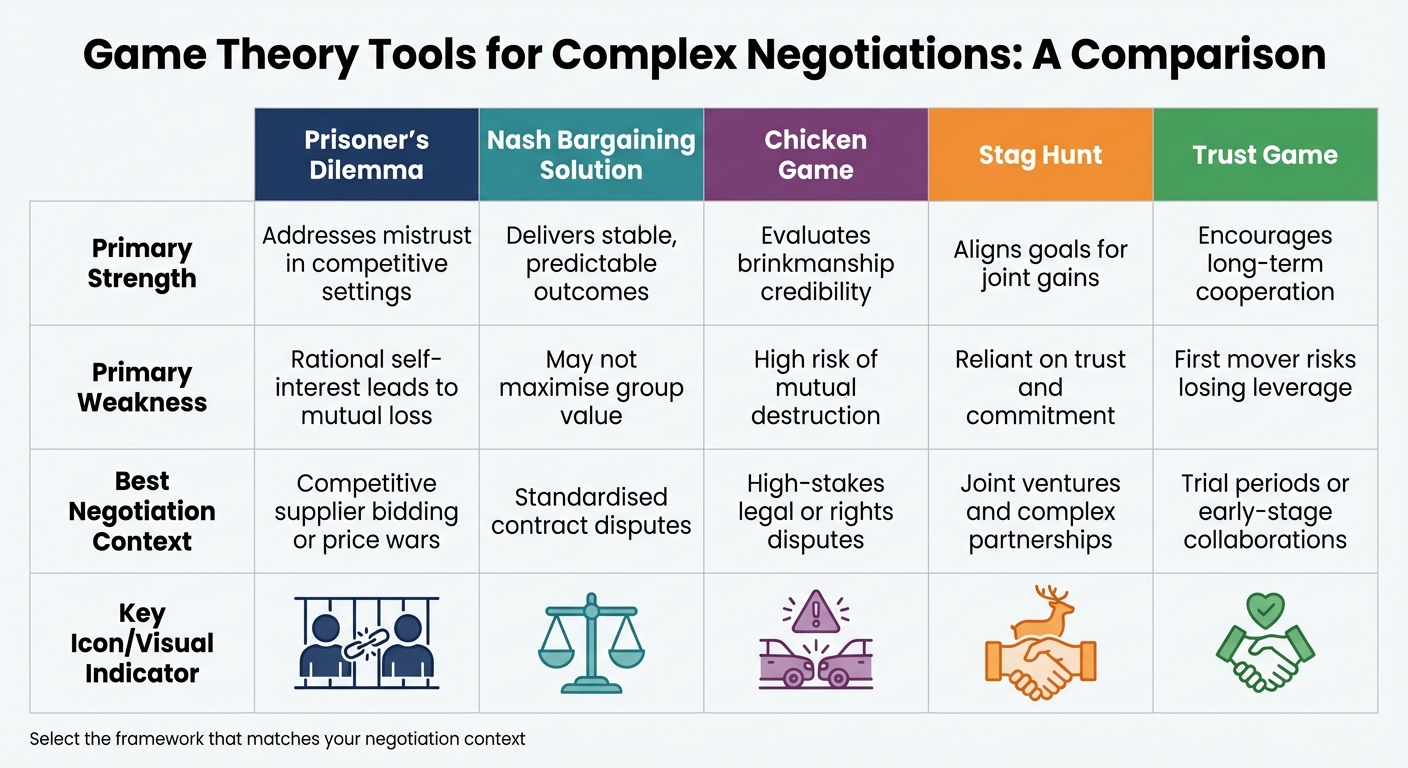
Game Theory Models for Negotiations: Strengths, Weaknesses and Best Use Cases
Building on the detailed analysis of each model, this comparison highlights the distinct advantages and challenges of these game theory tools, helping to clarify their suitability for various negotiation scenarios.
Each game theory framework offers specific strengths and drawbacks, making it essential to understand where they perform well - and where they may fall short - when applied to real-world negotiations.
The Prisoner's Dilemma showcases how mistrust can lead to mutual losses. It is particularly effective in scenarios like competitive supplier bidding or price wars, where rational self-interest can result in a "race to the bottom." However, its main limitation occurs in one-off interactions. Without repeated engagements, players often default to defection, leading to a sub-optimal Nash Equilibrium where both sides lose.
The Nash Bargaining Solution provides stable and predictable outcomes by identifying situations where no player can improve their position through unilateral action. This makes it well-suited for standardised contract disputes, where consistency is critical. However, these equilibrium outcomes may not always maximise overall group value. Additionally, the model relies on assumptions of complete rationality and full information - conditions rarely found in real-world negotiations.
The Chicken Game is valuable for evaluating brinkmanship in high-stakes situations such as legal disputes or market entry battles. For instance, two software firms disputing rights to the same algorithm ultimately opted for a joint licensing agreement, turning potential legal risks into shared revenue. However, the game’s inherent risk is severe: if neither side concedes, both face catastrophic losses - the "crash" that defines this framework.
The Stag Hunt is ideal for scenarios where aligned goals can maximise joint gains, such as joint ventures or complex partnerships. A typical example involves two firms considering a joint bid for a large government contract. They must decide whether to pursue the ambitious "stag" together or settle for safer, smaller individual contracts (the "hare"). The main challenge lies in trust: if one party doubts the other’s commitment, both may choose the safer option, leaving significant value unrealised. Clear agreements outlining roles, responsibilities, and exit terms can help mitigate this uncertainty.
Finally, the Trust Game focuses on fostering long-term reciprocity. Research indicates that cooperation can emerge even when traditional theory suggests otherwise. However, the first mover in this framework risks losing leverage if the expected reciprocity fails to materialise.
The table below provides a concise summary for easy reference:
| Game Theory Tool | Primary Strength | Primary Weakness | Best Negotiation Context |
|---|---|---|---|
| Prisoner's Dilemma | Addresses mistrust in competitive settings | Rational self-interest leads to mutual loss | Competitive supplier bidding or price wars |
| Nash Bargaining Solution | Delivers stable, predictable outcomes | May not maximise group value | Standardised contract disputes |
| Chicken Game | Evaluates brinkmanship credibility | High risk of mutual destruction | High-stakes legal or rights disputes |
| Stag Hunt | Aligns goals for joint gains | Reliant on trust and commitment | Joint ventures and complex partnerships |
| Trust Game | Encourages long-term cooperation | First mover risks losing leverage | Trial periods or early-stage collaborations |
Conclusion
Selecting the right game theory framework is crucial for navigating the complexities of negotiation. Each model offers a specific perspective to address distinct challenges. For example, in competitive scenarios like bidding wars, the Prisoner's Dilemma highlights how mistrust can lead to mutual losses, encouraging leaders to shift focus from price competition to value differentiation. In contrast, high-stakes collaborations, such as joint ventures, benefit from the Stag Hunt model, which emphasises aligning goals and structuring risk-sharing agreements to achieve shared success. The real test lies in applying these frameworks with precision when the stakes are highest. Leaders who rely on analytical approaches can replace impulsive decisions with strategies grounded in data and foresight. Services like House of Birch provide tools to map options, anticipate counterparty moves, and manage risks effectively. This integration of theory and practice equips leaders to achieve outcomes that balance ambition with mutual benefit.
From resolving legal disputes using the brinkmanship of the Chicken Game to fostering fairness with the Nash Bargaining Solution, the key is to tailor the framework to the specific negotiation context. When collaboration demands shared commitment, formalising agreements becomes essential. By reasoning backward from the desired outcome, leaders can ensure a structured approach to decision-making. With the right tools and support, these game theory frameworks evolve from abstract ideas into actionable strategies that enhance influence and optimise results in even the most intricate negotiations.
FAQs
How can game theory help leaders manage risk in complex negotiations?
Game theory offers leaders a structured way to dissect and evaluate the dynamics of negotiations. By framing a negotiation as a 'game' with specific players, strategies, and potential outcomes, it becomes possible to pinpoint risky moves and identify safer approaches that reduce the likelihood of significant losses. This method transforms uncertainty into scenarios that can be analysed and understood more clearly.
Tools like co-operative frameworks, including the Nash equilibrium, enable negotiators to weigh risk-adjusted outcomes and uncover agreements that benefit all parties, even when faced with unpredictable counterparts. These insights empower leaders to foresee potential hurdles, craft contingency plans, and approach negotiations with greater assurance.
House of Birch integrates game theory into its tailored advisory services, providing senior leaders with practical tools to navigate risks, refine strategic decisions, and sustain their influence in high-pressure negotiation environments.
What are the challenges of applying the Nash Bargaining Solution in real-world negotiations?
The Nash Bargaining Solution offers a useful theoretical lens for understanding negotiations, but it falls short when applied to real-world scenarios. It operates on the assumption that all parties involved are fully rational, risk-neutral, and have access to complete information - conditions that are rarely achievable in practice. Furthermore, the model depends on clearly defined disagreement points and precisely measurable outcomes, which can be challenging to determine in intricate or fluid situations.
Another limitation lies in its focus on static, two-party negotiations, which makes it less suitable for multi-party discussions or contexts where power dynamics and strategies shift over time. These shortcomings underscore the need for more flexible and practical frameworks to tackle the complexities encountered in real-world negotiation processes.
How does the Trust Game promote lasting cooperation in ongoing interactions?
The Trust Game promotes ongoing cooperation by encouraging participants to make decisions influenced by their previous encounters. Acts of trustworthiness are met with greater rewards in future rounds, whereas uncooperative behaviour often triggers retaliation, making defection less appealing. This dynamic naturally builds incentives for mutual trust and collaboration.
Through repeated interactions, the game underscores the importance of dependability and the potential costs of betrayal. It serves as a valuable framework for exploring how trust is established and maintained in intricate negotiation scenarios.

