How Executives Prevent Burnout with Work-Life Integration
Executives face unique pressures, often operating at high intensity with little recovery. This can lead to burnout, affecting health, decision-making, and organisational performance. Work-life integration offers a practical alternative to traditional work-life balance, blending professional and personal priorities to sustain long-term energy and clarity.
Key insights:
- Burnout Warning Signs: Fatigue, irritability, and declining decision-making often precede performance drops.
- Integration vs. Balance: Integration aligns work and life priorities, embedding recovery into daily routines.
- Practical Strategies: Time blocking, effective delegation, and prioritisation frameworks help manage demands.
- Recovery Tactics: Regular breaks, physical activity, and quality sleep are essential for resilience.
Leaders should evaluate their routines and recovery practices, ensuring they can maintain performance for the long term. A shift from managing time to managing energy may be crucial.
The Burnout Prevention Framework Every Executive Needs
sbb-itb-ce676ec
Spotting the Early Warning Signs of Burnout
Burnout often develops quietly, creeping in through subtle changes that can go unnoticed until they escalate. Workplace wellbeing expert Chris Salt explains:
"Burnout rarely begins with collapse. More often, it begins with subtle contraction. A little less emotional margin. A little less flexibility."
Identifying these early signals is crucial. The sooner they are recognised, the more opportunities there are to intervene and prevent significant damage to both wellbeing and performance.
Physical and Emotional Signs to Watch
The initial signs of burnout frequently manifest physically. Persistent fatigue, even after sufficient rest, recurring headaches, muscle tension, and a tendency to fall ill more often can all indicate early stages. Research links burnout to physiological changes, such as elevated cortisol levels and increases in LDL cholesterol and fasting glucose. These are not mere inconveniences - they are warning signs from the body that demand attention.
Emotionally, the changes can be harder to pinpoint. Enthusiasm wanes, patience wears thin, and tasks that once felt energising begin to feel burdensome. Many executives describe a sense of emotional detachment, feeling as though they are simply going through the motions without connection to their work’s purpose. Dr Deepika Kumaresan encapsulates this sentiment:
"Burnout doesn't always begin with exhaustion, it begins with disconnection."
This progression is often described as the "iceberg effect": the visible symptoms, such as irritability or fatigue, are just the tip, while deeper issues - like chronic self-criticism, guilt over boundaries, and concealed anxiety - lie beneath the surface.
These emotional and physical shifts typically precede noticeable changes in behaviour.
Behavioural Patterns That Precede Burnout
Behaviour often changes before there is a measurable decline in performance. Common early patterns include slower responses to emails, disengagement from team discussions, and arriving unprepared for meetings that would previously have been handled effortlessly. Alarmingly, leadership burnout has increased from 52% in 2023 to 56% in 2024, with 73% of C-level executives reporting excessive workloads and insufficient rest.
The instinct to "push harder" often exacerbates the problem. Skipping meals (a habit reported by 46% of executives), working longer hours, and cancelling personal plans in an effort to stay on top of demands only accelerates the depletion.
As one team at Superhuman noted:
"Burnout shows up in behaviour changes before it shows up in performance reviews."
These behavioural shifts not only impact the individual but can also lead to broader issues, such as impaired decision-making and strained leadership dynamics.
How Burnout Affects Decision-Making and Leadership
Spotting early signs of burnout is essential to recalibrating work-life integration and preserving executive performance. Leaders experiencing burnout often see their strategic decision-making capabilities diminish by as much as 70%, with overall effectiveness dropping by up to 30%. Chronic stress erodes the prefrontal cortex - the brain region critical for reasoning, problem-solving, and abstract thinking - functions that are indispensable for leadership.
This cognitive decline often results in a shift from proactive, strategic thinking to reactive firefighting. Instead of planning for the future, leaders find themselves consumed by immediate crises. Decision-making becomes either paralysed - avoiding critical choices - or impulsive, with hasty decisions made to reduce mental strain. Burned-out leaders are also more prone to irritability, with 60% reporting frequent outbursts, making them 2.5 times more likely to lose patience with colleagues.
| Burnout Indicator | Leadership Impact | Early Warning Sign |
|---|---|---|
| Cognitive slowdown | Decision paralysis; loss of clarity | Re-reading emails; delaying simple tasks |
| Behavioural drift | Trust erosion; communication issues | Irritability; interrupting conversations |
| Emotional detachment | Loss of purpose; conflict avoidance | Cynicism towards new initiatives; apathy |
| Physical leakage | Reduced stamina; absenteeism | Persistent fatigue; reliance on caffeine |
If symptoms like poor sleep, irritability, or difficulty making decisions persist for more than two weeks, it’s essential to treat the issue as systemic rather than personal. This reframing shifts the focus from "working harder" to recognising the need for structural changes to address the root cause.
Practical Work-Life Integration Strategies for Executives
Recognising the early signs of burnout is just the beginning. The real challenge lies in reshaping your daily routine to maintain peak performance. Strategies like time blocking, effective delegation, and focused prioritisation can make a significant difference.
Using Time Blocking to Manage Your Schedule
Many executives find their calendars packed with reactive commitments, leaving little room for meaningful, high-impact work.
A more effective strategy is adopting what some leadership experts call the "anti-calendar" - dedicating 40% of your week to uninterrupted strategic work, free from meetings or calls. As the Superhuman team explains:
"An empty calendar isn't laziness but rather intentional architecture that preserves space for high-impact work."
This approach works best when aligned with your natural energy cycles. Research shows that leaders who schedule their most critical tasks during peak energy periods experience a 21% boost in productivity and 50% greater engagement. For example, reserving two 90-minute, non-negotiable blocks daily for complex decision-making can yield significant results - treat these blocks as you would a critical board meeting.
Additionally, setting clear response windows for emails and messages can help you avoid the trap of constant reactivity. By communicating these boundaries to your team, you not only protect your focus but also model healthy work practices that can reduce stress across the organisation.
Once your calendar is optimised, the next step is to clear mental space by delegating effectively.
How to Delegate Effectively
Delegation often fails when executives pass on tasks but retain control over decisions, leading to unnecessary approval cycles.
For delegation to work, it’s essential to transfer the full decision-making framework along with the task. The Superhuman team advises: "Provide a decision framework and boundaries, then step away entirely. This prevents the common trap where delegated work bounces back for approval, defeating the purpose of delegation." Assigning single-threaded ownership, where one individual is fully responsible from analysis to execution, eliminates the coordination drain that often accompanies shared accountability.
Delegation isn't just about lightening your load - it’s also a tool for team development. Kristin Durney, an HR executive and consultant, notes:
"When you delegate, you also teach your team members about what you do, so you're providing professional development too, making it a win-win all around."
By delegating with clarity, you empower your team while freeing yourself to focus on decisions that genuinely require your attention.
With delegation in place, the next step is to refine your focus through strategic prioritisation.
Prioritisation Frameworks That Work
Even with a structured schedule and a capable team, executives can still feel overwhelmed if they fail to focus on what truly matters. Research shows that top-performing CEOs dedicate 43% of their time to high-value tasks, while less effective leaders spend 72% on reactive activities. The difference isn’t in effort - it’s in prioritisation.
Two frameworks stand out for their practicality. The Impact-Effort Assessment helps you evaluate weekly tasks by weighing their value against the effort required, ensuring your energy is directed towards high-leverage work. Meanwhile, the OGSM framework (Objectives, Goals, Strategies, and Measures) takes a broader view, anchoring daily actions to long-term strategic goals. Together, these tools make it easier to decline tasks that don’t contribute meaningfully.
| Framework | Purpose | Benefit |
|---|---|---|
| Impact-Effort Assessment | Ranks tasks by value vs. effort required | Reduces focus on low-value, reactive work |
| OGSM | Aligns daily actions with long-term objectives | Simplifies decision-making around priorities |
| Single-Threaded Ownership | Assigns full responsibility to one person | Eliminates coordination delays and approval loops |
High-performing leaders typically limit their focus to three to five core priorities at any given time. Narrowing your focus isn’t a limitation - it’s a strategy for sustaining high-quality performance over the long term.
Recovery Practices That Build Resilience
Once your schedule is in place and priorities are clear, the next step is ensuring you maintain the stamina to perform effectively over time. Recovery isn’t just a way to unwind after a long day; it’s a critical element of leadership. By making recovery a regular part of your routine, you strengthen your ability to handle challenges and sustain high performance.
Mental and Physical Recovery Techniques
Recovery plays a vital role in replenishing the brain chemicals that support clear thinking and emotional stability. Prolonged stress can deplete these resources, making it harder to stay focused and balanced. Recovery doesn’t mean completely disconnecting - it’s about giving your nervous system regular opportunities to reset.
A simple yet effective method is incorporating structured micro-breaks. For example, the Pomodoro Technique encourages 25 minutes of focused work followed by a 5-minute break, helping to stave off mental fatigue over the course of a busy day. These short breaks can significantly improve focus and efficiency.
Physical activity is another cornerstone of recovery. Whether it’s running, yoga, or high-intensity interval training (HIIT), regular movement supports both mental clarity and decision-making. Some leaders take this a step further by replacing traditional sit-down meetings with walking one-on-ones, seamlessly integrating exercise into their workday. However, no recovery strategy is as fundamental as sleep. Chronic sleep deprivation undermines even the best recovery practices, making consistent, quality rest indispensable.
Ginny Yi-Jiun Cheng, Global Head of Talent at ŌURA, highlights the importance of ongoing stress management:
"Managing stress and burnout at work - and in life - is an ongoing practice."
Equally important is modelling recovery habits. Kristin Durney offers a practical example:
"If your boundary is leaving at 5 p.m. to go to your kickboxing class... you must model those boundaries so others feel safe doing so too."
When leaders openly prioritise their own recovery, it sends a powerful message to their teams: well-being isn’t just a talking point - it’s a shared organisational value.
Beyond structured recovery practices, small moments of enjoyment can also play a significant role in maintaining resilience.
Adding Small Moments of Enjoyment to Your Day
True restoration often comes from activities done purely for pleasure, rather than those aimed at achieving mastery or ticking off tasks. These moments of enjoyment can refresh creativity and interrupt the constant loop of problem-solving. Robin Chase, Chairperson of Tucows, finds satisfaction in simple activities like gardening or knitting, describing them as "almost effortless and provide concrete satisfaction in a short period of time".
Doug Zingale, Co-founder and Managing Partner of Blue Goose Capital, underscores the importance of stepping away from work-related thoughts:
"These things take me away from my internal business dialogue of problems and solutions. You can't stay fully engaged with business all the time without having your creativity and productivity suffer."
Small tweaks to your daily routine can also make a big difference. For instance, using your commute to enjoy a podcast or chat with a friend instead of checking emails can transform otherwise unproductive time into an opportunity to recharge. Similarly, a quick "3-breath check-in" - taking three slow breaths and consciously releasing tension in your shoulders and face - can prevent stress from building up unnoticed.
Incorporating recovery into daily life is as essential for maintaining resilience as any strategic decision. Leaders who invest in their own well-being are better equipped to sustain their performance and inspire their teams.
Tracking the Results of Your Burnout Prevention Efforts
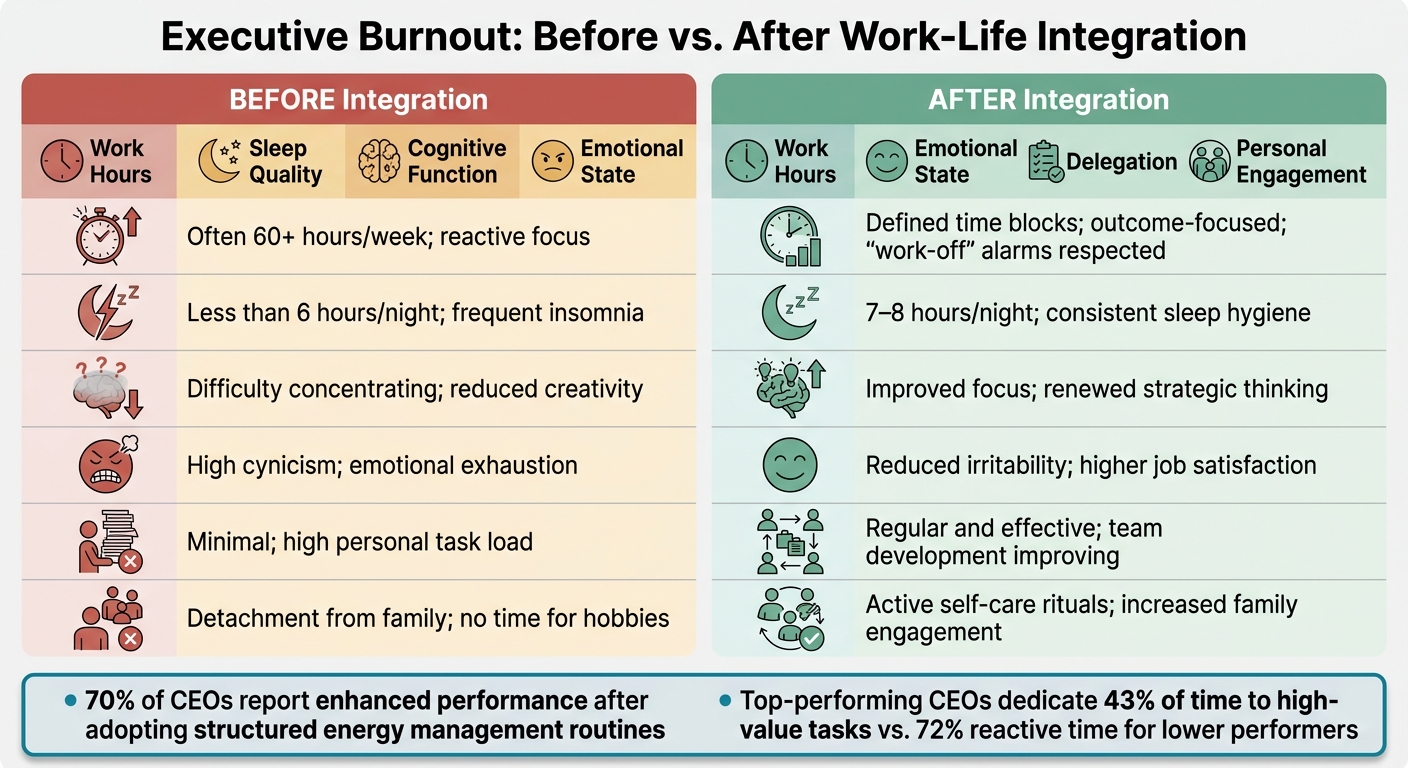
Executive Burnout: Before vs. After Work-Life Integration
Implementing strategies to counter burnout is just the beginning; tracking their effectiveness is where the real work lies. Without monitoring progress, it’s easy to fall into the trap of assuming things are improving when, in reality, the core issues remain unchanged.
Key Metrics to Monitor
To gauge the success of your efforts, focus on specific indicators across physical health, mental state, behaviours, and personal engagement. Physically, keep an eye on appetite changes and signs of chronic tension, particularly in areas like the neck and shoulders. As Ginny Yi-Jiun Cheng, Global Head of Talent at ŌURA, explains:
"Listening to our bodies is key. Only we know ourselves and the warning signs that often creep up in our relationships, our patience, and... the knots in my neck and shoulders."
Mentally, track feelings of irritability, cynicism, or difficulty concentrating. Behaviourally, check whether you’re sticking to boundaries like no-meeting blocks, delegating tasks effectively, and maintaining regular routines. A simple work–life balance score can also be useful - rate your balance on a 0–100 scale monthly, factoring in stress and productivity levels, and monitor changes over time .
Wearable devices, such as the ŌURA ring, provide data on heart rate variability (HRV) and sleep patterns, both of which can signal early stress build-up. Additionally, a quarterly 30-minute self-assessment focusing on energy and concentration levels can offer valuable insights .
These metrics create a framework for evaluating the impact of your integration strategies, allowing you to clearly compare conditions before and after implementation.
Before and After: Measuring the Impact of Integration
Tracking changes in these metrics provides a concrete view of how integration efforts are working. For instance, research from Stanford highlights that working more than 50 hours per week can reduce creativity and lead to decision fatigue. Therefore, a reduction in hours worked, paired with better decision-making, is a strong indicator of progress.
| Metric | Before Integration | After Integration |
|---|---|---|
| Work hours | Often 60+ hours/week; reactive focus | Defined blocks; outcome-focused; "work-off" alarms respected |
| Sleep quality | Less than 6 hours; frequent insomnia | 7–8 hours; consistent sleep hygiene |
| Cognitive function | Difficulty concentrating; reduced creativity | Improved focus; renewed strategic thinking |
| Emotional state | High cynicism; emotional exhaustion | Reduced irritability; higher job satisfaction |
| Delegation | Minimal; high personal task load | Regular and effective; team development improving |
| Personal engagement | Detachment from family; no time for hobbies | Active self-care rituals; increased family engagement |
One telling metric is how leaders allocate their time. Research shows that top-performing CEOs dedicate 43% of their time to high-value strategic tasks, compared to 72% spent on reactive activities by lower performers. Shifting this ratio is a clear sign of successful integration.
At House of Birch, the emphasis remains on consistent, data-driven self-assessment to refine work–life integration strategies. This approach helps sustain leadership performance over the long term.
Conclusion: Keeping Your Leadership Performance Strong Over Time
Preventing burnout is not a one-off task but an ongoing commitment. As Ginny Yi-Jiun Cheng, Global Head of Talent at ŌURA, aptly states:
"Managing stress and burnout at work - and in life - is an ongoing practice."
The techniques discussed - such as time blocking, effective delegation, prioritisation frameworks, and recovery rituals - only yield meaningful results when they become ingrained habits rather than sporadic efforts.
A pivotal shift lies in transitioning from time management to energy management. While organising your schedule is essential, protecting your mental and physical energy takes precedence. Studies reveal that 70% of CEOs experience enhanced performance and mental clarity after adopting structured energy management and self-care routines. This modest yet deliberate focus on energy can create a significant impact on clarity and overall effectiveness, forming the backbone of sustainable recovery practices.
Leaders who model healthy boundaries also set a powerful example for their teams. By visibly prioritising their own recovery, executives communicate that such practices are not only acceptable but encouraged. This fosters a culture of psychological safety, reducing burnout organisation-wide.
For long-term sustainability, personal strategies often need to be complemented by external support. Advisory partnerships can offer accountability, fresh perspectives, and tailored guidance that are difficult to obtain internally. For instance, House of Birch provides discreet, customised support for leaders navigating high-stakes decisions, emotional resilience, and enduring leadership performance.
The broader context underscores the urgency: burnout costs the global economy around £7 trillion (approximately $8.9 trillion), equating to 9% of global GDP. The consequences of inaction, both personal and organisational, are too substantial to overlook. By adopting these principles, leaders can build a resilient framework that not only withstands challenges but thrives over time. Embracing work–life integration as a leadership discipline is what sets enduring leaders apart.
FAQs
How do I tell if I’m burning out or just tired?
Burnout is more than simple exhaustion or being overly tired. It's important to evaluate whether your feelings arise from elements such as workplace culture, alignment with personal values, decision-making responsibilities, or overall capacity. These factors often contribute collectively to burnout, making it a more complex issue than just an overwhelming workload or physical fatigue.
What’s the quickest way to start work-life integration this week?
Start by handing off tasks that sap your energy and prioritise work that genuinely excites you. This approach not only alleviates stress but also frees up time for activities outside of work. Simple adjustments, such as establishing clear boundaries around work hours or introducing walking meetings, can make a noticeable difference. These minor shifts can help make balancing work and personal life more attainable and easier to maintain over time.
How can I delegate without work bouncing back for approval?
To delegate well, it’s crucial to empower your team by clearly outlining their responsibilities and the level of authority they hold. Specify the desired outcomes and establish clear boundaries for decision-making, so they understand when they can proceed independently and when they need to seek approval. By trusting your team to operate within these parameters, you can avoid micromanagement. This not only boosts their confidence but also minimises unnecessary back-and-forth, leading to a smoother and more efficient workflow.

