Executive Presence: Calm Under Pressure
When pressure spikes, people judge leadership fast. In high-stakes moments, calm is less about personality and more about what others can see: clear judgement, steady communication, emotional control and repeatable habits under strain.
From the evidence in this piece, I’d reduce the issue to four points:
- Stress changes behaviour before people notice it in themselves. Threat responses can narrow attention, shorten tempers and disrupt judgement.
- A short pause can change the outcome. Even 5 to 10 seconds may help shift a reply from reactive to measured.
- Calm can be trained. Simple tools such as emotional labelling, slower breathing and rehearsal appear to help leaders keep control when scrutiny is live.
- Presence is visible, not private. Tone, posture, pace and word choice shape how authority is read in a room.
This matters because high-pressure leadership is often judged in ordinary but exposed settings: a board challenge, an investor call, a crisis update or a public statement. In those moments, people are not only listening to the answer. They are reading the person delivering it.
The article points to a plain conclusion: calm under pressure is a practised behavioural skill. It rests on regulation, repetition, recovery and feedback rather than image alone.
Leaders may wish to review one recent high-stakes exchange and ask a simple question: did calm show up in visible behaviour, or only in intention?
Episode 93: Why Your Executive Presence Falls Apart Under Pressure
sbb-itb-ce676ec
Why pressure changes behaviour: the neuroscience of calm decision-making
Understanding what pressure does to the brain helps explain why even seasoned leaders can falter in high-stakes moments. It is not a character issue. It is biology.
Fight or flight, amygdala activation and narrowed judgement
When the brain detects a threat - physical or reputational - the amygdala can become more active. That response triggers cortisol and adrenaline, while reducing access to the prefrontal cortex, the part of the brain linked to planning, judgement and impulse control. The effect is familiar: attention narrows, thinking becomes less flexible, and behaviour grows more reactive.
Under scrutiny, that can look quite ordinary on the surface. A leader may talk too much, answer sharply, show irritation, or steer away from a hard conversation. Stress can also shift communication away from setting the agenda and towards seeking reassurance. In other words, pressure often appears first in behaviour, not in self-report.
That is why short regulation routines matter before judgement starts to harden into reaction.
How the prefrontal cortex restores control
The prefrontal cortex helps with logic, planning and impulse control. Under stress, access to it becomes harder. Regulation aims to restore that access.
Research points to a few tools that can help. Emotional labelling means putting the feeling into words. Cognitive reappraisal means reframing the situation in a less threatening way. Controlled breathing helps steady the nervous system. Taken together, these steps can lower emotional intensity and bring back perspective.
"Reactivity under pressure can be one of a leader's costliest habits... when we pause, even briefly, we create room to breathe and think." - Naz Beheshti, Executive Coach
Even a five-second pause between trigger and response may be enough to shift communication from reactive to responsive. That short gap often determines whether executive presence holds or slips.
"Calm leaders pause not because they hesitate, but because they choose precision over impulse." - Alix Needham, Executive Mindset Consultant
In practice, the difference often looks like this:
| Feature | Threat response | Executive control |
|---|---|---|
| Communication | Defensive, over-talking, or abrupt | Recommendation-first, clear, and authoritative |
| Decision style | Rushed to relieve internal pressure | Measured and aligned with long-term priorities |
| Attention | Narrowed and hyper-focused on the threat | Broad, considering competing priorities and social cues |
| Primary goal | Immediate reputational survival | Complex problem-solving and strategic alignment |
These controls tend to work best when practised often enough to become automatic.
Emotional regulation methods that strengthen executive presence
Knowing that pressure can narrow judgement is useful. The harder part is stopping that reaction while it is happening. These methods matter because people judge composure through behaviour first, not intention. In practice, they help leaders keep internal stress from spilling into visible reactivity.
Emotional labelling, pause routines and cognitive reappraisal
Emotional labelling is straightforward: a person names what they are feeling, silently and with some precision. “I am feeling defensive.” “I am anxious about this outcome.” Research suggests that this act of naming can reduce emotional intensity before it starts shaping behaviour. In a tense negotiation or during a board challenge, that can take only a few seconds. Sometimes those few seconds separate a measured reply from one that later looks rash.
Pause routines can work alongside labelling. A deliberate 10-second pause before answering a hard question can slow physiological arousal, project authority, and create room for a more precise answer rather than an impulsive one. In leadership settings, the quality of the first response often matters more than speed.
Cognitive reappraisal is often most useful before high-stakes moments. Instead of treating board scrutiny or media attention as a threat, a leader reframes it as part of the job. Evidence suggests this can reduce internal resistance and help restore perspective.
Comparison table: 3 regulation methods for high-pressure contexts
| Method | Purpose | Time Required | Best Use | Key Limitations |
|---|---|---|---|---|
| Emotional Labelling | Reduce emotional intensity and restore rational thinking | Seconds | Internal crises, high-conflict negotiations | Requires real-time self-awareness |
| Breathing Techniques | Regulate the nervous system and reduce physiological noise | 10–30 seconds | Before media interviews, high-stakes presentations | Can appear scripted if done visibly during a live exchange |
| Cognitive Reappraisal | Reframe threats as manageable challenges | 30–60 seconds | Board scrutiny, strategic planning, long-term uncertainty | Requires some mental distance from the immediate situation |
Used together, these methods can stop pressure from turning into visible reactivity.
Boundary setting and recovery as part of composure
In-the-moment regulation has limits. What tends to wear down executive presence over time is rarely one hard meeting. It is the build-up of unprocessed stress across many meetings, decisions and public exchanges.
When leaders hold sustained accountability without enough recovery, stress can accumulate and later show up as irritability, indecision or carry-over, where strain from one meeting bleeds into the next. Short, consistent recovery rituals can help prevent that build-up, while clear boundaries protect mental energy for high-impact strategic decisions. The effects are often visible in day-to-day behaviour: steadier judgement, cleaner communication and fewer reactive signals.
How calm looks in practice: behaviours that signal confidence and authority
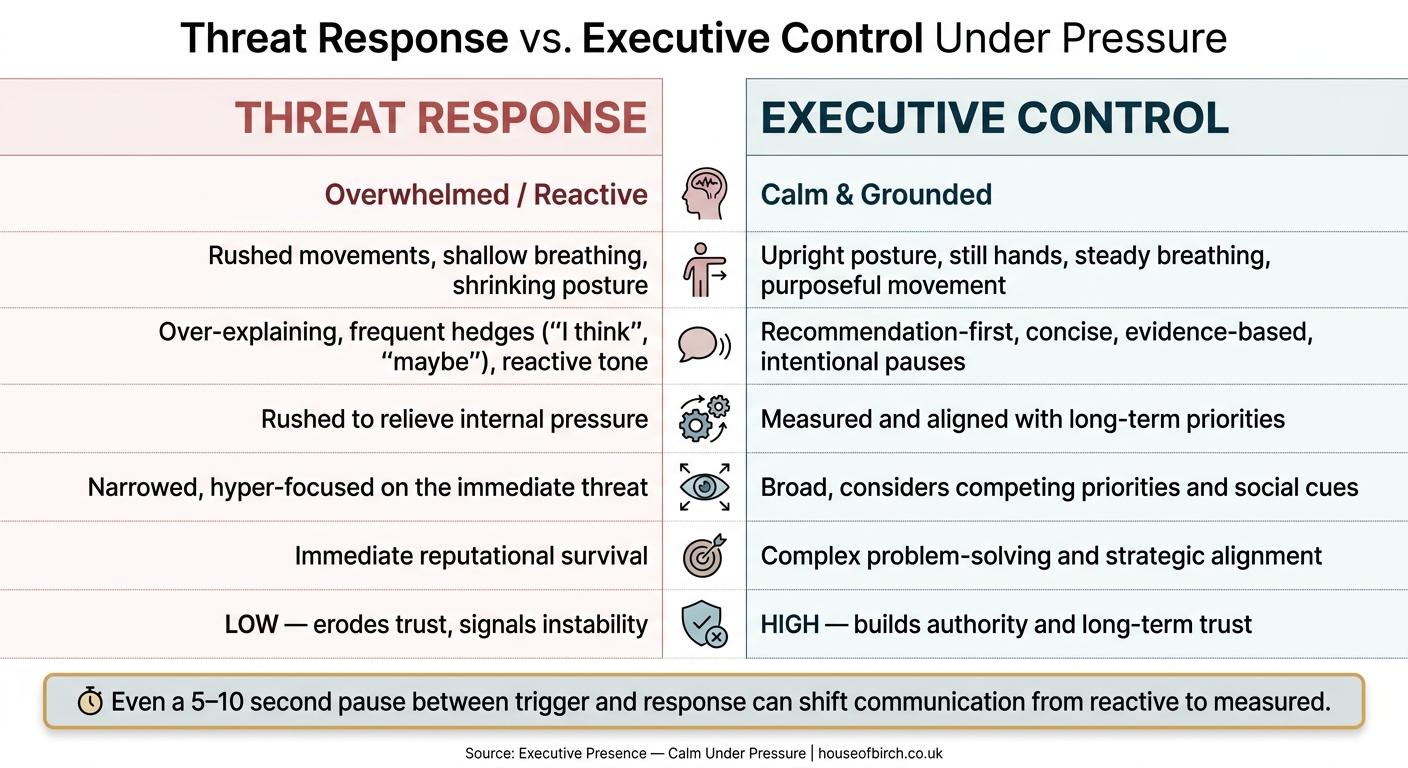
Threat Response vs Executive Control: How Calm Leaders Behave Under Pressure
Once regulation is in place, other people still need to see it. Internal control matters only when it shows up in behaviour: posture, tone, pace and word choice. Executive presence is judged through outward signals, not private intent, and those judgements are made fast.
"Your spine communicates more than your résumé." - Jac Beasley, Leadership Psychologist
Recommendation-first communication, clear judgement and accountability
One of the clearest signals appears at the very start of a conversation. Calm leaders tend to open with the judgement first, then offer three supporting points. That pattern signals clarity, control and direction.
Word choice matters as well. Hedges such as "I think" or "maybe" can weaken a message when the evidence is already clear. By contrast, direct, evidence-based statements suggest that the speaker has reached a considered view. When challenged, composed leaders tend to hold a clear position without becoming defensive. They use plain language that shows ownership of the decision rather than distance from it.
Consistent demeanour across crisis meetings, scrutiny and public communication
Calm also has to travel well. It cannot appear in one meeting and vanish in the next. Presence rests partly on whether tone, pace and manner stay steady across very different settings: a crisis call called at short notice, a difficult board exchange, or a public statement under scrutiny. If tone changes sharply under pressure, observers often read that as a sign that the pressure has landed, even when the analysis itself is sound.
Voice control is often overlooked. A steady cadence tends to read as confidence. On the other hand, over-explaining or apologising without clear reason often reads as insecurity rather than openness. Brevity, restraint and steady physical cues - upright posture, still hands and a neutral expression - help signal that the leader is directing the situation, not being pushed around by it.
Comparison table: internal state versus external signals of executive presence
| Internal State | Physical Cues | Communication Patterns | Impact |
|---|---|---|---|
| Calm & Grounded | Steady breathing, upright posture, purposeful movement | Concise, recommendation-first, structured reasoning, intentional pauses | High: Signals authority and competence; builds long-term trust |
| Controlled Under Pressure | Controlled breathing, neutral facial expression, still hands | Recommendation-first, uses evidence to support assertions | Moderate/High: Signals reliability and professionalism; credibility holds under pressure |
| Overwhelmed / Reactive | Rushed movements, shallow breathing, shrinking posture | Over-explaining, frequent hedges, reactive tone | Low: Signals instability; erodes credibility and creates anxiety in others |
Building calm under pressure over time
“Calm is a leadership skill, not a temperament.” Once that idea is taken seriously, the task changes. The question is no longer whether a leader is naturally steady. It becomes whether that steadiness can be repeated when the pressure is live, public and messy. The behaviours discussed throughout this guide - regulation, disciplined communication and a steady demeanour - can be built through deliberate practice.
Scenario rehearsal, stress inoculation and reflection loops
One of the clearest ways to build steadiness is to rehearse difficult situations before they happen. That can mean role-playing board challenges, investor questioning or crisis calls with incomplete information. The aim is simple: practise measured responses before the stakes are real. Repetition appears to help leaders keep emotional reactions in check and build more automatic, measured responses.
Rehearsal tends to work best when it moves in stages, from controlled practice to higher-pressure exposure. Research suggests that acute stress can impair reasoning, empathy and impulse control. In that setting, small regulation tools matter. A 10-second pause and a 4–6 breathing rhythm can help shift the body away from a threat response and towards better judgement. But there is a catch. These tools rarely hold up under pressure unless they have been practised enough to feel routine.
Reflection closes that loop. An end-of-day review - noting key decisions, emotional reactions and what would be done differently - can help identify recurring triggers and sharpen later responses. The focus should be observable behaviour, not good intentions alone. In practice, that means checking whether calm is visible in tone, pace and judgement. A monthly request for one specific behavioural observation from two stakeholders can add an outside view of whether that internal work is showing up in day-to-day conduct.
When bespoke advisory support helps
Practice matters, but live scrutiny often exposes gaps that rehearsal does not. A leader may appear composed in training, then lose precision during M&A activity, investor scrutiny, market volatility or reputational strain. In those cases, tailored support may help transfer skills from rehearsal into live performance. House of Birch provides discreet executive coaching and leadership advisory focused on decision-making, emotional discipline, strategic intelligence and social influence.
Conclusion: the habits behind calm executive presence
Executive presence under pressure rests on a set of repeated habits: understanding the stress response, rehearsing difficult moments, using regulation routines that fit the situation, and staying answerable through feedback and reflection. In that sense, calm is less a fixed trait than a pattern of practice carried out consistently over time.
"Executive poise is a trained skill: staying calm, clear and composed under pressure." - Noa Marley, Performance Psychology Coach
FAQs
Can executive presence be learned?
Yes. Executive presence is a learnable skill, not something a person is simply born with. Research in organisational psychology and behavioural science points in the same direction: it develops through deliberate practice of visible behaviours, including emotional regulation, clear communication and composure under pressure.
That matters because executive presence is often judged in the room, not in theory. A leader who pauses before responding to a hostile question, speaks with clarity during a tense board meeting, or stays steady when a project goes off course is displaying behaviour that colleagues can see and assess.
With intentional rehearsal, honest self-reflection and professional coaching, leaders can strengthen these capabilities. Over time, they may become calmer, more authoritative and more effective in high-pressure situations.
How do I stay calm in a high-pressure meeting?
Treat composure as a skill that can be trained, not as something a person either has or does not have. Research in behavioural science and psychophysiology suggests that stress is not only a mental state; it also shows up in the body. When pressure builds, a long, slow exhale can help shift physiological arousal and send a calming signal through the nervous system. That does not make stress vanish, but it can help a speaker steady their voice, slow their pace, and think with more control.
A short pause matters too. Before answering a hard question, a three-second silence can create useful distance between stimulus and response. In practice, that brief gap gives a leader time to sort their thoughts, cut reactive speech, and speak with more intent. In meetings, interviews, or public appearances, that can shape how authority is read by others: not as bluster, but as control under strain.
What behaviours make a leader look reactive?
A leader can look reactive when inner strain spills into outward behaviour. In plain terms, pressure starts showing on the surface, and that can signal weak emotional control in the moment.
The signs are often easy to spot. They include flushing, jaw tension, eye-rolling, abrupt withdrawal, a voice that rises or speeds up, interrupting, defensive or vague language, micromanagement, rushed decisions, and poor listening.
In a meeting, for example, a senior manager under strain may start speaking faster, cut across colleagues, and shift from clear direction to guarded or fuzzy language. The issue is not just tone. It is behaviour that others can see, and it can shape how judgement, authority, and self-control are read by the room.

