Emotional Intelligence in High-Stakes Decisions: A Case Study
Emotional intelligence (EI) is a critical skill for leaders managing high-pressure decisions. Research shows that 70% of leadership failures during crises stem from personal shortcomings, such as poor emotional control, rather than technical errors. Leaders with strong EI outperform others, improving decision-making by 47% and employee performance by 20%.
The 2023 Arventis Pharma product launch crisis highlights how EI can transform outcomes. Initially, leadership faltered under stress, leading to delays, poor communication, and team silos. Following targeted EI training, including mindfulness practices and feedback-based coaching, the organisation stabilised, rebuilt trust, and delivered a successful launch. Key EI components - self-awareness, self-regulation, empathy, and social skills - enabled leaders to navigate challenges effectively, improving team cohesion and decision quality.
Takeaways for leaders:
- Conduct emotional audits before critical decisions to identify biases.
- Use composure techniques, like delaying decisions when emotions run high.
- Build trust by prioritising clear, empathetic communication.
Organisations should reflect on integrating EI development into leadership training, as it directly impacts resilience and performance during crises.
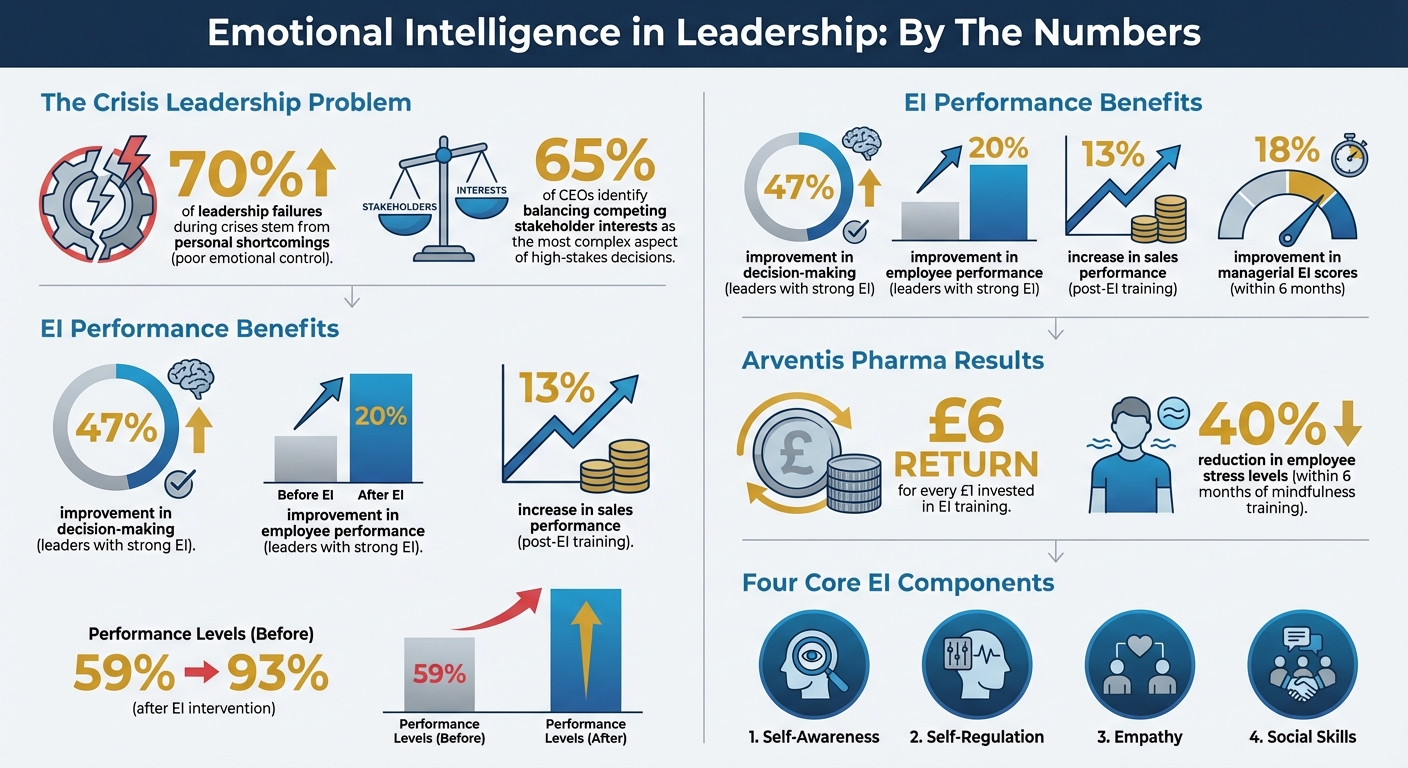
Emotional Intelligence Impact on Leadership Performance: Key Statistics
Emotional Intelligence and Making Better Decisions
sbb-itb-ce676ec
Case Study: The Arventis Pharma Launch Crisis
In early 2023, a small pharmaceutical company faced a pivotal moment as it prepared to launch a product that would shape its future in a highly competitive market. Success hinged on meticulous pre-launch planning and seamless execution. However, as the launch date loomed, the strain of managing complex operations and high expectations exposed cracks in the organisation's approach. This case study highlights how targeted emotional intelligence (EI) interventions helped steer the company out of a potentially disastrous situation.
Early Leadership Failures
The initial response to a manufacturing delay revealed significant shortcomings in leadership. Within 48 hours, decision-making stalled as conflicting advice from legal, financial, and public relations consultants muddled the company’s direction. Poor communication further aggravated the situation, creating silos between teams and eroding trust. These early missteps underscored a lack of emotional intelligence in navigating high-pressure scenarios.
The Shift
Recognising the need for change, the company sought an external review. While the leader’s technical expertise was never in question, their inability to manage the emotional and interpersonal aspects of the crisis became a clear obstacle. To address this, the leader undertook EI training focused on improving self-regulation and empathy. Practical changes, such as implementing regular team check-ins and actively seeking input from team members, began to break down silos and improve collaboration. Within weeks, these adjustments not only stabilised the situation but also set a new standard for how the organisation approached crisis leadership.
Emotional Intelligence Interventions and Results
Development Methods
To address leadership challenges during the crisis, the organisation implemented a targeted programme aimed at strengthening emotional intelligence (EI) skills. The initiative began with a 360-degree feedback process using the Emotional Capital Report, which assessed how the leader's actions and communication impacted others during the crisis. This evaluation highlighted recurring patterns of defensive communication and reactive decision-making, both of which had eroded team confidence.
Weekly coaching sessions were introduced to help the leader focus on self-regulation and empathy. These sessions included practical strategies like composure rituals for high-pressure meetings and reflective exercises designed to combat the fatigue caused by back-to-back virtual meetings. Mindfulness training was also incorporated, leveraging evidence that such practices can reduce employee stress levels by up to 40% within six months.
A key part of the intervention involved improving communication during decision-making. The leader shifted from issuing defensive, unclear directives to using more precise and controlled language. This adjustment helped rebuild authority and establish a stronger presence during board meetings and other critical interactions. Collectively, these efforts led to noticeable improvements in team cohesion and project outcomes.
Team and Project Outcomes
The changes in leadership style had a swift and tangible impact on team performance and organisational stability. Within six months, peer confidence and staff engagement levels rose significantly. The CEO remarked that his "presence in the room feels different now, measured, confident, and decisive". Improved team dynamics contributed to quicker decision-making and the breakdown of departmental silos.
These enhancements were instrumental in ensuring the success of a product launch that had previously been at risk of failure. The launch was completed without losing key talent or clients, surpassing industry norms for crisis recovery. This combination of stabilised leadership and cohesive teamwork proved critical in navigating the challenges effectively.
Core Emotional Intelligence Components in Decision-Making
Expanding on the earlier discussion of emotional intelligence (EI) in high-pressure leadership scenarios, the analysis below explores how core EI components shaped decision-making at Arventis Pharma.
The Arventis Pharma case highlights how four key domains of emotional intelligence directly influenced leadership effectiveness during critical moments. Self-awareness enables leaders to identify emotional triggers and cognitive biases before they interfere with judgement. In this case, 360-degree assessments revealed that defensive communication patterns were undermining team confidence.
Self-regulation, or the ability to maintain composure under pressure, helps prevent "amygdala hijack" - a stress response that narrows thinking - allowing the prefrontal cortex to remain engaged for rational, data-driven decisions. At Arventis, the introduction of composure rituals helped leaders stabilise their presence during board meetings, shifting their responses from erratic to strategic. This newfound stability directly improved the quality of boardroom decisions.
Empathy fosters trust by clarifying how decisions affect stakeholders. At Arventis, greater empathy helped break down silos, speeding up decision-making and strengthening team dynamics. Lastly, social skills empower leaders to explain the reasoning behind tough decisions and unite teams around a common goal, even during uncertain times.
Benefits of Developed EI
Leaders with strong emotional intelligence consistently achieve better outcomes. During the Arventis study (2017–2019), participants who underwent 360-degree assessments, workshops, and coaching demonstrated a 13% increase in sales performance, while the control group showed no improvement. This intervention delivered a notable return of £6 for every £1 invested.
Beyond financial gains, enhanced EI supports sustainable performance. At Arventis, overall performance levels rose from 59% to 93% following the intervention. Additionally, managerial EI scores improved by 18%, boosting both peer confidence and staff engagement within six months. These results were linked to leaders’ improved ability to balance intuition with data, create psychological safety, and navigate complex social dynamics - skills that directly elevated decision-making quality and team performance.
Risks of Low EI
A lack of emotional intelligence can lead to significant organisational difficulties. Before the intervention, Arventis faced revenue stagnation, cultural disconnection following its merger, and ongoing relational tensions between senior managers and their teams.
One participant described the change:
I have seen improvements in behaviour that have increased the bottom line with sales reps. From a management perspective, increased skills that have led to more buy-in, acceptance, spirit improved, and better communication. – Participant, Sanofi-Aventis
Low EI often results in impulsive, anxiety-driven decisions, emotional volatility that damages team trust, and defensive communication that poses operational and reputational risks. Without intervention, these challenges can escalate into "analysis paralysis", territorial behaviour, and an inability to integrate diverse perspectives during critical transitions. In a study of 111 CEOs, over 65% identified balancing competing stakeholder interests as the most complex aspect of high-stakes decision-making - a task requiring empathy and social skills that leaders with low EI frequently lack. These findings emphasise the pressing need for stronger EI in leadership, particularly during pivotal moments.
Conclusion: Lessons for High-Stakes Leaders
The Arventis Pharma case underscores the importance of emotional intelligence (EI) in high-pressure leadership scenarios. Leaders who cultivate self-awareness, self-regulation, empathy, and social skills consistently achieve stronger outcomes compared to those relying purely on technical expertise or instinct.
Emotionally intelligent leadership fosters quicker decision-making, tighter team cohesion, and greater resilience in challenging situations - qualities that cannot be automated or delegated. However, the dangers of neglecting EI are equally evident. Leaders with low EI often succumb to common pitfalls: impulsive decisions driven by stress, defensive communication that undermines trust, and an inability to balance competing priorities. These patterns highlight the need for actionable strategies to strengthen leadership under pressure.
Applying These Lessons
The lessons from Arventis Pharma offer practical ways to embed emotional intelligence into crisis management. For instance, conducting a personal emotional audit before critical meetings can help leaders recognise their emotional state and its potential impact on their behaviour. This simple practice reduces reactive decision-making and promotes a more composed approach.
In high-pressure environments, composure rituals can help leaders maintain clarity and control. Techniques like the 24-hour rule - delaying major decisions or communications when emotions are heightened - can be particularly effective.
To avoid the inefficiencies seen at Thames Water, which spent approximately £159 million on adviser fees during its financial crisis, leaders should establish integrated decision-making structures. A centralised leadership point can reconcile conflicting advice before it reaches the executive team, while a trusted advisory board can provide balanced perspectives during critical moments.
How House of Birch Can Help
The Arventis Pharma example demonstrates how essential emotional intelligence is in navigating crises. House of Birch applies these principles to support leaders facing high-stakes challenges.
Specialising in leadership advisory services, House of Birch focuses on areas like decision discipline, emotional regulation, and narrative control - key capabilities for turning pressure into precision. For instance, in 2025, the firm assisted a Chief Operating Officer at a FTSE 250 company in recovering from a failed transformation initiative. By refining decision-making processes and communication strategies, the executive regained peer confidence and improved staff engagement within two quarters, enabling them to lead the next phase of transformation.
For leaders managing merger integrations, market turbulence, or reputational risks, House of Birch offers frameworks grounded in behavioural science and practical application. Visit houseofbirch.co.uk to learn how tailored advisory services can elevate your decision-making and influence during critical moments.
FAQs
How can I spot my emotional bias before a big decision?
To identify emotional bias, begin with developing self-awareness and learning to regulate your emotions. Recognise your current emotional state - whether it's stress, anger, or enthusiasm - that could potentially distort your judgement. Distinguish emotional responses from factual information by outlining the key data and reviewing it with an objective lens. Take time to reflect on how your emotions might be shaping your decisions and try to view the situation from others' perspectives. By pausing to analyse emotional patterns, you can make more balanced and deliberate choices, particularly in high-pressure scenarios.
What should I do when stress is driving my decisions?
When stress affects decision-making, it’s crucial to prioritise managing emotional responses to remain focused and effective. Stress often clouds rational thinking, pushing people towards impulsive or reactive choices. Strengthening emotional intelligence (EI) can make a significant difference by helping individuals regulate their emotions, build self-awareness, and respond more thoughtfully.
Practical techniques such as mindfulness, active listening, and taking time for reflection can support the development of EI. Additionally, using structured approaches to decision-making can minimise the influence of emotional distractions, leading to better outcomes even in high-pressure situations.
How can I rebuild trust quickly after poor crisis communication?
To regain trust quickly, begin by openly recognising the problem without resorting to denial or overcomplicating explanations. Stick to clear, factual communication to correct any misinformation and show a willingness to take responsibility.
A transparent approach is crucial - acknowledge where improvements are needed, engage with stakeholders empathetically, and keep communication channels open. Demonstrating integrity through actions and committing to making meaningful operational changes are essential steps towards rebuilding credibility and trust.

