Digital Body Language for Leaders
Digital communication dominates modern workplaces, with 70% of team interactions occurring virtually. Yet, nearly half of emails are misunderstood, leading to mistrust and disengagement. Without physical cues like eye contact or posture, leaders must rely on digital behaviours - response times, writing tone, and platform choices - to convey authority, clarity, and engagement.
Key insights for leaders include:
- Clarity in Writing: Structured, unambiguous messages prevent misunderstandings. Use acronyms like "NNTR" (No Need To Respond) or "2D" (Action needed in 2 days) to set expectations.
- Acknowledging Contributions: Replace physical gestures with thoughtful responses. A detailed "thank you" or follow-up question signals value and attentiveness.
- Channel Selection: Match the medium to the message. Use email for detailed updates, messaging apps for urgent matters, and video calls for sensitive topics.
- Building Trust: Consistent communication habits, like timely responses and visible engagement during meetings, reinforce reliability and connection.
Leaders should refine these skills to maintain influence and foster alignment in virtual settings. Every digital interaction shapes how teams perceive leadership.
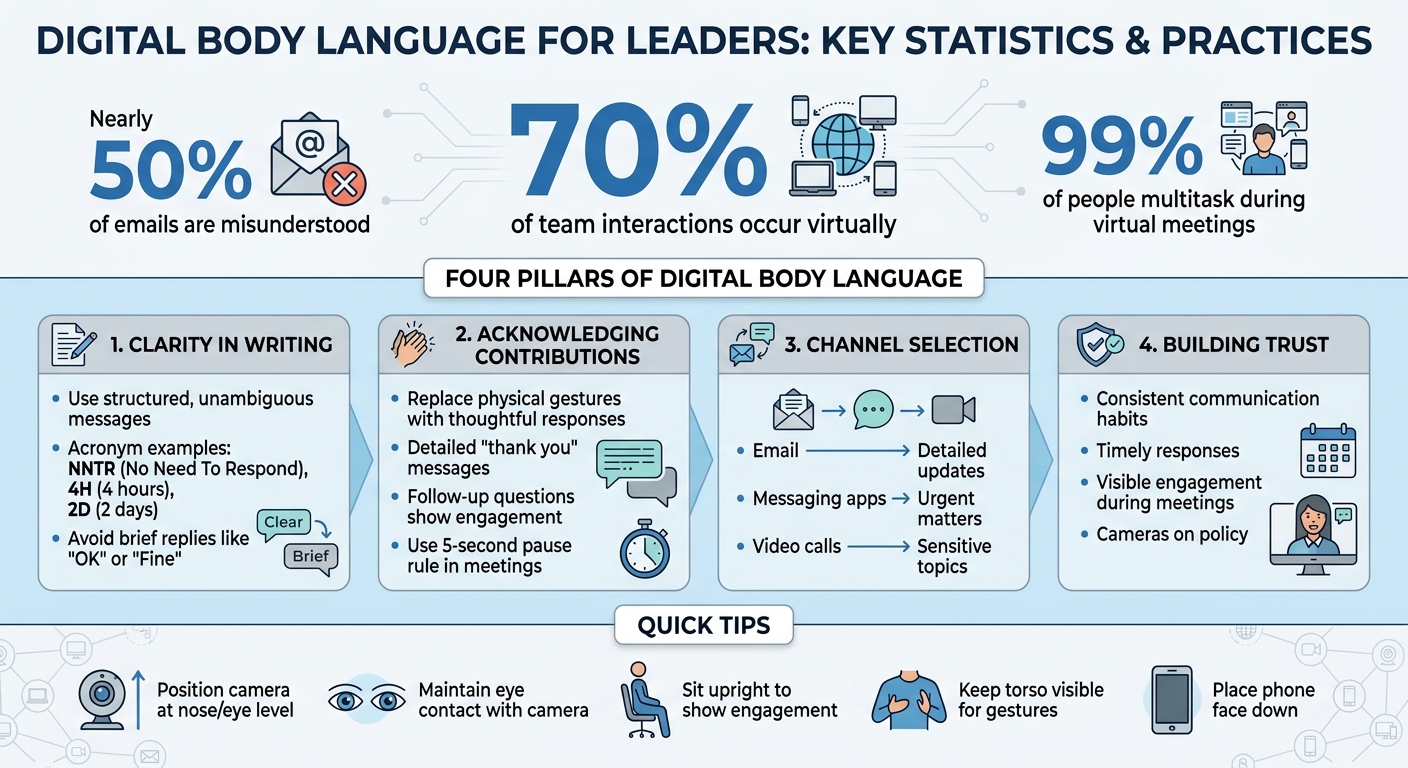
Digital Body Language Statistics and Key Communication Practices for Leaders
Digital Body Language: How to Build Trust and Connection, No Matter the Distance Or Platform
sbb-itb-ce676ec
Making Your Presence Known
In virtual settings, leaders can't rely on physical cues like entering a room or leaning forward to convey authority or attentiveness. Instead, their visibility hinges entirely on how they communicate digitally. This means every written word, response time, and sign of acknowledgement becomes a signal of their priorities. At the heart of this is the clarity of written communication, which serves as the foundation of an effective digital presence.
Writing Clear Messages
The way leaders write shapes how their intentions and priorities are perceived. Clear and structured paragraphs suggest organised thinking, while dense, unstructured text can come across as chaotic. The aim should always be clarity, rather than mere brevity. As Erica Dhawan, CEO advisor and author, cautions:
"Don't confuse brevity with clarity".
Short replies such as "OK", "Sure", or "Fine" may seem efficient but are often read as dismissive or even passive-aggressive.
Before hitting send, consider: Is my request clear? Have I included the right people? Is the deadline unambiguous?. Acronyms in subject lines can help set expectations upfront, such as "NNTR" (No Need To Respond), "4H" (Action needed in 4 hours), or "2D" (Action needed in 2 days). These small steps can reduce miscommunication and cut down on unnecessary follow-ups.
Even punctuation plays a role. For instance, a full stop might come across as cold, while an exclamation mark can add warmth. Overusing question marks, on the other hand, may feel accusatory or impatient. The medium matters too: emails are best for detailed instructions, messaging apps suit urgent updates, and video calls are ideal for nuanced or sensitive topics. By focusing on clarity, leaders enhance both their visibility and their precision in virtual interactions.
Yet clarity alone isn't enough. Recognising contributions is equally vital in building a strong digital presence.
Acknowledging Team Contributions
In the absence of physical cues like nodding or eye contact, leaders need to replace these with deliberate digital gestures. The speed of a response, for example, signals how much a leader values a team member's input. While a quick "thumbs up" can work for minor acknowledgements, more detailed feedback or follow-up questions demonstrate active engagement.
Avoid overly simplistic responses. Instead of replying "Fine" to a completed task, add context, such as: "This addresses the client's concerns perfectly - thank you." In virtual meetings, verbal affirmations like "I'm listening" or "I hear you" can help bridge the gap left by the lack of physical presence. Pausing for five seconds after asking a question also allows participants time to process and respond without feeling rushed.
To ensure everyone has a chance to contribute, rotating roles like meeting moderator and using features like hand-raising can give quieter team members a platform. These practices not only acknowledge individual contributions but also foster trust and collaboration - critical components of effective digital leadership.
Communicating with Precision
With nearly half of all emails frequently misunderstood, choosing the right communication channel and timing is essential for effective leadership.
Selecting the Right Communication Channel
The medium through which you communicate significantly influences how your message is received. Complex topics benefit from phone or video calls, where immediate feedback and trust-building are possible. On the other hand, urgent updates are better suited to messaging platforms, while detailed information or lengthy reports should be shared via email, giving recipients the opportunity to review and process. Erica Dhawan, a CEO advisor and author, aptly observes:
"In this day and age, we are all immigrants in the world of digital body language".
Avoid overwhelming your team by mixing communication channels for a single request. For sensitive feedback, shifting from text to phone or video calls can reduce the risk of misinterpretation by incorporating vocal cues. Additionally, always seek permission before using personal communication methods, such as text messaging.
Once the appropriate channel is chosen, it’s important to establish clear expectations for responses to maintain order and clarity.
Setting Response Time Expectations
The timing of responses communicates both urgency and respect. Using subject line acronyms can help signal the priority of an email. Define the purpose of each platform: reserve messaging for urgent matters and email for detailed updates. Always include a specific deadline, such as "Confirm by 15:00 on Friday". This approach prevents confusion when multiple channels compete for attention and ensures that key messages don’t go unnoticed. These choices also enhance your digital presence by reinforcing clarity and acknowledgement, as discussed earlier.
Addressing Unclear Messages
Once channels and response expectations are defined, it’s crucial to address any ambiguity immediately. Misunderstandings can lead to negative assumptions. Randy Conley from Blanchard highlights this risk:
"If there is a lack of clarity in any communication, people are likely to assume the worst".
To avoid this, rephrase key points and summarise decisions made during digital exchanges. For complex or sensitive topics, consider switching to a phone or video call to ensure your intent is clear. Even minor details, such as punctuation, can influence tone. For example, "Sure" without punctuation might come across as indifferent, whereas "Sure!" conveys enthusiasm. These small but deliberate adjustments can turn potentially unclear interactions into productive and meaningful conversations.
Building Team Relationships Digitally
Leading in virtual environments demands more than just technical expertise; it requires intentional efforts to nurture team connections. Without the casual in-person moments that naturally build rapport, leaders must create deliberate digital practices to fill this gap. These "digital rituals" are as crucial to fostering team cohesion as nonverbal communication is in face-to-face settings. The strategies below highlight ways to encourage active engagement and accommodate diverse communication preferences.
Ensuring Everyone Participates
Virtual meetings can unintentionally amplify existing power dynamics, often silencing quieter voices. A simple yet effective technique is the five-second rule: after asking a question, pause for five seconds before inviting responses. This brief pause allows all participants time to process and respond, reducing the likelihood of dominant voices taking over. Another approach is rotating the role of meeting moderator, ensuring everyone has a chance to lead and participate equally.
Digital tools can also help balance discussions. Features like chat functions and hand-raising provide quieter team members with alternative ways to contribute. Starting meetings with a brief period of informal conversation or sharing recent successes can recreate the casual interactions that once occurred naturally in office spaces. These small adjustments can make a big difference in fostering inclusivity and connection within remote teams.
Adapting to Cultural and Generational Differences
Virtual communication styles can vary widely across generations and cultural backgrounds. For example, what one person views as concise and efficient might come across as curt or impersonal to someone else. To bridge these differences, leaders should clearly state their intentions and reiterate key objectives to maintain alignment.
When delivering sensitive feedback, opting for a phone or video call instead of text-based communication can help avoid misunderstandings. The nuances of tone and inflection often soften feedback and reduce defensive reactions. If a team member appears disengaged - such as consistently keeping their camera off or frequently seeking clarification - address the issue privately. This approach respects their psychological safety while acknowledging potential cultural or personal factors.
Building Trust Through Consistent Digital Habits
Trust is the foundation of effective virtual leadership, and in digital environments, it thrives on consistent and reliable behaviours rather than grand gestures. The limitations of digital communication, such as the absence of physical presence, can lead to misunderstandings. This makes deliberate trust-building practices essential for leaders.
Maintaining Consistent Communication
Consistency in communication is critical to building digital trust. It starts with ensuring your tone, facial expressions, and responsiveness align with your spoken words. Any mismatch between these elements can cause confusion, as people often rely on nonverbal cues to gauge intent. Researcher Albert Mehrabian emphasised this point:
"When there are inconsistencies between attitudes communicated verbally and posturally, the postural component should dominate in determining the total attitude that is inferred".
Reliability in virtual settings can be reinforced through digital rituals. For instance, starting meetings with a brief social check-in or promptly addressing urgent messages creates a predictable and dependable communication style. Such habits make team members feel supported and secure.
Authenticity, while more challenging in virtual environments, can be enhanced by increasing warmth and enthusiasm to counteract the medium's limitations. Simple actions, such as looking directly into the camera to simulate eye contact or ensuring your camera is positioned at eye level, can make interactions feel more personal. Keeping your torso visible allows for the use of hand gestures, which help convey clarity and emotion. These practices establish a foundation of trust through transparent and consistent communication.
Being Transparent and Accountable
Transparency is vital for preventing disengagement in virtual teams. Ambiguity in communication can leave team members feeling disconnected or unclear about objectives. Active digital listening - using verbal cues like "I hear you" or "I understand" - is particularly important during video calls, where physical gestures like nodding may go unnoticed.
Accountability is built through delivering on commitments and addressing concerns promptly. With 99% of people admitting to multitasking during virtual meetings, leaders must remain visibly focused. Actions that suggest divided attention, such as checking phones or notifications, are easily perceived and can quickly erode trust. As Ginger Leadership Communications aptly noted:
"You wouldn't walk into a meeting with a bag on your head. So why is it OK to have your camera off?".
Integrating Trust into Team Processes
Trust-building should extend into everyday workflows. For example, rotating the role of meeting moderator among team members not only shares responsibility but also fosters mutual trust. Similarly, establishing clear communication protocols - such as defining which channels to use for urgent matters, updates, or strategic discussions - reduces uncertainty and allows teams to focus on meaningful tasks.
Encouraging vulnerability can also strengthen trust. Phrases like "Can you help me with this?" or "I'm open to suggestions" signal that it is safe to admit uncertainty. Regular video check-ins that include personal updates help team members feel valued as individuals. These structured practices embed trust into team culture, reinforcing its importance in effective digital leadership.
How to Improve Your Digital Body Language
Developing effective digital body language requires focused effort, particularly as virtual communication now dominates team interactions, accounting for 70% of all exchanges. The encouraging news is that these skills can be honed through self-awareness, structured team practices, and, when needed, expert advice.
Reviewing Your Current Habits
Virtual communication lacks the richness of in-person interactions. Subtle cues like smiles, pauses, and posture often get lost or distorted on screen. This makes self-assessment a critical starting point.
Begin by auditing your on-screen presence. For example, evaluate your posture during video calls - slouching can suggest disengagement, while sitting upright conveys attentiveness and confidence. Ensure your camera is positioned at nose height; a poorly angled camera can unintentionally make you appear condescending or disengaged. Pay attention to your eye contact as well. Erica Dhawan, an authority on digital body language, underscores the importance of maintaining focus:
"It is so obvious if you are busy looking down at your phone when others are trying to make video eye contact with you".
Consider your engagement habits. Multitasking during meetings or using the mute button to handle unrelated tasks can undermine trust and collaboration. Even small gestures, like touching your face or neck, may unintentionally communicate insecurity or dishonesty. Adjustments such as sitting closer to the edge of your chair to avoid leaning back can significantly improve how others perceive you.
Another useful technique is the "five-second rule": when asking a question, pause for five seconds before speaking. This pause allows others time to think and respond, fostering respect and encouraging participation. Once personal habits are refined, these principles can be extended to team-wide practices.
Creating Team Communication Standards
Digital body language isn't just an individual responsibility - it thrives when teams adopt shared norms. Leaders play a key role in formalising previously unspoken rules, such as response times and meeting etiquette, which were more intuitive in physical settings.
One effective practice is establishing a "cameras on" policy for virtual meetings. This helps restore nonverbal communication and discourages distractions like multitasking. Clearly define which communication channels to use for specific purposes. For instance, emails can handle non-urgent updates, instant messaging can address quick queries, and video calls should be reserved for complex, nuanced discussions.
Incorporate meeting rituals to strengthen team cohesion. For example, dedicate the first five minutes to informal conversation or celebrating recent successes. Rotating the role of meeting moderator can also encourage inclusivity and accountability. Features like "hand-raising" tools can manage speaking turns, while chat functions allow quieter team members to contribute without being overshadowed.
Leaders must model these behaviours themselves. Placing phones face down during meetings, for instance, signals full attention. When team members deviate from agreed norms, address the issue privately in one-on-one discussions to maintain trust and respect.
Working with Leadership Advisors
For leaders operating in high-stakes environments - such as mergers and acquisitions, investor relations, or major organisational changes - digital body language becomes even more critical. In these situations, external advisors can provide tailored guidance to help leaders master their virtual presence.
House of Birch, for example, offers leadership advisory services that combine neuroscience, behavioural psychology, and cognitive science. These services are designed to help leaders excel in digital settings, particularly in moments where every interaction carries significant weight. Tommy Birch, founder of House of Birch, explains:
"I build individuals who are emotionally disciplined, strategically intelligent, socially dominant, and unshakeable under pressure".
Advisors like Birch focus on more than just communication basics. They help leaders develop emotional discipline - the ability to remain composed under pressure - and social dominance - the skill to shape relationships and narratives through intentional digital habits. This kind of bespoke support allows leaders to evaluate how their current digital behaviours influence their decision-making and strategic foresight.
As Birch puts it:
"Every engagement is bespoke and discreet, designed to enhance your digital presence, turning high potential into high performance in the moments that truly matter".
For leaders navigating high-stakes scenarios, such tailored advice ensures their digital presence aligns seamlessly with their broader strategic goals.
Conclusion
Roughly 70% of team interactions now take place virtually, reducing the impact of nonverbal cues that traditionally conveyed much of our intent and meaning. This shift can undermine trust and engagement - two factors that leaders cannot afford to overlook. Developing strong digital body language skills has become crucial for maintaining authority, fostering relationships, and driving team performance in today’s hybrid work settings.
The strategies outlined in this guide - ranging from optimising camera angles and setting clear expectations for response times to establishing consistent communication norms - provide a practical roadmap for reintroducing a sense of human connection in virtual environments. These practices not only mitigate the effects of physical distance but also help counter proximity bias, fostering trust and alignment around shared objectives. The result is improved communication efficiency and better team outcomes.
Strong digital habits reduce misunderstandings and enhance engagement. Demonstrating cognitive presence - through timely responses and intentional digital cues - plays a pivotal role in keeping distributed teams connected and motivated. Simple actions, such as pausing for a few seconds before responding, using deliberate gestures, or consistently acknowledging contributions, can significantly strengthen team cohesion.
For leaders operating in high-pressure scenarios - whether steering organisational change, managing investor expectations, or building cohesive teams - every digital interaction matters. A deliberate approach to digital body language ensures that a leader’s influence is felt, regardless of physical distance. Investing in these communication habits enhances credibility, strengthens influence, and ensures effective leadership from any location.
In this digital age, mastering virtual communication is not optional - it is a core leadership skill. Leaders who prioritise and refine these abilities will be best equipped to succeed in an environment where connection, clarity, and trust must be consciously cultivated in every interaction. Through intentional effort, digital presence can become a powerful tool for shaping outcomes and driving success.
FAQs
How can I sound clear without sounding cold?
To convey a message that's both clear and approachable, it's important to combine straightforward language with a touch of empathy. Precision ensures your audience understands you, but pairing it with a friendly tone and active listening shows genuine engagement. In virtual settings, looking directly at the camera can simulate eye contact, while using a warm and steady voice adds a personal touch. By communicating with sincerity and maintaining emotional composure, you can build trust - striking a balance between confidence and relatability without coming across as distant.
When should I switch from text to a call or video?
Switching to a call or video is a smart move when dealing with complex, sensitive, or nuanced messages that benefit from non-verbal cues like tone, facial expressions, or body language. This approach is particularly effective for giving feedback, addressing emotional topics, or engaging in strategic discussions. Calls or video not only minimise the risk of misinterpretation but also help build trust and ensure clarity - especially in high-stakes conversations where immediate understanding is essential.
What digital habits build trust fastest in remote teams?
Building trust in remote teams hinges on deliberate communication practices. Habits such as responding promptly, delivering clear and open messages, and scheduling regular check-ins help establish credibility. Nonverbal elements also play a crucial role - maintaining eye contact during video calls, using expressive facial gestures, and thoughtfully incorporating digital tools like emojis can make interactions feel more personal. Demonstrating consistency, actively listening, and showing genuine engagement contribute to creating psychological safety, a cornerstone for trust and meaningful connections in virtual settings.

