Decision-Making Frameworks for Ambiguous Scenarios
Decision-making in uncertain situations requires structured approaches to balance incomplete data and unpredictable outcomes. Leaders face ambiguity daily - market shifts, regulatory changes, and unforeseen crises like Airbnb’s 80% revenue drop in March 2020 or Microsoft’s costly Nokia acquisition. While waiting for perfect data risks inaction, overconfidence can erode trust. Research shows 45% of strategic decision success depends on the process used, not just the analysis quality.
Key takeaways for navigating ambiguity:
- Define the problem clearly: Focus on precise questions and criteria to avoid vague goals.
- Use frameworks: Scenario planning, the Cynefin Framework, and the OODA Loop help tailor responses to different contexts.
- Balance structure and intuition: Structured methods reduce bias but can be slow; unstructured approaches suit low-stakes, reversible decisions.
- Communicate transparently: Acknowledge uncertainties, set realistic expectations, and involve stakeholders early.
Leaders should consider tools like hypothesis testing, pre-mortems, and decision classifications (e.g., "one-way" vs "two-way doors") to manage complexity effectively. These methods, supported by behavioural insights, enable faster, more reliable decisions under pressure.
Not too smart: making decisions under uncertainty | Giedrius Jucevičius | TEDxKaunas
sbb-itb-ce676ec
Problem Structuring: Building a Foundation for Clarity
Defining the problem accurately is the first step in effective decision-making. Research indicates that nearly half of major organisational decisions fail due to poor problem formulation, underscoring the importance of precise framing. As Charles Kettering aptly put it, "A problem well stated is a problem half solved". The difficulty often lies in translating broad objectives - such as increasing growth or cutting costs - into focused decision questions that clarify ownership and trade-offs. For example, instead of aiming vaguely to "improve growth", leaders could ask: "Which two customer segments should we prioritise for growth over the next 18 months?" This type of question provides clarity by pinpointing what operational changes - whether in resources, policies, or governance - are required. A well-structured problem definition sets the stage for thorough analysis and logical deconstruction in subsequent steps.
Defining the Decision Context
A clear decision context is essential for narrowing the scope and avoiding ambiguity. This involves specifying boundaries such as geographies, market segments, timeframes, and constraints (e.g., budget limits or risk tolerance). Success criteria should also be established early on to answer the critical question: "How will we know we made the right choice?" This prevents the common pitfall of selecting an option first and justifying it later. Limiting evaluation to five to seven key criteria helps maintain focus and reduces cognitive overload.
Another useful tool is classifying decisions as either "one-way doors" (irreversible and high-stakes) or "two-way doors" (reversible and lower-stakes). This distinction helps determine how much analysis and rigour are necessary. By defining the context clearly, leaders ensure that decision-making frameworks are applied to a well-targeted and precise question.
Breaking Down Problems with Logic
After setting the context, complex problems can be broken into smaller, more manageable components. Tools like issue trees and the MECE principle (Mutually Exclusive, Collectively Exhaustive) are particularly effective. For instance, when investigating declining revenue, MECE logic might divide the issue into factors like website traffic, conversion rates, and average basket size - ensuring all relevant drivers are considered.
A hypothesis-driven approach can further streamline this process. Instead of gathering excessive data, leaders can start with a "Day 1 answer" - a provisional hypothesis - and design analyses to test it. Actively seeking evidence that challenges this initial assumption helps counter confirmation bias. Techniques like the "5 Whys" can also uncover deeper, systemic causes behind surface-level issues.
Structured vs Unstructured Problem Approaches
The choice between structured and unstructured problem-solving methods depends on the stakes and reversibility of the decision. Structured approaches - such as frameworks, issue trees, and MECE logic - offer consistency, minimise cognitive biases, and make reasoning transparent to stakeholders. However, they can be time-consuming and risk leading to "analysis paralysis" if overly complex.
Unstructured methods, like intuition or brainstorming, allow for faster decision-making in reversible situations and can draw on expert pattern recognition in familiar contexts. Yet, they are more prone to biases like recency or confirmation and often result in inconsistent, hard-to-justify outcomes.
| Approach | Advantages | Disadvantages |
|---|---|---|
| Structured (Frameworks, Issue Trees, MECE) | Consistent outcomes; reduces bias; transparent reasoning; scalable | Slower to implement; risk of "analysis paralysis"; requires discipline |
| Unstructured (Intuition, "Gut Feel", Brainstorming) | Quick decisions for reversible cases; uses expert pattern recognition | Prone to biases; inconsistent results; harder to defend |
The effort invested should match the decision's stakes. As Gary Klein observed, "Intuition is the result of unconscious pattern recognition". While intuition can be a powerful tool in familiar situations, it carries risks in novel or high-stakes scenarios. For ambiguous and critical decisions, structured analysis offers the clarity and confidence leaders need to act decisively.
Decision-Making Frameworks for Ambiguity
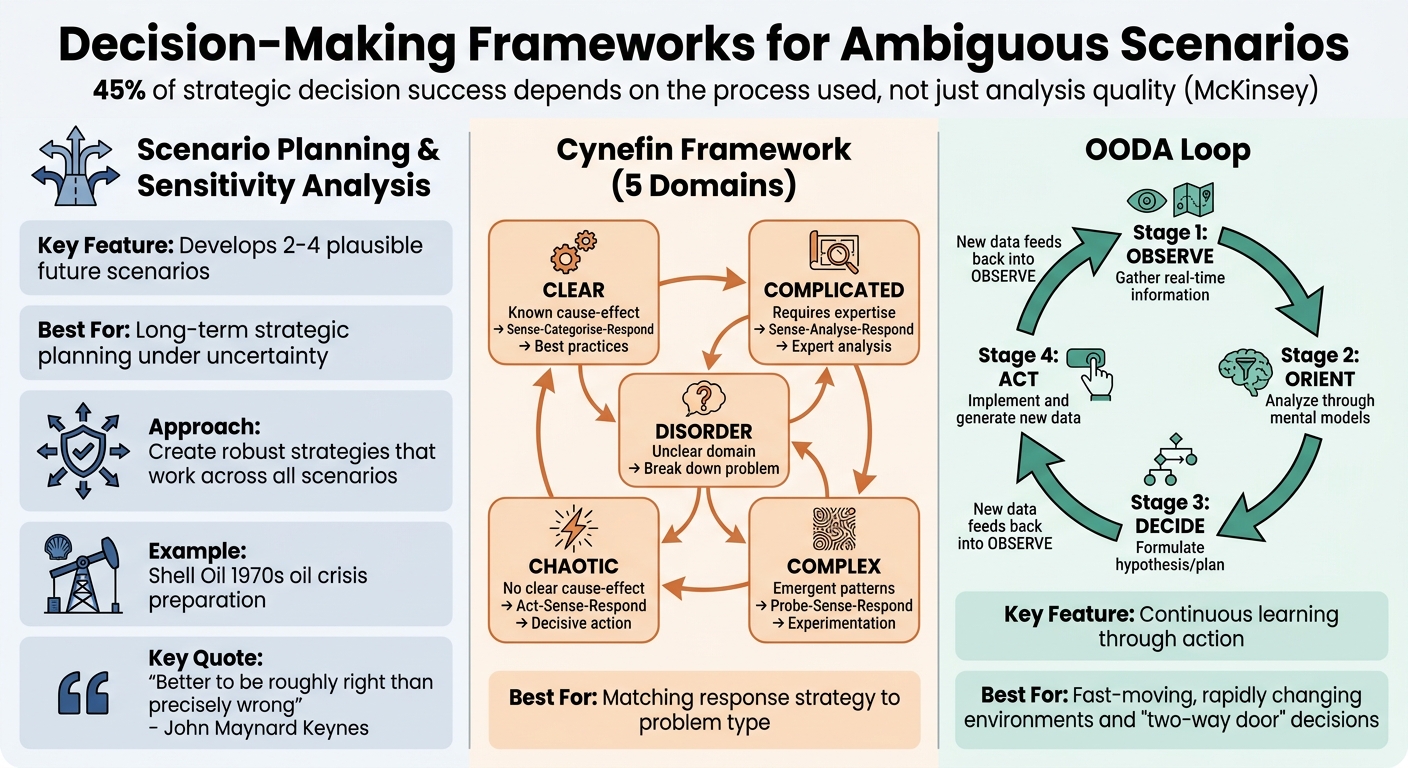
Decision-Making Frameworks Comparison Guide for Ambiguous Scenarios
After clearly defining the problem, the next step for leaders is to adopt a framework suited to navigating uncertainty. These frameworks are particularly useful when waiting for complete information is not an option, and inaction risks falling behind.
Scenario Planning and Sensitivity Analysis
Unlike traditional forecasting, which hinges on a single prediction, scenario planning develops two to four plausible future scenarios. The goal is not to predict the future but to create "robust strategies" - actions that perform reasonably well across all scenarios.
A classic example comes from Shell Oil in the 1970s. By using scenario planning to consider both stable and disruptive oil market futures, Shell was better prepared for the 1973 oil crisis than its competitors. Their success lay not in foreseeing the crisis but in preparing for a range of possibilities.
Sensitivity analysis works alongside scenario planning by testing decisions against uncertain assumptions. Leaders pinpoint the assumptions with the greatest impact and evaluate how changes in these factors might alter outcomes. If a decision holds up despite these variations, it is likely robust. As economist John Maynard Keynes famously said:
"It is better to be roughly right than precisely wrong".
This approach underscores the idea that decisions should not wait for perfect data. Instead, preparation and adaptability become the focus.
The Cynefin Framework
The Cynefin Framework, developed by Dave Snowden, helps leaders tailor their responses to the specific nature of a problem. It categorises decision-making contexts into five domains, each with its own approach.
| Domain | Characteristics | Response Strategy |
|---|---|---|
| Clear (Simple) | Known cause-effect relationships; stable and predictable | Sense – Categorise – Respond: Apply best practices and standard procedures. |
| Complicated | Cause-effect exists but requires expertise to uncover | Sense – Analyse – Respond: Use expert analysis and apply good practices. |
| Complex | Cause-effect only visible in hindsight; emergent patterns | Probe – Sense – Respond: Experiment to discover what works. |
| Chaotic | No clear cause-effect; urgent stabilisation needed | Act – Sense – Respond: Take decisive action to restore order. |
| Disorder | Unclear domain; multiple perspectives in conflict | Break down: Deconstruct the problem into components for clearer categorisation. |
The framework's strength lies in avoiding mismatched responses. For instance, rigid procedures are ineffective in complex situations, while experimentation during a crisis could lead to unnecessary harm. Leaders often face "control anxiety" in complex scenarios, where the instinct to rely on familiar analysis can hinder progress. Instead, safe-to-fail experiments are more appropriate.
A real-world example comes from March 2020, when Professor Soroush Saghafian advised Bahrain's government during the early COVID-19 outbreak. With no clear probabilities for the virus's spread, decisions had to account for "ambiguity" - a range of uncertain models rather than fixed risks. Recognising the situation as both complex and chaotic shaped the decision-making approach.
The OODA Loop for Real-Time Decisions
The OODA Loop - Observe, Orient, Decide, Act - was designed by military strategist John Boyd for rapidly changing environments. Unlike linear models, it focuses on continuous learning through action, making it ideal for ambiguous, fast-moving situations.
- Observe: Gather raw, real-time information.
- Orient: Analyse the data through existing mental models, adjusting for bias.
- Decide: Formulate a hypothesis or plan based on the current evidence.
- Act: Implement the decision and generate new data.
Each cycle feeds directly into the next, enabling constant adaptation. This iterative process is particularly effective for "two-way door" decisions - reversible choices where action provides valuable information faster than prolonged deliberation. Practising the OODA Loop in low-risk scenarios helps build confidence and resilience for high-pressure situations. It offers both structure and the agility needed to navigate uncertainty effectively.
Best Practices for Decision Support Under Uncertainty
Prioritising Direction Over Precision
In uncertain environments, leaders often have to make decisions without the luxury of complete information. A useful framework is to differentiate between Type 1 decisions - those that are irreversible and high-stakes - and Type 2 decisions, which are reversible and lower-risk, allowing for adjustments as new information emerges. For Type 2 decisions, acting quickly can enable valuable learning through action.
Take the example of Disney CEO Bob Iger in 2017. He faced a critical Type 1 decision when launching Disney+. Despite the potential risks of disrupting traditional revenue streams, Iger committed to acquiring BAMTech for streaming technology and pulling Disney’s content from Netflix. The move proved successful, with Disney+ amassing 100 million subscribers within just 16 months of its launch.
When planning under uncertainty, single-point predictions like "revenue will be £1 million" can be misleading. Instead, using confidence intervals, such as "£800,000 to £1.2 million", acknowledges the range of possible outcomes and helps leaders prepare for multiple scenarios. Emphasising "no-regrets moves" - actions that yield acceptable outcomes across various scenarios - can further reduce risk. Before committing significant resources, leaders can conduct a pre-mortem, imagining a project's failure and working backwards to identify potential pitfalls. Additionally, setting kill criteria - specific thresholds for pivoting or halting a project - can help counteract emotional biases like the sunk cost fallacy.
These practices not only enable faster, more adaptive decisions but also pave the way for clearer communication.
Transparent Communication of Assumptions
Effective decision-making under uncertainty requires transparent communication. Overstating certainty or relying on overly precise figures - such as reporting excessive decimal places - can create a "specificity heuristic", where numbers appear more credible than they are. Instead, openly categorising what is known, what is unknown, and how uncertainties are being addressed can set realistic expectations and reduce anxiety.
During crises, regular and honest communication is essential for maintaining stability. Avoiding false optimism - often referred to as "toxic positivity" - is key. Leaders should acknowledge genuine uncertainty while encouraging action. As Andy Grove, former Intel CEO, famously noted:
"In times of uncertainty, bold action is often safer than inaction".
Another valuable approach is the Devil's Advocate Protocol, where a team member is tasked with challenging the dominant viewpoint to uncover hidden assumptions and risks. Regularly scheduled check-ins ensure that strategies remain flexible and assumptions are revisited as new information comes to light.
Transparent communication, however, is just one part of the equation. Aligning stakeholders is equally critical for effective decision-making.
Stakeholder Alignment and Buy-In
Gaining stakeholder alignment under uncertain conditions requires early engagement and open dialogue. Involving diverse teams at the outset not only broadens perspectives but also fosters a sense of ownership over the outcomes. Before diving into detailed analysis, presenting a model mockup to stakeholders can help confirm that the data being generated will meet their decision-making needs. Rather than fixating on finding an "optimal" solution, leaders should quantify trade-offs - such as balancing costs against customer coverage - so stakeholders can make informed choices.
When Satya Nadella became CEO of Microsoft in 2014, the company was plagued by stagnation and a toxic work culture. Nadella shifted the organisation's mindset from "know-it-all" to "learn-it-all" and prioritised a "cloud-first, mobile-first" strategy. This cultural and strategic shift helped propel Microsoft’s market capitalisation from £300 billion to over £2 trillion.
Regular, predictable meetings can serve as a psychological anchor during periods of strategic uncertainty. Even when no new information is available, consistent communication helps prevent an information vacuum, which could otherwise fuel anxiety and speculation.
Integrating Frameworks with House of Birch Advisory

Bespoke Leadership Advisory in Action
House of Birch works closely with high-stakes leaders across the UK, particularly in areas such as mergers and acquisitions (M&A), investor relations, and pivotal industry decisions. By blending decision-making frameworks with insights from neuroscience, behavioural psychology, and cognitive science, the firm helps leaders cultivate emotional discipline, strategic thinking, and social influence.
Through personalised 1:1 and group sessions, House of Birch adapts established frameworks like the Cynefin Framework and the OODA Loop to the specific challenges faced by each leader. Rather than relying on off-the-shelf models, these tools are enhanced with the firm's proprietary "Decision Circle." This unique approach enables executives to assess their environment - whether it is Clear, Complicated, Complex, or Chaotic - before determining the most effective response. This method avoids common errors, such as over-analysing when swift action is needed or reacting too quickly when deeper assessment is essential.
The advisory process is built on three foundational pillars: Clarity (developing strategic foresight), Control (honing emotional discipline), and Connection (strengthening influence and storytelling). Together, these elements underpin the practical results achieved by House of Birch’s clients.
Case Study Insights: Applications in Practice
The practical benefits of these tailored methods are evident in House of Birch’s case studies. For instance, during a UK-based M&A engagement, the advisory enabled leadership teams to navigate complex scenarios using structured scenario planning and alignment of stakeholder viewpoints. This approach ensured clarity and cohesion in decision-making during a highly intricate process.
In another example, House of Birch supported an executive managing investor relations under significant pressure. By applying the OODA Loop, the advisory introduced a structured, iterative decision-making process that helped the executive maintain composure during critical presentations. This framework strengthened emotional resilience and sharpened strategic thinking, allowing the leader to maintain control over the narrative. As Tommy Birch explains:
"Every engagement is bespoke, designed to sharpen decision-making, amplify presence, and maximise influence".
Currently, House of Birch provides support to a network of over 7,200 leaders.
Conclusion
Handling ambiguity demands more than just instinct; it calls for structured approaches that refine decision-making. As DecideIQ highlights:
"Decision making frameworks provide a structured, repeatable process for evaluating options. They do not replace judgment; they sharpen it".
The aim is not to eliminate uncertainty or strive for perfection but to reduce risks while staying adaptable as circumstances shift.
This perspective is reinforced by compelling data. McKinsey research shows that the decision-making process quality has a 45% correlation with successful outcomes, far surpassing the 21% correlation linked to the depth of analysis. This underscores that how decisions are made often matters more than the sheer amount of data involved. Whether tackling a straightforward go/no-go choice or navigating complex, uncertain scenarios, aligning the right framework with the situation is crucial.
The real impact lies in practical execution. For instance, the "Two-Way Door" test helps differentiate between decisions that are reversible and require quick action versus those that are irreversible and demand thorough analysis. Pre-mortems can uncover hidden flaws in assumptions before resources are committed. Confidence intervals offer a more flexible alternative to rigid forecasts, and encouraging dissent ensures critical assumptions are rigorously tested. These methods often distinguish leaders who excel under pressure from those who struggle.
For leaders managing high-stakes decisions, House of Birch provides tailored advisory services designed to address specific challenges. By combining insights from neuroscience, behavioural psychology, and tested frameworks, the firm equips leaders with the tools to cultivate emotional resilience, strategic clarity, and steady composure. Their discreet, personalised approach mirrors the principles outlined here, helping leaders remain agile and effective in uncertain conditions.
At its core, effective leadership in ambiguous times isn't about predicting outcomes but about preparing for them. By using structured frameworks and seeking the right support, leaders can transform uncertainty into a strategic opportunity.
FAQs
How do I choose the right framework for my situation?
To choose an appropriate decision-making framework, think about the decision's reversibility, uncertainty, and complexity. For example, the 'Type 1/Type 2' framework categorises decisions as either irreversible (Type 1) or reversible (Type 2), guiding how much analysis and caution might be required.
Align the framework with your specific situation to improve clarity and confidence. Tools such as regret minimisation strategies or mental models can help reduce biases and organise your thought process more effectively.
When should I rely on intuition instead of structure?
In environments where familiarity and expertise reign, such as firefighting or chess, relying on intuition can be highly effective. This is because intuition stems from subconscious learning and pattern recognition, allowing swift decision-making under time pressure. However, when faced with complex or ambiguous situations, a different approach is needed. Structured methods - like systematic analysis or mental models - are more reliable in these contexts. They help minimise bias, ensure clearer thinking, and maintain consistency, particularly when the stakes are high or the outcome is uncertain.
How do I communicate uncertainty without losing trust?
Effectively addressing uncertainty hinges on a blend of honesty, openness, and reassurance. Leaders should maintain composure, resist the temptation to present false certainty, and clearly acknowledge areas where information is lacking. This candid approach builds trust and ensures clarity. By combining transparent communication with a steady and confident demeanour, leaders can help their teams manage ambiguity without undermining morale or creating confusion.

