Cross-Cultural Negotiation Strategies for High-Stakes Deals
High-stakes negotiations across borders often fail due to misunderstandings rooted in cultural differences. Research shows that 70% of international deals break down because of misaligned communication styles, hierarchies, and values. Success requires understanding how cultural norms influence decision-making, trust, and communication. Key insights include:
- Cultural values shape priorities: Individualistic cultures (e.g., US, UK) focus on goals and autonomy, while collectivist cultures (e.g., China, Japan) emphasise harmony and consensus.
- Power distance matters: High power distance cultures (e.g., India, Mexico) expect senior-level decision-makers, unlike low power distance cultures (e.g., Denmark, Netherlands).
- Communication styles differ: Low-context cultures (e.g., Germany, US) prefer directness, while high-context cultures (e.g., Japan, China) rely on indirect cues and non-verbal signals.
- Trust is built differently: Western cultures often start with trust, reinforced by consistency, while East Asian and Middle Eastern cultures prioritise relationships and reputation.
Tailoring communication, respecting norms, and building trust through small, reliable actions can transform cultural differences into opportunities. Leaders should prepare by studying cultural frameworks, consulting local experts, and using interpreters when necessary. This approach can strengthen relationships and lead to lasting agreements.
Takeaway: Leaders should prioritise understanding cultural dynamics to improve communication, build trust, and achieve better outcomes in global negotiations.
“Mastering Cross-Cultural Negotiation: Strategies for Global Success”
sbb-itb-ce676ec
How Cultural Dimensions Affect Negotiations
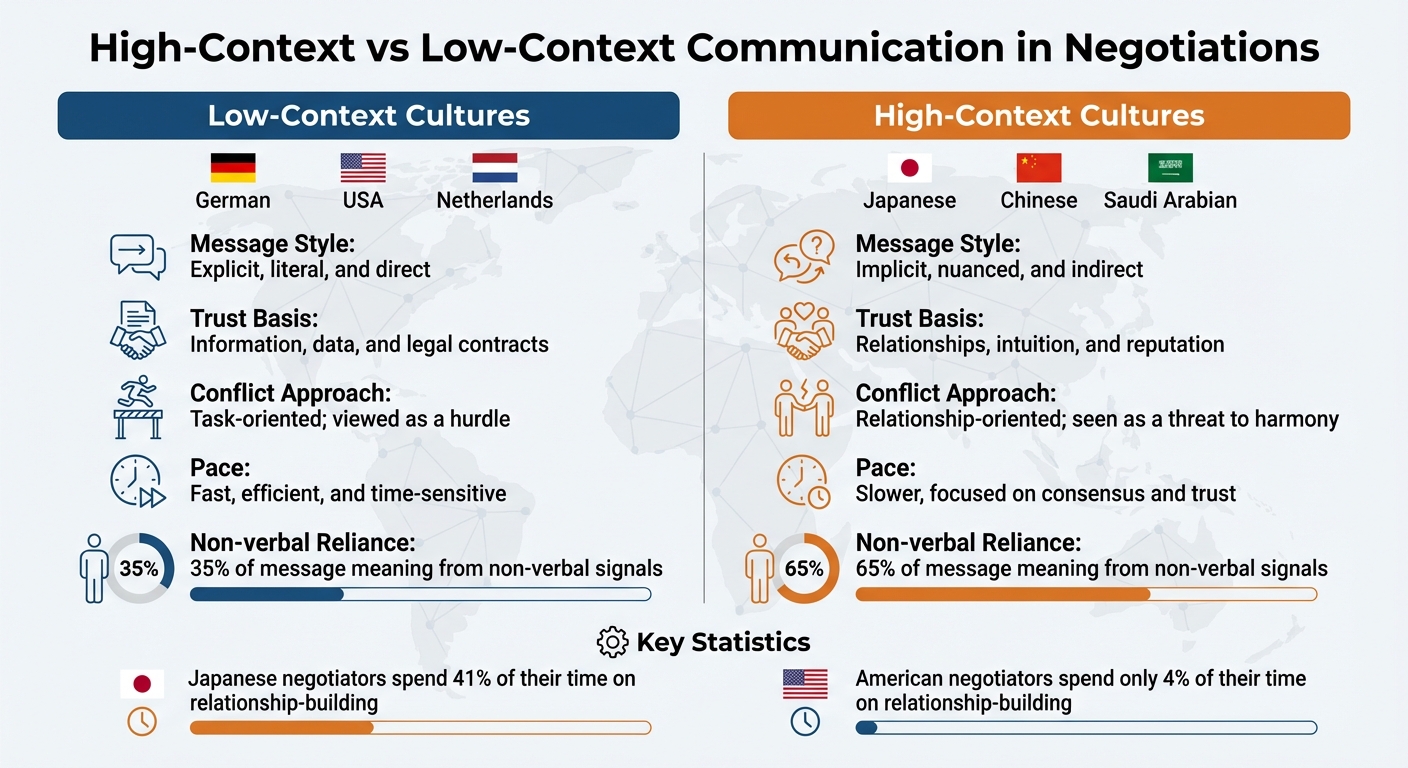
High-Context vs Low-Context Communication Styles in Cross-Cultural Negotiations
Understanding cultural values plays a critical role in high-stakes negotiations. Frameworks from scholars like Geert Hofstede and Edward Hall provide practical insights into how cultural differences influence communication, decision-making, and trust-building. These concepts help explain scenarios such as a German executive's directness alienating a Japanese partner or how mismatched delegation levels can derail discussions.
Cultural Dimensions That Shape Negotiations
Individualism versus Collectivism influences negotiation priorities. Negotiators from individualistic cultures, such as the United States and the UK, often focus on organisational goals and personal autonomy, favouring transactional and competitive approaches. On the other hand, collectivist cultures like China, Japan, and Brazil emphasise group harmony and consensus. For example, Japanese negotiators spend 41% of their time on relationship-building, compared to just 4% for Americans.
Power Distance affects decision-making authority. In high power distance cultures, such as those in Malaysia, Mexico, and India, decisions are centralised, and senior-level representation is essential. A Finnish delegation once faced challenges when negotiating with Thai government agencies because they sent mid-level officials instead of senior representatives, inadvertently signalling disrespect. Conversely, in low power distance cultures like Denmark and the Netherlands, decision-making is more collaborative, with contributions from junior team members welcomed.
Uncertainty Avoidance shapes risk tolerance and preferences for contract structure. Cultures like Greece, Japan, and Russia, which score high on uncertainty avoidance, prefer detailed and rigid contracts to reduce ambiguity. By contrast, negotiators from the United States and Singapore are more comfortable with flexible, principle-based agreements. This difference often leads to misunderstandings, as Western negotiators may see contracts as finalised endpoints, while some Asian negotiators view them as adaptable frameworks.
Time Orientation influences the pace and priorities of negotiations. Monochronic cultures, such as Germany and the United States, see time as linear, emphasising punctuality and efficiency. Polychronic cultures, including those in Latin America, the Middle East, and China, adopt a more fluid approach, placing greater value on relationship-building over strict schedules. For example, in the 1990s, Turner Broadcasting's negotiations with Indian officials stalled because the Americans prioritised a quick deal, while their Indian counterparts focused on establishing trust first.
These dimensions also shape communication styles, as explored below.
High-Context vs Low-Context Communication
Low-context cultures, such as Germany, the United States, and the Netherlands, rely on direct, explicit communication where meaning is embedded in the words themselves. In contrast, high-context cultures, including Japan, China, and many Arab nations, depend heavily on non-verbal cues, tone, and shared understanding. For instance, Japanese negotiators derive up to 65% of message meaning from non-verbal signals, compared to just 35% for Americans.
Such differences can lead to friction. A German engineering firm, for instance, failed to reach an agreement with a Chinese state enterprise because the Germans interpreted frequent consultation breaks and indirect responses as a lack of commitment. Meanwhile, the Chinese viewed the Germans' directness as overly aggressive and disrespectful. In high-context environments, phrases like "we will consider it" or "it is very difficult" often serve as polite rejections rather than genuine commitments.
| Feature | Low-Context (Germany, US, Netherlands) | High-Context (Japan, China, Saudi Arabia) |
|---|---|---|
| Message | Explicit, literal, and direct | Implicit, nuanced, and indirect |
| Trust Basis | Information, data, and legal contracts | Relationships, intuition, and reputation |
| Conflict | Task-oriented; viewed as a hurdle | Relationship-oriented; seen as a threat to harmony |
| Pace | Fast, efficient, and time-sensitive | Slower, focused on consensus and trust |
To navigate these cultural nuances effectively, leaders can adopt structured tools and frameworks.
Tools for Mapping Cultural Differences
Frameworks like Hofstede's Cultural Dimensions Theory help negotiators prepare by examining six key dimensions, including Power Distance, Individualism versus Collectivism, and Uncertainty Avoidance. For instance, the United States scores 40 on the Power Distance Index, compared to Guatemala's 95 and Austria's 11, illustrating stark differences in authority structures.
Hall's Cultural Dimensions focus on context, time orientation, and space (proxemics), while Trompenaars' Seven Dimensions address business-specific concerns like Universalism versus Particularism. Tools such as the Intercultural Development Inventory (IDI) and the Cultural Intelligence Scale (CQS) can also assess and enhance intercultural competence.
Preparation is crucial. Before negotiations, leaders should create a checklist covering communication styles, relationship expectations, time orientation, decision-making authority, and risk tolerance. In high power distance or high-context settings, showing respect for senior leaders and avoiding actions that could cause a counterpart to "lose face" is essential. Consulting local experts can further prevent misunderstandings and ensure smoother communication.
Negotiation Strategies for Cross-Cultural Success
Achieving success in cross-cultural negotiations requires adapting strategies in real time to align with the values and expectations of the other party. This involves fine-tuning communication, building trust strategically, and leveraging cultural differences to create opportunities - turning theoretical frameworks into practical tactics.
Adjusting Communication Styles
Tailoring communication to cultural norms is essential to avoid misunderstandings that could derail negotiations. For instance, in low-context cultures like the United States and Germany, directness is valued, and a clear "no" is expected. In contrast, high-context cultures such as Japan or the Middle East often express disagreement through subtler cues like silence, delays, or phrases such as "we will consider it." Research indicates that cultural differences in communication and hierarchy contribute to up to 70% of negotiation misunderstandings.
Different cultures require distinct approaches. For example:
- German negotiators value data and precision.
- Japanese counterparts prioritise harmony and long-term commitment.
- Brazilian partners respond well to flexibility and personal rapport.
A historical example highlights the importance of cultural sensitivity: During the 1990–1991 Gulf War Coalition negotiations, U.S. Secretary of State James Baker initially intended to leave a meeting in frustration. However, his interpreter advised staying, recognising that his counterpart was softening towards a concession. By heeding this advice, Baker secured the desired agreement.
Non-verbal cues also vary widely. Eye contact, for instance, signals confidence in cultures like the US, Germany, and the UK but may be perceived as aggressive in Japan, South Korea, and China. Similarly, silence can carry different meanings: in Germany, it may indicate thoughtful consideration, while in the UK, it might suggest discomfort. Even seating arrangements play a role - face-to-face setups common in Western cultures may feel confrontational in Japan or China, where side-by-side arrangements better reflect harmony and equality.
"Cultural intelligence in negotiations isn't about saying the wrong thing – it's saying the right thing in the wrong culture." – Commisceo Global
High-pressure situations can exacerbate reliance on stereotypes. Taking breaks or extending deadlines can help negotiators maintain flexibility and avoid cultural missteps. Once communication styles are aligned, the next step is to build trust across cultural divides.
Building Trust Across Cultures
Trust operates differently across cultures. In North America and Europe, trust is often assumed initially and reinforced through openness and consistency - an approach summarised as "trust but verify". In East Asia, trust develops more gradually, relying on reputation, third-party introductions, and social bonding after negotiations. Meanwhile, in the Middle East and South Asia, trust is deeply tied to respect for values and hospitality, with personal character taking precedence over formal agreements.
Third-party introductions are particularly critical in cultures like Japan and China, where the introducer's reputation is on the line. In Latin America, personal connections and shared values must be established through informal interactions before formal discussions can begin.
"In order to trust, we have to know the [person] first" – Korean manager
"It's not, I trust, [then] I verify; it's I verify first, then I trust" – Lebanese manager
Consistency in small actions builds credibility. For example, delivering on minor promises - such as sending a proposal by a specific deadline - demonstrates reliability. In relationship-oriented cultures, trust can also be strengthened through non-business interactions like shared meals or conversations about family. To avoid causing offence in cultures where "no" is considered impolite, open-ended questions such as "By when could you complete this?" are more effective than yes/no questions.
"Trust is a renewable source of bargaining power." – Smolinski and Kesting
A memorable example of trust-building occurred in March 2016, when President Barack Obama participated in a traditional tango during a state dinner in Buenos Aires. This gesture of engaging with local culture helped bridge cultural divides and reinforced diplomatic ties between the United States and Argentina.
Using Cultural Differences to Your Advantage
When trust and communication are established, cultural differences can serve as a foundation for creating value. Negotiators with high Cultural Intelligence (CQ) often achieve better outcomes by adapting their strategies mid-conversation. Studies suggest that cross-cultural pairs who overcome communication barriers often generate more creative solutions than same-culture pairs.
For example, a Nestlé acquisition team initially struggled to negotiate with a Chinese manufacturer. By shifting their focus to cultivating guanxi - a concept centred on building personal rapport - they set aside deal discussions temporarily to foster mutual trust. This approach ultimately led to a successful partnership. Such examples highlight how understanding collectivist or high-context cultures can open doors to more substantive agreements.
Cultural frameworks can also aid in resolving complex global issues. During the 2015 Paris Climate Talks, negotiators adopted the South African "indaba" process, which emphasises consensus-building. While unfamiliar to many participants, this approach helped break through traditional Western deadlocks and resulted in a global agreement.
"Adaptation is not weakness; it's wisdom put into action." – Ahmed, Saha & Tasrif
Before entering negotiations, it is essential to map out cultural gaps in areas like power dynamics, risk tolerance, and decision-making preferences. Trusted interpreters can play a dual role - not only translating language but also identifying emotional cues and interpreting indirect communication. For instance, hesitation from an Asian counterpart in a virtual meeting might reflect careful consideration rather than disinterest. By recognising and bridging these gaps, negotiators can achieve more balanced and successful outcomes.
Managing Tensions in High-Stakes Scenarios
Even with thorough preparation, cultural differences are bound to surface during high-stakes negotiations. However, tension doesn’t necessarily mean failure - it often highlights underlying values and priorities. When handled thoughtfully, addressing these tensions can lead to stronger, more effective agreements.
Turning Conflict into Opportunity
Effective negotiators understand that tensions can be opportunities in disguise. By leveraging trust and clear communication, they turn disagreements into chances for creative problem-solving. For instance, the collaboration between Ford and Mazda highlighted this dynamic. Ford’s straightforward communication style initially clashed with Mazda’s consensus-driven approach. However, by blending Ford’s group discussions with Mazda’s direct methods, the companies transformed their differences into advancements in automotive technology.
When conflicts arise, it’s important to identify the issue without placing blame. Open-ended questions can help uncover the cultural or logical reasons behind the friction. For example, a delay from a counterpart in a high-context culture might stem from their need to consult widely to maintain group harmony, rather than resistance or inefficiency. Adjusting timelines, rethinking decision-making structures, or revising proposals can help align the process with the other party’s values.
"When Americans adapt to the slower pace of counterparts from tighter cultures, they are likely to make fewer concessions, whilst also building stronger relationships." – Programme on Negotiation at Harvard Law School
In many cultures, maintaining dignity is critical. Addressing disagreements privately helps avoid public embarrassment and preserves mutual respect[9,29]. Separating technical issues from emotional or political concerns can also provide space for experts to resolve specific problems without derailing the entire negotiation. This approach allows for realistic expectations and carefully calibrated compromises.
Setting Expectations and Making Concessions
A practical framework for managing discussions is the 70/30 rule: spend 70% of the time listening and only 30% talking. This helps uncover the other party’s motivations and identify opportunities to build rapport. For example, negotiators can pinpoint “nice-to-have” items - such as flexible delivery options or improved payment terms - that hold significant value for the other side but come at minimal cost to themselves.
Preferences for agreement structures also vary across cultures. Globally, 78% of people prefer detailed agreements, but negotiators from countries like Japan and Germany often favour broader, more adaptable arrangements. Understanding these tendencies makes it easier to tailor concessions in a way that resonates with the other party. Offering multiple well-thought-out options allows counterparts to select a path that aligns with their internal decision-making hierarchy without feeling coerced. Supporting proposals with credible benchmarks or industry examples, and using techniques like “test and summarise” to confirm mutual understanding, further strengthens trust[7,29].
Working with Mediators and Interpreters
When internal strategies fail to resolve persistent misunderstandings, external expertise can be invaluable. Professional interpreters and cultural mediators help bridge gaps where language or cultural differences threaten the clarity of an agreement. Attempting to speak the other party’s language without full fluency can lead to critical misunderstandings, particularly in technical or legal contexts[5,33].
"Precise language is the key to creating lasting agreements, and attempts to speak the language of the other side can undermine that precision with misunderstanding." – Programme on Negotiation at Harvard Law School
Interpreters do more than translate words - they provide insights into emotional states and non-verbal cues that might otherwise go unnoticed. A skilled interpreter acts as a strategic ally, advising on when to pause or when a particular argument has gained traction. It’s essential to maintain eye contact with the entire negotiation team, rather than focusing solely on the interpreter, to foster a sense of inclusion and respect.
Cultural mediators are especially helpful when negotiations falter due to unspoken norms or traditions. Practices like guanxi in China or indirect diplomacy in Europe can create stumbling blocks if misunderstood[7,9]. Collaborating with local advisers to understand cultural sensitivities, historical contexts, and relationship-building practices is crucial. Mediators can help create a shared professional framework or “third culture” that bridges even significant cultural divides.
Successfully managing tensions not only resolves immediate conflicts but also lays the foundation for long-lasting, cross-cultural partnerships.
Building Relationships for Long-Term Success
Long-term success in negotiations often depends on the strength of relationships, not just technical expertise. Research involving nearly 1,000 negotiations highlights that the most effective negotiators are "integrated achievers" - individuals who pair discipline with a high degree of empathy. This combination elevates trust from a simple interpersonal skill to a powerful and renewable asset in negotiations.
Finding Common Ground
Discovering shared values goes beyond polite conversation; it requires a deep dive into your counterpart's core motivations. For instance, in countries like Germany or Switzerland, trust is rooted in competence and reliability. In contrast, in Spain or Brazil, personal rapport and emotional intelligence are key, while in China or Japan, trust develops through long-term loyalty and reciprocity. Asking thoughtful questions to uncover what respect and success mean to your counterpart demonstrates cultural sensitivity, breaking down barriers and signalling openness.
Adapting your approach to align with these cultural nuances can reveal shared values and even spark operational improvements. For example, adjusting how discussions are structured to fit cultural expectations can foster collaboration. Shared values are not pre-existing; they are built through intentional efforts to understand and adapt to differing perspectives.
The Value of Informal Interactions
In cultures that prioritise relationships, such as China, Brazil, and the UAE, trust often begins outside the formal meeting room. Social interactions like shared meals or participation in cultural activities are essential before moving into business discussions. These informal settings provide opportunities to pick up on non-verbal cues and implicit messages that might be missed in formal negotiations.
For example, taking part in local traditions or cultural activities during these informal moments can strengthen mutual respect and deepen trust. A genuine interest in your counterpart’s culture creates goodwill that structured meetings alone cannot replicate.
Leadership Advisory for Enhanced Influence
Building strong cross-cultural relationships demands more than just cultural awareness - it requires emotional control and strategic insight. House of Birch offers tailored advisory services to help leaders effectively balance empathy with assertiveness, interpret cultural signals accurately, and maintain composure under pressure. These one-to-one sessions equip leaders to turn cultural differences into opportunities, fostering resilient partnerships. Such strategies are essential for creating enduring relationships that drive success in high-stakes environments.
Case Studies: Lessons from Cross-Cultural Negotiations
These examples highlight how understanding cultural dynamics can lead to success in high-stakes negotiations.
Case Study: Navigating Guanxi in China
In the mid-1990s, General Motors secured a £1bn assembly plant deal in Shanghai, thanks to the guanxi (relationship network) of Shirley Young, a Shanghai-born vice-president with strong local connections. By contrast, Ford faced initial setbacks due to limited cultural awareness and language barriers. However, the appointment of Mei-Wei Cheng to a senior role in 1998 helped them recover, ultimately leading to a joint venture with Chongqing Chang’an in 2001.
In China, trust is often built through a trusted intermediary, or zhongjian ren, who serves as a crucial link between parties. For example, Celanese Corporation successfully partnered with the China National Tobacco Corporation (CNTC) between 1982 and 1992 by working with the London Export Company as a mediator. This investment of approximately £1 million over two years enabled Celanese to expand its Nantong plant profitably. Research from 2022 underscores the importance of sustained engagement, with 70% of successful foreign deals in China relying on continued relationship-building after agreements are signed.
A striking example of reciprocity and the concept of "saving face" occurred in a shipbuilding negotiation. When NOR, a classification company, refused a minor discount request from Chinese shipbuilder Chando, it inadvertently damaged the relationship. Even after NOR later reduced its price significantly - from £380,000 to £220,000 per vessel - Chando awarded the contract to a competitor, LL. This decision was a deliberate reminder of the importance of reciprocity and respect.
These cases demonstrate that tailored strategies and a deep understanding of local customs are essential for navigating complex cultural landscapes.
Case Study: Indirect Diplomacy in European Negotiations
The Brexit negotiations, concluded in January 2021, provide a compelling example of indirect diplomacy. Led by UK Chief Negotiator Lord Frost and EU Head of Task Force Michel Barnier, a critical turning point came during a phone call between Prime Minister Boris Johnson and European Commission President Ursula von der Leyen. Johnson cleverly played on von der Leyen’s native German, saying, "Hummer (lobster) nicht Hammer!" to steer the conversation away from her metaphor of a "hammer" as punishment for rule-breaking. This linguistic manoeuvre helped lay the groundwork for the 1,246-page Trade and Cooperation Agreement.
This negotiation highlighted the contrasting styles of British pragmatism and French Cartesian logic. Michael Gates, an Associate Fellow at Saïd Business School, explained:
"In negotiation style, the French and British are worlds apart... negotiation is about adopting a logically coherent set of principles and defending them rigidly [for the French], where for the British it tends to be an experimental process".
Further research suggests that mirroring the language, tone, and style of counterparts - such as judges in legal contexts - can significantly increase success rates, doubling the likelihood of a favourable outcome.
The Brexit case underscores the power of linguistic nuance and cultural awareness in European negotiations, offering valuable lessons for leaders navigating similar challenges.
Leadership Transformations with House of Birch
House of Birch has worked with leaders to tackle culturally intricate negotiations through tailored advisory services. In one instance, a political leader climbed from a low-ranking position to a top-10 finish within two election cycles by focusing on strategic positioning and maintaining composure under pressure. For a FTSE 250 company recovering from a failed transformation initiative, the firm introduced "composure rituals" for high-stakes meetings and revamped communication strategies to prioritise clarity. These changes restored trust among peers and re-engaged staff within two quarters.
In another case involving an international merger, House of Birch developed a shared decision-making framework and unified language to address inter-departmental conflicts. This approach significantly improved decision turnaround times within a single quarter.
House of Birch’s methods highlight the importance of adapting communication styles and trust-building strategies to fit the cultural context. By aligning leadership practices with these principles, organisations can achieve long-term success in complex negotiations. These examples further reinforce the value of cultural sensitivity and adaptive techniques in high-pressure environments.
Conclusion
Navigating cross-cultural negotiations successfully requires thorough preparation, flexible communication, and a focus on building meaningful relationships. Leaders who take the time to understand their counterpart’s cultural boundaries, preferred communication styles, and decision-making structures significantly reduce the chances of missteps in international dealings.
The strategies highlighted earlier underline how adjusting communication methods can turn potential obstacles into collaborative opportunities. This might mean adapting the speed of discussions, interpreting non-verbal cues like silences more effectively, or presenting proposals in a way that aligns with the other party’s values. As Nicola Cronin from Aligned Negotiation aptly states:
"Cultural awareness isn't an instinct – it's a skill that ought to be trained like any other".
Strong relationships are the cornerstone of successful negotiations. In many cultures - such as those in Shanghai or São Paulo - trust and informal connections often outweigh the importance of formal contracts. The case studies mentioned earlier illustrate how investing in personal rapport and shared experiences can open doors to agreements that might otherwise remain out of reach.
With 72% of executives citing cross-cultural negotiation skills as critical to effective leadership in global markets, these abilities are no longer optional but essential. Leaders equipped with cultural intelligence can navigate complexities, transform tension into cooperation, and craft agreements that stand the test of time.
FAQs
How can I recognise a polite “no” in a high-context culture?
In cultures where communication tends to be high-context, a polite “no” is often expressed indirectly to maintain harmony and prevent embarrassment. Instead of outright refusal, people may use phrases like “we’ll see” or “that might be difficult” to indicate a lack of interest or agreement. Non-verbal cues - such as tone of voice, facial expressions, and body language - play a crucial role in conveying true intentions. Recognising and interpreting these subtleties is essential for fostering trust and managing relationships effectively in these environments.
Who should be on my delegation in high power-distance countries?
In countries where high power-distance dynamics prevail, the presence of senior leaders or high-ranking officials is crucial. These individuals are adept at managing formalities, demonstrating respect for authority, and engaging meaningfully with key decision-makers. Additionally, involving culturally aware advisors or intermediaries can help navigate subtle cultural differences, maintain formal communication protocols, and foster trust. By combining authority with cultural sensitivity, teams can significantly enhance their chances of achieving successful negotiation outcomes in such settings.
When should I use an interpreter or cultural mediator?
When navigating negotiations where language barriers or differences in cultural norms might pose challenges, employing an interpreter or cultural mediator can be invaluable. This approach is especially critical in high-stakes scenarios where communication styles and expectations may differ significantly. A mediator not only facilitates clear dialogue but also ensures that cultural nuances are respected. This can build trust, minimise misunderstandings, and enhance the chances of reaching mutually beneficial agreements.

