Confidence vs. Overconfidence in High-Stakes Leadership
Confident leadership builds trust and drives sound decisions, while overconfidence risks poor judgement and organisational setbacks. Confidence is grounded in competence and evidence, enabling leaders to admit mistakes and adapt. Overconfidence, however, stems from inflated self-belief, often ignoring feedback and underestimating risks.
Key Points:
- Confidence: Based on self-awareness, realistic assessments, and openness to feedback. Encourages calculated risks and team collaboration.
- Overconfidence: Overestimates abilities, dismisses input, and leads to impulsive or high-risk decisions. Often erodes trust and team morale.
- Leaders should balance confidence with humility, seek diverse perspectives, and remain critical of their assumptions to navigate uncertainty effectively.
Why Overconfidence Kills Leadership Success (And How to Overcome It)
sbb-itb-ce676ec
Confidence in High-Stakes Leadership
True confidence in leadership exists between two extremes: paralysing self-doubt and inflexible certainty. Instead of believing they already have all the answers, confident leaders rely on their ability to adapt and respond as challenges arise. The following explores the qualities of such leadership and its broader impact.
What Confidence Looks Like
Confident leaders demonstrate intellectual humility - a readiness to admit mistakes and change direction when new evidence emerges. They approach decisions with curiosity, often asking, "What am I missing?" This mindset allows them to acknowledge gaps in their knowledge and involve their teams in problem-solving.
Bradley Owens, a Professor of Ethics at Brigham Young University, explains:
"Leaders with intellectual humility are able to transcend the temptation to doggedly defend their own ideas. They are willing to sacrifice some of their power and even reputation to ensure the right outcome."
This mindset extends to how they handle uncertainty. Instead of pretending to have all the answers, they use measured language to convey their decisions, which studies show enhances trust in their judgement. Additionally, they maintain a conversational balance - roughly 60% questions and 40% statements - to avoid projecting undue certainty.
This thoughtful approach not only sharpens decision-making but also strengthens team cohesion.
Benefits of Confidence in Leadership
In high-stakes environments, balanced confidence is essential for managing uncertainty. It helps leaders remain composed, keeping the prefrontal cortex - the brain's decision-making hub - focused and effective under pressure. This composure enables clearer thinking and better judgement. Moreover, confident leaders create a sense of psychological safety, a key factor identified in Google's Project Aristotle, which encourages teams to take calculated risks and recover from setbacks.
The influence of such confidence extends beyond individual decisions to the entire organisation. With 71% of employers prioritising emotional intelligence over technical skills, and demand for these traits expected to grow sixfold in the coming years, leaders who combine self-assurance with openness to feedback foster trust, improve communication, and align teams more effectively in high-pressure contexts.
Overconfidence in High-Stakes Leadership
Confidence arises from an accurate understanding of one’s abilities, but overconfidence takes this a step too far, distorting a leader’s perception of their own expertise. This bias can lead leaders to genuinely believe they are more capable than they are, presenting themselves as experts while unknowingly operating under flawed assumptions.
What Overconfidence Looks Like
Overconfidence manifests in three key ways: overestimating one’s performance, overplacing one’s abilities above others, and expressing unwarranted precision in certainty. A striking example comes from a survey where 93% of American drivers rated themselves as better than the median - a clear statistical impossibility.
In leadership settings, overconfident individuals often dominate discussions, project unwavering certainty, and dismiss feedback that challenges their self-perception. They may even use excessive certainty to hide insecurities, inadvertently shutting down meaningful dialogue. Cameron Anderson from the Haas School of Management, University of California, Berkeley, highlights this dynamic:
"Confidence makes individuals appear more competent in the eyes of others, even when that confidence is unjustified and unwarranted".
These tendencies can significantly distort decision-making processes and strategic planning, as explored further below.
Risks of Overconfidence in Decision-Making
Overconfidence doesn’t just skew personal judgement; it can have serious repercussions for organisational decisions. Studies have shown that overconfident leaders often misjudge their ability to forecast accurately, leading to flawed decisions. Itzhak Ben-David, Associate Professor of Finance at Ohio State University, observes:
"These executives are too sure of their ability to predict the future. And we found this overconfidence was linked to decision-making at their firms, so there is a real-world impact".
This overconfidence often results in underestimating risks and bypassing thorough analysis. Leaders may pursue overly aggressive growth strategies or initiate mergers that ultimately destroy value, failing to account for competitive pressures or internal constraints. Research indicates that firms led by overconfident CEOs are about 25% more likely to face securities class actions compared to others.
Beyond financial consequences, overconfidence can damage team dynamics. It marginalises dissenting opinions, discourages employee engagement, and increases turnover among top talent. Furthermore, when overconfident projections fail, the resulting gap between expectations and reality erodes stakeholder trust. These cascading effects highlight the dangers of unchecked overconfidence in leadership.
Confidence vs. Overconfidence: A Direct Comparison
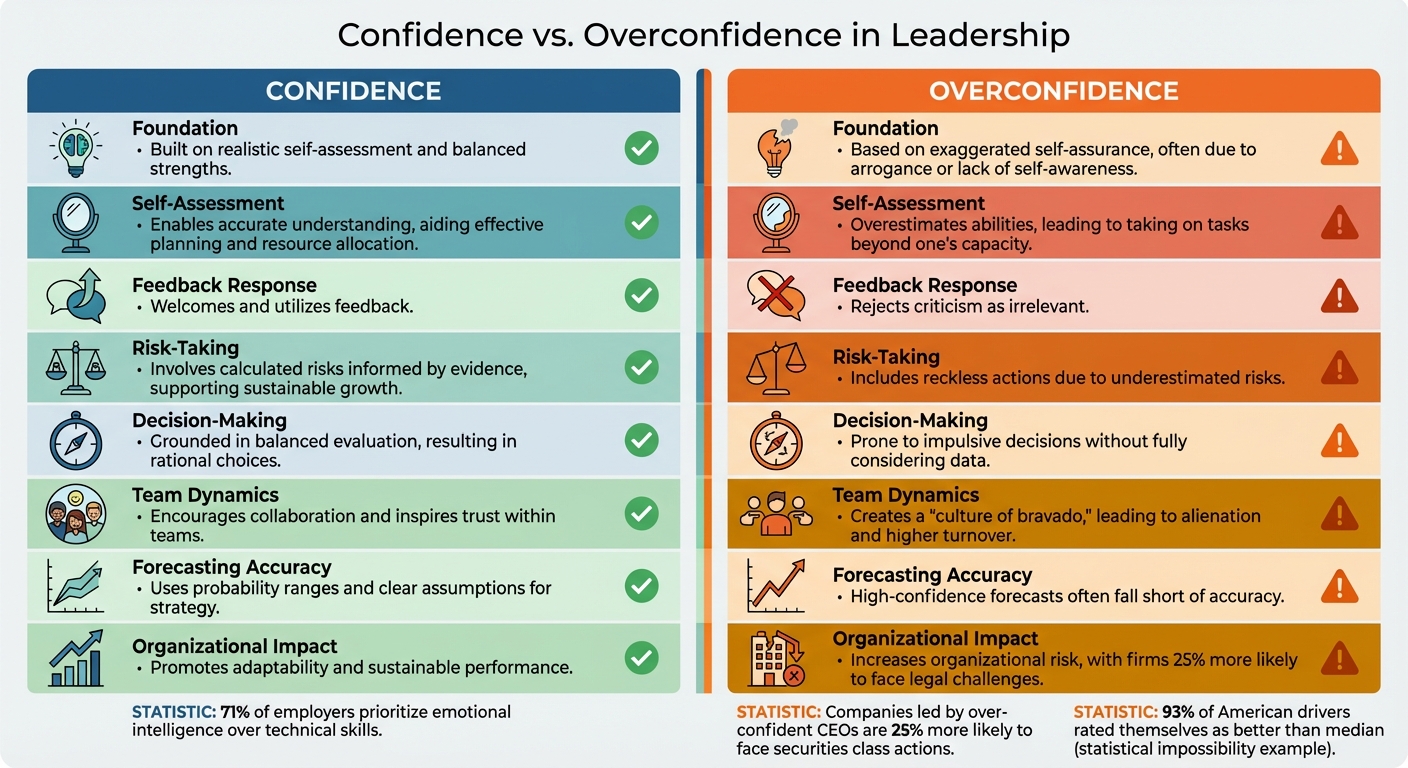
Confidence vs Overconfidence in Leadership: Key Differences
Continuing the earlier discussion on leadership traits, this section contrasts confidence with overconfidence. While confidence reflects an alignment with objective reality, overconfidence represents a misalignment, creating a gap between perception and actual performance.
Confidence is rooted in a realistic self-assessment and a balanced view of one’s strengths and limitations. Overconfidence, on the other hand, distorts this balance, manifesting in behaviours such as overestimation of abilities, overplacement in comparison to others, and unwarranted precision in judgments.
A critical distinction lies in how leaders handle feedback. Confident leaders actively seek out constructive criticism and diverse viewpoints to refine their approach. In contrast, overconfident leaders often disregard feedback, perceiving it as irrelevant. This attitude fosters a "culture of bravado", alienating colleagues and delaying the identification of potential risks. Such differences in feedback reception directly affect risk management in leadership decisions.
The influence of these traits is also evident in risk-taking and decision-making. Confident leaders are known for taking calculated risks, relying on evidence and thorough analysis to support sustainable growth. Conversely, overconfident leaders tend to underestimate risks, leading to reckless behaviour. For example, research shows that companies led by overconfident CEOs are about 25% more likely to face securities class actions. As Professor Don A. Moore explains:
"The perverse consequence when it comes to leaders, though, is that by selecting the most confident, we are also very likely selecting the most overconfident".
Comparison Table
The table below outlines the key differences between confidence and overconfidence:
| Trait | Confidence | Overconfidence |
|---|---|---|
| Foundation | Built on realistic self-assessment and balanced strengths | Based on exaggerated self-assurance, often due to arrogance or lack of self-awareness |
| Self-Assessment | Enables accurate understanding, aiding effective planning and resource allocation | Overestimates abilities, leading to taking on tasks beyond one’s capacity |
| Feedback Response | Welcomes and utilises feedback | Rejects criticism as irrelevant |
| Risk-Taking | Involves calculated risks informed by evidence, supporting sustainable growth | Includes reckless actions due to underestimated risks |
| Decision-Making | Grounded in balanced evaluation, resulting in rational choices | Prone to impulsive decisions without fully considering data |
| Team Dynamics | Encourages collaboration and inspires trust within teams | Creates a "culture of bravado", leading to alienation and higher turnover |
| Forecasting Accuracy | Uses probability ranges and clear assumptions for strategy | High-confidence forecasts often fall short of accuracy |
| Organisational Impact | Promotes adaptability and sustainable performance | Increases organisational risk, with firms more likely to face legal challenges |
How Leaders Can Strike the Right Balance
In high-pressure leadership roles, the fine line between confidence and overconfidence can be managed through intentional self-awareness and effective feedback systems. Striking this balance requires leaders to combine genuine confidence with a dose of critical scepticism, helping them avoid the pitfalls of overconfidence.
Building Self-Awareness and Calibration
A key step in achieving balanced confidence is understanding the difference between confidence and certainty. As Allison Dunn, CEO and Executive Coach at Deliberate Directions, succinctly puts it:
"Confidence says: 'I believe in my ability to figure this out.' Certainty says: 'I already know the answer.' One keeps you learning. The other stops you cold".
This distinction hinges on calibration - the ability to align confidence levels with actual accuracy. According to the Behavioural Insights Team:
"To be well-calibrated means your confidence in your judgement aligns with accuracy. If you say you're 80% sure, you should be right roughly 80% of the time".
Calibration isn’t an innate ability but a skill that can be developed through consistent practice. One effective method involves tracking predictions. Leaders can document their forecasts, including confidence levels and reasoning, and later review outcomes to identify instances where confidence exceeded evidence. This process is crucial, as research shows that individuals with lower performance often overestimate their abilities, highlighting how a lack of knowledge can obscure awareness of personal limitations.
This kind of self-assessment naturally leads to seeking external input to refine one’s perspective further.
Seeking Feedback and Different Perspectives
Feedback from others is invaluable for maintaining balance, as self-assessment alone can be unreliable in complex leadership scenarios. Kevin Novak, CEO and Chief Strategy Officer at 2040 Digital, cautions:
"The person who speaks most confidently may understand the topic least. The person with the most valuable perspective may hold back".
To counteract this, leaders can adopt the 60/40 rule, which emphasises asking questions over making statements. Simple yet powerful questions like, "What am I missing?" or "What evidence would change my mind?" can foster open dialogue. Another practical approach is introducing a challenge clause in team meetings, enabling any member to question decisions without fear of professional consequences.
Leaders should also discourage excessive agreement or flattery, as it can signal a lack of honest feedback. When faced with uncritical approval, they can prompt more candid responses by actively encouraging constructive criticism. This approach is particularly relevant as emotional intelligence becomes increasingly valued in the workplace. With 71% of employers prioritising emotional intelligence over technical skills, and demand for these abilities expected to grow significantly in the coming years, leaders who embrace challenge gain a distinct edge.
Such practices not only enhance decision-making but also foster a culture of balanced thinking across teams.
The Role of Leadership Advisory Services
Leadership advisory services offer an external perspective that internal teams may struggle to provide due to hierarchical dynamics. Allison Dunn highlights a common leadership pitfall:
"The very trait that propelled you to success can become the ceiling that prevents your next level of growth".
These services help leaders uncover "confidence blind spots" - areas where past successes may have led to unwarranted certainty. For instance, House of Birch’s advisory services focus on helping leaders balance conviction with adaptability. Through tailored coaching, they guide leaders in articulating uncertainty levels, implementing structural tools like challenge clauses, and building confidence that is grounded in evidence rather than assumption.
This approach aligns with insights from Professor Ginka Toegel of IMD Business School, who describes a more nuanced form of confidence:
"When senior leaders are willing to say 'I am 60% confident in this path, here are the key risks and here is what would make me change my mind,' they redefine what confidence looks like across the organisation".
Conclusion: Finding the Right Level of Confidence in Leadership
Confidence drives growth, while certainty can bring it to a halt. This distinction matters because authentic confidence encourages leaders to keep learning and adapting, whereas overconfidence often leads to poor judgement, unnecessary risks, and a breakdown in team trust.
Overconfidence doesn’t usually appear overnight - it builds gradually and often goes unnoticed by those it affects the most. Leadership roles, in particular, can make individuals more susceptible to overestimating their abilities and control. Notably, 71% of employers now prioritise emotional intelligence over technical skills, with demand for these capabilities expected to grow sixfold in the years ahead.
Striking the right balance in confidence is critical for navigating uncertainty. Leaders who achieve this balance - avoiding both paralyzing self-doubt and misplaced certainty - foster innovation and retain top-performing teams. By openly admitting when they don’t have all the answers, encouraging differing viewpoints, and staying curious about potential blind spots, these leaders build trust and make better decisions. For those seeking to refine this skill, an external perspective can offer vital insights.
Balanced confidence not only enhances decision-making but also strengthens team cohesion, especially in high-pressure situations. House of Birch offers leadership advisory services tailored to help leaders uncover blind spots, develop emotional discipline, and refine their decision-making processes. Their bespoke coaching equips leaders to express uncertainty effectively, guard against overconfidence, and base their decisions on evidence rather than assumptions.
The key question remains: is your confidence flexible enough to embrace change, surprises, and continuous learning? Discover how House of Birch's tailored leadership advisory can support you in maintaining this crucial balance.
FAQs
How can I tell confidence from overconfidence in myself?
Confidence stems from a clear understanding of oneself and a solid track record of demonstrated abilities. It allows for making informed choices and maintaining a willingness to accept constructive feedback. In contrast, overconfidence arises from an exaggerated sense of one’s skills, often unsupported by evidence. This can result in taking unnecessary risks and ignoring valuable advice. To evaluate your own stance, consider this: Is your confidence rooted in genuine experience and feedback, or are you overlooking potential risks while overestimating your level of control?
What habits help me stay calibrated under pressure?
To remain steady under pressure, it’s crucial to align your confidence with reality by engaging in regular self-assessment. Cultivate habits such as actively seeking constructive feedback and practising intentional actions that reinforce authentic confidence. These approaches can help you steer clear of overconfidence while ensuring sound decision-making in demanding situations.
How do I invite honest challenge from my team?
Creating an environment where feedback is openly shared and genuinely valued requires intentional effort. Leaders should prioritise humility, embracing a range of perspectives, and fostering psychological safety - a state where individuals feel secure expressing their honest opinions without fear of judgement or reprisal.
Confidence is key, but it should be tempered with approachability. Striking the balance between self-assurance and humility helps build trust and credibility. This, in turn, encourages team members to engage more openly.
Active listening is equally important. When leaders listen attentively and acknowledge feedback - whether through verbal appreciation or by acting on it - they reinforce a sense of collaboration and mutual respect. Over time, these behaviours create a culture where everyone feels empowered to contribute their insights.

