Cognitive Load Reduction: 7 Leadership Tips
Reducing cognitive load is critical for effective leadership, especially in high-pressure situations. Overloaded minds lead to poor decision-making, emotional instability, and reduced focus. This article offers seven evidence-based strategies to help leaders manage mental strain and maintain clarity:
- Establish Predictability Anchors: Use structured routines to minimise decision fatigue, such as prioritising tasks in the morning when mental energy is highest.
- Focus on Core Outcomes: Limit objectives to avoid overloading the brain's decision-making capacity, and include dissenting perspectives to sharpen decisions.
- Use 30-Minute Bookends: Start and end the day with structured planning and reflection to protect cognitive resources.
- Work in 60–90 Minute Cycles: Break tasks into focused intervals with regular breaks to maintain mental clarity and prevent overload.
- Set Digital Guardrails: Limit interruptions by muting notifications and batching emails to preserve focus.
- Apply Generative Strategies: Use tools like pre-mortem analysis and scaffolding techniques to simplify complex decisions and encourage creative problem-solving.
- Automate Routine Decisions: Delegate or automate low-stakes tasks to conserve mental energy for critical decisions.
These methods are backed by behavioural science and neuroscience, offering practical ways for leaders to optimise decision-making and maintain composure under pressure. Leaders should reflect on their current practices and consider integrating these strategies to sustain long-term effectiveness.
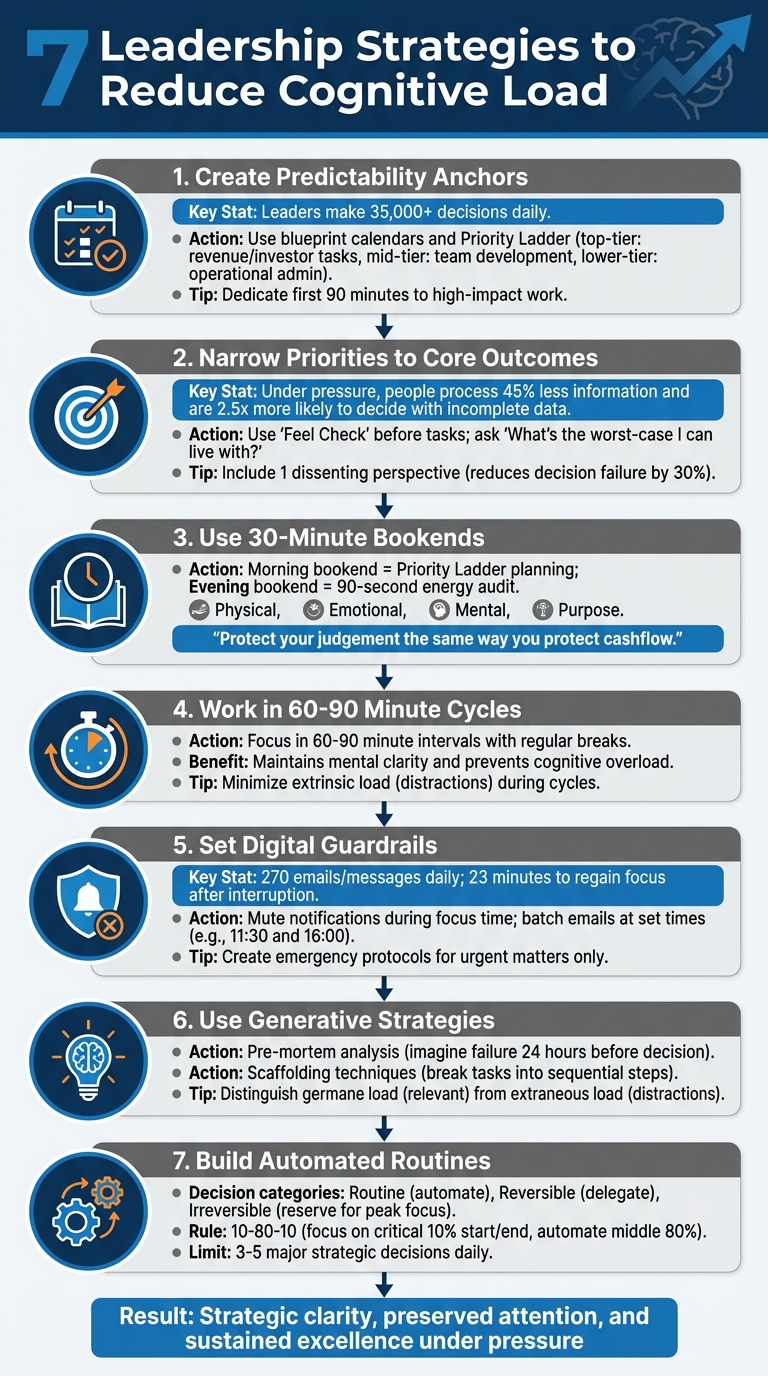
7 Evidence-Based Strategies to Reduce Cognitive Load in Leadership
Cognitive periodisation & Mental Resilience for Leaders with Clint Rahe
sbb-itb-ce676ec
1. Create Predictability Anchors
Leaders face an overwhelming number of daily decisions - more than 35,000, according to estimates - and each decision chips away at their finite cognitive energy. By mid-afternoon, this mental strain can lead to overanalysing trivial matters while overlooking critical strategic issues. To combat this, leaders can benefit from implementing structured routines.
Predictable routines, or predictability anchors, help minimise unnecessary deliberation. Tools like "blueprint calendars" establish consistent frameworks, reducing decision fatigue. Research on judicial rulings highlights the importance of this approach: judges were significantly more likely to grant parole earlier in the day, indicating that cognitive depletion later on often results in defaulting to the status quo.
Executive coach Beth Hope succinctly explains this phenomenon:
The more decisions you make, the worse they get. That's not weakness, it's neuroscience.
Instead of relying on traditional to-do lists, leaders can use a Priority Ladder. Tasks are divided into three levels: top-tier tasks focus on revenue or investor-critical activities, mid-tier tasks centre on team development, and lower-tier tasks handle operational admin. Progression to the next level only happens once the highest-priority tasks are completed.
To maximise productivity, the first 90 minutes of the day should be dedicated to the most impactful work. During this time, distractions like phones, emails, and minor decisions should be avoided. Before making any major decisions, leaders are encouraged to ensure they are in a rested, calm, and focused state, aligned with their broader goals. Even a brief 90-second pause can significantly lower stress responses and help prevent impulsive reactions when mental resources are running low.
2. Narrow Priorities to Core Outcomes
The prefrontal cortex, which governs focus, planning, and decision-making, has distinct biological limits. Trying to manage too many objectives at once can quickly exhaust this part of the brain, leading to diminished strategic thinking and weakened self-regulation. Amy Brann, an expert in applied neuroscience, explains:
The PFC has limits. It fatigues quickly, struggles with... high-order functions like focus, planning, self-regulation, and decision-making.
Leaders often find themselves mentally drained not because of the size of their workload, but because they burden their brains with an excess of secondary objectives. Under tight deadlines, individuals process nearly half as much information - 45% less - and are 2.5 times more likely to make decisions based on incomplete data. The key isn’t to push harder but to refine focus on the most critical outcomes. This highlights the importance of a deliberate pre-decision check to ensure attention is centred on what truly matters.
A quick "Feel Check" can help prevent draining cognitive resources unnecessarily. Before committing to a task, take a moment to evaluate whether you’re feeling tired, stressed, or reactive, as these states can impair judgement. Then, ask yourself: "What is the worst-case I can live with?" This question helps identify whether a task genuinely deserves your limited mental energy.
Incorporating at least one dissenting perspective before settling on priorities can also sharpen decision-making. Teams that include opposing views reduce their chances of decision failure by 30%. Business strategist Ian Baker highlights the risks of pressure, stating, "Pressure distorts thinking, accelerates timelines, narrows perspectives, and amplifies risk." This serves as a valuable reminder to challenge assumptions and focus on what truly drives impact.
3. Use 30-Minute Bookends
The prefrontal cortex, the part of your brain responsible for decision-making, operates with limited energy. Every choice you make chips away at this resource, which is why judgement often falters by the afternoon.
Setting aside 30 minutes at the start and end of your day acts as a safeguard for this cognitive resource. This approach helps minimise decision fatigue by establishing structured routines to frame your day. Executive coach Beth Hope puts it succinctly:
Protect your judgement the same way you protect cashflow. Limit trivial decisions.
In the morning, planning helps reduce uncertainty and prioritise tasks. In the evening, reflection allows you to identify and address energy-draining activities.
For the morning "bookend", consider using a Priority Ladder to organise tasks. Place high-value activities - such as those impacting revenue or investors - at the top, followed by tasks affecting your team or customers, and finally operational duties. Only move to the next level once the most critical tasks are complete.
The evening "bookend" can include a quick 90-second energy audit. Before wrapping up your day, evaluate four key areas:
- Physical: Are you well-rested and hydrated?
- Emotional: Are you feeling calm or reactive?
- Mental: Do you have any cognitive capacity left?
- Purpose: Are your actions aligned with long-term goals?
This short exercise helps pinpoint when your mental resources are under strain, preventing stress-driven behaviours from spilling over into the next day.
Hope's advice captures the essence of this practice:
Clarity is a muscle. Train it.
4. Work in 60-90 Minute Cycles
After establishing routines and strategic planning, structuring work into focused intervals can further protect your mental resources.
The brain’s working memory is quick but fragile. It handles rapid processing well but has limited capacity. Prolonged, uninterrupted work sessions can overwhelm this system, leading to cognitive overload. When this happens, the brain struggles to process, store, and recall information effectively.
The Australian Education Research Organisation summarises this well:
Working memory is a fast and flexible, but unstable, system that can manipulate information quickly, allowing us to use it at a given time without storing information.
Breaking your workday into 60-90 minute focused intervals, punctuated by regular breaks, helps maintain focus and energy. This approach works hand in hand with earlier strategies, preserving mental clarity over long periods of decision-making.
During these intervals, focus on the intrinsic cognitive load - the actual complexity of the task - while minimising the extrinsic load, which includes distractions or poorly organised information. Concentrating effort within defined time blocks allows for sustained strategic thinking, which is critical when making high-pressure decisions.
Equally important are the breaks. Stepping away and returning to the task helps reinforce learning by encouraging the brain to retrieve recently processed information. This practice strengthens long-term memory connections. Research shows that breaking tasks into smaller, manageable pieces ensures information is absorbed more effectively than attempting to process large volumes all at once. This method not only prevents burnout but also preserves the clarity needed for critical thinking under pressure.
To get the most out of these cycles, prepare your environment beforehand. Clear your workspace - both physical and digital - so your limited cognitive resources are directed solely toward the task at hand. Use these focused intervals for your most important decisions, where maintaining clarity and discipline is key to avoiding overwhelm.
5. Set Digital Guardrails
In structured work cycles, protecting focus from digital interruptions is vital. Research highlights how disruptive these interruptions can be.
On average, employees receive around 270 emails and chat messages daily. Each interruption can take up to 23 minutes to regain full focus. This constant switching between tasks drains mental energy, leaving less capacity for strategic thinking. Leadership expert Laura Bouttell puts it succinctly:
The ping of notifications, the endless stream of emails, and the pressure to respond immediately have created conditions fundamentally incompatible with the reflection that distinguishes leadership from mere management.
The aim isn’t to ditch technology but to use it in a way that aligns with your priorities. One practical step is to set up emergency protocols - dedicated channels for truly urgent matters. This allows you to disconnect from routine messaging platforms without worrying about missing critical issues. Additionally, clearly communicate boundaries to your team. For instance, stating, "I do not check email between 09:00 and 11:00", sets expectations and reduces the pressure for immediate replies.
During focused 60–90-minute work cycles, mute notifications and close email applications entirely. Allocate specific times - such as 11:30 and 16:00 - to review and respond to messages in batches rather than sporadically throughout the day. This approach preserves uninterrupted focus for demanding tasks that deliver real value. By managing digital communication in this way, leaders maintain the clarity needed for significant decisions.
Your digital behaviours set a tone for the organisation. When you demonstrate healthy disconnection, you empower your team to follow suit. A leader who is occasionally unavailable but highly focused when present is often more effective than one who is constantly reachable. By establishing and modelling clear digital boundaries, leaders create the mental space necessary for making impactful decisions.
6. Use Generative Strategies
When encountering challenges, the brain employs generative thinking to stay clear-headed and strategically focused. This involves blending new information with long-term memory. As noted by the Australian Education Research Organisation:
Knowledge stored in long-term memory can be recalled to working memory, where it can be combined and recombined with other information to help students generate novel ideas, solve unfamiliar problems and think critically and creatively.
This process helps condense complex information into manageable pieces, allowing more mental resources to be directed towards strategy.
To put this into practice, consider using pre-mortem analysis. This involves imagining a major initiative has failed - 24 hours before making a decision - and working backwards to identify potential causes, such as a hiring error or underperforming product. This method engages the brain's natural threat-detection system, transforming potential risks into actionable strategies.
Another effective approach is scaffolding techniques, which provide structure without stifling innovation. For instance, offering clear models or worked examples can help your team tackle complex problems without becoming overwhelmed. Breaking tasks into sequential, manageable steps reduces cognitive strain and allows for better focus on creative solutions.
Before making critical decisions, a quick readiness audit can ensure alignment with strategic goals. Research has shown that cognitive depletion affects decision-making - judges, for example, are more likely to grant parole in the morning than in the afternoon. This underscores the impact of decision fatigue, as highlighted by Executive Coach Beth Hope:
Decision fatigue is the hidden cost of trying to do everything at once.
For collaborative efforts, focus on distinguishing between germane load (relevant information) and extraneous load (distractions or unnecessary details). Tools like centralised learning boards and after-action reviews can streamline processes, making it easier to manage complexity and drive effective teamwork.
7. Build Automated Routines
Automating decision-making processes is a practical way to free up mental energy for the more demanding aspects of leadership. Leaders, who often make thousands of decisions daily, can find their mental clarity drained by seemingly minor choices such as approving emails or adjusting schedules. These micro-decisions, though small, accumulate and sap cognitive resources.
To address this, decisions can be classified into three categories: routine, reversible, and irreversible. Routine tasks, such as scheduling or approvals, can be automated using pre-set rules. Leadership coach Jake Smolarek highlights this issue succinctly:
Decision fatigue is not a mindset issue. It's a bandwidth leak.
Reversible decisions can be delegated, provided there are clear time limits and fallback plans. Irreversible, high-stakes decisions should be reserved for periods of peak mental focus.
A "Decision Operating System" can streamline this process. This involves creating pre-defined criteria and triggers to guide outcomes under pressure. For example, leaders might limit themselves to making only 3–5 major strategic decisions daily. For repetitive tasks, the 10–80–10 rule is effective: dedicate energy to the critical beginning and end stages while automating or delegating the middle 80%. This approach reduces the burden of ad-hoc decision-making and ensures focus is preserved for strategic priorities.
Leaders can also turn successful decisions into templates, enabling quicker and more consistent choices in the future. As Smolarek explains:
Clarity is not a gift; it's an engineered outcome. Leaders who treat their minds as systems, not vessels, sustain excellence long after competitors burn out.
Conclusion
The seven strategies highlighted aim to reduce cognitive load by externalising commitments, grouping decisions, maintaining focus for deep work, and automating routines. These measures help protect the limited resource of attention. Research underscores that regaining deep focus after interruptions takes a significant amount of time. Even minor disruptions can add up over the course of a day, diminishing decision-making quality and long-term foresight.
By consistently applying these approaches, leaders can shift from cognitive strain to achieving greater strategic clarity. Delegating routine tasks not only improves the quality of decisions but also helps preserve emotional balance under pressure. As Herbert Simon famously remarked, "The scarce resource is attention, not information."
An example of these principles in action is House of Birch, which has supported executive alignment during complex transitions in London. Their tailored engagements ensure leaders remain composed and strategically sharp even in challenging circumstances. This disciplined methodology forms the backbone of House of Birch’s leadership advisory services, which are crafted for those operating at the highest levels where mistakes are not an option.
Tommy Birch, founder of House of Birch, articulates this ethos:
I build individuals who are emotionally disciplined, strategically intelligent, socially dominant, and unshakeable under pressure.
This approach goes beyond standard productivity advice, addressing the nuanced dynamics of influence and authority required in top-tier leadership roles.
For leaders aiming to implement these strategies with precision, House of Birch offers advisory services designed to enhance clarity, control, and connection in demanding environments. To learn more about bespoke leadership development, visit House of Birch. Their expertise is tailored for those who must consistently perform at their peak.
FAQs
How can I spot decision fatigue before it affects my judgement?
Watch for indicators such as mental fatigue, diminished self-control, or trouble making clear decisions - particularly after prolonged periods of decision-making. Spotting these signs early allows you to pause, recharge, or delegate responsibilities, helping to maintain focus and productivity.
What should I do if my role demands instant replies all day?
If your position demands frequent, immediate responses, it's crucial to manage your mental resources wisely. One effective approach is to reduce cognitive load by externalising memory - use tools to track tasks and decisions rather than relying solely on recall. Additionally, grouping similar decisions together, or batching, can help conserve mental energy.
Set aside blocks of time during your peak energy periods for focused, deep work, enabling you to tackle complex challenges with greater efficiency. Simplifying daily routines can also help minimise avoidable mental strain, leaving you better equipped to handle demanding situations.
For more personalised approaches, organisations like House of Birch specialise in leadership advisory services, offering tailored strategies to help leaders stay focused and disciplined under pressure.
Which tasks should I automate or delegate first to save mental energy?
Automating or delegating routine and repetitive tasks is a practical way to ease cognitive load. By offloading activities that don’t demand strategic input or emotional engagement, leaders can free up mental bandwidth. This allows them to concentrate on high-stakes decisions and pivotal moments, ensuring they remain focused and perform effectively.

