Case Study: Confirmation Bias in High-Stakes Leadership
Confirmation bias can derail even the most experienced leaders, especially in high-pressure situations. This cognitive tendency leads individuals to favour information that aligns with their pre-existing beliefs while disregarding contradictory evidence. The article examines two key examples - Time Warner's disastrous AOL merger and a mid-sized cybersecurity firm's leadership misstep in 2026 - to showcase how unchecked biases can result in costly errors, lost opportunities, and damaged team morale.
Key insights include:
- What is confirmation bias? It’s the automatic preference for evidence that supports existing beliefs, often leading to selective interpretation and flawed decision-making.
- Why does it happen? Under stress, leaders often rely on intuition and mental shortcuts, amplifying biases. Ego, overconfidence, and hierarchical isolation exacerbate the issue.
- Consequences: Poor decisions can lead to financial losses, employee turnover, and a culture where dissent is stifled.
- How to counter it: Strategies include appointing a devil’s advocate, actively seeking disconfirming evidence, using anonymous feedback, and framing questions to challenge assumptions.
Leaders should reflect on their decision-making processes and consider external advisory support to ensure objectivity during critical moments. Addressing biases can improve outcomes and foster balanced, evidence-based decisions.
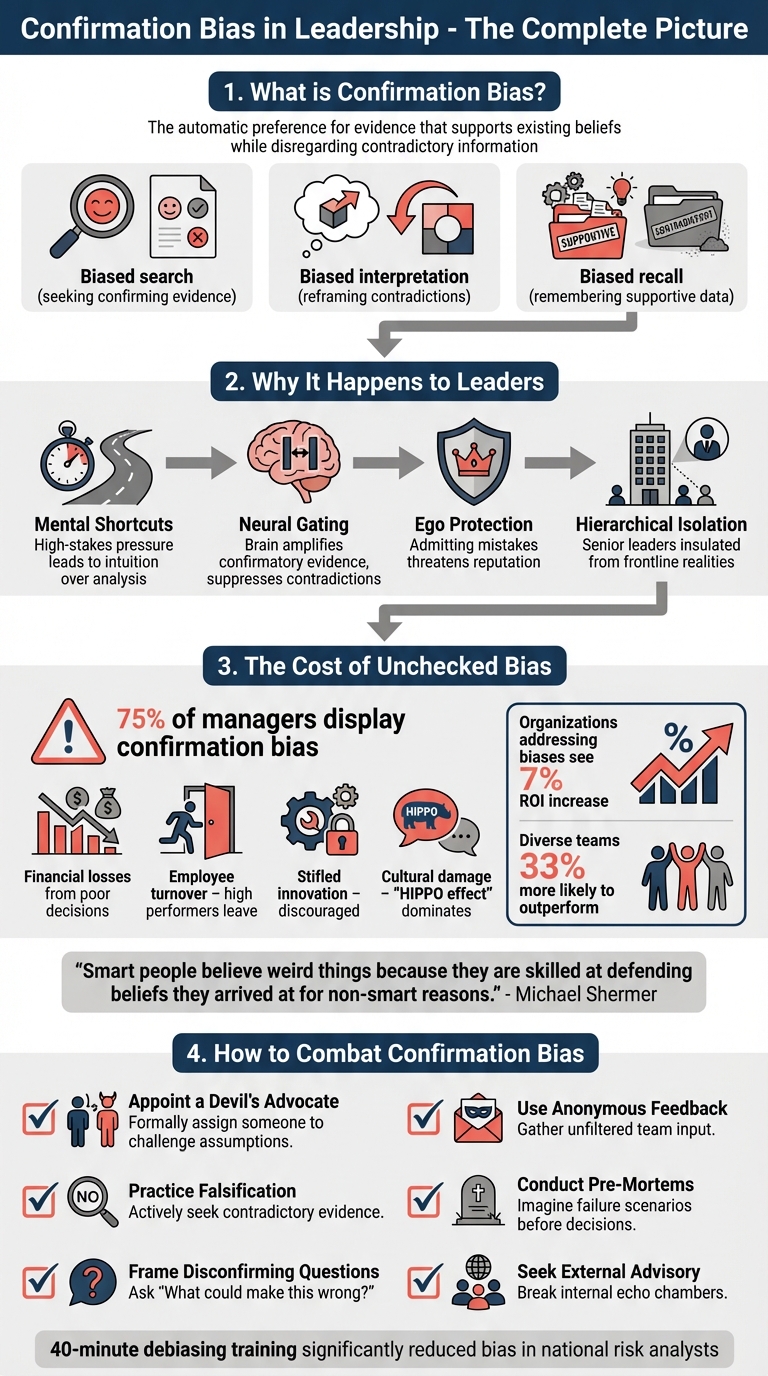
How Confirmation Bias Affects Leadership Decisions and Counter-Strategies
The Case: A High-Stakes Leadership Decision
The Leader's Role and Context
Maggie, the CEO of a mid-sized cybersecurity firm, was responsible for overseeing strategic partnerships, including a crucial collaboration with NexaTech - a prominent European provider essential to the firm’s encryption solutions. By February 2026, the company was under intense pressure to sustain its competitive edge in an increasingly saturated market. Maggie’s leadership approach leaned heavily on her personal convictions, often placing intuition above data-driven insights. Her decision-making process highlights the challenges leaders face when instinct takes precedence over evidence.
The Critical Decision Point
During a pivotal quarterly review, Maggie’s executive team presented data showing that NexaTech had surpassed all key performance metrics. The evidence strongly supported strengthening the partnership to accelerate product development. However, Maggie’s scepticism about NexaTech led her to fixate on a minor legal issue involving one of NexaTech’s smaller suppliers - an issue with no direct relevance to the partnership’s commercial prospects. This behaviour reflects confirmation bias, where individuals seek out information that aligns with their pre-existing beliefs while disregarding evidence to the contrary. In this case, Maggie’s belief that the partnership was inherently risky caused her to overemphasise the lawsuit, despite its limited significance.
Overriding her team’s recommendation, Maggie chose to scale back the partnership. The decision had far-reaching consequences: the firm lost its competitive edge, faced delays in product launches, and experienced a decline in internal morale. This scenario provides a compelling lens through which to examine the psychological underpinnings of confirmation bias and its impact on leadership decisions.
sbb-itb-ce676ec
What Is Confirmation Bias and Why It Matters
Defining Confirmation Bias
Confirmation bias refers to the automatic inclination to favour evidence that supports existing beliefs while disregarding information that contradicts them. Philosopher Francis Bacon aptly described this centuries ago:
"The human understanding when it has once adopted an opinion... draws all things else to support and agree with it."
This bias manifests in three key ways: biased search, interpretation, and recall. Leaders often frame questions in ways that elicit affirmations, apply stricter scrutiny to contradictory evidence, and remember supportive data more readily. For example, Maggie, a leader grappling with a supplier issue at NexaTech, focused disproportionately on a minor legal matter that aligned with her scepticism. In doing so, she dismissed her team’s robust performance data, which contradicted her preconceptions.
The implications of confirmation bias extend well beyond individual decisions. Studies indicate that organisations addressing decision-making biases can see a 7% boost in ROI, and diverse teams that challenge individual assumptions are 33% more likely to outperform less diverse groups. In contrast, unchecked biases can lead to costly errors, such as the failures seen in high-profile mergers. These patterns underscore why even seasoned leaders, like Maggie, are not immune to the effects of confirmation bias.
Why Leaders Fall Into This Trap
High-stakes decisions often compel leaders to rely on mental shortcuts. The complexity of these decisions creates fertile ground for confirmation bias, as the brain leans towards reaffirming existing beliefs rather than objectively analysing all evidence. Neuroscientific research highlights a phenomenon called "neural gating", where strong confidence in a decision causes the brain to amplify confirmatory evidence while suppressing contradictory information. Psychologist Michael Shermer captures this dynamic succinctly:
"Smart people believe weird things because they are skilled at defending beliefs they arrived at for non-smart reasons."
Ego and self-esteem also play a critical role. Leaders often resist evidence that challenges their professional judgement, as admitting mistakes could harm their reputation. For experienced leaders, past successes can further complicate matters, fostering overconfidence and making them less receptive to strategic adjustments. Additionally, hierarchical structures frequently insulate senior leaders from frontline realities, creating echo chambers where initial assumptions go unchallenged. Maggie’s overemphasis on the minor legal issue, despite her team’s data-driven recommendation, exemplifies how these cognitive traps can lead to flawed decision-making.
How Confirmation Bias Influenced the Decision
Seeking Supporting Evidence Only
Maggie's decision-making process highlights a classic case of selective evidence gathering. Instead of evaluating all available information impartially, she employed a "positive test strategy" - actively seeking out evidence that aligned with her scepticism while disregarding anything that contradicted it. This bias revealed itself in several ways: she distanced herself from dissenting opinions within her team, gave undue weight to a minor legal issue uncovered early on, and subjected any contradictory performance data from her team to far more scrutiny than the data that supported her doubts.
This behaviour mirrors other high-profile decisions, such as Time Warner CEO Gerald Levin's 2001 merger with AOL. Levin completed the deal after only three days of due diligence, heavily influenced by the "primacy effect", which placed undue importance on initial information. Similarly, Maggie’s selective focus on evidence demonstrates how confirmation bias can lead leaders to craft a one-sided narrative, reinforcing pre-existing beliefs rather than fostering a balanced evaluation.
Justifying the Decision Despite Contrary Data
Maggie’s bias extended beyond selective evidence gathering. When her team presented strong performance data that contradicted her concerns, she did not revise her stance. Instead, she reinterpreted the data to fit her initial doubts. For instance, she dismissed the supplier's proven track record as an unreliable predictor of future success, while treating a single legal issue as definitive proof of systemic risk.
This behaviour echoes Gerald Levin’s approach during the AOL merger, where he overlooked revenue inconsistencies and the broader collapse of the dot-com sector. Similarly, Tony Blair’s handling of intelligence in the lead-up to the Iraq War reflected a comparable pattern. Blair reframed the absence of weapons of mass destruction as a moral justification for intervention, rather than reassessing the original intelligence basis. As Sir John Chilcot noted in the Iraq Inquiry:
"Sir Richard Dearlove's personal intervention, and its urgency, gave added weight to a report that had not been properly evaluated and would have coloured the perception of ministers and senior officials".
This tendency to reinterpret conflicting evidence to align with pre-existing beliefs is a hallmark of confirmation bias at its most destructive. Researchers describe this as "confirmatory thought", where individuals focus on justifying their assumptions rather than engaging in "exploratory thought", which involves genuinely considering alternative perspectives. Maggie’s decision-making process underscores how even seasoned leaders can fall into these cognitive traps, leading to flawed choices with potentially far-reaching consequences.
The Consequences of the Biased Decision
Immediate Impact
Ending the supplier relationship caused significant disruption, requiring leadership to dedicate hundreds of hours to onboarding a new partner while managing their regular responsibilities. The already overstretched team faced even greater demands, fostering an environment where individuals with differing opinions felt compelled to stay silent.
The financial repercussions surfaced quickly. The organisation exceeded its operational budget by addressing what was mistakenly perceived as a critical issue. Maggie had framed the decision as a form of risk mitigation, but in practice, it led to genuine inefficiencies. These immediate challenges set the stage for deeper, more persistent organisational problems.
Long-Term Costs
Within a year and a half, two of the most experienced team members left the organisation, citing frustration with decision-making processes that prioritised assumptions over evidence-based analysis. High performers began to leave as they recognised that the system rewarded conformity rather than merit, a well-documented outcome of confirmation bias in leadership.
Perhaps the most damaging consequence was the cultural shift that emerged. Senior opinions began to overshadow evidence-based insights, a dynamic often referred to as the "HIPPO effect" (Highest Paid Person’s Opinion). Innovation slowed as employees realised that questioning leadership assumptions could jeopardise their careers. This created what researchers call a "mirrortocracy", where dissenting perspectives were systematically excluded.
Lessons and How to Counter Confirmation Bias
What This Case Teaches Us
This example highlights how confirmation bias can skew decision-making, even among seasoned leaders. In this scenario, a leader prioritised evidence that aligned with their initial belief, disregarding conflicting input from the team. This selective interpretation created a seemingly logical narrative that ultimately led to poor outcomes, including financial losses, employee turnover, and a workplace culture that stifled constructive criticism. The case underscores the risks of unchecked biases and serves as a reminder that even experienced leaders are not immune to these cognitive pitfalls. It also points to actionable ways to address such challenges.
Practical Methods to Reduce Bias
To combat confirmation bias, leaders can adopt specific, evidence-backed strategies:
- Appoint a devil's advocate: Assign someone the formal role of questioning assumptions and identifying weaknesses in proposed strategies.
- Engage in falsification: Actively seek out evidence that contradicts your initial assumptions or beliefs.
- Frame disconfirming questions: For example, in hiring processes, ask questions like, "What reasons might make you unsuitable for this role?".
- Use anonymous polling: Gather anonymous feedback to validate or challenge prevailing assumptions.
Evidence suggests that even brief interventions can make a difference. A study found that a single 40-minute debiasing training significantly reduced confirmation bias in national risk analysts. This was notable considering these professionals already devoted over a quarter of their work hours to risk analysis prior to the training. As Matt Brady from Volley Solutions explains:
"We are just not wired to be contrarian to our own beliefs. What we end up doing is favouring data that confirms our existing viewpoints and downplaying evidence that doesn't".
How House of Birch Supports Leaders
The strategies outlined above align closely with the services offered by House of Birch. This consultancy provides tailored advisory support to help leaders navigate complex decisions with greater objectivity. Through emotional discipline training, leaders learn to recognise when their need to be "right" might be clouding their judgement. Tools such as Red Teaming and pre-mortem exercises are integrated into their frameworks to uncover hidden assumptions and prevent costly errors. By offering an external perspective, House of Birch helps leaders reframe their narratives and make more balanced, evidence-driven decisions.
How Confirmation Bias Reduces Business Profits
Conclusion
Confirmation bias poses a serious threat to effective leadership decisions. Studies reveal that 75% of managers display this bias in their decision-making, often unknowingly. The fallout can be devastating, as illustrated by high-profile failures like the AOL merger and the Post Office Horizon scandal. Both cases demonstrate how leaders, entrenched in their own narratives, ignored conflicting evidence and relied on flawed assumptions.
The impact of addressing such biases is clear: organisations that actively tackle decision-making biases report an approximate 7% increase in ROI. As Lorne Epstein succinctly puts it:
"If you ignore confirmation bias, it will eventually blow up. But if organisations are mindful of it and address it, they can better ensure that their decisions are fair, informed and effective".
A critical takeaway is that unchallenged confidence often signals risk, not certainty.
External advisory services can play a vital role in breaking internal echo chambers and improving decision-making quality. House of Birch, for instance, provides tailored advisory solutions incorporating methods like Red Teaming and pre-mortem analysis to combat confirmation bias. Emotional discipline training further equips leaders to step outside their blind spots. Research suggests that collective decision-making can neutralise nearly all identified managerial biases. By leveraging bespoke advisory support, leaders gain the external challenge and objective insight needed to make well-rounded, evidence-based decisions during critical moments.
FAQs
How can leaders recognise and overcome confirmation bias in their decision-making?
Leaders can address confirmation bias by actively seeking out viewpoints and evidence that contradict their initial beliefs. This means challenging assumptions, exploring alternative perspectives, and basing decisions on a well-rounded and thorough analysis of the information available. Taking this approach helps to minimise the risks of overly narrow thinking and unwarranted confidence.
Equally, fostering an environment that prioritises critical thinking plays a crucial role. Encouraging team members to question ideas and engage in open dialogue can illuminate potential blind spots. Leaders should also take time to examine their own decision-making habits, ensuring they remain impartial and flexible, especially in high-pressure scenarios. While overcoming confirmation bias demands deliberate effort, it is a crucial step towards effective and responsible leadership.
What are the long-term effects of confirmation bias on organisations?
Confirmation bias can create profound challenges for organisations, particularly when it persists over the long term. When leaders prioritise information that aligns with their existing views, they may inadvertently overlook evidence that contradicts their assumptions. This selective approach can lead to flawed strategic decisions, stifled innovation, and an inability to respond effectively to evolving circumstances - all of which can impede organisational growth and adaptability.
Moreover, unchecked confirmation bias can cultivate an environment where differing viewpoints are disregarded, curbing critical thinking and reinforcing internal silos. Such a culture not only hinders organisational learning but also heightens exposure to external risks. Over time, these dynamics can escalate, potentially resulting in reputational damage, financial setbacks, or even organisational collapse. Tackling confirmation bias is therefore crucial for leaders aiming to build resilience and maintain competitiveness in an ever-changing landscape.
How can leaders create a culture that reduces confirmation bias in decision-making?
Leaders aiming to tackle confirmation bias can benefit from cultivating an environment that prioritises diverse perspectives and critical thinking. Encouraging teams to actively seek out information that challenges their assumptions and to explore alternative viewpoints can help counter the natural tendency to focus solely on evidence that aligns with pre-existing beliefs.
Implementing structured decision-making practices can further support this effort. For instance, requiring team members to justify their decisions with concrete evidence ensures that choices are well-founded. Additionally, fostering inclusive group discussions where all opinions are genuinely considered can prevent dominant voices from overshadowing others. Training programmes focused on bias awareness and self-regulation can also help leaders identify and address their own biases more effectively.
By embracing open dialogue, questioning entrenched assumptions, and embedding thoughtful processes into decision-making, organisations can pave the way for more balanced and informed outcomes.

