Case Studies in Strategic Decision-Making for Leaders
Strategic decision-making is a critical skill for leaders, with far-reaching consequences for organisations. This article examines three case studies - Fiat’s recovery under Sergio Marchionne, Apple’s iPhone launch, and a leadership transformation at the House of Birch - offering practical lessons on navigating complex challenges. Each example highlights how leaders used frameworks, decisive action, and emotional discipline to overcome uncertainty and achieve success.
Key takeaways include:
- Fiat: Marchionne streamlined bureaucracy, sold non-core assets, and revitalised the brand with new models, achieving profitability within a year.
- Apple: Steve Jobs identified market gaps, prioritised user experience, and disrupted the mobile industry with the iPhone.
- House of Birch: Tailored coaching helped an HR leader balance stakeholder interests, manage stress, and present effective strategies.
These cases underscore the importance of combining analytical tools, like SWOT and decision trees, with emotional awareness to make well-informed choices. Leaders can apply these insights by adopting structured methods, managing risks effectively, and fostering clarity under pressure.
Case Study 1: Fiat's Turnaround under Sergio Marchionne

Fiat's Problems Before the Turnaround
When Sergio Marchionne took the reins at Fiat in June 2004, the company was in dire straits. Fiat was grappling with net losses totalling £7.3 billion, outdated production systems that could only handle single models, and a tarnished reputation. It was only through emergency financial support from banks and other Fiat Group branches that the company avoided total collapse. Meanwhile, competitors from Germany and Japan were pulling ahead with superior manufacturing methods, leaving Fiat's failed car launches and subpar quality to alienate customers further. Adding to the turmoil, a rigid bureaucracy and frequent industrial strikes made recovery seem almost impossible.
"Whenever you opened a newspaper in Italy, there was another embarrassing story: Fiat had lost more money; its new car had flopped; a strike was on somewhere."
- Sergio Marchionne, CEO, Fiat
Marchionne became Fiat's fifth CEO in just three years, stepping into a company that had endured three consecutive years of losses from 2001 to 2003. In a desperate attempt to stem the financial bleeding, Fiat laid off over 14,000 workers in 2002 alone. Meanwhile, the company neglected research and development, leaving it ill-prepared to address shifting consumer demands or adapt to emerging environmental challenges. Faced with these overwhelming issues, Marchionne moved quickly to implement sweeping reforms.
Marchionne's Key Decisions and Methods
Marchionne's strategy combined immediate crisis management with a long-term vision for transformation. One of his first actions was to streamline the organisation by cutting through layers of bureaucracy, making decision-making faster and more agile. He replaced senior executives who resisted change with younger, more adaptable leaders.
To stabilise Fiat's finances, Marchionne sold off non-core assets, including the company's aerospace division, to free up resources for its core focus: car manufacturing. This shift in priorities allowed Fiat to invest in new models like the Grande Punto and the iconic Fiat 500, which would later become a symbol of the company's resurgence. In August 2005, he unveiled a three-year industrial plan to revitalise Fiat's automotive division.
One of his most striking moves was negotiating a settlement with General Motors in February 2005. GM agreed to pay Fiat $2 billion (approximately £1.6 billion) to cancel a contractual agreement that could have forced GM to acquire Fiat's struggling car division. This deal not only provided a much-needed financial boost but also gave Fiat the flexibility to chart its own course.
"It is not a matter of how good they are at their jobs; it is a matter of change. I can spend 12 months arguing with them about what and how to change, but this won't work... I look for the youngster. They don't have seniority, they don't play the corporate habits; they're pure."
- Sergio Marchionne, CEO, Fiat Chrysler Automobiles
By 2005, Fiat had returned to profitability, slashed the time it took to develop new models from four years to just 18 months, and successfully relaunched the Fiat 500, which went on to sell over 1.2 million units. These bold actions underline the leadership principles that made Marchionne's turnaround a success.
Leadership Lessons from Fiat
Marchionne's leadership offers valuable lessons for navigating high-pressure situations. His ability to act decisively and swiftly was critical. Instead of getting bogged down in lengthy analyses, he focused on removing obstacles and making the tough calls - whether it involved significant layoffs or selling off non-core assets. These short-term sacrifices laid the groundwork for Fiat's long-term recovery.
Equally transformative was the cultural shift he spearheaded. Recognising that real change required more than just new strategies, Marchionne prioritised a shift in mindset. By promoting younger managers and encouraging a culture where "everyone is expected to lead", he dismantled the inertia that had plagued the organisation. His decision to work from within the engineering department, rather than an executive suite, sent a clear message: he was committed to being at the heart of the action.
Marchionne's pragmatic approach to partnerships also stands out. His negotiation with General Motors demonstrated the importance of knowing when to walk away from unproductive alliances. This strategic decision-making - coupling rapid restructuring with stakeholder management and cultural renewal - proved to be a winning formula. By the time Marchionne stepped down, Fiat's revenue, operating profit, and share price had all tripled. Remarkably, by June 2018, he had eradicated Fiat's net industrial debt.
"FCA leaders were born out of adversity and operate without sheet music. It's the only way we know."
- Sergio Marchionne, CEO, Fiat Chrysler
Case Study 2: Apple's Launch of the iPhone
The Market Opportunity Apple Identified
In January 2007, at Macworld San Francisco, Steve Jobs introduced the iPhone as a solution to a glaring issue in the mobile phone industry: smartphones were clunky, unintuitive, and lacked sophistication. Apple seized the chance to redefine the market by merging three products into one: a mobile phone, a widescreen iPod with touch controls, and an Internet communication device.
At the time, Nokia dominated the mobile phone sector, but its ageing Symbian operating system and underwhelming Ovi App Store left room for innovation. Most smartphones relied on clunky plastic keyboards or styluses and offered a subpar web experience. Apple disrupted this model by bringing desktop-class applications such as Safari, HTML email, and Google Maps to a handheld device.
Apple also leveraged its existing iTunes Store, which already hosted over 350 TV shows, 250 films, and 5,000 music videos, positioning the iPhone as a comprehensive entertainment device. Furthermore, Apple partnered exclusively with Cingular, the leading US carrier with over 58 million subscribers, ensuring a seamless network experience while retaining full control over hardware and software. The iPhone launched at £382 for the 4GB model and £458 for the 8GB model, offering a premium product that was unmatched in the market. This strategic identification of a gap in the market laid the foundation for Apple's innovative vision.
"iPhone is a revolutionary and magical product that is literally five years ahead of any other mobile phone."
- Steve Jobs, CEO, Apple
How Apple Managed Uncertainty
Apple tackled the risks and uncertainties surrounding the iPhone launch with a mix of intuition and strategic planning. Unlike many companies that rely heavily on traditional market research, Steve Jobs and his team trusted their instincts to anticipate consumer needs. This approach was part of Apple's "digital hub" strategy, which focused on creating seamless integration between digital content and devices, making it difficult for competitors to catch up.
The decision to incorporate OS X into the iPhone presented significant technical challenges. Additionally, the introduction of new sensor technologies and a multitasking mobile operating system carried risks. Apple addressed these challenges by keeping tight control over hardware and software development, allowing for quick problem-solving and iterative improvements. Jobs’ commitment to quality was evident when he ordered a redesign of the iPhone's enclosure shortly before launch because it failed to meet his aesthetic standards.
Leadership Lessons from Apple
Apple's approach to the iPhone launch offers three key leadership lessons.
First, bold decision-making can transform industries. Jobs and his team prioritised user experience over conventional engineering constraints, integrating advanced technology into a groundbreaking form factor. This approach disrupted the market rather than merely improving on existing products. Their willingness to revise decisions, even late in the process, highlights the value of staying true to core principles.
Second, creating integrated ecosystems provides long-term advantages. The launch of the App Store in 2008 strengthened Apple's ecosystem, allowing it to capture 30% of third-party developer revenue. This closed yet cohesive system created a "moat" that competitors struggled to overcome. By 2011, iPhone sales skyrocketed from 40 million to 72.3 million units, and Apple's market capitalisation grew from £1.5 billion in 1997 to nearly £319 billion by August 2011.
Finally, organisational culture plays a critical role in adaptability. Nokia, for example, faltered due to "temporal myopia" and a corporate culture that stifled honest feedback from middle managers. This inability to adapt left Nokia vulnerable to the disruption caused by the iPhone.
"Jobs' true secret weapon is his ability to meld technical vision with a gut feel of what regular consumers want and then market it in ways that make regular consumers want to be part of tech's cool club."
- Burrows and Grover, Authors/Analysts
Case Study 3: House of Birch Leadership Transformation
The Leader's High-Pressure Situation
Following the examples of Fiat and Apple, this case study delves into a leadership transformation within a distinct organisational setting.
Natalie, an HR Director at a regional professional services firm, found herself under intense pressure as the company grappled with declining revenues. Despite having clear strategic ideas for turning the business around, she was sidelined from senior leadership discussions and became entangled in numerous personnel challenges. Matters worsened when she was tasked with offshoring the firm's financial accounting team, a decision that led to the loss of 30 local jobs. This period was marked by a combination of strategic exclusion, operational strain, and the emotional toll of implementing difficult decisions. It became a pivotal moment in her career, requiring her to balance the competing demands of stakeholders while managing her own emotional well-being.
House of Birch's Tailored Approach
To support Natalie, House of Birch designed a customised programme of one-to-one advisory sessions. The initiative began with emotional discipline training, which helped her manage personal emotions and incorporate them into decision-making under pressure. Additionally, she participated in scenario planning exercises and decision-making simulations. These activities were aimed at strengthening her ability to handle uncertainty and anticipate potential organisational challenges. This structured approach helped Natalie move away from a reactive mindset dominated by stress, allowing her to adopt a more proactive, growth-oriented perspective. She developed a heightened awareness of her own biases and became more deliberate in her strategic decision-making.
Results and Lessons from the Engagement
Through this transformation, Natalie achieved a balance between intuitive judgement and analytical thinking - an essential skill, especially when 65% of CEOs identify managing competing stakeholder interests as a major challenge. Instead of being consumed by day-to-day operational crises, she gained the confidence to present her turnaround strategies effectively, positioning herself as a valued strategic leader within the organisation.
Natalie's journey highlights the importance of emotional awareness, systematic stakeholder engagement, and strategic resilience in high-pressure leadership roles. For leaders encountering similar challenges, this case underscores the value of investing in emotional discipline and structured strategic planning. Her experience serves as a reminder that with deliberate emotional management and a clear strategic focus, leaders can transform overwhelming pressure into meaningful, goal-oriented actions. Natalie's story, much like the previous examples, reinforces the necessity of emotionally intelligent and adaptable leadership in navigating complex and high-stakes situations.
Strategic Decision Making for Leaders - Balancing Data and Intuition
sbb-itb-ce676ec
Comparing Frameworks and Lessons from the Case Studies
Strategic Decision-Making Frameworks Comparison for Leaders
Framework Comparison Table
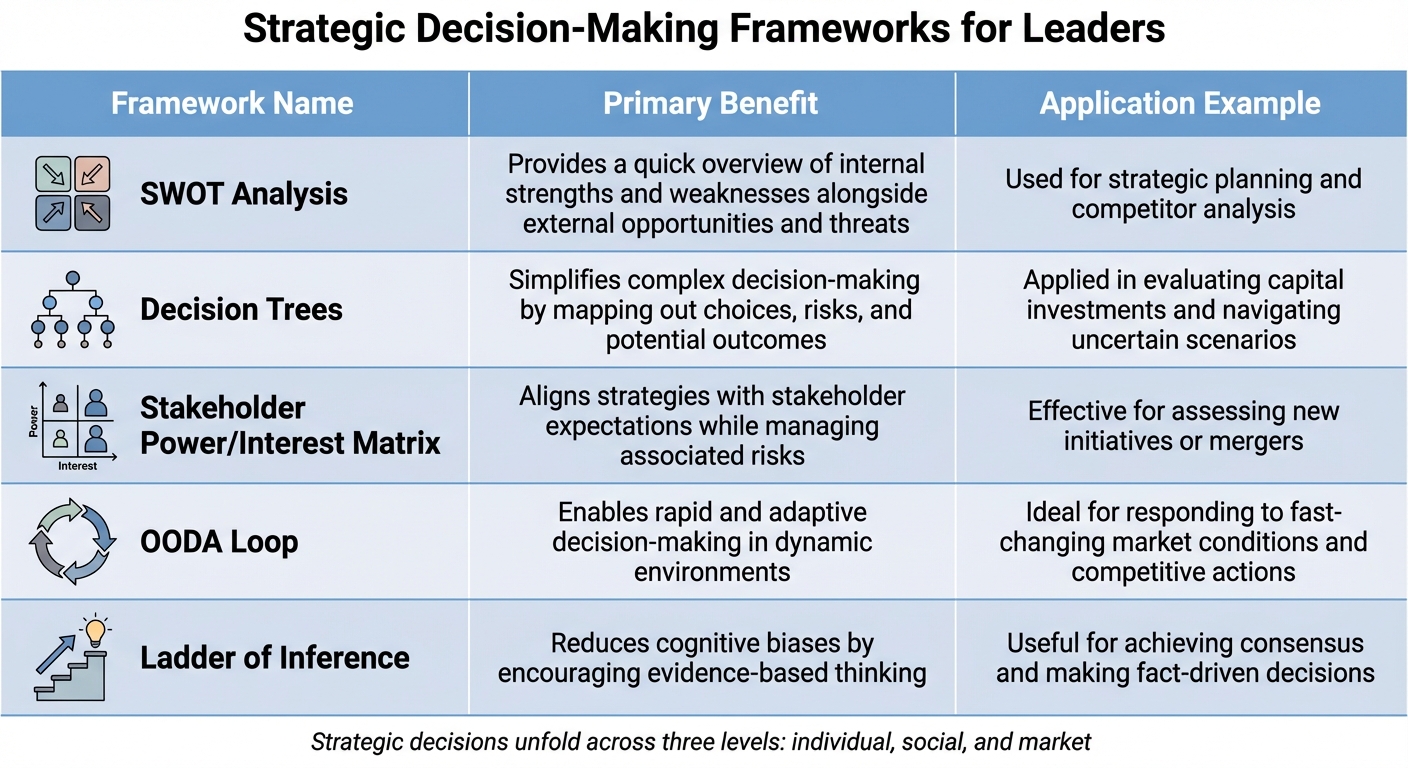
Fiat's swift restructuring, Apple's use of scenario planning, and House of Birch's focus on emotional discipline offer diverse examples of leadership frameworks in action. These approaches underscore the variety of tools available for strategic decision-making.
| Framework | Primary Benefit | Application Example |
|---|---|---|
| SWOT Analysis | Provides a quick overview of internal strengths and weaknesses alongside external opportunities and threats | Used for strategic planning and competitor analysis |
| Decision Trees | Simplifies complex decision-making by mapping out choices, risks, and potential outcomes | Applied in evaluating capital investments and navigating uncertain scenarios |
| Stakeholder Power/Interest Matrix | Aligns strategies with stakeholder expectations while managing associated risks | Effective for assessing new initiatives or mergers |
| OODA Loop | Enables rapid and adaptive decision-making in dynamic environments | Ideal for responding to fast-changing market conditions and competitive actions |
| Ladder of Inference | Reduces cognitive biases by encouraging evidence-based thinking | Useful for achieving consensus and making fact-driven decisions |
Strategic decisions often unfold across three levels: the individual (adjusting personal leadership style), the social (influences from interpersonal dynamics and organisational culture), and the market (interactions with competitors and stakeholders). Poorly executed decisions not only waste time but also carry significant financial repercussions for businesses.
This comparison highlights actionable strategies that leaders can apply to enhance their decision-making processes.
Practical Strategies for Leaders
Building on the frameworks above, leaders can implement specific strategies to address complex challenges. For instance, Marchionne disrupted entrenched assumptions at Fiat, while Natalie leveraged the Ladder of Inference to base her decisions on facts rather than assumptions. These examples illustrate how critical de-biasing is to ensuring objective and effective evaluations.
When facing 'unknown unknowns' - unpredictable events or Black Swan scenarios - combining theoretical models with practical tools becomes essential. As Alberto Feduzi, Associate Professor of Management Practice at Cambridge Judge Business School, notes:
"Unknown unknowns and Black Swans are rampant, and time is of the essence"
In such unpredictable conditions, qualitative scenario planning often proves more effective than traditional quantitative approaches, offering leaders a flexible way to navigate uncertainty.
Another valuable tactic involves employing nudge strategies, which draw on behavioural insights to influence organisational culture positively. For example, Cisco has successfully used these strategies to shape its corporate environment. These insights, derived from the case studies of Fiat, Apple, and House of Birch, emphasise the importance of swift, evidence-based leadership.
The social aspect of decision-making also plays a pivotal role. Christoph Loch, Professor of Operations and Technology Management at Cambridge Judge Business School, highlights this dynamic:
"Our decisions are influenced by the people around us. If I secretly don't respect you... I may make a decision that pertains to you in a different way than if I respect you very much"
This perspective was particularly evident in Natalie's case, where balancing competing stakeholder interests while maintaining strategic credibility required a combination of emotional intelligence and structured engagement. Her approach underscores the value of understanding interpersonal dynamics in achieving effective leadership outcomes.
How to Apply These Insights to Your Leadership
Evaluating Risks and Opportunities
There’s a noticeable gap between recognising risks and taking action. For instance, only 36% of organisations have a formal enterprise risk management programme, yet 62% have faced a critical risk event in the past three years. This highlights a lack of structured frameworks that leaders need to navigate high-stakes decisions effectively.
A good starting point is to distinguish between tame problems - those that can be solved with straightforward analysis - and wicked problems, which demand systems thinking and collaboration among stakeholders. A practical example comes from the UK Ministry of Justice, which tackled reputational risks in 2013 by implementing a contract management programme with measurable performance targets.
Leaders can also adopt tools like visual management hubs to keep track of performance goals and monitor real-time risk changes. Interestingly, over 80% of risk leaders now use risk appetite frameworks to guide strategic decisions, moving beyond mere compliance. For instance, when considering a £500,000 investment or entering a new market, it’s crucial to assess how such decisions might trigger secondary risks. A case in point is the Francis Crick Institute, a £750 million research facility completed in 2015. The project faced potential disruption from the proposed Crossrail 2 tunnel. Through negotiations, the Department for Business, Innovation and Skills secured an agreement to keep the tunnel at least 70 metres away from sensitive imaging equipment, ensuring operations remained unaffected.
When presenting options, avoid single-point estimates. Instead, offer ranges like: "The asset resale value is 90% likely to fall between £190,000 and £390,000". This approach embraces uncertainty while providing actionable insights for decision-making.
Once risks are clearly assessed, the focus shifts to enhancing the brain’s ability to make strategic decisions.
Strengthening Your Decision-Making Skills
Neuroscience sheds light on how leaders make decisions. The brain operates on two pathways: the "Low Road" (ventral prefrontal cortex), which handles quick, tactical decisions often driven by immediate fears or desires, and the "High Road" (dorsal prefrontal cortex), which supports long-term, strategic thinking.
Despite the importance of decision-making, only 24% of UK organisations consider their leadership’s decision-making highly effective, even though 87% see it as a critical skill. This gap is often due to an overreliance on intuition rather than structured processes. Organisations with strong decision-making frameworks not only outperform their peers financially by 33% but also achieve 27% higher success rates in implementing decisions.
Daily mindfulness exercises can improve neuroplasticity and enhance strategic thinking. Jeffrey Schwartz, a research psychiatrist at UCLA, explains:
"The focus of your attention in critical moments of choice can build your capacity to be an effective leader".
Simple practices like focused breathing for 10–30 minutes a day can help shift brain activity from the Low Road to the High Road, enabling a more strategic outlook. For example, when a leader’s thoughts drift to fears or obligations, refocusing on a neutral anchor, such as their breath, can redirect the brain towards long-term thinking.
Another useful tool is the premortem. Before finalising decisions, this technique involves identifying potential reasons for failure. In a study of 26 senior executives, 73% of strategic proposals were deemed not "decision ready" due to biases. By confronting potential pitfalls upfront, leaders can mitigate overconfidence and refine their plans.
The Vanishing-Options Test is another effective method. When stuck between choices, imagine that none of the current options are available. This forces teams to think creatively and develop entirely new solutions rather than tweaking existing ideas. Additionally, having a personal board of advisers - trusted mentors or coaches - can provide fresh perspectives during high-pressure situations. Over 65% of CEOs cite balancing competing stakeholder interests as one of the most challenging aspects of decision-making.
These strategies build a foundation for leaders to seek tailored support when facing critical decisions.
Bespoke Support for High-Stakes Leaders
Structured decision-making processes can increase returns on innovation by 47%, yet only 29% of organisations apply these methods to major decisions. Many still lean heavily on intuition, which is a risky approach when the stakes are high.
With solid risk evaluation and decision-making practices in place, leaders can further benefit from expert advisory services. For example, House of Birch offers bespoke 1:1 advisory services designed to help leaders navigate complex challenges. These services combine emotional discipline training with strategic foresight, enabling leaders to access the High Road of decision-making, even under intense pressure. Whether managing a business turnaround, evaluating a significant capital investment, or balancing diverse stakeholder interests, House of Birch equips leaders with the tools and frameworks they need to consistently make high-quality decisions. Their services are tailored for leaders who understand that, in today’s complex world, the ability to make sound decisions is a defining strength.
Conclusion
The case studies highlight that effective strategic decision-making hinges on preparation, structured approaches, and a commitment to ongoing learning. Successful leaders combine well-defined frameworks with an understanding of human behaviour, blending hard data with intuition while remaining composed under pressure.
Experts from INSEAD emphasise that excelling in high-stakes decision-making requires readiness - not just for oneself, but also for one’s team. This readiness involves refining technical skills through tools such as scenario planning and risk assessment, alongside cultivating methods to manage stress effectively. Strategies like consulting a personal board of advisers and prioritising downtime to combat decision fatigue play a crucial role in maintaining clarity and focus.
This dual emphasis on structured frameworks and emotional discipline serves to bridge the gap between theoretical knowledge and practical application. Remarkably, more than 65% of CEOs report that juggling stakeholder interests and navigating unpredictable market conditions presents significant challenges. Leaders who successfully integrate analytical methods with emotional resilience consistently achieve better outcomes than those who rely on one approach alone.
The takeaway is unmistakable: decision-making is an ongoing process. As John C. Maxwell aptly puts it, "Successful people make the right decisions early and manage those decisions daily". Whether steering a business recovery, assessing a major investment, or balancing the interests of diverse stakeholders, the strategies discussed here provide a strong foundation for navigating high-pressure situations.
To put these insights into action, leaders should focus on fostering psychological safety, seeking advice from trusted advisers, and knowing when to act decisively rather than overthinking. High-stakes leadership requires a thoughtful blend of strategic precision and emotional awareness - a combination that these case studies have clearly demonstrated.
FAQs
How did Sergio Marchionne's leadership revitalise Fiat?
When Sergio Marchionne stepped into the role of CEO at Fiat in 2004, the company was in dire straits, grappling with heavy financial losses and significant labour challenges. Recognising the urgent need for a complete overhaul, Marchionne took decisive action. He introduced sweeping changes, including aggressive cost-cutting measures, a simplification of the product line, and a comprehensive restructuring of operations.
One of his most impactful decisions was forming a strategic alliance with Chrysler, a move that eventually led to Fiat's full acquisition of the American automaker. This bold step not only extended Fiat’s global footprint but also transformed the company into a thriving and profitable enterprise. Under Marchionne's leadership, Fiat’s share price more than doubled, a testament to the extraordinary turnaround achieved during his tenure.
What strategic decisions contributed to the success of the iPhone launch?
Apple's iPhone achieved global success through a series of carefully planned strategic moves. Drawing on its expertise in miniaturisation honed during the development of the iPod, Apple crafted a sleek, touchscreen device that was both visually appealing and easy to use. Its intuitive operating system redefined what users expected from a smartphone, setting a high benchmark for the industry. By positioning the iPhone as a premium product, the company cultivated a sense of aspiration and exclusivity around the brand.
Apple also maintained strict control over distribution, relying on its own Apple Stores, iTunes, and select carrier partnerships. This approach ensured a seamless and consistent experience for customers at every touchpoint. The launch itself was a spectacle, marked by a high-profile event that captured widespread media attention and created an immediate buzz. These strategic choices, coupled with a relentless focus on innovation and delivering an exceptional user experience, firmly established the iPhone as a leader in the smartphone market.
How does emotional discipline improve leadership in high-pressure situations?
Emotional discipline – the ability to recognise, understand, and manage your emotions – is an essential trait for leaders navigating high-pressure situations. It allows them to remain calm and focused, ensuring that stress does not cloud their judgement. By tapping into the rational parts of the brain, leaders can assess their options more clearly and avoid making rash or poorly considered decisions.
This skill strengthens leadership in several important ways:
- Building trust: A leader who remains composed creates a sense of stability, which fosters confidence and encourages open, effective communication within their team.
- Promoting flexibility: Emotional discipline allows leaders to let go of ineffective strategies and explore new approaches without being paralysed by fear of failure.
- Balancing instinct with evidence: It enables leaders to weigh their gut feelings against factual data, leading to more informed and balanced decisions while minimising personal biases.
By cultivating a calm and reliable demeanour, leaders not only inspire their teams but also navigate uncertainty with greater confidence, ultimately driving better results even in the toughest circumstances.

