Case Studies: Role Adaptation in Teams
Leaders who ignore the distinction between technical problems and deeper challenges risk failure. Addressing complex team dynamics requires flexibility, emotional control, and a clear understanding of evolving circumstances. This article explores how leaders in diverse contexts - ranging from humanitarian crises to corporate transitions - adjust team roles and decision-making approaches to achieve better outcomes.
Key findings include:
- Technical vs. adaptive challenges: Technical problems rely on existing knowledge; adaptive challenges demand behavioural shifts and new learning.
- Diverse teams: Personal diversity may reduce cohesion, but contextual differences can improve performance on complex tasks.
- Leadership skills: Emotional discipline, forward-thinking, and trust-building are critical for navigating high-stakes environments.
From Microsoft’s cultural transformation under Satya Nadella to crisis management in Syria, this analysis reveals why flexibility often outperforms experience. Leaders should prioritise psychological safety, encourage experimentation, and step back to identify systemic issues. Organisations must also consider tailored advisory support to strengthen decision-making and team resilience under pressure.
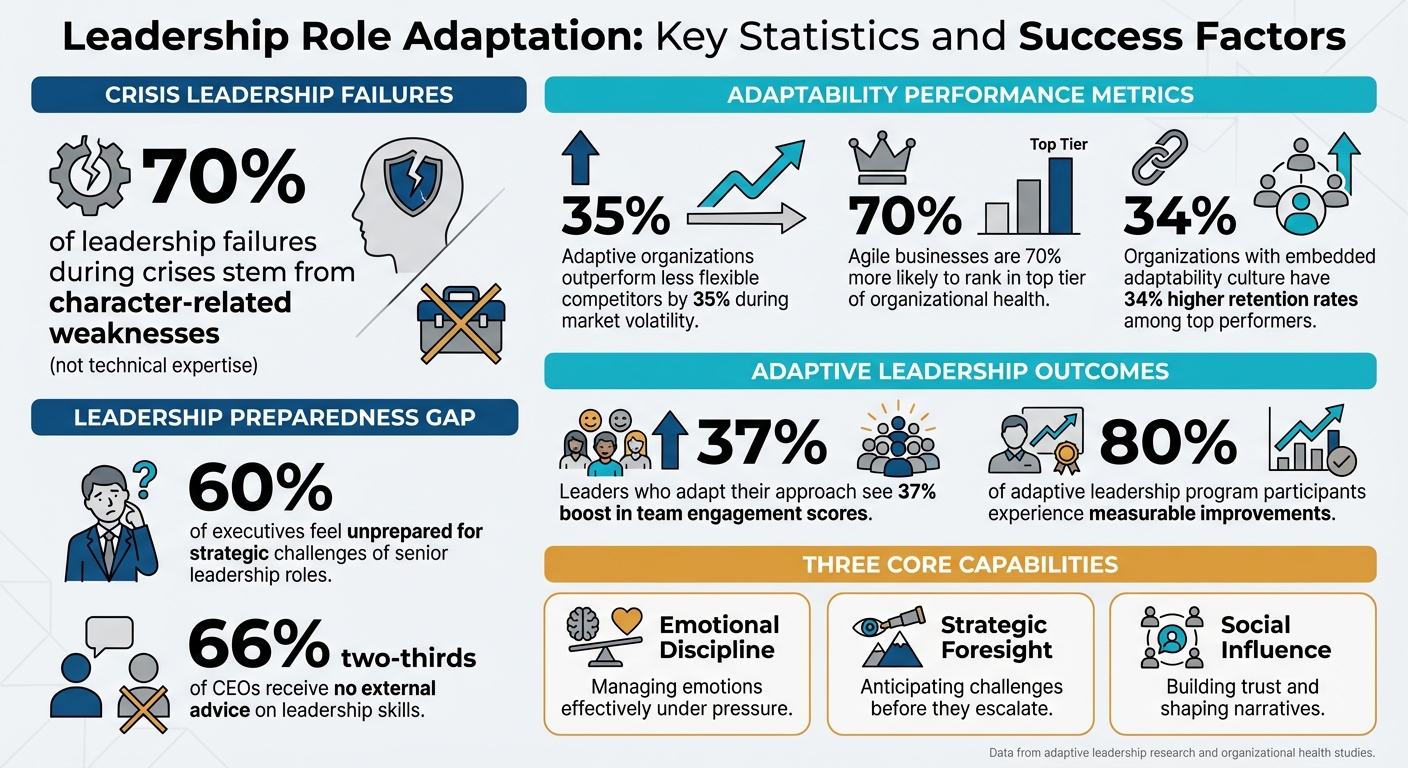
Leadership Role Adaptation: Key Statistics and Success Factors
Adaptive Leadership Theory: 6 Behaviors Every Leader Needs to Handle Tough Times
sbb-itb-ce676ec
Case Studies of Role Adaptation
These case studies highlight how leaders adjusted roles to navigate complex challenges effectively. They illustrate that flexibility and situational awareness often outweigh strict adherence to traditional hierarchies.
Case 1: Transforming Agricultural Markets in Uganda
In Uganda's Acholi region, leaders of agricultural market development programmes encountered a mix of routine tasks and unforeseen challenges that threatened progress. The ADAPT partnership, initiated in 2015 by the International Rescue Committee and Mercy Corps, tested adaptive management strategies across six complex scenarios, including Uganda.
Rather than sticking to rigid, top-down approaches, leaders shifted to empowering teams to create tailored solutions. This cultural change allowed for quicker responses to evolving market conditions, such as fluctuating crop prices and supply chain disruptions.
A key factor in the programme's success was leaders' ability to develop market awareness and anticipate changes. As Mercy Corps explained:
"To drive improvements in impact we need to be better able to analyse the dynamics of a given situation, anticipate how these might evolve, and be sufficiently agile to adapt to changes in context and need".
This case demonstrates that enabling teams to identify and address local problems can lead to significant improvements, even in unpredictable situations.
Case 2: Crisis Response in Syria
In South and Central Syria, relief teams faced the immense challenge of delivering humanitarian aid during an active crisis. Leaders recognised early on that situational awareness had to be actively cultivated to guide strategic decisions.
Traditional hierarchical structures proved too slow, so leaders granted local partners more autonomy for real-time decision-making and reduced bureaucratic hurdles. Senior leaders focused on building trust, clarifying goals, and removing barriers rather than maintaining direct control.
This approach succeeded because leaders understood that rigid frameworks stifled innovation and risk-taking. By simplifying approval processes and empowering field teams, they enabled faster and more context-sensitive responses, improving the effectiveness of aid delivery. This case underscores the value of adaptive leadership in overcoming the limitations of conventional structures.
Case 3: Adapting to Remote Work in a Technology Firm
The shift to remote work presented challenges in maintaining productivity and team cohesion without face-to-face interaction. Leaders who thrived during this transition recognised that the issue went beyond technical fixes like better video conferencing tools. It required a complete rethink of communication, decision-making, and team support.
Successful leaders assigned senior, trusted individuals to champion innovative work practices and secure buy-in from other leadership levels. They also simplified overly complex processes inherited from traditional office environments, understanding that remote teams needed clearer communication and streamlined decision-making frameworks.
The most effective leaders collaborated with their teams to establish new norms around availability, communication, and collaboration. Rather than enforcing rigid policies, they encouraged experimentation and the sharing of successful practices. Teams that were empowered to adapt their workflows reported greater productivity and stronger cohesion, demonstrating the power of flexible role adaptation over blanket solutions.
These varied examples offer valuable insights into leadership strategies that enhance adaptability and effectiveness in diverse contexts.
Leadership Approaches for Role Adaptation
The case studies discussed earlier highlight how purposeful leadership practices can enable effective role adaptation. Three key capabilities stand out: emotional discipline, strategic foresight, and social influence. These skills, grounded in neuroscience, behavioural psychology, and cognitive science, are not innate but can be developed through deliberate effort.
Research reveals that 70% of leadership failures during crises stem from character-related weaknesses - such as an inability to stay calm and think clearly - rather than a lack of technical expertise. This finding emphasises that technical skills alone are insufficient when leaders face rapid role changes and high-stakes situations.
Building Emotional Discipline
Given that many leadership failures are rooted in character deficiencies, cultivating emotional discipline is crucial. Emotional discipline involves maintaining composure and adaptability during times of upheaval. It’s not about suppressing emotions but learning to manage them effectively. Evidence suggests that managers who fail to address their own challenging emotions often create environments where team members experience poorer psychological wellbeing and higher frustration levels.
At the heart of emotional discipline lies psychological flexibility - the capacity to adjust to changing circumstances while staying true to core values. Effective leaders don’t shy away from discomfort; instead, they confront it head-on. One practical strategy is self-distancing, which involves viewing high-pressure situations from an outsider’s perspective. This technique can help leaders detach from immediate emotional reactions and respond more thoughtfully.
Other methods, such as box breathing, labelling emotions, and deliberate pauses, can help reduce stress and prevent impulsive decision-making. For leaders managing critical decisions, tailored advisory services offer valuable support. For instance, House of Birch applies principles from neuroscience and behavioural psychology to help leaders maintain emotional control, shape narratives, and make sound decisions under pressure. As founder Tommy Birch puts it:
"I build individuals who are emotionally disciplined, strategically intelligent, socially dominant, and unshakeable under pressure".
Foresight and Decision-Making
Strategic foresight allows leaders to anticipate challenges and adapt roles before issues escalate. It’s not about predicting the future but systematically analysing how current trends may unfold. Leaders can improve their decision-making by reframing how they view pressure - seeing situations as "problems to solve" rather than "disasters" can significantly alter emotional responses and judgement quality.
Asking reflective questions such as, "How will this situation look a year from now?" or "What would the wisest person I know do in this scenario?" can broaden perspective and enhance decision-making. These techniques encourage leaders to step back and assess situations more objectively.
Increasing Social Influence
While foresight equips leaders to address challenges early, social influence ensures their teams remain aligned and committed during transitions. Social influence hinges on trust - leaders must connect with their teams by shaping narratives and building strong relationships. Authenticity and accountability are key to earning this trust.
A notable example comes from November 2018, when Google CEO Sundar Pichai faced widespread employee protests over the company’s handling of sexual harassment cases. By actively listening to employee concerns and implementing tangible changes - such as ending forced arbitration for harassment claims and tightening workplace misconduct policies - Pichai demonstrated that accountability and decisive action strengthen social influence.
Adapting communication styles is equally important, particularly in diverse, global teams. Leaders must navigate challenges such as time zone differences, language barriers, and varying work approaches. Strategies like cross-cultural training, virtual collaboration tools, and global team-building initiatives can help foster trust and cohesion across regions.
Interestingly, 60% of executives report feeling unprepared for the strategic challenges of senior leadership roles, and two-thirds of CEOs admit they receive no external advice on their leadership skills, despite being open to coaching. This highlights the growing need for bespoke advisory services, which provide tailored support to enhance decision-making, strengthen presence, and amplify influence during critical moments.
Lessons from the Case Studies
Why Adaptability Matters More Than Experience
Examining the case studies reveals a clear pattern: adaptability often trumps experience when teams encounter uncharted territory. The difference between technical problems and adaptive challenges is key here. Technical problems rely on existing skills - a malfunctioning system, a budget gap, or a staffing issue. Adaptive challenges, on the other hand, demand a shift in mindset, learning new behaviours, and confronting uncomfortable trade-offs.
The story of LEGO underscores this concept. Back in 2004, the company was losing £640,000 daily. CEO Jørgen Vig Knudstorp recognised that this wasn't just about fixing operational inefficiencies - it was an adaptive challenge centred on rediscovering the brand's essence. By involving adult fans in product development and encouraging employees to experiment, Knudstorp steered LEGO to become the world's largest toy company by 2015. Research supports this approach: adaptive organisations outperform less flexible competitors by 35% during periods of market volatility, and agile businesses are 70% more likely to rank in the top tier of organisational health. These findings highlight the importance of fostering adaptability, and the recommendations below provide practical ways for leaders to achieve this within diverse teams.
Practical Recommendations for Diverse Teams
To cultivate adaptability in diverse teams, leaders should prioritise three key practices:
- Dedicate time for "balcony moments" - set aside weekly sessions to step back from day-to-day tasks and identify broader patterns. This helps leaders move beyond surface-level issues to address deeper, systemic challenges.
- Promote psychological safety by ensuring team members feel safe to challenge ideas and acknowledge mistakes without fear of reprisal. Research shows this is the strongest predictor of team effectiveness.
- Encourage "safe-to-fail" experiments by designing initiatives where learning is prioritised over immediate success. Leaders who can adapt their approach - switching between directive, collaborative, and coaching styles depending on the situation - see a 37% boost in team engagement scores. Explaining the reasoning behind these shifts is crucial, as transparency prevents teams from mistaking adaptability for inconsistency.
Organisations that embed adaptability and learning into their culture enjoy 34% higher retention rates among top performers. In high-pressure environments, these practices are not just helpful - they're essential for staying ahead.
Conclusion: Applying Role Adaptation for Leadership Success
The case studies highlight how role adaptation has become a critical factor in navigating today's high-pressure environments. Organisations that embrace flexibility consistently outperform those that remain rigid, with agile organisations demonstrating stronger overall health. However, global research reveals that most change initiatives fail to achieve their intended outcomes, often due to challenges related to people rather than technical shortcomings.
Drawing insights from these examples, leaders managing diverse teams must prioritise more than just technical expertise. Emotional discipline is essential to stay composed under pressure, strategic foresight helps in recognising broader patterns, and social influence is key to shaping narratives and fostering trust. This perspective acknowledges that thriving in high-stakes situations goes beyond traditional management approaches - it requires tailored development that addresses the specific challenges leaders encounter. These enhanced capabilities open pathways for specialised leadership advisory services designed to support such growth.
To implement adaptive strategies effectively, many leaders are turning to targeted advisory programmes. House of Birch offers bespoke solutions aimed at refining decision-making during high-pressure scenarios, strengthening emotional discipline, and enhancing presence in pivotal moments. Reports from adaptive leadership initiatives show that nearly 80% of participants experience measurable improvements in their leadership abilities. These outcomes are driven by shifting focus from routine technical solutions to fostering strategic curiosity, systemic awareness, and intentional influence - skills that underpin successful role adaptation in diverse and dynamic environments.
FAQs
How do I tell a technical problem from an adaptive challenge?
A technical problem is typically straightforward and can be resolved using existing knowledge or expertise. Examples include fixing machinery or implementing established procedures. In contrast, an adaptive challenge goes beyond surface-level fixes, requiring a deeper focus on altering values, beliefs, or behaviours. These challenges often encounter resistance because they demand shifts in mindset or priorities. If a solution is clear and procedural, it’s likely technical; if it involves navigating complex human dynamics, it’s adaptive.
What should I change first when roles need to shift fast?
When roles need to change rapidly, the first step is to clearly outline and adjust responsibilities and expectations. This approach minimises delays and enables team members to respond more effectively to shifting demands. Maintaining open lines of communication is equally important - ensure that all team members are on the same page regarding updated priorities and goals. These practices reflect the core ideas of adaptive leadership, supporting teams in managing transitions efficiently while preparing them for future changes.
How can I maintain trust and psychological safety during change?
To preserve trust and a sense of psychological safety during periods of change, prioritise open communication and transparency. Take the time to listen attentively to concerns, address uncertainties openly, and provide clear, truthful updates. Show empathy through your words and actions, uphold integrity, and maintain consistency in your behaviour. Encourage team members to participate in decision-making processes and cultivate a shared sense of purpose. These steps help create an atmosphere where people feel secure, appreciated, and supported as they navigate transitions.

