How to Build Credibility in High-Stakes Roles
In high-pressure leadership roles, credibility is a critical asset, especially when formal authority isn't enough. It revolves around three key elements: expertise, reliability, and emotional discipline. Leaders who master these areas can navigate uncertainty, win trust, and make better decisions under scrutiny. Research highlights that 70% of leadership failures during crises stem from character flaws, not technical skills, and 40% of leaders fail within 18 months due to a lack of trust-building.
Key takeaways:
- Expertise: Show competence through visible reasoning, asking the right questions, and separating facts from assumptions.
- Reliability: Align actions with words, maintain consistent behaviour, and communicate decision-making processes clearly.
- Emotional Discipline: Stay composed under stress, use methods like structured breathing, and practise empathy without overreacting.
Leaders should focus on transparent communication, self-reflection, and seeking external feedback to maintain trust over time. Organisations should encourage these behaviours to ensure leadership success under pressure.
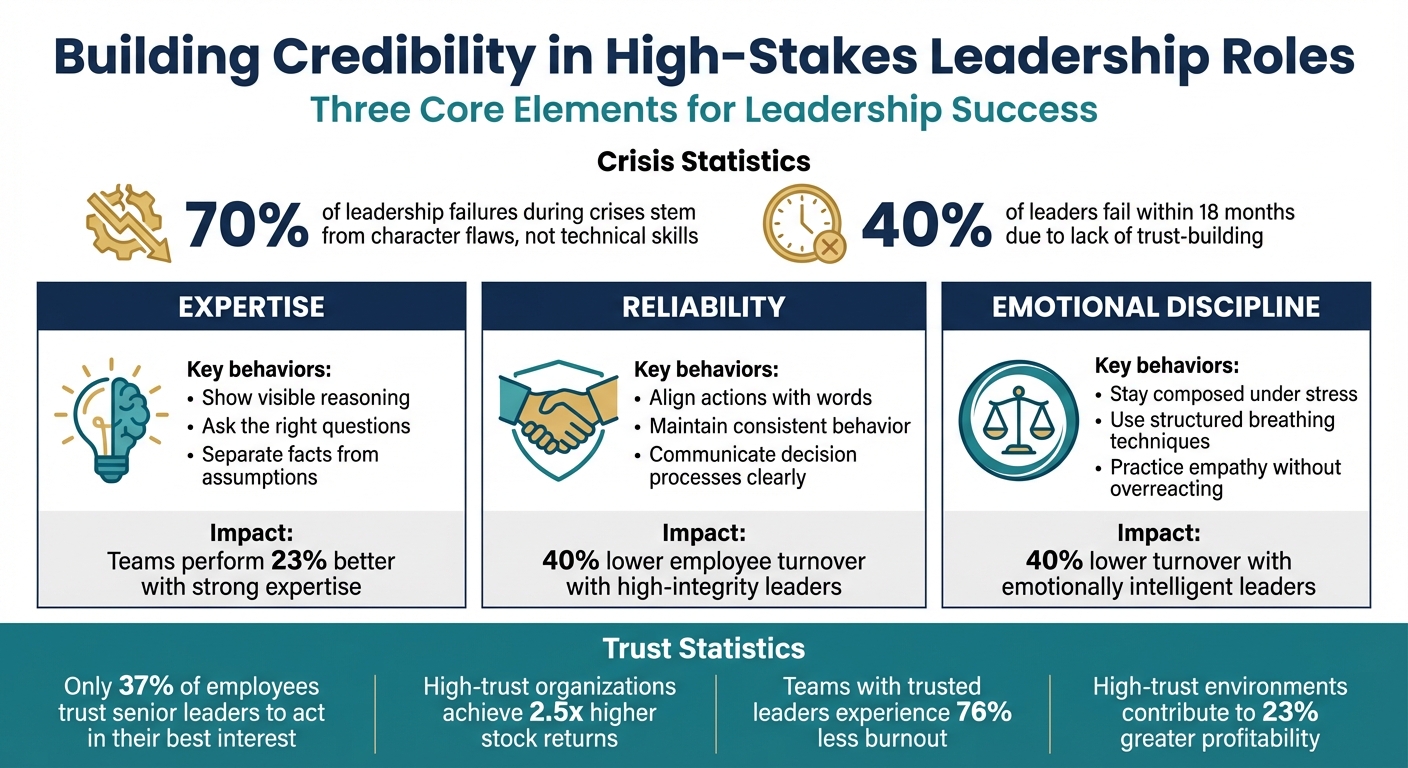
Building Leadership Credibility: Key Statistics and Three Core Elements
Nobody Believes You: Building Trust & Credibility in Leadership with Author Jenni Field
sbb-itb-ce676ec
Building Expertise: Developing Knowledge and Skill
Expertise in demanding, high-pressure roles goes beyond formal qualifications. It is revealed through the ability to ask the right questions, quickly identify limitations, and break down complex problems into actionable steps. Leaders establish their credibility by demonstrating how they approach challenges in real time, rather than relying solely on credentials.
Deepening Your Subject-Matter Knowledge
To showcase expertise, focus on making your thought processes visible. Share how you approach reasoning, weigh trade-offs, and manage assumptions, rather than presenting only polished conclusions. This openness not only invites constructive feedback but also reflects confidence in your judgement.
"Credibility grows when competence is visible through behaviour rather than stated through credentials." - Gregory Whelan
Strategic listening is an essential tool for effective leaders. By actively listening, leaders can gather better inputs and spot potential misalignments early, ensuring decisions are well-informed rather than isolated. Keeping a decision journal is another valuable practice. Documenting the assumptions and logic behind major decisions allows for regular reviews, helping to identify patterns and refine understanding over time. Before acting, clearly differentiate between facts and assumptions - this reduces defensiveness among stakeholders and promotes clarity.
When making decisions, it’s useful to distinguish between "one-way door" decisions, which are irreversible, and "two-way door" decisions, which can be reversed. Invest more time in deepening knowledge for the former, while moving swiftly on the latter. This approach ensures that the most critical decisions receive the necessary level of scrutiny.
"Clarity about what you don't know builds more trust than pretending you know everything." - Clear Whitespace
This transparent and systematic approach not only builds trust but also demonstrates expertise in a way that delivers tangible results.
Proving Expertise Through Results
Expertise shines through consistent and sound judgement, not through performative displays of competence. Leaders who excel in synthesising complex information streams into clear, actionable strategies see measurable benefits: teams perform 23% better, employee retention improves by 34%, and engagement scores rise by 18%.
Avoid behaviours that erode trust, such as over-preparing, hiding uncertainties, or micromanaging - often referred to as "credibility theatre." Instead, share your data and reasoning openly, not just the final outcomes. When mistakes happen, take ownership rather than deflecting blame. Research shows that nearly 40% of leaders fail within their first 18 months in a new role, often because they prioritise appearing flawless over demonstrating adaptability and growth.
Establishing authority outside your organisation can also enhance internal credibility. Writing thought leadership articles, speaking at events, or publishing original research are effective ways to build your reputation. A six-month campaign of public engagement is often sufficient to position yourself as a respected expert.
Incorporating external insights can further enhance your ability to navigate complex leadership challenges.
Working with External Advisors and Resources
Once you’ve demonstrated expertise internally and delivered results, external advisors can provide critical support during pivotal moments. These could include transitions to C-suite roles, preparing for IPOs, or presenting to boards - situations where decisions carry significant weight and require strategic precision. The best advisors offer honest, agenda-free feedback rather than simple validation. This tough love helps refine decision-making and strengthens leadership presence.
"People hire me when the utility of feedback outweighs the vanity of validation." - Peter Botting, Narrative and Risk Advisory
Advisors can also help leaders identify irreversible "one-way door" decisions and ensure external expertise is focused where it matters most. Conducting a narrative audit is another valuable step, ensuring your leadership story resonates with boards, media, and talent. The aim isn’t to delegate judgement but to refine it by gaining an objective perspective, especially when personal biases might cloud decision-making.
For example, organisations like House of Birch specialise in bespoke leadership advisory services. Their approach helps leaders develop strategic intuition, emotional discipline, and the ability to synthesise diverse information streams - qualities that separate truly authoritative leaders from those who simply hold senior titles.
Building Reliability: Consistency in Leadership
Reliability is a cornerstone of effective leadership. While expertise demonstrates what a leader knows, reliability showcases their character, particularly in critical situations. Studies indicate that organisations led by high-integrity leaders achieve stock returns 2.5 times higher than their peers and see 40% lower employee turnover. However, only 37% of employees currently trust their senior leaders to act in their best interest. This disparity highlights an urgent need for leaders to cultivate consistent behaviours that foster stability, even in uncertain times.
Matching Actions with Words
Few things erode trust faster than a leader whose actions fail to align with their words. This alignment is especially significant as 88% of younger employees report they would leave a job if the company's values clashed with their own.
"Leadership is practised not so much in words as in attitude and in actions."
- Harold S. Geneen, Author of Managing
To build trust, leaders must translate abstract values into tangible, measurable actions. For instance, instead of vaguely committing to "honesty", a leader might pledge to acknowledge uncertainties during presentations rather than provide speculative answers. When mistakes occur, addressing them openly and presenting clear plans for improvement reinforces credibility.
Daily self-reflection is a powerful tool for maintaining this alignment. Research shows that teams led by trusted leaders are 76% less likely to experience burnout. Moreover, employees in high-trust environments contribute to 23% greater profitability. Over time, the habit of matching words with actions creates a reputation that can endure even under pressure.
Setting Clear Processes and Expectations
Beyond individual actions, structured processes play a vital role in establishing reliability. When team members understand how decisions are made, confusion and doubt diminish. Implementing a formal decision-making framework - considering factors such as values alignment, stakeholder impact, long-term consequences, and precedents for future actions - can provide clarity and consistency.
Leaders should not only explain their decisions but also communicate the reasoning behind them. A three-step communication model can help: first, provide context by outlining the broader situation; second, detail the process used to reach the decision; and third, acknowledge the impact on various stakeholders. Embedding such frameworks into organisational systems ensures that reliability becomes ingrained. For example, aligning hiring, promotions, and performance reviews with stated values can lead to 50% lower turnover rates and 6% higher sales growth.
Practising Honesty and Transparency
Transparency serves as the final pillar of reliable leadership. High-stakes environments often bring uncertainty, but transparent communication can help manage expectations. By explaining the logic and trade-offs behind decisions, leaders can build trust based on their process rather than just the outcomes.
Addressing risks openly and sharing uncertainties fosters a sense of inclusion among team members. This approach not only strengthens psychological safety but also encourages innovation by reducing the fear of failure. Explaining decision-making criteria before outcomes are final demonstrates humility and reinforces confidence in leadership.
"The choice is clear: lead with integrity, or risk leading at all."
- Laura Bouttell, Managing Director, Quarterdeck
The advantages of transparency extend beyond ethical considerations. When employees trust their leaders, the brain releases oxytocin, a hormone that boosts collaboration and reduces stress. Conversely, breaches of integrity can have catastrophic financial consequences. For instance, the Volkswagen emissions scandal resulted in over £30 billion in fines and settlements. In short, honesty isn't just the ethical choice - it’s also the smart one, benefiting both individuals and organisations.
For more guidance on integrating these practices into leadership strategies, explore the advisory services offered by House of Birch.
Maintaining Emotional Discipline: Staying Composed Under Pressure
Emotional discipline is what sets resilient leaders apart from those who falter under pressure. During moments of intense stress, the brain tends to shift from the prefrontal cortex - responsible for thoughtful decision-making - to the limbic system, which governs reactive responses. This shift can lead to impulsive choices and diminished judgement. Leaders who cultivate emotional control can counteract this natural response, preserving their credibility and effectiveness when it matters most.
Managing Stress Without Reacting
Effective stress management begins with recognising personal triggers before they take hold. Self-reflection is key to identifying behavioural patterns that surface under pressure. By tuning into internal signals - such as shifts in tone, posture, or focus - leaders can employ structured techniques to regain control. For instance, box breathing, which involves equal counts for inhaling, holding, exhaling, and pausing, activates the parasympathetic nervous system, calming the body. Similarly, grounding exercises, like focusing on physical sensations or observing one’s surroundings, can help anchor attention during high-pressure moments.
Reframing stressful situations as challenges rather than threats can also be transformative. This mindset shift helps prevent tunnel vision and encourages a more engaged response. Tools like the OODA Loop (Observe, Orient, Decide, Act) enable leaders to process information quickly and avoid paralysis under pressure. Instead of micromanaging, prioritising clarity by defining and communicating core objectives can reduce chaos and foster team alignment. A composed approach not only enhances decision-making but also creates room for empathetic interactions with the team.
Using Empathy to Build Trust
Empathy has become a non-negotiable skill for leaders. Without it, organisations risk losing £180 billion annually due to attrition. Teams led by emotionally intelligent leaders report 40% lower turnover rates and a 25% boost in employee engagement. However, effective empathy requires balance. Leaders need to practise self-control to engage empathetically without being overwhelmed. The "strategic pause" - a deliberate moment of reflection between stimulus and response - can help acknowledge emotions without letting them dictate actions.
"Emotional intelligence accounts for 90% of what moves people up the career ladder when IQ and technical skills are roughly similar."
- Laura Bouttell, Writer, Quarterdeck
Daily emotional audits can help leaders assess their feelings and understand how those emotions might influence their behaviour. The PEACE Framework offers a structured approach to conflict resolution: Perspective taking, Empathy demonstration, Alternative generation, Commitment building, and Evaluation. This method ensures leaders remain compassionate while avoiding emotional exhaustion or impulsive decisions rooted in shared distress.
Developing Emotional Resilience
To sustain emotional discipline, consistent practice is essential. Conducting After-Action Reviews (AAR) after stressful events allows leaders to reflect on what happened and why, capturing lessons to refine future responses. Long-term resilience also depends on managing energy across four dimensions: physical (adequate rest and nutrition), emotional (processing emotions), mental (strategic disengagement), and spiritual (connection to a deeper purpose).
Engaging with a professional coach can provide tailored insights into specific stress triggers and help leaders strengthen their performance under pressure. House of Birch offers leadership advisory services rooted in neuroscience and behavioural psychology, helping leaders develop the skills needed to remain composed and authentic, even in the face of adversity. By adopting these strategies, leaders can enhance their decision-making and maintain authority, no matter how unpredictable the circumstances.
Maintaining Credibility Over Time
Credibility is not a one-time accomplishment; it is built through consistent actions that match what is promised. Leaders in demanding roles know that their authority hinges on maintaining this alignment. When actions and words diverge, trust diminishes, and teams may begin to doubt a leader’s judgement. Sustaining credibility requires ongoing effort to stay aligned, even as circumstances shift. Below, we explore how leaders can reassess their behaviours, adapt to new challenges, and use reflection to ensure credibility endures.
Reviewing and Adjusting Your Leadership Behaviours
Regular self-evaluation is crucial for maintaining credibility. Leaders should routinely question whether their actions reflect their values and consider how they respond when trust is at stake. This process can uncover gaps between intentions and actions before they become obvious to others.
Being honest about past commitments - whether they were successful or not - demonstrates accountability. Acknowledging failures openly fosters trust and shows emotional discipline. Strategic listening is another critical tool; actively seeking out dissenting opinions or insights from outside your own expertise can help identify blind spots early on. Instead of projecting overconfidence, leaders who acknowledge risks and trade-offs inspire greater trust by showing they are grounded in reality.
Adapting to New Challenges While Maintaining Trust
After reassessing behaviours, the challenge becomes navigating new situations without sacrificing trust. Research suggests that 70% of leaders who falter during crises do so due to issues with character - such as failing to remain composed or inspire confidence - rather than a lack of technical ability. Transparency is key in these moments. Admitting what you don’t know, instead of feigning certainty, reinforces integrity.
The OODA Loop (Observe, Orient, Decide, Act) is a practical framework for managing fast-changing scenarios. It allows leaders to make decisions faster than the pace of the challenge. Frequent and early communication - even when all the facts aren’t yet available - prevents the confusion and speculation that silence can create. If overwhelmed, leaders can reset expectations by acknowledging gaps in their knowledge. This approach not only demonstrates accountability but also fosters a growth-oriented environment that teams respect.
Strengthening Credibility Through Reflection and Learning
Sustained credibility depends on turning experience into growth, which requires deliberate reflection. Without this, even extensive experience can fail to produce meaningful progress, leading to repetitive mistakes.
"Experience alone doesn't develop leaders. Reflected experience does. The same ten years can produce ten years of growth or one year repeated ten times."
- Laura Bouttell, Quarterdeck
A structured reflection routine can help leaders consolidate their learning. This might include 5–10 minutes of daily reflection, 20–30 minutes weekly, and 1–3 hours monthly or quarterly to review key decisions and goals. Such practices not only reinforce lessons but also demonstrate a leader’s commitment to self-improvement. Seeking external perspectives, such as through mentorship or coaching, can provide fresh insights and help uncover blind spots. For instance, House of Birch offers tailored leadership advisory services aimed at helping leaders develop the self-awareness and strategic focus needed to navigate complex challenges. By combining systematic reflection with external feedback, leaders can ensure their actions consistently align with their core values, which is essential for maintaining credibility.
Conclusion: Building Credibility in High-Stakes Roles
Credibility in high-stakes roles rests on three tightly connected elements: expertise, reliability, and emotional discipline. Leaders who excel in these areas foster trust across teams, stakeholders, and organisations. Expertise forms the bedrock - leaders must demonstrate competence and commit to ongoing learning to ensure their decisions are well-informed. Reliability stems from consistent behaviour; when actions align with words, trust becomes steady and predictable. Emotional discipline weaves these qualities together, enabling leaders to stay composed under pressure, reassure those around them, and avoid impulsive decisions that could undermine confidence. Together, these elements reflect the strategies explored earlier.
"Leadership is practiced not so much in words as in attitude and in actions." - Harold S. Geneen, Author of Managing
Geneen’s insight highlights that leadership is proven through actions, not declarations. Credibility, therefore, isn't something leaders can claim; it must be earned through consistent, visible behaviour. This aligns with research emphasising the impact of character-related missteps in high-pressure environments.
Maintaining credibility requires ongoing effort. Leaders should routinely evaluate their actions, adapt openly to change, and embrace lessons learned. By demonstrating transparency, accountability, and humility, they reinforce trust over time. These qualities, when consistently applied in challenging situations, form the foundation of effective leadership discussed throughout this piece.
FAQs
How can I prove credibility fast in a new high-stakes role?
To build credibility swiftly in a high-pressure role, prioritise active listening. Engage by asking thoughtful questions, taking detailed notes, and showing genuine interest in others' perspectives. This approach fosters trust and connection. Equally important is proving reliability - make carefully considered decisions early and consistently deliver on promises. These behaviours signal capability and earn the respect and confidence of your team.
What should I do if I don’t know the answer in front of senior stakeholders?
If you're unsure of an answer, it's better to be honest and composed rather than guessing. Acknowledge the gap in your knowledge and commit to providing the correct information later - and make sure to follow through promptly. Remaining calm and collected under pressure helps to maintain trust. Preparing ahead of time, perhaps through mental rehearsal, can equip you to tackle unexpected questions with confidence and grace.
How do I stay calm under pressure without seeming detached or uncaring?
To maintain composure under pressure while remaining approachable, prioritise emotional discipline. Techniques such as mindfulness or controlled breathing can help manage stress and convey confidence. At the same time, balance this with authentic empathy - actively listening and showing genuine concern ensures you don’t come across as distant. By staying calm, showing care, and projecting a steady presence, you enhance your credibility and foster trust in challenging situations.

