5 Biases That Impact High-Stakes Leaders
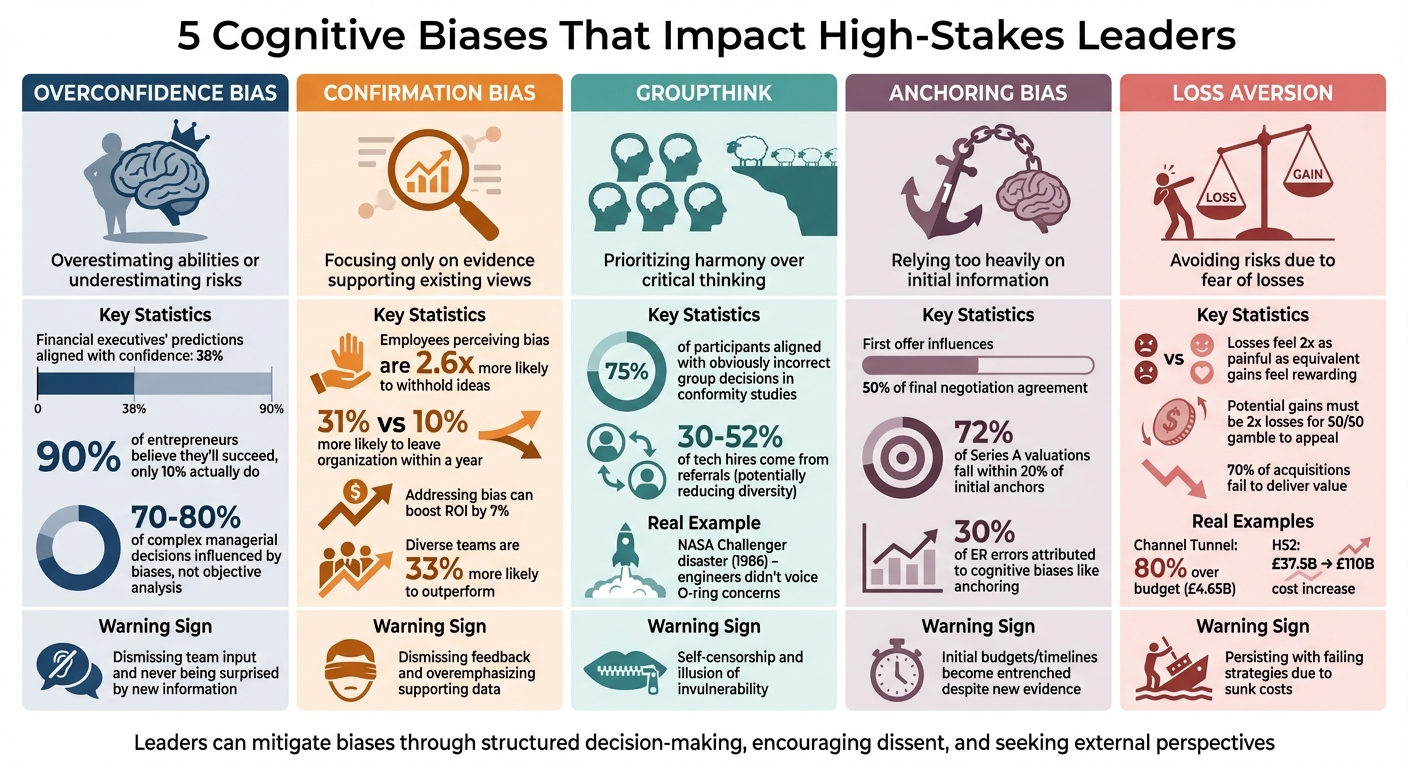
Cognitive biases - mental shortcuts that often lead to errors in judgement - can significantly impact leaders, especially in high-pressure environments. These biases distort decision-making, hinder innovation, and contribute to organisational challenges like poor investments or disengaged teams. Here are the five most common biases affecting leaders and how they manifest:
- Overconfidence Bias: Overestimating abilities or underestimating risks, leading to unrealistic projections or dismissing team input.
- Confirmation Bias: Focusing only on evidence that supports pre-existing views, creating blind spots and stifling dissent.
- Groupthink: Prioritising harmony over critical thinking, which can suppress diverse perspectives and lead to flawed decisions.
- Anchoring Bias: Relying too heavily on initial information, even if it's irrelevant or outdated, which skews subsequent decisions.
- Loss Aversion: Avoiding risks due to fear of losses, often resulting in missed opportunities or persisting with failing strategies.
Key Takeaway
Leaders can mitigate these biases by encouraging dissent, seeking external perspectives, using structured decision-making tools, and practising deliberate, reflective thinking. These strategies help counteract instinctive errors and promote more balanced judgement.
5 Cognitive Biases That Impact Leadership Decision-Making
The Bias Trifecta: The Effect on Leadership Decision Making | Michael Brainard | TEDxUCIrvine
sbb-itb-ce676ec
1. Overconfidence Bias
Overconfidence bias occurs when leaders overestimate their abilities, underestimate risks, or display unwarranted certainty in their predictions. This bias typically appears in three forms: overestimation (overrating one's own skills), overplacement (believing oneself superior to others), and overprecision (being excessively certain about the accuracy of one's beliefs). It often operates unnoticed, leading leaders to overrate their expertise and project an inflated sense of competence.
The impact of this bias is stark. For example, financial executives' market return predictions only aligned with their confidence intervals 38% of the time. Similarly, while 90% of entrepreneurs believe their ventures will succeed, the actual success rate hovers around just 10%. A striking case comes from Steve Ballmer, the former CEO of Microsoft, who boldly claimed: "There's no chance that the iPhone is going to get any significant market share. No chance". The subsequent dominance of the iPhone underscores how overconfidence can warp judgement, often before decisions are even made.
Leaders frequently misattribute past successes to their own capabilities, ignoring external factors like market trends or regulatory shifts. This mindset can lead to ignoring contradictory evidence, setting unrealistic deadlines, or underestimating the resources needed for projects. Research in behavioural economics reveals that 70–80% of complex managerial decisions are influenced more by cognitive and emotional biases than by objective analysis. Interestingly, individuals with high intelligence or status are often more prone to overconfidence, as they may mistakenly believe they are less likely to make errors.
"Overconfident professionals sincerely believe they have expertise, act as experts and look like experts. You will have to struggle to remind yourself that they may be in the grip of an illusion." – Daniel Kahneman, Psychologist and Author
Warning signs of overconfidence include dismissing team input, reacting defensively to concerns, or never being surprised by new information. A lack of surprise often signals an unwarranted certainty in one's current understanding. To counteract this bias, leaders can employ techniques such as conducting pre-mortems, appointing devil's advocates, or utilising reference class forecasting. Recognising these warning signs is a crucial first step in addressing and mitigating overconfidence.
2. Confirmation Bias
Confirmation bias leads leaders to focus on data that supports their existing views while ignoring evidence that challenges them. This selective approach can create strategic blind spots, resulting in poor decisions, overlooked opportunities, and a resistance to innovative solutions that could reshape an organisation. Its impact isn’t limited to individual judgement - it also influences team dynamics and organisational culture.
Dan Lovallo, a professor and decision-making researcher, highlights the pervasive nature of this issue:
"Confirmation bias is probably the single biggest problem in business, because even the most sophisticated people get it wrong. People go out and they're collecting the data, and they don't realize they're cooking the books."
For instance, leaders may fixate on positive performance metrics while ignoring warning signs such as rising employee burnout or operational inefficiencies. This selective focus can foster groupthink, where teams align with the views of dominant voices rather than exploring alternative perspectives. Studies indicate that employees who perceive bias in their leaders are 2.6 times more likely to withhold ideas and over three times as likely (31% versus 10%) to consider leaving their organisation within a year.
Common indicators of confirmation bias include dismissing valuable feedback, overemphasising data that supports a pre-chosen strategy, and interpreting neutral information in ways that validate existing assumptions. Leaders may also resist change, clinging to familiar strategies, and use past successes as evidence of their "correct thinking", even when circumstances have shifted. As leaders gain status, their confidence in their decisions can grow, further entrenching these tendencies.
Addressing confirmation bias requires targeted strategies. Exercises like the "Kill-Thrill" method, where teams identify potential flaws in an idea before refining it, force leaders to confront weaknesses they might otherwise ignore. Research shows that tackling decision-making biases can boost ROI by 7%, while diverse teams are 33% more likely to outperform less diverse groups.
Structured tools such as decision matrices, combined with fostering psychological safety, can also help counteract bias. Instead of merely asking, "Do you agree?", leaders should pose questions like, "What could go wrong here?" to encourage balanced, reality-driven feedback.
3. Groupthink
Groupthink arises when the desire for harmony within a team overshadows critical thinking. It has been described as "a mode of thinking that people engage in within cohesive teams, when the members' strivings for unanimity override their motivation to realistically appraise alternative courses of action". In high-stakes settings, this tendency can lead to rushed decisions, often at the expense of decision quality. This push for conformity can result in serious risks being ignored.
For leaders operating in such environments, groupthink presents a dual challenge: it stifles innovation and weakens risk management. Common symptoms include an illusion of invulnerability - where teams develop unwarranted optimism - and self-censorship, which suppresses critical analysis and open dialogue. A notable conformity study found that 75% of participants aligned with an obviously incorrect group decision, demonstrating how easily independent judgement can be overridden, leaving critical concerns unheard.
The impact of groupthink can be severe. In January 1986, NASA's Space Shuttle Challenger disaster tragically highlighted this, as engineers who knew about faulty O-ring seals refrained from voicing their concerns due to pressure to maintain the launch schedule and group consensus [25, 1]. Similarly, the crash of Air Florida Flight 90 in January 1982, which claimed 74 lives, was linked to crew members withholding warnings about dangerous ice accumulation to avoid criticism. These examples underscore how crucial it is for leaders to counteract such pressures to safeguard oversight and decision-making.
Promoting cognitive diversity - bringing together varied perspectives and approaches to problem-solving - has been shown to enhance innovation and risk assessment. Yet, practices such as employee referral programmes, which account for 30% to 52% of new hires in some technology sectors, may unintentionally reduce diversity if teams become overly homogenous. Evidence also shows that groups with greater gender and ethnic diversity tend to make better decisions. However, the emergence of "mindguards" who suppress dissent can erode these benefits.
Addressing groupthink requires intentional structural changes. Leaders can reduce its influence by speaking last during meetings to minimise authority bias, designating a devil’s advocate to challenge dominant views, and using anonymous input tools to encourage honest feedback [24, 25, 27]. A striking example of success comes from Alan Mulally, who, upon taking the helm at Ford Motor Company in 2006, transformed leadership meetings into forums where executives could openly discuss challenges without fear. This shift played a key role in steering the company away from bankruptcy. Tackling groupthink is critical for fostering balanced and effective decision-making processes.
4. Anchoring Bias
Anchoring bias occurs when the brain latches onto the first piece of information it encounters - the "anchor" - and relies heavily on it to shape subsequent decisions. As PsychologyFor.com puts it, "Anchoring bias is basically your brain being incredibly lazy in the most sophisticated way possible". Instead of conducting a thorough, independent analysis, individuals often make only minor adjustments from the initial reference point. This mental shortcut can lead to notable real-world consequences.
In negotiations, for example, the first offer can influence as much as 50% of the final agreement. Research on venture capital reveals that 72% of Series A valuations fall within 20% of their initial anchors, even when later developments should theoretically shift them. Remarkably, even when people are explicitly told that an anchor is arbitrary - like a number spun on a wheel - it still skews their final estimates. This persistence makes anchoring especially risky in high-pressure situations requiring quick decisions.
For leaders, anchoring bias can manifest in several critical areas. In strategic planning, initial budget estimates or project timelines often become entrenched, causing leaders to downplay the need for adjustments. During hiring, the performance of a "star" predecessor can set an unrealistic standard, leading to unfair evaluations of new candidates. In crisis management, early - often flawed - diagnoses can create "diagnostic momentum", where alternative solutions are overlooked. In fact, around 30% of personal errors in emergency rooms have been attributed to cognitive biases like anchoring.
To combat this bias, leaders can adopt specific strategies. For instance, a "Clean Slate" exercise encourages imagining a scenario without prior data, prompting leaders to rethink which questions to ask from scratch. Pre-mortem analyses, where teams envision a decision failing a year later and trace back the reasons, can help uncover whether flawed initial assumptions played a role. Additionally, setting strong and intentional anchors in negotiations or enforcing "cool-off" periods before finalising decisions can mitigate the bias.
Emotional states also influence susceptibility to anchoring. Leaders are more prone to biased decision-making when feeling sad, angry, stressed, or fatigued. Awareness of this vulnerability is critical. As Nathaniel Branden observed, "The first step toward change is awareness. The second step is acceptance". By actively seeking diverse perspectives and generating at least three alternative starting points to challenge the initial anchor, leaders can weaken its grip on their judgement. Recognising and addressing anchoring bias is a vital step in improving decision-making and avoiding similar pitfalls.
5. Loss Aversion
Loss aversion highlights how losses tend to feel about twice as painful as equivalent gains feel rewarding. For leaders making critical decisions, this psychological imbalance often results in an overly cautious approach. Research shows that for a 50/50 gamble to be appealing, the potential gains must be at least double the size of the possible losses. This aversion to loss frequently leads leaders to shy away from genuine growth opportunities, as the fear of failure overshadows the potential for success. The result? A skewed perception of risk that hampers decision-making and stifles progress.
One common pitfall is an overemphasis on the risks of taking action, while the hidden costs of inaction - such as losing market relevance or falling behind competitors - are overlooked. As Joseph Michelli points out:
"Doing nothing is still a choice... When you do any risk-benefits calculation, you have to include the risk of inactivity".
Despite this, loss-averse leaders often treat the status quo as a safer option, even when it may carry significant risks. This misjudgement can erode strategic flexibility, leaving organisations vulnerable in fast-changing environments.
This bias also manifests in several damaging behaviours. Leaders may persist with failing initiatives due to sunk costs, rather than evaluating future potential with a clear head. For example, they might continue supporting break-even legacy products that drain resources, instead of investing in new ventures with the potential to generate substantial growth. Large-scale infrastructure projects illustrate this dynamic vividly. The Channel Tunnel, for instance, exceeded its original budget by 80%, ultimately costing £4.65 billion, while HS2’s estimated costs ballooned from £37.5 billion in 2009 to as much as £110 billion. In both cases, decision-makers pressed on despite overwhelming evidence of spiralling costs, unable to confront the psychological discomfort of accepting a loss.
On the flip side, loss aversion can also push leaders into reckless behaviour. When facing losses, some leaders become unusually risk-tolerant, doubling down on failing strategies in an attempt to recover their position. This tendency partly explains why 70% of acquisitions fail to deliver value - leaders often combine overconfidence in their integration plans with an unwillingness to shift course when problems arise.
Addressing loss aversion requires deliberate strategies. Regular "reset meetings" can help leaders reassess ongoing projects, separating current decisions from past investments. Conducting opportunity cost analyses - explicitly quantifying the financial and strategic consequences of inaction - can counter the tendency to avoid risk altogether. Setting predefined "kill points" for projects ensures that failing initiatives do not consume resources indefinitely. Finally, adopting what Nancy Burger calls a growth mindset can help leaders approach decisions with greater clarity. As she explains:
"Instead of passing on an opportunity simply because it seems risky, a leader with a growth mindset can step out of fear-based thoughts and weigh pros and cons with clarity".
How to Reduce the Impact of Cognitive Biases
The human brain, while comprising just 2% of body weight, consumes a striking 20% of total energy. This energy demand drives the brain to rely on mental shortcuts, leaving leaders vulnerable to cognitive biases. For those in high-stakes roles, the goal is not to eradicate these biases - an impossible task - but to create systems that promote a shift from fast, instinctive (Type 1) thinking to slower, more analytical (Type 2) reasoning.
Encourage dissent systematically. Leaders can institutionalise dissent by adopting practices like appointing a devil's advocate or setting up challenge teams to scrutinise dominant assumptions. For example, when Alan Mulally took over as CEO of Ford Motor Company, he introduced a "Business Plan Review" process. This transformed leadership meetings into open forums where executives could candidly discuss challenges, a pivotal step in pulling the company back from the brink of bankruptcy. Amazon employs a similar approach, starting meetings with 30 minutes of silent reading of a detailed memo to ensure all participants begin discussions with a shared understanding of the data.
Leverage pre-mortems. Before finalising major decisions, simulate a scenario where the decision has failed catastrophically. This exercise can uncover hidden risks and help combat overconfidence. Reflective questions such as "Why do I believe this?", "Am I ignoring evidence that contradicts my view?", and "What would admitting I might be wrong mean for my ego?" can further challenge entrenched biases. Research shows that when leaders express absolute certainty in their decisions, they are only correct 70% to 85% of the time.
Bring in an external perspective. Outsiders can often spot assumptions that insiders overlook. Jeremy from the Influence Journal highlights this point:
"A well-placed outsider can surface assumptions you didn't know you were making."
Leaders like Ray Dalio of Bridgewater Associates have embraced this principle by fostering "radical transparency", recording meetings, and encouraging rigorous debate. Bespoke advisory services, such as those offered by House of Birch, can also help leaders uncover cognitive distortions and refine their decision-making processes. These external viewpoints equip leaders to approach critical decisions with greater clarity and evidence-based reasoning.
Take time with critical decisions. Slowing down decisions provides further clarity, especially when combined with dissent and external input. Before committing to a course of action, leaders can use structured tools like SWOT analyses, decision matrices, or the Five Whys method to examine the issue objectively. Reframing the problem - such as considering it in terms of potential gains versus losses - can also reveal alternative perspectives that might influence the final decision. These deliberate pauses create the mental space needed to counter biases and ensure decisions are grounded in evidence rather than instinct.
Conclusion
Overconfidence, confirmation bias, groupthink, anchoring, and loss aversion are five cognitive traps that can undermine leadership effectiveness. These biases distort judgement, often leading to poor decisions that can erode trust within organisations. While leaders may feel confident in their ability to predict outcomes, research highlights a striking gap between perceived and actual success rates. This gap underscores how even seasoned decision-makers can be misled by mental shortcuts.
Eliminating bias entirely is unrealistic - our brains are wired for survival, not flawless logic. Instead, leaders operating in high-stakes environments must prioritise self-awareness as their strongest defence. Developing metacognition - the ability to reflect on one’s own thinking - helps leaders identify when their initial judgements might be skewed by unconscious biases. As Rich Lauria of Columbia University explains:
"You can't eliminate bias - you can only design processes that help counteract it".
However, self-awareness alone isn’t enough. Organisations must foster a culture of psychological safety, where team members feel empowered to question decisions and challenge assumptions. This goes beyond tolerating dissent; it involves actively embedding mechanisms like devil's advocates, red teams, and structured challenge sessions into decision-making processes. When biases are left unchecked, the consequences can be severe - employee morale may decline by as much as 19%, and innovation output can fall by 33%.
Structured frameworks further strengthen leaders’ resistance to cognitive bias. Tools like pre-mortems, decision matrices, silent memo reviews, and enforced pause periods encourage slower, more deliberate thinking. These methods act as a safeguard, helping leaders shift from instinctive, rapid decisions to more analytical and thoughtful approaches. Such strategies offer a practical way to mitigate the systematic errors that naturally arise from human cognition.
FAQs
How can I spot my own biases in real time?
To identify biases as they occur, it’s important to understand the mental shortcuts your brain often relies on and challenge your first impressions. Practical approaches include establishing clear decision-making criteria, actively looking for evidence that contradicts your assumptions, and engaging with diverse viewpoints. Taking a moment to reflect, especially during high-pressure decisions, can help you spot potential blind spots. Techniques such as scenario analysis or premortems - where you imagine a decision has failed and work backwards to understand why - can also be valuable in uncovering and addressing biases in the moment.
Which bias is most dangerous in a crisis?
When a crisis hits, the 'Hero' bias can be particularly risky. This bias emerges when leaders place excessive focus on their own role in resolving the problem. While this might stem from good intentions, it often results in overconfidence, flawed decisions, and a failure to tap into the skills and knowledge within their team. To navigate crises effectively, leaders must remain objective and prioritise collaboration over individual action.
What decision process best reduces bias?
The most effective way to minimise bias in decision-making is to actively question assumptions, look for evidence that contradicts initial beliefs, and apply structured decision-making frameworks. Techniques such as setting clear decision criteria in advance and including a range of perspectives can help counter cognitive biases like confirmation bias and anchoring bias. These methods encourage more balanced and objective choices, particularly in high-stakes scenarios.

