Top 5 Tools for Task Prioritisation
When faced with competing demands, executives often struggle to focus on what truly matters. Research shows that the mere-urgency effect - prioritising urgent tasks over important ones - can undermine long-term goals. Structured tools can help leaders move from reactive decision-making to a clear, systematic approach. This article breaks down five tools that reduce mental strain and improve task prioritisation:
- Eisenhower Matrix: Sort tasks by urgency and importance for quick, daily triage.
- Impact Effort Matrix: Identify "Quick Wins" versus resource-heavy projects for monthly or quarterly planning.
- RICE Scoring Framework: Rank initiatives using Reach, Impact, Confidence, and Effort for data-driven decisions.
- Kanban Boards: Visualise workflows to track progress and manage capacity in real time.
- Decision Matrix: Evaluate complex options by scoring them against weighted criteria.
Each tool serves a specific purpose, from managing daily tasks to making high-stakes decisions. Using these frameworks consistently can help leaders focus on high-value work and reduce inefficiency caused by cognitive overload.
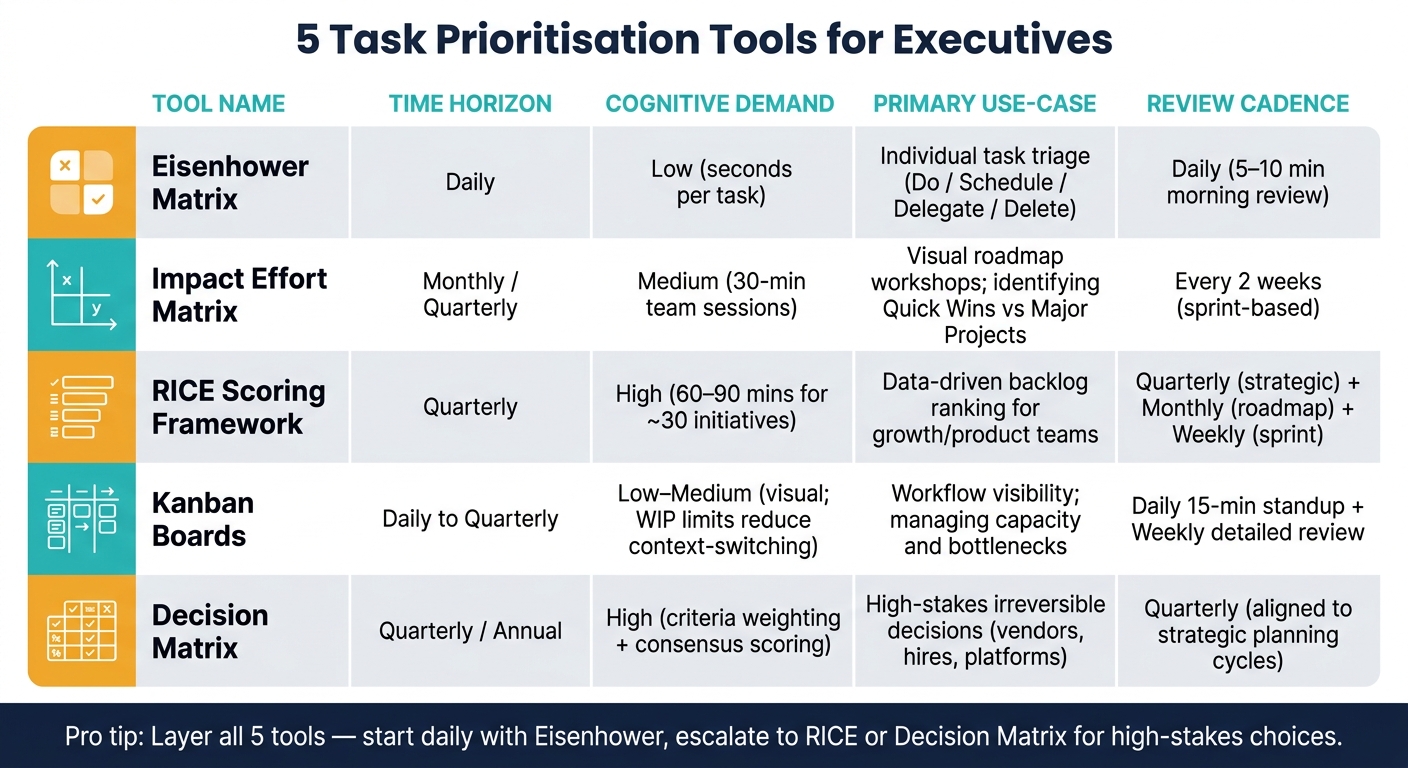
5 Task Prioritisation Tools: At-a-Glance Comparison for Executives
Top Tools for Effective Prioritisation: How to Use Eisenhower's Matrix
sbb-itb-ce676ec
What Executives Need Before Choosing a Tool
Before diving into prioritisation frameworks, it's essential to understand your decision-making needs. Picking a framework without clear objectives might create a false sense of organisation while failing to address the real issue. The right choice depends on four main factors: your time horizon, cognitive resources, the specific use-case, and your review cadence. Here's a closer look at each.
Time horizon plays a pivotal role. Quick, intuitive tools work best for daily tasks, while quarterly planning requires data-heavy approaches. Additionally, consider your risk exposure - initiatives lacking validated data demand more thorough evaluation.
Stakeholder impact is equally important. Some tools are tailored for individual clarity, while others are designed to drive collective decision-making. Ensuring the framework aligns with those who will act on its outcomes can help streamline progress rather than slow it down.
The table below highlights how popular prioritisation frameworks align with these criteria:
| Tool | Time Horizon | Cognitive Demand | Primary Use-Case | Review Cadence |
|---|---|---|---|---|
| Eisenhower Matrix | Daily | Low (seconds per task) | Individual triage | Daily |
| Impact Effort Matrix | Monthly/Quarterly | Medium | Visual roadmap workshops | Weekly or fortnightly |
| RICE Scoring | Quarterly | High (60–90 mins) | Data-driven backlog ranking | Quarterly |
As Asal Elleuch, Senior Product Manager at Amazon Prime, explains:
"Prioritisation is a never-ending and iterative process."
For executives in the UK, integrating prioritisation frameworks into your calendar can help transform prioritisation from a reactive effort into a consistent, disciplined practice.
1. Eisenhower Matrix
Named after Dwight Eisenhower, this approach organises tasks into four quadrants by asking two key questions: Is it urgent? and Is it important? The outcome is a straightforward grid that helps you decide whether to do, schedule, delegate, or delete each task.
"What is important is seldom urgent and what is urgent is seldom important." - Dwight D. Eisenhower, 34th President of the United States
Time Horizon
Quadrant 1 (Urgent & Important) includes tasks that demand immediate attention, typically within 48 hours, such as crises or pressing deadlines. Meanwhile, Quadrant 2 (Important, Not Urgent) is where long-term planning, relationship building, and strategic goals take precedence. Tasks in Quadrants 3 and 4 are better suited for delegation or elimination.
Cognitive Demand
The matrix is designed to minimise effort. Sorting tasks takes just seconds, and its true value lies in acting as decision insurance. By making decisions upfront, it eliminates the need to constantly reassess priorities throughout the day. Two quick tests simplify this process: the Urgency Test (does the task have a firm deadline in the next 48 hours?) and the Importance Test (does it directly support one of your top three goals or quarterly OKRs?). Together, these tests provide a clear framework for prioritisation, reducing mental strain and enhancing executive decision-making, especially under pressure.
Use-Case
This tool is particularly useful when you feel overwhelmed by constant demands, leaving little room for long-term progress. It works best for managing between 10 and 50 tasks per day. To keep it effective, limit each quadrant to 8–10 items; exceeding this number can dilute its benefits. To reduce the volume in Quadrant 1, aim to spend at least 30% of your week on Quadrant 2 activities.
Ideal Review Cadence
A quick daily review - 5 to 10 minutes in the morning - can help you sort tasks and identify your top priority for the day. On Mondays, a 15-minute session can align weekly priorities and preserve time for Quadrant 2 work. Additionally, a monthly review of long-term goals ensures that your Quadrant 2 efforts remain aligned with your overarching objectives.
2. Impact Effort Matrix
The Impact Effort Matrix evaluates tasks based on their business value and the resources they require. Unlike the Eisenhower Matrix, which focuses on urgency and importance, this tool balances potential business outcomes against the effort needed. Tasks are categorised into four groups on a 2x2 grid: Quick Wins, Major Projects, Fill-Ins, and Money Pits. The framework asks two key questions: How much value does this task create? and How many resources will it consume?
"The impact vs effort matrix cuts through this noise. It's a simple framework that forces you to be honest about what's worth doing and what's just noise." - Faisal Mustafa, Task Management Expert, TaskFino
Time Horizon
Time sensitivity plays a critical role in determining how tasks are prioritised. Quick Wins, which are high-value but low-effort tasks, should be completed within the current week or sprint. On the other hand, Major Projects, which require significant effort but yield high impact, are better suited for quarterly roadmaps with resources allocated in advance. A practical guideline is to consider any task taking more than a quarter to complete as "high effort". Additionally, it’s wise to include a 30–50% time buffer to account for the common tendency to underestimate how long tasks will actually take.
Cognitive Demand
To keep the process efficient, tasks can be scored using simple ratings of High, Medium, or Low for both impact and effort. This avoids prolonged debates over exact measurements. When working with a team, limit discussions about each task to five minutes. If consensus isn’t reached, assign a median rating to maintain momentum. This approach minimises mental strain and ensures the session remains focused.
Use-Case
The matrix proves especially useful during stakeholder negotiations. It shifts conversations from emotional appeals to logical prioritisation by highlighting the trade-offs of limited resources. For example, in January 2026, a SaaS project management team used the matrix to decide between implementing a viral sharing feature or rewriting their backend system. The sharing feature was identified as a Quick Win, requiring just two engineers and three weeks to complete. This feature increased new sign-ups by 17%. The resulting boost in revenue then provided the resources needed to tackle the backend rewrite as a Major Project. This systematic categorisation not only clarifies immediate priorities but also helps maintain focus during regular reviews.
Ideal Review Cadence
To ensure priorities stay relevant, the matrix should be revisited every sprint - typically every two weeks - in a focused 30-minute session. This avoids the risk of working on outdated priorities.
"Your matrix goes stale fast. A major project from six months ago might be a quick win today because you've built the necessary infrastructure." - Faisal Mustafa, Task Management Expert
Additionally, recreating the matrix quarterly allows teams to adapt to changes in market conditions or organisational capabilities. Regular updates ensure the tool remains a reliable guide for decision-making.
3. RICE Scoring Framework
The RICE Scoring Framework, developed at Intercom, offers a structured approach to product prioritisation. By evaluating initiatives against four criteria - Reach, Impact, Confidence, and Effort - it generates an objective score using the formula: (Reach × Impact × Confidence) ÷ Effort. This method minimises bias and subjective judgement, making it easier to focus on high-value tasks. Here's how each factor contributes to effective planning and decision-making:
| Factor | Measurement | Significance |
|---|---|---|
| Reach | Users or events per quarter | Ensures focus on broader, impactful ideas rather than niche or narrow ones. |
| Impact | Multiplier: 0.25 (minimal) to 3 (massive) | Directs attention to initiatives that can drive substantial change. |
| Confidence | 100% (high), 80% (medium), 50% (low) | Balances enthusiasm with evidence, discouraging poorly validated ideas. |
| Effort | Person-months | Evaluates whether the anticipated benefits justify the resources required. |
Time Horizon
RICE operates best within a quarterly framework, supported by monthly reviews and weekly sprint planning. The Reach metric, often defined as "customers impacted per quarter", ensures a standardised comparison across initiatives. Maintaining consistency in time units, such as "unique monthly users over the next 90 days", is crucial to prevent misaligned scoring.
Cognitive Demand
Implementing RICE requires a significant investment of time and collaboration. Scoring around 30 initiatives can take 60–90 minutes and often involves cross-functional input. A low Confidence score highlights areas where assumptions need validation before resources are allocated. When two initiatives achieve similar scores for Reach and Impact, Confidence can act as a tiebreaker, favouring projects with stronger supporting evidence. Teams should also establish a capacity threshold, such as 12 person-months, to ensure only the most impactful initiatives are pursued.
Use-Case
RICE is particularly effective for growth teams and cross-functional projects where diverse initiatives must be compared on an equal footing. For example, TitanApps’ marketing team used RICE to evaluate growth strategies for its Smart Checklist product. By scoring initiatives, they shifted focus from influencer marketing (score: 2) to updating website copy (score: 7), aligning their efforts more closely with monthly recurring revenue (MRR) objectives. This example highlights the value of regular reassessment in maintaining alignment with strategic goals.
Ideal Review Cadence
The most effective teams apply RICE at three levels: quarterly for strategic reprioritisation, monthly to adjust roadmaps as new data emerges, and weekly for sprint planning and backlog refinement. While RICE scores provide useful estimates, they are not static. Market conditions and team capacity can shift, making regular reviews essential. These reviews not only refine priorities but also reduce mental strain, enabling teams to focus on broader strategic decisions. For smaller, day-to-day tasks, RICE can be paired with a simpler framework to avoid overburdening the process.
4. Kanban Boards
For executives juggling a variety of responsibilities, Kanban offers a clear, real-time view of task progress. By building on scoring frameworks, it turns task management into a visual workflow that identifies bottlenecks and highlights capacity issues. Tasks are organised into columns - typically "To Do", "In Progress", and "Done" - providing an instant snapshot of where everything stands. As Nikolay Tsonev from Businessmap explains:
"Most teams don't have a prioritisation problem. They have a capacity and visibility problem."
Rather than assigning a single score to prioritise tasks, Kanban focuses on showing where work is stuck, who is overburdened, and which tasks are moving forward.
Time Horizon
Kanban operates across different timeframes simultaneously. A weekly board can track daily tasks, while a quarterly version can oversee broader strategic goals. Unlike sprint-based methods, Kanban does not rely on artificial resets. The board remains active and adapts continuously, making it especially effective for executives managing both structured projects and unpredictable tasks.
Cognitive Demand
Setting up a Kanban board is straightforward, and its visual layout eliminates the need to interpret spreadsheets or chase email updates. The real cognitive advantage comes from Work-in-Progress (WIP) limits. By capping the number of active tasks, teams are compelled to complete ongoing work before starting new projects, reducing the mental strain of frequent context switching. In May 2024, Matt Andrews, Marketing Campaign Manager at Aerotek, reported an 85–90% drop in internal emails after his team transitioned to a Kanban-based system. Replacing fragmented email threads with task-level comments and @mentions brought clarity and focus to their workflow.
Use-Case
Kanban is ideal for teams dealing with unpredictable workloads, such as content creation, recruitment, software development, or executive support. Using horizontal swimlanes to separate priority levels - for example, "Expedite", "Standard", and "Debt" - makes it easy to see which tasks need immediate attention and which can wait. Allocating 10–25% of capacity for unplanned work ensures teams can handle unexpected demands without overwhelming the system.
Ideal Review Cadence
A daily 15-minute standup is sufficient to address blockers and keep the board up to date. A more detailed weekly review ensures the board reflects the current state of work rather than outdated assumptions. For instance, in February 2026, the Product Director at Geneplanet shared how their team struggled with tasks rolling over across six sprints due to poor estimation. After adopting a continuous Kanban flow in Businessmap, they moved from a "backlog of ideas" to a visible and optimised workflow. The key to maintaining a useful board lies in keeping it current and reflective of real-time priorities.
5. Decision Matrix
The Decision Matrix addresses a specific challenge: how to choose when multiple options seem equally viable. While tools like Kanban enhance visibility and RICE brings numerical precision, the Decision Matrix thrives in situations requiring collective judgement. It compels teams to assess each option against a set of weighted criteria, reflecting their strategic importance. This process transforms decision-making from instinct-driven to logic-based, producing a ranked list of options.
The approach is straightforward. Assign each criterion a weight (1–5) and score every option (1–10). Multiply the scores by the weights and sum them up; the option with the highest total takes precedence. As DecideIQ explains:
"Decision making frameworks provide a structured, repeatable process for evaluating options. They do not replace judgment; they sharpen it."
Time Horizon
The Decision Matrix is ideal for high-stakes, irreversible decisions - such as selecting vendors, hiring senior leaders, or choosing a technology platform. These "one-way door" choices, where errors can be costly, justify the method's time investment. Scoring a backlog of 30 items typically takes 60–90 minutes. For routine decisions or daily prioritisation, faster tools are more practical.
Cognitive Demand
Building a Decision Matrix requires upfront effort: defining criteria, assigning weights, and reaching consensus on scores. However, this preparation eliminates the need to repeatedly revisit trade-offs, reducing mental fatigue. To streamline the process, begin with the three most critical criteria, expanding the list only if necessary.
Use-Case
This method shines in scenarios involving diverse stakeholders with differing priorities. By documenting and quantifying trade-offs, it provides executives with a clear rationale for their choices - one they can confidently present to boards or leadership teams. Organisations using structured decision-making tools like the Decision Matrix report up to 30% improvements in strategic alignment and quicker decision cycles. This systematic approach integrates seamlessly into strategic planning, offering a defensible foundation for major decisions.
Ideal Review Cadence
A quarterly review fits naturally within strategic planning cycles, ensuring the Decision Matrix is applied thoughtfully rather than reactively. Additionally, maintaining a Decision Journal - a log of contexts, considered options, and anticipated outcomes - helps leaders refine their judgement over time. As Carlos Gonzalez de Villaumbrosia, CEO of Product School, notes:
"Prioritisation isn't a one-time event; it's an ongoing process."
How to Use All Five Tools Together
Each tool discussed in this article plays a specific role in enhancing task and decision management. By layering these tools strategically and using them at the right time, you can create a structured system that integrates seamlessly into your daily, weekly, and quarterly routines.
| Time Horizon | Tool | Primary Purpose |
|---|---|---|
| Daily | Eisenhower Matrix | Quickly prioritising incoming tasks and emails |
| Daily/Weekly | Kanban Boards | Visualising workflows and managing tasks in progress |
| Weekly/Monthly | Impact Effort Matrix | Highlighting high-return "quick wins" for the team |
| Quarterly | RICE Scoring | Ranking projects and backlogs using quantitative criteria |
| Quarterly/Annual | Decision Matrix | Analysing complex trade-offs with tailored criteria |
This framework ensures your workflow remains adaptable yet strategically aligned.
Start your week by spending 15 minutes on Monday morning sorting through incoming tasks with the Eisenhower Matrix. Once prioritised, transfer these tasks to a Kanban board, turning them into a clear, manageable plan for the week. During weekly team meetings, introduce the Impact Effort Matrix to pinpoint "quick wins" and identify any high-effort, low-value tasks that could be quietly draining your team’s resources.
Regular reviews - weekly, monthly, and quarterly - are essential to stay on track and avoid overcommitting. Use the RICE scoring method to objectively prioritise your backlog, setting a capacity limit based on your team’s available resources. For high-stakes decisions, such as choosing a vendor or hiring for key roles, the Decision Matrix provides a structured, defensible approach. Consistency in applying these tools is critical: research shows that organisations using structured prioritisation frameworks complete 28% more high-value work per quarter, while structured decisions are reversed at less than half the rate of instinct-driven ones.
"A mediocre framework applied consistently is worth more than a perfect framework applied once." - Camellia, Principal Product Marketing Strategist, Rework
However, embedding these tools into daily practice can be challenging. Cognitive biases, like the mere urgency effect - where urgent tasks are prioritised simply because they demand immediate attention - can undermine even the most well-designed systems. To counteract this, external support may help institutionalise these practices. For example, House of Birch collaborates with leaders to integrate these frameworks into team processes, mitigate biases, and maintain prioritisation discipline through organisational changes and high-pressure periods. By combining these tools, leaders can establish a robust system that frees up mental space for more strategic decision-making.
Conclusion
For executives working in high-pressure environments, mastering the art of prioritisation is not just helpful - it’s essential. With limited cognitive resources, every moment spent deciding what to focus on is time lost from advancing the tasks that truly matter.
Evidence suggests that structured prioritisation can lead to a significant increase in time spent on strategic, high-value work. To incorporate these findings into daily routines, leaders can adopt a few practical strategies. Start each day by dedicating 10–15 minutes to identify two or three top priorities before engaging with emails. Add a 30% time buffer to critical tasks to account for the common tendency to underestimate how long things will take - a concept known as the planning fallacy. Finally, treat periods reserved for deep, focused work as immovable appointments rather than optional goals.
However, knowing about prioritisation frameworks and consistently applying them under pressure are two very different challenges. Generic approaches often falter when faced with the unique complexities of senior roles. Tailored solutions, such as those provided by House of Birch, can bridge this gap. By designing bespoke systems that align with an individual’s leadership style and organisational needs, these tools become both actionable and sustainable.
The research is clear, and the tools are available. The next step is yours.
FAQs
Which prioritisation tool should I use first?
When choosing a productivity tool, your decision should align with your specific needs. A straightforward option to begin with is the Eisenhower Matrix, valued for its simplicity. This method separates tasks into urgent and important categories, helping to quickly decide which to tackle, delegate, or postpone.
For more detailed planning, particularly when handling multiple projects or intricate tasks, frameworks like RICE or MoSCoW offer added structure. Starting with a simpler tool can help establish clarity and build effective habits before moving on to more advanced methods.
How do I stop urgent tasks taking over my day?
To stop urgent tasks from taking over your day, consider using a structured prioritisation tool such as the Eisenhower Matrix. This approach helps you sort tasks into categories based on their urgency and importance, making it easier to decide which tasks to schedule, delegate, or even discard.
You can also tackle "urgency bias" - the tendency to focus on tasks that feel pressing but may not be important - by using frameworks like RICE (Reach, Impact, Confidence, Effort) or MoSCoW (Must have, Should have, Could have, Won’t have). These methods encourage a more deliberate evaluation of your workload, ensuring that crucial tasks receive the attention they require while minimising unnecessary chaos.
How can I combine these tools without adding admin?
To simplify task prioritisation while avoiding additional administrative workload, consider integrating tools into an automated workflow. Features such as email-to-task conversion, task management platforms, and automation tools that sync with calendars and communication apps can be particularly effective. Frameworks like impact-effort matrices or scoring models (e.g., ICE or RICE) provide a structured approach to identifying high-impact tasks. By automating updates and consolidating tasks in a centralised system, organisations can minimise manual effort and ensure priorities align with broader strategic objectives.

