How Behavioural Psychology Shapes Stress Resilience
Stress resilience - the ability to recover from and manage pressure - is critical for leaders in demanding environments. High stress impairs decision-making, emotional control, and team dynamics, but behavioural psychology offers practical strategies to build resilience.
Key insights include:
- Resilience is a skill: It can be developed through structured techniques, not an innate trait.
- Cognitive Behavioural Techniques: Methods like reframing negative thoughts and the ABC Model help leaders respond rationally under pressure.
- Habits matter: Keystone habits, such as exercise and sleep, reduce stress but require reinforcement during challenging times.
- Emotional regulation: Identifying emotions and practising calming techniques like controlled breathing enhances focus and decision-making.
- Decision-making frameworks: Tools like SPEAR and WRAP counteract stress-driven errors.
Leaders who apply these principles not only improve their own performance but also create a stabilising effect on their teams. Organisations should consider integrating these behavioural science approaches into leadership development programmes.
Behavioural Psychology Principles That Shape Stress Resilience
Cognitive Behavioural Techniques
Cognitive Behavioural Therapy (CBT) operates on the principle of the Cognitive Triangle, which highlights the interplay between thoughts, feelings, and behaviours. By altering one - most commonly thoughts - leaders can influence the others. This approach is particularly useful in high-pressure contexts, where the brain’s natural tendency to focus on negatives can amplify perceived threats and obscure opportunities.
A key part of CBT is identifying cognitive distortions - irrational thought patterns like catastrophising (expecting the worst), black-and-white thinking, or overgeneralising. Through cognitive restructuring, leaders can replace unhelpful thoughts such as "I’m going to fail" with more constructive ones like "This is a challenge I can handle". Studies indicate that leaders who use these techniques improve their stress management and decision-making effectiveness by 30%.
The ABC Model offers a structured way to apply CBT: identify the Activating Event (the trigger), the Belief (the thought it generates), and the Consequence (the resulting emotion or behaviour). During stressful moments, the Stop, Think, Respond approach encourages leaders to pause and ask, “What’s really happening here?” or “Are my thoughts accurate?” before reacting impulsively. Techniques like Box Breathing - inhaling, holding, exhaling, and pausing for four seconds each - can also help maintain calm under pressure.
For long-term success, embedding these practices into daily habits is crucial.
How Habits Reinforce Stress Management
Habits play a vital role in stress resilience by shifting control from conscious decision-making (managed by the Prefrontal Cortex) to automatic routines (governed by the Basal Ganglia). Under stress, the Prefrontal Cortex’s activity can decrease by 20–40%, while the Basal Ganglia’s role increases by 15–25%, meaning leaders fall back on ingrained behaviours. This makes it essential to cultivate habits that promote resilience rather than undermine it.
Keystone habits - like regular exercise, consistent sleep, and mindfulness practices - help reduce baseline cortisol levels and positively influence other areas of life. However, stress can disrupt these routines: heightened cortisol levels decrease the likelihood of forming new habits by 45% and increase the risk of reverting to old ones by 60%. To counter this, leaders can use Implementation Intentions - pre-planned "If-Then" strategies (e.g., "If I feel overwhelmed, then I’ll take three deep breaths") - to bypass on-the-spot decision-making.
Another effective strategy is Habit Stacking, which links new stress-management behaviours to existing routines, using the formula: "After [current habit], I will [new habit]". The Two-Minute Rule simplifies habit formation by starting small (e.g., "read one page" instead of "read for 30 minutes"). During particularly stressful times, maintaining a symbolic version of a habit - like putting on workout clothes even if no exercise follows - preserves the habit loop and reinforces identity.
While habits lay the groundwork, emotional regulation is another key element in navigating stress effectively.
Emotional Regulation and Its Effects
Stress shifts brain activity from the Prefrontal Cortex, which handles planning and strategy, to the Amygdala, the brain’s threat detector. This transition often leads to reactive, survival-based decisions as leaders oscillate between three states: Ventral Vagal (safe/social), Sympathetic (fight/flight), and Dorsal Vagal (shutdown/numb). Emotional regulation helps leaders recognise these shifts and regain control.
A leader’s emotional state can also influence their team through co-regulation. When leaders remain calm and composed, they create a sense of safety, which enhances the team’s collective executive function and psychological security. Conversely, stress impairs empathy, perspective-taking, and complex reasoning, making it critical to avoid major decisions during the first 20 minutes of acute stress, allowing cognitive recovery.
Practical strategies include labelling emotions more specifically than just “stressed” - for example, identifying whether one feels “anxious” or “overwhelmed.” This clarity paves the way for targeted solutions. Another technique, thought-defusion, involves visualising anxious thoughts as leaves floating down a stream, helping to detach from unhelpful emotions. In high-pressure moments, focusing on “What is the 10% I can genuinely influence right now?” restores a sense of control and reduces overwhelm.
As Viktor Frankl famously observed:
"The last of the human freedoms – to choose one's attitude in any given set of circumstances, to choose one's own way".
sbb-itb-ce676ec
S4-Ep37: From Stress to Strength: How to Rewire Your Brain for Resilience
Using Behavioural Psychology to Address Leadership Challenges
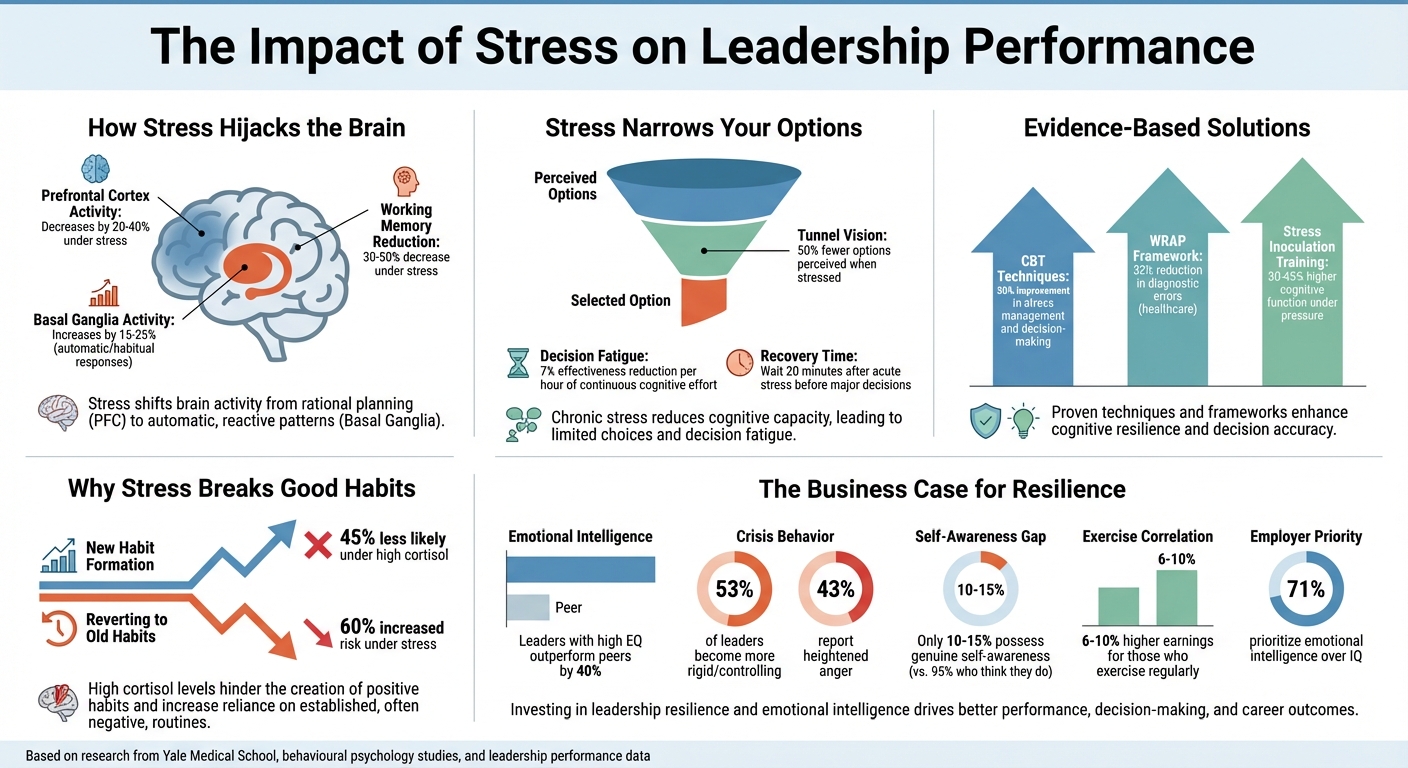
How Stress Impacts Leadership Performance: Key Statistics on Cognitive Function and Decision-Making
Improving Decision-Making Under Pressure
Leaders often face significant challenges when making decisions under stress, as the brain’s natural responses can hinder clear thinking. Stress activates the amygdala and triggers cortisol release, reducing working memory capacity by 30–50%. This phenomenon, sometimes referred to as "cognitive hijacking", explains why even highly skilled leaders may falter during crises.
As Amy Arnsten from Yale Medical School explains:
"The prefrontal cortex - the very region we most need during complex decision-making - is precisely the brain region most vulnerable to stress".
To counteract this, structured decision-making frameworks, such as the SPEAR method (Stop, Perspective, Evaluate, Act, Reassess) and the WRAP approach (Widen options, Reality-test assumptions, Attain distance, Prepare to be wrong), can help leaders navigate high-pressure situations. These methods disrupt stress-driven reactions and broaden focus, addressing the common issue of tunnel vision - where individuals perceive around 50% fewer options when stressed.
For decisions requiring prompt action, the 70% Solution offers a practical guideline: once a leader has 70% of the information and 70% confidence, they should act rather than waiting for perfect clarity. This principle, rooted in military psychology, helps prevent decision paralysis in uncertain situations. Additionally, delaying irreversible decisions during the acute stress response allows the prefrontal cortex to recover.
Decision fatigue, another challenge, reduces effectiveness by approximately 7% for every hour of continuous cognitive effort. Leaders can mitigate this by prioritising critical decisions in the morning ("morning loading") and using Decision Triage to categorise choices into three levels: immediate (minutes), urgent (hours), and important (days), ensuring appropriate effort is allocated.
Gary Klein, a psychologist specialising in decision-making, highlights the value of experience:
"Experienced decision-makers don't generate and compare options. They use their experience to identify a workable solution and move forward".
This Recognition-Primed Decision (RPD) Model explains why seasoned leaders often rely on pattern recognition rather than exhaustive analysis in time-sensitive scenarios. Structured approaches like WRAP have been shown to reduce diagnostic errors by 32% in healthcare settings, while stress inoculation training can preserve 30–45% higher cognitive function under pressure compared to untrained individuals.
Maintaining Emotional Discipline
Emotional discipline is a cornerstone of effective leadership, particularly in high-stakes situations. With 71% of employers now prioritising emotional intelligence over IQ in leadership roles, the ability to manage emotions has become critical. Leaders with strong emotional intelligence outperform their peers by over 40% in areas such as coaching, engagement, and decision-making.
However, genuine self-awareness is rare - only 10–15% of people possess it, despite 95% believing they do. This gap becomes especially problematic during crises, when 53% of leaders tend to become more rigid and controlling, and 43% report heightened anger. These behaviours are linked to the brain's three states: Ventral Vagal (calm and connected), Sympathetic (mobilised and anxious), and Dorsal Vagal (shutdown and numb).
Practical tools can help leaders maintain the optimal Ventral Vagal state. Cognitive reframing, for instance, shifts the brain’s perspective on stress - reframing a challenge as an opportunity can redirect processing from a threat-focused to a solution-focused mindset. Similarly, labelling emotions with precision (e.g., "I’m frustrated about the timeline" instead of just "stressed") engages the rational brain, reducing emotional intensity.
Nancy Koehn of Harvard Business School highlights Abraham Lincoln’s approach to emotional discipline:
"One of the things Lincoln cultivated in high-stakes situations was to do nothing in the moment... the higher the stakes, the less likely he was to do anything".
This deliberate Lincoln Pause allows time for the prefrontal cortex to re-engage, preventing impulsive decisions. The 4C Model of Mental Toughness - Control (focusing on what can be influenced), Commitment (sticking to habits), Challenge (seeing pressure as growth), and Confidence (trusting one’s abilities) - offers a framework for developing emotional resilience.
Leaders who regulate their emotions effectively also influence their teams. A leader’s calm presence and steady tone can stabilise their team’s nervous systems, fostering a sense of psychological safety. This ripple effect often determines whether a team thrives under pressure or fractures.
Developing Adaptive Leadership Behaviours
Adaptive leadership is essential for navigating unexpected challenges. When stress triggers a "Red Brain" state - marked by reactivity and defensiveness - leaders lose access to strategic reasoning. The Mindshifting technique (Catch and Calm) trains leaders to recognise this state and implement interventions to return to "Green Brain" functioning.
The Growth Index, which measures the ratio of DHEA (a resilience hormone) to cortisol, serves as a biological marker of this shift. Ashley Leach, founder of Leda, explains:
"When the Growth Index is low (high cortisol, low DHEA), you tip into what we call a Red Brain state. Reactive. Defensive. Unable to think strategically".
Leaders can influence this ratio by reframing stress as beneficial rather than harmful, which boosts DHEA production and enhances focus. This approach, grounded in neurobiology, is supported by findings that regular exercise - known to improve resilience - correlates with 6–10% higher earnings compared to sedentary individuals.
The 10% Rule encourages leaders to focus on controllable factors, avoiding the paralysis of trying to manage everything simultaneously. Implementation intentions - pre-planned responses to stress - further automate resilient behaviours.
Organisations are increasingly adopting these principles. For example, John Lewis partnered with the Behavioural Insights Team to expand applicant pools by 50% using behavioural science interventions. Lloyds Banking Group introduced a wellbeing framework for executives, providing round-the-clock access to mental health coaching. Nike has incorporated mindfulness and resilience training into its leadership development programmes.
The Resilience Paradox remains a key issue: under pressure, leaders often neglect sleep and exercise, which are critical for managing stress effectively. Treating these habits as "performance essentials" rather than optional extras helps break this cycle. As executive coach Edwin Eve puts it:
"Resilience is not about heroics or simply 'toughing it out'. It's about understanding how stress really works in the body, then deliberately building the psychological capacities that allow you... to navigate challenge".
Case Studies: Behavioural Psychology in Practice
These examples highlight how applying behavioural psychology techniques can lead to measurable improvements in leadership resilience under stress.
Leadership Transformation Through Emotional Discipline
One case involved a Chief Financial Officer at a global technology firm navigating a high-pressure Series A fundraising round during a period of market volatility. Her heightened stress responses were negatively affecting investor meetings. A tailored intervention was introduced, focusing on composure rituals and communication strategies to improve clarity and reduce reactive tendencies. Key elements included recognising physical stress signals - such as shallow breathing and chest tightness - and reframing investor scrutiny as a collaborative process. Within three months, the firm saw stabilisation in valuation, smoother board interactions, and a successful funding round closure.
In another instance, a Chief Operating Officer at a FTSE 250 company in London recovered from the fallout of a failed transformation initiative that had damaged his credibility with the board. Using behavioural psychology techniques, he tackled automatic stress responses that had been limiting his decision-making capacity. By refining how he framed decisions and regaining control of the narrative, he restored confidence among peers and staff. Within six months, he was reappointed to lead the next phase of transformation. These cases underline how emotional discipline can strengthen leadership under pressure.
Building Resilience Through Foresight
Behavioural psychology doesn't just benefit individual leaders - it can also help teams and organisations adapt to challenges. For example, a UK Fire and Rescue Service responsible for safeguarding 500,000 residents faced resistance to operational changes within its Senior Leadership Team. By employing a Behavioural Science Framework, which included Target Behaviour Mapping to pinpoint specific behaviours needing adjustment, the team shifted its focus to actionable strategies. This approach led to greater clarity in leadership and significant improvements in operational strategy.
Similarly, a London-based media agency undergoing a merger implemented a shared behavioural framework to enhance composure and decision-making discipline across its leadership team. By addressing behavioural patterns that fuelled inter-departmental conflicts, the framework accelerated decision-making processes and ensured a smooth merger. Within three months, the agency exceeded industry benchmarks, retaining key talent and achieving operational alignment. These examples illustrate how behavioural psychology principles can drive organisational resilience and adaptability.
Conclusion: Building Stress Resilience Through Behavioural Psychology
Practical Takeaways for Leaders
Stress resilience is about understanding and managing your nervous system's reactions. The strategies discussed here provide a practical framework for leaders to stay composed and make sound decisions under pressure.
Start with the "Catch and Calm" method to interrupt the "Red Brain" response, which often leads to reactive decision-making. When facing overwhelming challenges, apply the 10% Rule by focusing on the aspects of the situation you can control. Before critical meetings, adopt composure rituals such as controlled breathing or structured communication techniques to help transition your nervous system into a calm, focused state.
Physical habits play a pivotal role. Regular exercise not only enhances stress management but is also linked to a 6–10% increase in earnings. However, under intense pressure, leaders frequently sacrifice essentials like sleep, exercise, and proper nutrition, which undermines their resilience. Overcoming this "resilience paradox" requires treating these habits as non-negotiable priorities.
A leader's physiological state also impacts their team. Maintaining a composed and steady presence doesn’t just improve personal decision-making - it also fosters a sense of psychological safety within the team. This stability enables others to perform effectively, even in high-pressure environments.
These strategies provide a foundation for leaders to build resilience that is both practical and sustainable.
How Bespoke Leadership Advisory Supports Resilience
Generic wellness programmes often fail to address the nuanced behavioural patterns that affect leadership effectiveness. Bespoke advisory services, such as House of Birch, take a more tailored approach to strengthening resilience. They go beyond superficial interventions, focusing instead on identifying the specific reactive tendencies and interpretive patterns that can undermine a leader’s authority during critical moments, such as M&A negotiations or investor discussions.
FAQs
How can I identify my main stress triggers at work?
To pinpoint what causes stress at work, start by observing the situations or factors that regularly make you feel uneasy or overwhelmed. These might include things like strict deadlines, demanding expectations, or difficult interactions with colleagues. Take note of emotional reactions such as irritation or worry, and look for recurring patterns in specific tasks or workplace settings. Identifying these stressors is an important first step in applying principles from behavioural psychology to strengthen your resilience.
Which resilience technique works fastest in a crisis?
The fastest way to build resilience during a crisis is through emotional regulation. This includes techniques like cognitive reframing - changing how one interprets a challenging situation - and setting clear boundaries to manage stress effectively. Practical behaviours, such as reaching out for support and bouncing back after setbacks, are key components. These abilities aren’t innate but can be cultivated through focused training and strong leadership backing, helping individuals stay composed and flexible when faced with high-pressure scenarios.
How can I stay resilient when I can’t control the situation?
Resilience in situations beyond one’s control stems from concentrating on internal responses rather than external events. Insights from behavioural psychology suggest practices such as emotional regulation, cognitive reframing, setting clear boundaries, and actively seeking support. Accepting emotions as they arise and shifting perspectives can help maintain a sense of balance. By focusing on how you react and behave, it becomes possible to navigate stress and uncertainty with greater composure, building emotional strength and flexibility - skills particularly vital for effective leadership.

