5 Behavioural Pathways Linking Personality to Leadership
Personality traits influence leadership effectiveness through observable behaviours, shaping how leaders are perceived and how they perform under pressure. This article explores five key pathways linking personality to leadership success, grounded in behavioural science and leadership research:
- Extraversion drives task-focused actions, helping leaders achieve goals and coordinate teams effectively.
- Task-focused behaviour enhances perceptions of assertiveness, a critical trait for leadership, though balance is essential to avoid being overly aggressive or passive.
- Agreeableness fosters member-focused behaviour, enabling leaders to build strong relationships and prioritise team well-being.
- Member-focused behaviour strengthens perceptions of trust, which is fundamental to team cohesion and long-term influence.
- Emotional stability equips leaders to remain calm and resilient, particularly in high-pressure situations, ensuring clarity and effective decision-making.
These pathways emphasise how personality traits translate into leadership outcomes through deliberate behaviours. While genetics play a role, leadership capacity is primarily shaped by experience, training, and purposeful development. Leaders can refine these behaviours to align their traits with effective leadership practices.
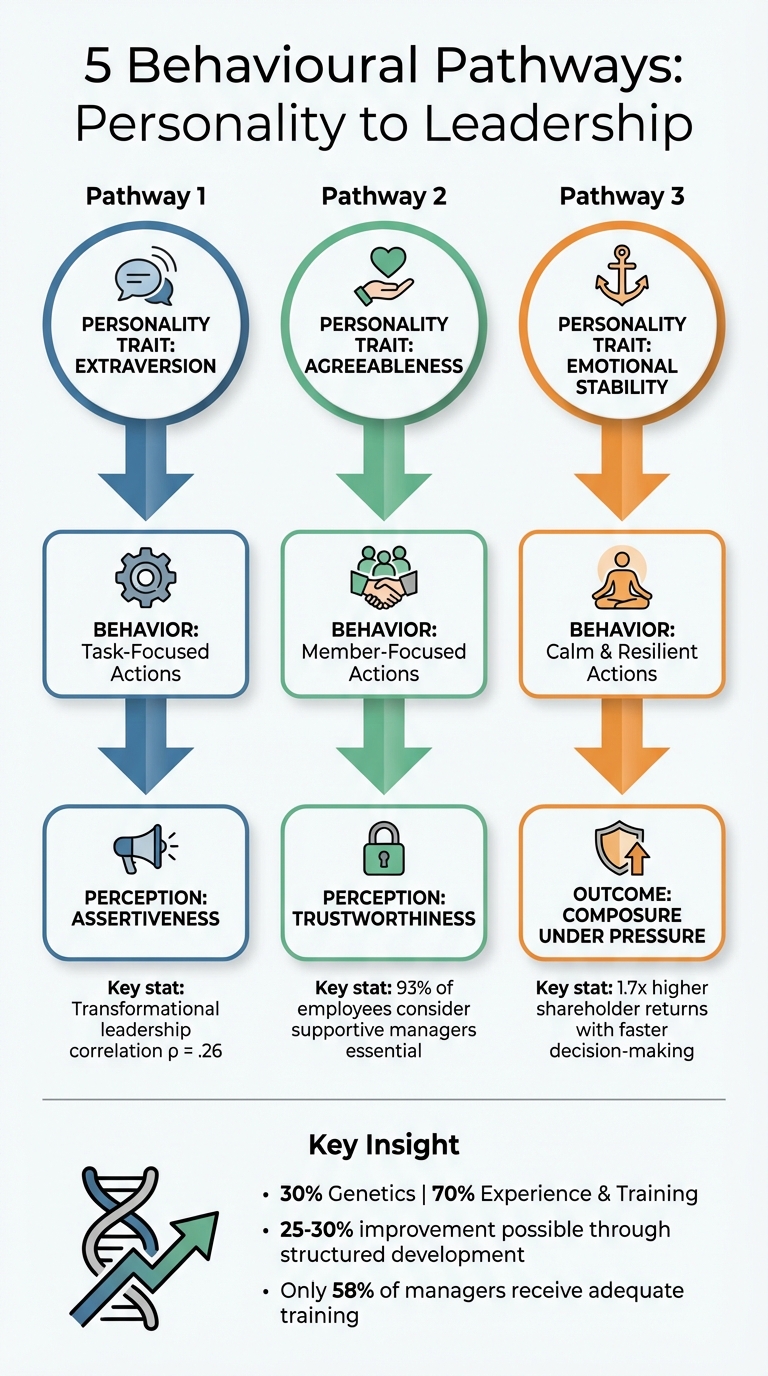
5 Behavioral Pathways Linking Personality Traits to Leadership Effectiveness
1. Extraversion Increases Task-Focused Behaviour
Extraversion stands out as the most reliable Big Five trait for predicting leadership, largely due to its agentic qualities - such as assertiveness, dominance, and a focus on achieving goals.
These agentic traits naturally translate into task-focused actions. Extraverts tend to push teams towards achieving objectives, often stepping into informal leadership roles. They bring structure to tasks and coordinate efforts with energy and confidence. This drive is rooted in their biology, as their dopamine systems are highly responsive, motivating them to seek social rewards and status.
Interestingly, research highlights two distinct facets of extraversion. The agentic side is strongly linked to transformational leadership (ρ = .26) and leadership effectiveness (ρ = .31). On the other hand, the affiliative side - characterised by warmth and sociability - shows no connection to transformational leadership and is even negatively associated with leadership effectiveness. Leadership success stems from assertiveness and goal orientation rather than mere sociability.
"Extraversion was more important to leadership emergence due to impressions of assertiveness evoked by task‐focused behaviour being strongly valued." - Tobias M. Härtel, Osnabrück University
Crucially, task-focused behaviour isn't exclusive to those naturally high in extraversion. Research suggests that individuals lower in extraversion can adopt 'state extraversion' when the situation demands it. By deliberately displaying assertive, bold, and action-oriented behaviours, people can enhance their leadership presence, regardless of their baseline personality traits.
sbb-itb-ce676ec
2. Task-Focused Behaviour Strengthens Perceptions of Assertiveness
Leaders who prioritise task-focused behaviour often shape how others perceive their assertiveness. Actions such as setting clear objectives, structuring processes, and tracking progress send a strong message: this is someone capable of taking charge and driving results. These behaviours align closely with the assertive tendencies often associated with extraversion.
Task-oriented leadership communicates both dominance and competence - qualities that researchers identify as central to "agency." Evidence from a study involving 364 participants in group settings highlights how task-focused actions leave a stronger impression of assertiveness than any other leadership trait.
However, assertiveness is a delicate balance. An analysis of nearly 1,000 coworker comments revealed that "assertive" was the most frequently mentioned descriptor in feedback about leadership weaknesses. Interestingly, opinions were nearly evenly split: 48% criticised leaders for being "too assertive", while 52% felt they were "not assertive enough". Professor Daniel Ames of Columbia Business School summarised this challenge:
"When leaders get assertiveness wrong, it's glaring and obvious, but when they get it right, it seems to disappear." - Daniel Ames, Professor, Columbia Business School
Ames also noted the potential consequences for leaders who lack assertiveness:
"Aspiring leaders who are low in assertiveness can't stand up for their interests, and they suffer by being ineffective at achieving goals and delivering results." - Daniel Ames, Professor, Columbia Business School
To navigate this fine line, leaders must ensure their task-focused actions project consistent and goal-oriented assertiveness without crossing into aggression. Research suggests that up to 40% of the well-being underpinning assertive behaviour can come from intentional practice. This means that leaders, regardless of their natural tendencies, can improve how they signal assertiveness through deliberate and sustained effort.
3. Agreeableness Encourages Member-Focused Behaviour
Agreeableness, marked by traits like empathy, cooperation, and care for others, often leads to leadership that prioritises team members' well-being. Leaders with this quality build strong relationships, creating environments where individuals feel valued, heard, and psychologically secure. This approach shifts the focus from tasks to relationships, blending empathy with effective leadership.
Professor Randall Peterson from London Business School highlights this:
"Agreeableness goes far deeper than being pleasant or easygoing. It encompasses the ability to collaborate effectively, empathise with diverse viewpoints, and foster strong, harmonious relationships." - Randall Peterson, Professor, London Business School
The benefits of agreeableness extend beyond interpersonal harmony. Research supports its role in enhancing team dynamics and morale. A longitudinal study involving 648 male military personnel revealed that leaders with agreeable traits and cohesive teams at the start of training saw significantly improved well-being among their teams two months later. Meanwhile, fMRI studies have shown that agreeableness is associated with heightened activity in brain regions tied to empathy and social understanding, such as the posterior cingulate cortex.
In practice, member-focused leadership manifests through behaviours like active listening, building consensus, and regularly checking in on team morale. Instead of relying solely on hierarchical authority, these leaders use interpersonal influence - delegating responsibilities meaningfully while providing support where needed.
However, agreeableness must be genuine to be effective. As Cerebral Quotient explains:
"Agreeableness isn't about being nice for the sake of approval. It's about fostering genuine human connection through empathy, trust, and emotional presence. It's about choosing compassion, not compliance." - Cerebral Quotient
Leaders must differentiate between authentic agreeableness, rooted in genuine care, and people-pleasing, which stems from a fear of rejection and can lead to burnout. When practised authentically, agreeableness aligns personality with sustainable leadership success.
For leaders seeking to cultivate these skills, tailored services from House of Birch provide guidance in developing empathetic and authentic leadership approaches.
4. Member-Focused Behaviour Creates Perceptions of Trustworthiness
When leaders demonstrate genuine care for their teams, they cultivate trust that extends beyond mere compliance. This approach underscores how member-focused behaviours can transform personality traits into enduring leadership success. While task-oriented actions may help leaders stand out initially, people-oriented strategies are what truly deepen trust and magnify a leader’s influence. This shift from focusing on tasks to prioritising team members builds on the earlier discussion of agreeableness as a foundational leadership trait.
Research indicates that 93% of employees consider having a supportive manager essential for job satisfaction. However, a gap persists: while 77% of frontline workers value clear communication, only 29% believe their managers possess strong communication skills. This disparity highlights the critical role of trustworthiness in leadership.
Trust is often evaluated through four key dimensions: ability, benevolence, integrity, and consistency. Leaders can cultivate these qualities through actions such as active listening, meaningful emotional check-ins, and inclusive decision-making that genuinely values team input. These behaviours not only enhance team cohesion but also reinforce a leader’s credibility. For instance, the phrase "I'm fine" is reportedly used 14 times a week in workplace conversations, yet it is sincerely meant only 19% of the time. Leaders who probe beyond surface-level responses with thoughtful follow-up questions help establish a culture of psychological safety. This demonstrates how a genuine focus on team members bridges the gap between superficial interactions and authentic connections.
A compelling example comes from Harriet Karia, who became Managing Director at Cuttsy & Cuttsy in July 2025. Embracing a philosophy of openness, she avoided leading solely from her title. Instead, she introduced 'Company Week' workshops to enhance cross-team collaboration and acknowledged areas where she lacked expertise. An internal survey revealed that 77% of employees felt her approach successfully built trust. As Karia explained:
"I didn't want to lead from a title, I wanted to be seen, heard and trusted as myself. That meant being open, asking questions, and acknowledging what I didn't yet know".
Her leadership style illustrates how an authentic focus on team members can foster lasting trust. Conversely, once trust erodes within a team, performance often deteriorates, and rebuilding that trust becomes a formidable challenge. Trust serves as the bridge between inherent personality traits and tangible leadership effectiveness. For leaders operating in high-pressure environments, House of Birch provides tailored support in developing the emotional discipline and social influence necessary for sustained leadership success.
5. Emotional Stability Produces Calm and Resilient Behaviour
Emotional stability, when paired with task-focused assertiveness and trust-building, equips leaders with the calm required to navigate crises effectively. Studies suggest that leaders with emotional stability respond to challenges with composure, which enhances their leadership impact. This is particularly relevant as 42% of executives admit to delaying crucial decisions due to the discomfort of uncertainty, while 32% report experiencing decision paralysis during critical moments.
Such leaders often act as "circuit breakers" for group anxiety, providing what researchers call "affective containment". This involves absorbing stress without passing it onto others, creating a supportive environment that enables teams to think and act clearly. Instead of suppressing emotions, effective leaders manage them, aligning emotional steadiness with assertiveness and trust-building. The benefits of this approach are tangible: organisations with quicker decision-making processes have been shown to achieve 1.7 times higher total shareholder returns over a decade.
Examples from the business world highlight the strategic value of emotional stability. For instance, during the COVID-19 pandemic, Southwest Airlines' CEO maintained transparent communication and upheld a no-layoff policy, which resulted in both market share gains and increased employee engagement. Similarly, Best Buy's CEO transformed challenges into opportunities between 2012 and 2019, leading to a stock price rise of over 330%.
While energetic leaders may initially attract attention, those who can absorb pressure without deflecting it earn enduring respect. As Pinch of Health aptly summarises:
"Confidence gets you in the door. Emotional stability keeps you at the head of the table".
In high-pressure environments, emotional stability becomes a cornerstone of effective leadership. For those seeking to strengthen this quality, House of Birch provides bespoke guidance to help leaders maintain clarity and composure when it matters most.
Conclusion
Leadership is not an innate quality dictated by personality alone. Instead, it evolves through specific behavioural pathways that transform inherent traits into visible actions - actions that, in turn, shape perceptions of competence, trust, and composure. These pathways illuminate not only who rises to leadership but also how they lead effectively.
Research indicates that genetics play a role, accounting for approximately 30% of leadership capability, while the remaining 70% depends on experience, training, and purposeful development. Structured programmes designed to enhance leadership skills can lead to improvements of 25% to 30%. Yet, despite this potential, only 58% of managers receive the training required to excel. This gap underscores the importance of targeted support to unlock latent leadership potential.
The process begins with aligning development efforts to one's natural tendencies. As Laura Bouttell aptly puts it:
"Genetics load the dice but don't determine the outcome".
Leaders who understand their natural inclinations can build on their strengths while intentionally cultivating behaviours that may not come as naturally. For instance, an introverted leader does not need to become extraverted but can instead adopt strategies to navigate high-stimulation environments with confidence.
For leaders facing pivotal decisions, heightened scrutiny, or organisational transformation, House of Birch offers tailored advisory sessions. These sessions focus on identifying behavioural patterns and blind spots while providing frameworks for composure, disciplined decision-making, and social influence. Such bespoke guidance helps leaders refine the behaviours that matter most in critical moments.
The transformation of personality into effective leadership is not a mystery - it is a behavioural-perceptual chain that can be learned, practised, and perfected. The real question is not whether your personality is suited to leadership, but whether you are prepared to develop the behaviours that turn your traits into meaningful influence.
FAQs
Can introverts learn to lead effectively?
Yes, introverts can lead effectively. Leadership requires qualities such as empathy, active listening, and strategic thinking - attributes often associated with introverts. Prominent leaders like Warren Buffett, who identifies as an introvert, demonstrate how these traits can serve as powerful tools. With a supportive environment, targeted development, and the right mindset, introverts can harness their strengths to motivate and steer others successfully.
How do I show assertiveness without seeming aggressive?
To show assertiveness without crossing into aggression, it’s important to combine clear communication with a respectful approach. Speak with confidence but remain calm, steering clear of any confrontational language or behaviour.
Practical strategies include adopting an open posture, maintaining steady eye contact, and using a calm, measured tone. When presenting your points, focus on framing them in terms of shared benefits, and make a genuine effort to listen to others’ perspectives. This approach not only encourages mutual respect but also ensures that your assertiveness contributes to a productive and positive interaction.
What daily habits build trust in a team?
Building trust within a team hinges on consistent behaviours that reflect openness, dependability, and respect. Essential practices include clear and honest communication, delivering on promises, and acknowledging the efforts and achievements of team members. Leaders play a crucial role by cultivating self-awareness and maintaining emotional control, which helps establish a stable and dependable atmosphere. These actions gradually build confidence and deepen connections, allowing trust to develop steadily over time.

