Behavioural Intelligence in Competency Models
Leadership success often depends on translating skills and behaviours into actionable frameworks. Yet, many organisations struggle to bridge the gap between competency models and effective leadership. The missing piece? Behavioural intelligence.
Behavioural intelligence, distinct from IQ and emotional intelligence, focuses on recognising and adjusting to behavioural cues. It enhances decision-making, team alignment, and execution by addressing how leaders behave under pressure. Research highlights its importance: 75% of leadership failures stem from interpersonal skill gaps, while emotionally aware leaders achieve 40% lower turnover rates and 47% higher team innovation.
Key insights:
- Competency models define what leaders must do; behavioural intelligence focuses on how they act.
- Emotional, social, and decision-making skills form the foundation of behavioural intelligence.
- Observable actions, rather than abstract traits, drive leadership development.
Organisations should consider integrating behavioural intelligence into their leadership frameworks to reduce bias, align teams with goals, and improve decision-making under pressure.
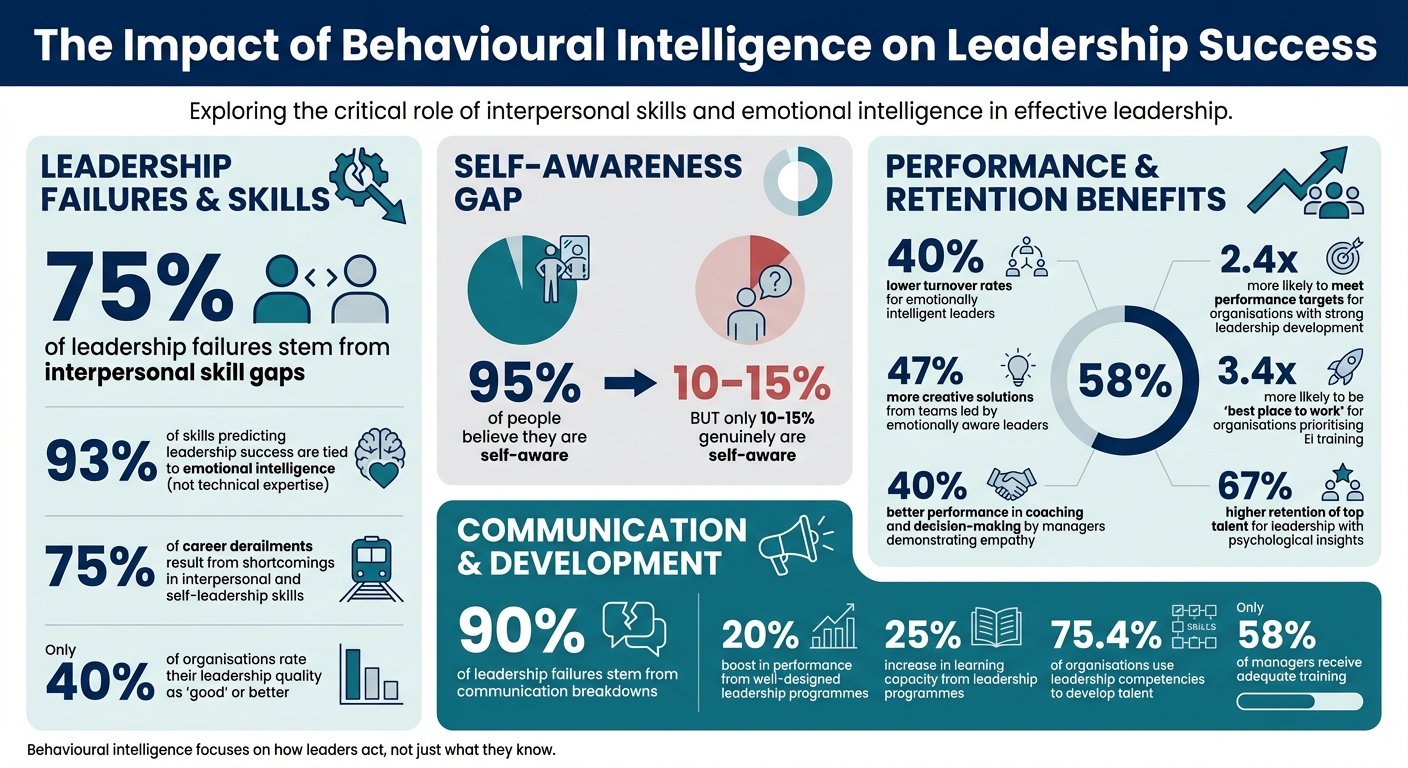
Key Statistics on Behavioural Intelligence and Leadership Success
Dr Charles Cotter_Leadership Behavioural Competencies
sbb-itb-ce676ec
Core Elements of Behavioural Intelligence
Behavioural intelligence revolves around three interconnected domains - emotional, social, and decision-making - that form the backbone of effective leadership.
Emotional Intelligence
At its core, emotional intelligence provides the internal stability essential for behavioural intelligence. It starts with self-awareness, which is the ability to identify emotional triggers and understand how personal emotions impact others. Interestingly, while 95% of people believe they are self-aware, research shows only 10–15% genuinely are. This gap often explains why leaders may misjudge how their actions influence their teams.
The second pillar, self-regulation, refers to managing impulses and staying composed under stress. A simple yet effective technique is "The Pause" - a practice of taking three deliberate breaths before responding to a situation, helping leaders act thoughtfully instead of reacting instinctively. Notably, 93% of the skills that predict leadership success are tied to emotional intelligence rather than technical expertise.
While emotional intelligence fosters internal balance, social intelligence turns that understanding outward, enabling leaders to connect effectively with others.
Social Intelligence
Social intelligence focuses on social awareness - the ability to gauge the emotional atmosphere within a team or organisation - and relationship management, which involves influencing, resolving conflicts, and building trust without over-relying on formal authority . For instance, managers who demonstrate empathy tend to perform over 40% better in areas like coaching and decision-making.
Emotionally intelligent leadership doesn’t just improve individual performance - it also transforms teams. Teams led by emotionally aware leaders experience 40% lower turnover rates and are far more innovative, with psychologically safe environments producing 47% more creative solutions. By navigating social dynamics effectively, leaders create "resonance", a state where teams feel aligned and motivated.
These social skills feed directly into decision-making, equipping leaders to integrate emotional and analytical insights when making choices.
Decision-Making Behaviours
Decision-making behaviours blend emotional and social intelligence to guide informed and balanced choices. This involves collecting relevant data, recognising emotional biases, and combining analytical thinking with human insight . Successful leaders understand not just the numbers but also the behavioural factors that influence how data is interpreted.
The consequences of poor decision-making are stark. Research indicates that 75% of career derailments stem from shortcomings in interpersonal and self-leadership skills, rather than gaps in technical knowledge. To counteract this, effective decision-makers actively seek input from diverse perspectives and make a conscious effort to identify and challenge the assumptions underlying their options. Such structured methods are especially valuable in high-pressure situations, where reactive tendencies can easily dominate.
Building Behavioural Intelligence into Competency Models
Incorporating behavioural intelligence into competency models demands a deliberate strategy that connects leadership behaviours to specific organisational goals. The process starts with strategic alignment, ensuring the framework aligns with the organisation's key objectives and values. This guarantees that each behavioural indicator directly supports the organisation's broader aims.
To pinpoint behaviours that set exceptional leaders apart, organisations should gather insights from high performers through 360-degree interviews. These interviews, involving managers, peers, and direct reports, can help identify critical behaviours. Targeted questions - such as "Who do you collaborate with most?", "How often do you face deadlocks?", or "What is your planning timeframe?" - can uncover around 30 key behaviours spanning five to eight dimensions. These behaviours should then be grouped into broad categories like "Developing Others" or "Driving Results", with three to six clear, observable behaviours under each category.
Identifying Behavioural Indicators
Effective behavioural indicators are specific, observable, and measurable. For instance, "Asks clarifying questions" is far more actionable than a vague descriptor like "communicates well." Indicators should include both positive actions and warning signs. For example, a leader who "consults relevant stakeholders for input" demonstrates sound decision-making, while one who "makes decisions without consulting those with expertise" signals potential issues.
To keep the framework manageable, limit the total number of behaviours to fewer than 48. This ensures that employees can focus on the behaviours, and HR professionals can implement the model without being overwhelmed.
"Leadership capability develops through deliberate practice of specific behaviours - not through understanding concepts alone."
Laura Bouttell, writing for Quarterdeck, highlights the importance of actionable, practice-based indicators.
Structuring Proficiency Levels
Proficiency levels should reflect how leadership behaviours evolve with experience. Emerging leaders may concentrate on mentoring peers and sharing their expertise. Middle managers might focus on creating structured development plans and advocating for high-potential employees. Senior executives, on the other hand, are expected to prioritise building leadership capacity across the organisation. This progression - from focusing on "Self" to "Team" to "Organisation" - clarifies what excellence looks like at each stage of leadership.
For example, in the category of "Developing Others", a novice might give occasional feedback, while an expert would design tailored development plans that align with individual career goals. This kind of differentiation helps organisations identify readiness for promotion and pinpoint areas for development. Research shows that participants in well-designed leadership programmes can boost their performance by 20% and their capacity for learning by 25%.
This structured progression naturally shapes how leaders develop their core competencies, as outlined below.
Application in Leadership Competencies
Behavioural intelligence plays a vital role across leadership competencies. In decision-making, for instance, a novice might focus on "gathering relevant data", while an expert would "take accountability for high-stakes outcomes and clearly explain complex reasoning". For adaptability, a proficient leader might "adjust their approach based on new information", whereas a concerning behaviour would be "sticking to outdated methods despite evidence they are ineffective".
In conflict resolution, effective behaviours include staying composed under pressure and coaching team members to tackle challenges independently, rather than stepping in to solve problems for them. To embed these frameworks sustainably, organisations should integrate them into existing processes such as performance evaluations, 360-degree feedback, succession planning, and recruitment. Typically, embedding these frameworks into an organisation's culture takes 18–24 months.
How Behavioural Intelligence Improves Leadership Decisions
Behavioural intelligence plays a crucial role in refining leadership decisions, particularly when integrated into competency frameworks. Leaders who apply behavioural intelligence effectively can navigate high-stakes environments with greater accuracy, minimising errors and fostering alignment within their organisations. This shift from theory to practice focuses on three key areas: reducing bias, aligning teams with strategic objectives, and influencing teams to deliver results.
Reducing Bias in Decisions
Behavioural intelligence equips leaders with the tools to recognise and address unconscious biases - those mental filters that shape how they perceive, think, and act. These biases can create blind spots, distorting judgement. Leaders with strong emotional intelligence can identify their own moods and assumptions, understanding how these factors influence their decisions and their teams’ dynamics. This self-awareness enables them to step back and challenge their own perspectives before committing to a decision.
"The most consequential leadership failures I've witnessed weren't from lack of knowledge or analytical horsepower... They stemmed from dimensional intelligence gaps - blind spots in how leaders process and respond to different aspects of their complex environments."
– Dr. Michael Williams, Co-founder, Global Coach Cooperative
Analytical intelligence further supports this process by helping leaders assess competing ideas objectively, while self-regulation ensures emotions do not override rational thinking in high-pressure situations. Structured reflection techniques encourage leaders to analyse challenges from multiple angles, uncovering hidden biases. Seeking input from diverse groups also strengthens decision-making, as varied perspectives can reveal gaps that might otherwise go unnoticed.
Organisations that prioritise training and mentoring to develop these competencies see tangible benefits. For instance, they are 3.4 times more likely to be recognised as a "best place to work". However, only 40% of organisations currently rate their leadership quality as "good" or better.
By addressing bias, leaders lay the groundwork for stronger alignment with organisational goals.
Aligning Teams with Organisational Goals
Behavioural intelligence bridges the gap between strategic planning and effective execution by helping leaders clarify the purpose behind tasks and objectives. The 3A Model - Awareness (understanding behavioural patterns), Alignment (linking traits and roles to goals), and Action (reinforcing behaviours through repetition) - provides a framework for achieving this alignment.
Effective leaders tailor their communication to match team members’ motivational styles. For example, individuals motivated by gains respond better to messages about achievements, while those focused on avoiding losses prefer language that highlights risk mitigation. Adjusting communication in this way reduces resistance and accelerates buy-in.
Research shows that 90% of leadership failures stem from communication breakdowns. Moreover, organisations with leaders who apply psychological insights are 67% more likely to retain top talent. By assigning roles that align with team members’ behavioural strengths - such as placing high-initiative individuals in creative roles and those with a preference for structure in operational tasks - leaders ensure everyone contributes effectively to the broader strategy.
Once teams are aligned, behavioural intelligence empowers leaders to drive performance more effectively.
Influencing Teams to Deliver Results
Behavioural intelligence enhances a leader’s ability to inspire commitment and action, especially in high-stakes environments. Leaders who understand their teams’ behavioural preferences can adapt their approach to resonate more deeply. For instance, when guiding a team through organisational change, recognising whether the group favours "sameness" or "change" allows leaders to tailor their strategy to minimise anxiety and build confidence incrementally.
Emotional intelligence plays a pivotal role here, accounting for 58% of job performance across industries. Leaders who demonstrate empathy by acknowledging concerns before presenting their own views build trust and create psychological safety - key factors for sustained performance. Coaching, rather than instructing, helps team members grow and leverage their strengths effectively.
"The easy way to lead is to tell people what to do, but then they don't need to think on their own. Coaching allows people to develop in a meaningful way."
– Susie Tomenchok, Executive Coach, Syndeo Institute
Practical routines, such as "Monday Morning Huddles" for shared learning or "Focused Ideation Blocks" with structured templates (problem → idea → prototype), help maintain momentum and reinforce priorities. Leaders who practise self-regulation - pausing before reacting and maintaining composure during challenges - set a stabilising example for their teams. Notably, organisations with strong leadership development programmes are 2.4 times more likely to meet their performance targets.
House of Birch: Developing Leaders Through Behavioural Intelligence
For leaders navigating high-stakes environments where decisions carry weighty consequences, House of Birch offers bespoke advisory services that embed behavioural intelligence into leadership development. This approach draws on neuroscience, behavioural psychology, and cognitive science, focusing on three core elements: Clarity (strategic foresight), Control (emotional discipline), and Connection (influence and trust). Each engagement is tailored to the leader’s unique challenges - whether managing mergers, handling investor relations, or steering through pivotal organisational moments. This method demonstrates how behavioural insights can integrate seamlessly into leadership competency frameworks.
The following examples illustrate how House of Birch transforms this approach into actionable leadership strategies.
1:1 Leadership Advisory
House of Birch serves as a discreet partner for leaders shaping organisations, industries, and even nations. Through one-on-one sessions, leaders refine their behavioural intelligence to make sharper decisions and elevate their executive presence. These engagements focus on tangible, observable actions rather than abstract goals, ensuring measurable effectiveness. For instance, during a bespoke engagement in London in 2025–26, House of Birch guided executives through "Building Executive Alignment During M&A", leveraging behavioural intelligence to foster leadership cohesion during a critical corporate merger.
"I build individuals who are emotionally disciplined, strategically intelligent, socially dominant, and unshakeable under pressure."
– Tommy Birch, Founder, House of Birch
Beyond individual coaching, House of Birch strengthens leadership capabilities with focused training programmes.
Emotional Discipline and Strategic Foresight Training
Training modules are designed to help leaders regulate emotions and plan strategically, enabling them to maintain composure and authority in high-pressure scenarios. For example, in Herzliya, Israel, and Silicon Valley, US, House of Birch provided advisory services under the banner "Stabilising Executive Composure in Investor Relations." These sessions emphasised emotional discipline as a key to earning and maintaining investor trust. This aligns with findings that 75% of career derailments stem from gaps in interpersonal and self-leadership skills, such as managing emotional reactions.
Tailored Competency Frameworks
House of Birch develops competency models built around the principles of Clarity, Control, and Connection. These frameworks are designed to transform potential into performance during critical moments like mergers or investor negotiations. By incorporating specific behavioural indicators and proficiency levels, the frameworks are customised to suit each leader’s unique context. This approach reflects research showing that while 75.4% of organisations use leadership competencies to develop talent, only 58% of managers receive adequate training to master them. This tailored methodology underscores the importance of turning behavioural insights into practical, measurable leadership tools.
"Every engagement is bespoke and discreet, designed to sharpen your decision-making, amplify your presence, and maximise your influence, turning high potential into high performance in the moments that truly matter."
– House of Birch
Conclusion
Behavioural intelligence transforms abstract leadership theories into tangible, measurable actions that directly influence performance. By focusing on how leaders behave - rather than solely on what they know - organisations can establish clear, observable criteria for leadership development. For example, behaviours like "seeking input before making key decisions" or "paraphrasing to confirm understanding" replace subjective evaluations with concrete evidence. This approach is crucial, as while 75.4% of organisations use leadership competency frameworks to nurture talent, the persistent gap between knowledge and action continues to hinder real progress.
The importance of behavioural intelligence is underscored by key statistics: emotional intelligence accounts for 58% of workplace performance, and informed leadership improves talent retention by 67%. Conversely, 75% of career failures stem from deficits in interpersonal skills - precisely the area where behavioural intelligence provides a critical advantage. Leaders who can manage their emotions under pressure, accurately interpret team dynamics, and adapt their strategies to different situations not only make smarter decisions but also create high-performing environments where teams thrive and deliver on objectives.
"Business Intelligence gets you a plan. Behaviour Intelligence gets you execution, engagement, and growth. You need both."
– Nagui Bihelek, Founder, Behaviour Intelligence Institute
The practical value of behavioural intelligence is evident. For instance, in May 2025, a business redefined its team roles from 'operations' to a 'sales engine,' leading to the breakthrough of its £1 million revenue barrier. This example illustrates how embedding behavioural insights into leadership frameworks can drive measurable success and sustained organisational growth.
FAQs
What is behavioural intelligence in leadership?
Behavioural intelligence in leadership refers to the skill of understanding, interpreting, and shaping social interactions by recognising both one’s own behaviours and those of others. This ability supports better decision-making, emotional self-control, and effective social influence. Core competencies include creating positive first impressions, mastering non-verbal communication, and building trust. Leaders who excel in behavioural intelligence are better equipped to handle complex situations, encourage teamwork, and achieve organisational goals through thoughtful and emotionally balanced strategies.
How is behavioural intelligence different from emotional intelligence?
Behavioural intelligence revolves around grasping and influencing social interactions by observing, interpreting, and adjusting behaviours to suit different contexts. It involves skills such as managing impressions, anticipating how others might react, and handling social dynamics with precision. In contrast, emotional intelligence zeroes in on identifying, understanding, and regulating emotions - both personal and those of others - to foster better relationships. While emotional intelligence prioritises emotional awareness, behavioural intelligence extends to include broader social capabilities, such as exerting strategic influence and navigating social hierarchies effectively.
How can we measure behavioural intelligence in a competency model?
Measuring behavioural intelligence focuses on pinpointing visible actions that demonstrate essential leadership abilities. The process begins with clearly defining behaviours tied to broader competencies, allowing for systematic evaluation. Common approaches include 360-degree feedback, behavioural interviews, and performance simulations. These methods assess how often, how consistently, and how effectively these behaviours occur, ensuring they align with leadership objectives such as decision-making, emotional control, and social influence.

