Availability Heuristic in Political Leadership
The availability heuristic influences decision-making by prioritising recent, striking, or emotionally charged events over broader, less memorable data. This mental shortcut helps leaders make quick decisions under pressure but often leads to biased judgments. Political leaders, in particular, face unique challenges as they interpret ambiguous public sentiment and voter behaviour, frequently relying on vivid anecdotes rather than statistical evidence. This can distort perceptions of risks, policies, and public priorities, especially when information overload exacerbates reliance on easily recalled examples.
Key takeaways:
- What it is: The availability heuristic is a cognitive bias where decisions are influenced by information that is easiest to recall, often recent or emotionally impactful.
- Why it matters: In politics, this bias can lead to flawed policies, overreactions to isolated events, and misjudged public sentiment.
- Broader impact: Similar patterns are seen in business, finance, and military decisions, where vivid events overshadow systematic analysis.
- Mitigation strategies: Leaders can counteract this bias by adopting structured, evidence-based decision-making frameworks, challenging assumptions, and consulting objective advisors.
Political leaders should reflect on how this bias shapes their decisions and consider strategies to reduce its influence, ensuring choices are grounded in balanced and well-analysed evidence.
The Availability Heuristic (Intro Psych Tutorial #92)
sbb-itb-ce676ec
How the Availability Heuristic Influences High-Stakes Decisions
The availability heuristic shapes decisions by favouring information that is easiest to recall. This ease of recall is influenced by three main factors: recency, vividness, and salience. Recent events tend to linger in our minds, emotionally intense experiences leave lasting impressions, and striking or dramatic occurrences stand out against everyday experiences. These tendencies are deeply rooted in how the brain processes information.
The amygdala, a key part of the brain involved in processing emotions, plays a central role in reinforcing memories of such events, making them more accessible during decision-making. As Amos Tversky and Daniel Kahneman observed, this mechanism reflects an evolutionary adaptation, blending swift decision-making with certain inherent flaws:
"Lifelong experience has taught us that instances of large classes are recalled better and faster than instances of less frequent classes, that likely occurrences are easier to imagine than unlikely ones, and that associative connections are strengthened when two events frequently co-occur".
While this approach allows for quick judgements, it can lead to biased conclusions. The brain often equates the ease of recall with frequency, meaning events that are easier to remember or imagine are assumed to be more common.
For political and corporate leaders, this bias can distort perceptions and decision-making. For instance, political leaders may overestimate the likelihood of risks such as natural disasters or geopolitical crises when recent, high-profile events dominate their thinking. Similarly, corporate leaders might overemphasise recent market fluctuations or memorable performance reviews when making critical investment or hiring decisions. In both arenas, stress exacerbates the reliance on such mental shortcuts, as high-pressure situations limit the ability to thoroughly evaluate all available information. This can lead to overreactions or misjudgements, particularly in scenarios requiring long-term strategic thinking.
1. Political Leadership
Impact on Decision-Making
Political leaders often rely on mental shortcuts, such as the availability heuristic, to navigate the constant flood of dramatic events and data they face daily. This heuristic, which prioritises vivid and easily recalled events over abstract statistics, plays a significant role in shaping their decisions under time pressure.
A study conducted in Chile between 15 March 2022 and 15 May 2022 highlights the extent of this bias. The research involved 300 elected officials, including mayors, councillors, and members of the National Congress, and revealed that these leaders frequently favoured anecdotal evidence over statistical data when evaluating public services and policies. Interestingly, their cognitive patterns mirrored those of a control group comprising 1,325 ordinary Chilean citizens, indicating that political expertise does not shield individuals from this cognitive bias.
The implications of this bias are far-reaching. Michael Cohen from the Australian National University explains:
This heuristic enables leaders to deal with the vast amount of extant information but also can cause systematic biases in causal inference.
Leaders often misattribute outcomes to specific individuals rather than recognising systemic or societal factors, which distorts their understanding of complex policy issues. This tendency to oversimplify causes significant challenges in political analysis and decision-making.
Role of Information Overload
The overwhelming volume of political information further exacerbates these biases. Leaders must sift through an endless stream of briefings, reports, and constituent concerns, often gravitating towards information that is emotionally resonant or easier to recall.
Research underscores the disparity in how different types of information influence perceptions. Quantitative data loses 73% of its impact within a single day, while the influence of emotionally charged anecdotes declines by only 32% over the same period. This discrepancy means that a single compelling story can overshadow comprehensive data, potentially skewing policy decisions towards the interests of a select few with stronger connections or more striking narratives.
Use of Emotional Influence
Adding to these challenges, political leaders frequently use emotionally charged narratives to simplify complex policy issues. By focusing on vivid, concrete examples rather than aggregate statistics, they tap into the same heuristic that shapes their own decision-making. Episodic information, characterised by its emotional and detailed nature, tends to be more memorable and persuasive.
However, this approach is not without risks. Interest groups and advisers can exploit this bias by presenting carefully curated anecdotes, thereby distorting a leader’s understanding of public priorities. This manipulation can lead to decisions that reflect the interests of a vocal minority rather than the broader needs of the population.
2. Other High-Stakes Environments
Impact on Decision-Making
The biases seen in political leadership are not confined to that sphere - they appear just as prominently in finance, military operations, and corporate decision-making. In financial markets, traders and investors often overestimate potential returns after a single recent success or overreact to a downturn they’ve just experienced. This tendency was a key factor in the 2008 financial crisis, where decision-makers placed undue confidence in the housing market’s recent performance, ignoring broader risks and warning signs.
Military and foreign policy decisions show a similar pattern. Leaders frequently focus on vivid, dramatic events - such as a highly publicised operational failure - rather than relying on thorough strategic analysis. Research by Cohen highlights how this approach can skew perceptions of grand strategy, nuclear policy, and alliances, as decisions become overly influenced by isolated incidents rather than systematic evaluations. These distortions are often exacerbated by the operational pressures inherent to such environments, an issue closely tied to the challenge of information overload.
Role of Information Overload
High-stakes environments, like politics, finance, and emergency response, come with an overwhelming influx of data. This deluge of information amplifies cognitive biases, as leaders under time pressure often resort to mental shortcuts. These shortcuts favour the most readily available information, while alternative or contradictory evidence is overlooked. In fast-paced emergency situations, this heuristic can be a practical advantage, enabling swift decisions when time for deeper analysis is unavailable. However, in corporate contexts, the same mechanism can lead to overly cautious decision-making. For instance, leaders may overemphasise a single project failure, allowing it to overshadow a history of successful outcomes.
Use of Emotional Influence
Emotionally charged memories, prioritised by the brain’s amygdala, tend to dominate decision-making. In recruitment, for example, a single negative experience with a problematic employee can lead decision-makers to view all subsequent candidates through the lens of that one instance. This phenomenon, known as the vividness effect, also causes rare but dramatic events - like plane crashes or economic collapses - to be overestimated in their likelihood. Meanwhile, more frequent but less memorable risks are often underestimated. This imbalance in risk perception can have far-reaching consequences, influencing policies and strategies across various high-stakes domains.
Advantages and Disadvantages
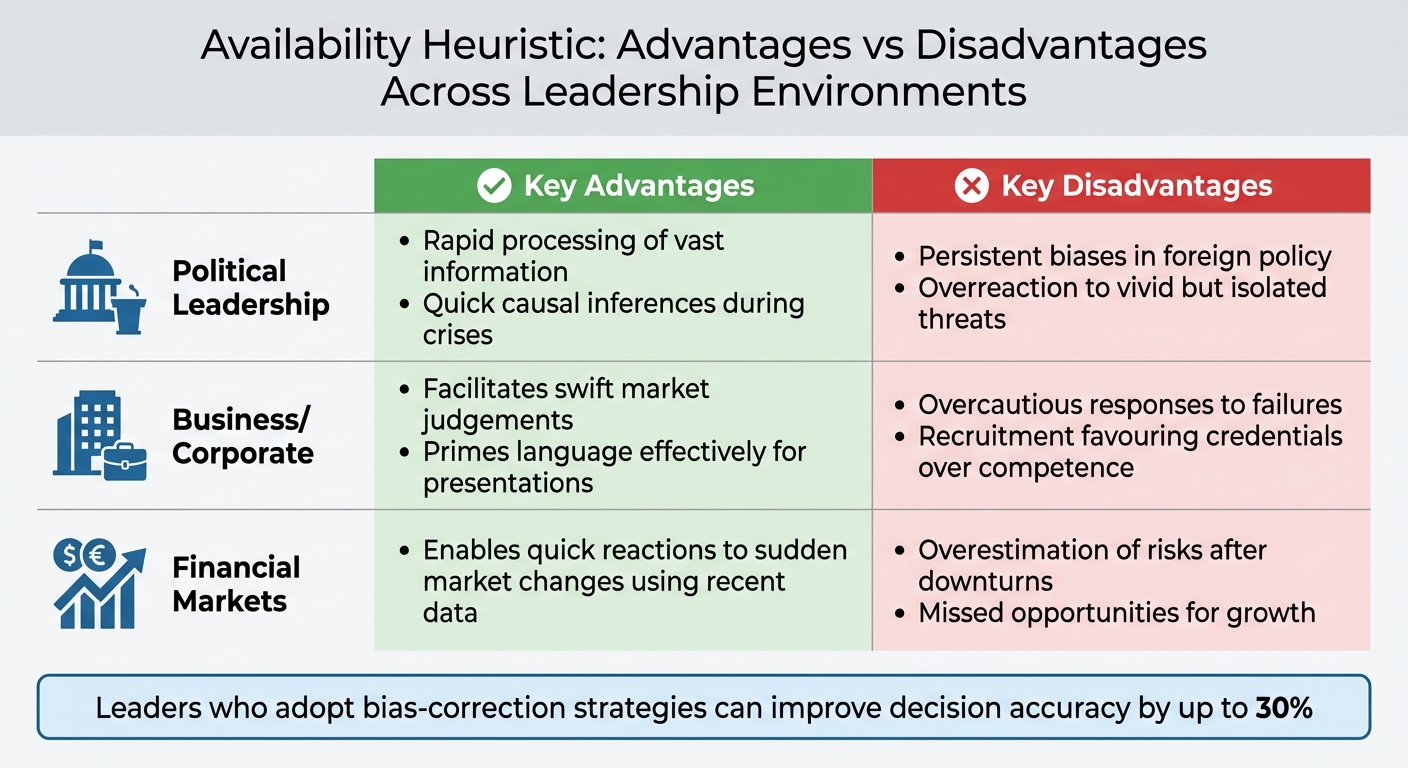
Availability Heuristic Impact Across Leadership Environments
The availability heuristic plays a double-edged role in decision-making, offering speed but at the risk of systematic errors. In political leadership, it allows leaders to make swift causal judgements during high-pressure situations, where time is a critical factor. Research by Cohen highlights this duality: while the heuristic helps leaders manage overwhelming amounts of data during crises, it also skews their perception of causality, often leading to distorted interpretations.
However, the effects of this heuristic vary significantly across different domains. In business and finance, it enables quick decision-making and can be strategically utilised - for example, by presenting key information just before important meetings to influence outcomes. Yet, it also introduces potential pitfalls. Recruitment processes may give undue weight to memorable signals, such as prestigious qualifications, rather than actual competence. Similarly, isolated failures can lead to excessive caution, hindering future risk-taking.
The persistence of bias also differs by context. In politics, biases - particularly in threat perception - can have long-term consequences, such as shaping international security policies in ways that are hard to reverse. Unlike the corrective mechanisms seen in business or medical fields, where feedback loops like profit reports or patient outcomes gradually adjust decision-making, political leaders often lack such clear feedback, allowing flawed beliefs to persist throughout their careers. Studies suggest that leaders who actively adopt bias-correction strategies can improve their decision accuracy by as much as 30%.
| Environment | Key Advantages | Key Disadvantages |
|---|---|---|
| Political Leadership | Rapid processing of vast information; quick causal inferences during crises | Persistent biases in foreign policy; overreaction to vivid but isolated threats |
| Business/Corporate | Facilitates swift market judgements; primes language effectively for presentations | Overcautious responses to failures; recruitment favouring credentials over competence |
| Financial Markets | Enables quick reactions to sudden market changes using recent data | Overestimation of risks after downturns; missed opportunities for growth |
Conclusion
The availability heuristic presents a double-edged sword for political leaders. On one hand, it facilitates swift decision-making during crises by prioritising vivid and immediate information. On the other, it risks distorting judgement by amplifying the influence of memorable events over comprehensive, data-backed analysis. Unlike domains where feedback mechanisms help refine decisions, political contexts - particularly in international security - often suffer from skewed evaluations of threats and policy priorities, with long-lasting and sometimes irreversible consequences.
To mitigate these cognitive challenges, leaders must take deliberate steps to counteract such biases. Research indicates that actively addressing cognitive distortions can enhance decision-making accuracy by up to 30%. Practical strategies include implementing structured, evidence-based approaches, employing red-teaming exercises to challenge assumptions, and systematically reviewing information to reduce reliance on instinctive but flawed heuristics.
The sheer volume of information modern leaders face further compounds these challenges. For instance, 74% of Belgian politicians report feeling overwhelmed by the daily influx of data. This highlights the value of external advisory services, which can function as a "System 2" resource - offering objective, analytical perspectives to complement leaders’ instinctive judgements. Organisations like House of Birch specialise in providing frameworks tailored for high-pressure decision-making, helping leaders identify when dramatic events are disproportionately influencing their thinking and ensuring that decisions align with strategic objectives.
The goal is not to eradicate the availability heuristic but to harness its efficiency while addressing its limitations. By integrating structured methodologies with external expertise, political leaders can navigate complex decisions more effectively, ensuring their choices reflect long-term priorities rather than fleeting emotional responses.
FAQs
How can a leader tell when a vivid story is skewing their judgement?
Leaders may notice this bias when their decisions are swayed by recent, emotional, or particularly memorable examples instead of relying on objective data. This tendency, known as the availability heuristic, often causes individuals to place undue emphasis on such instances, which can skew judgement. Being aware of this cognitive bias is crucial for achieving more balanced and well-informed decision-making.
What quick checks help balance anecdotes with data during a crisis?
To strike a balance between anecdotes and data during a crisis, it’s essential to use tools designed to assess cognitive biases, review relevant data in conjunction with vivid or emotionally memorable events, and actively pursue a broader range of information. Relying only on easily recalled or emotionally charged examples can distort decision-making. By following these steps, leaders can adopt a more measured and well-informed approach in high-pressure scenarios.
Why do political decisions stay biased longer than business decisions?
Political decisions are often subject to prolonged bias due to the reliance on mental shortcuts, such as the availability heuristic. This cognitive shortcut causes leaders to prioritise vivid or recent events when making judgments. In the political arena, the combination of high stakes, tight deadlines, and relentless public scrutiny reinforces these shortcuts, leaving little room for deeper analysis or reflection. By comparison, business decisions typically offer more opportunities for rational deliberation and course correction, which helps to minimise the long-term impact of such biases.

