Authenticity vs. Authority: Balancing Leadership Styles
Effective leadership hinges on balancing two critical qualities: authenticity and authority. Leaders who achieve this balance foster trust, accountability, and high performance within their teams. Overemphasising one at the expense of the other can lead to disengagement, indecision, or stifled innovation.
Key insights include:
- Authenticity builds trust through self-awareness, transparency, and alignment with personal values but may risk bluntness or inconsistency.
- Authority ensures structure, accountability, and decisive action but can hinder creativity and reduce approachability if overused.
- Leaders must combine empathy with clear boundaries, maintain transparency without oversharing, and exercise emotional discipline under pressure.
Research shows that balancing these approaches leads to better team engagement, sustained respect, and long-term organisational stability. Leaders should reflect on their style and adjust behaviours to meet situational demands while retaining their core principles.
The Hard Skills - Authenticity vs Authority: the Tricky Balance of Mastering Both
sbb-itb-ce676ec
What Authenticity and Authority Mean in Leadership
Understanding authenticity and authority is key to navigating effective leadership styles. These two concepts rely on distinct sources of influence and operate through different mechanisms, yet both are critical for leadership success.
Authenticity in Leadership
Authenticity in leadership is about the alignment of internal values with external actions. It doesn't mean sharing every thought but ensuring that actions reflect core principles. Bill George's framework identifies four key pillars that bring authenticity to life:
- Self-awareness: This involves recognising your values, strengths, and weaknesses. It’s about understanding what drives your decisions and how your leadership style impacts others.
- Relational transparency: Being open and genuine in interactions builds trust, an essential foundation for effective leadership.
- Balanced processing: Authentic leaders objectively evaluate all relevant information, even when it challenges their own views, before making decisions.
- Internalised moral perspective: This means staying true to personal moral standards rather than yielding to external pressures.
Authenticity isn't a fixed trait but something that can be cultivated through self-reflection and learning from key experiences. The Centre for Creative Leadership highlights that managers who struggle with inauthenticity often report lower job satisfaction and find their roles draining due to the effort required to maintain a façade.
While authenticity is inwardly focused, authority in leadership draws its strength from external structures.
Authority in Leadership
Authority-based leadership centres on structure, accountability, and decisive guidance. It often stems from formal roles and external factors such as organisational norms, team expectations, and directives from supervisors. Unlike authenticity, which builds influence through trust and genuineness, authority relies on position, hierarchy, and proven expertise.
This leadership style is typically goal-driven, prioritising measurable outcomes over long-term vision. It provides clear direction within established hierarchies, enforces organisational boundaries, and assumes responsibility for mistakes. Communication under this approach is direct and focused on maintaining boundaries. Authority works by leveraging the weight of formal roles to align teams and ensure commitment.
Both authenticity and authority offer distinct but complementary tools for effective leadership, each suited to different challenges and contexts.
Authenticity vs. Authority: Strengths and Weaknesses
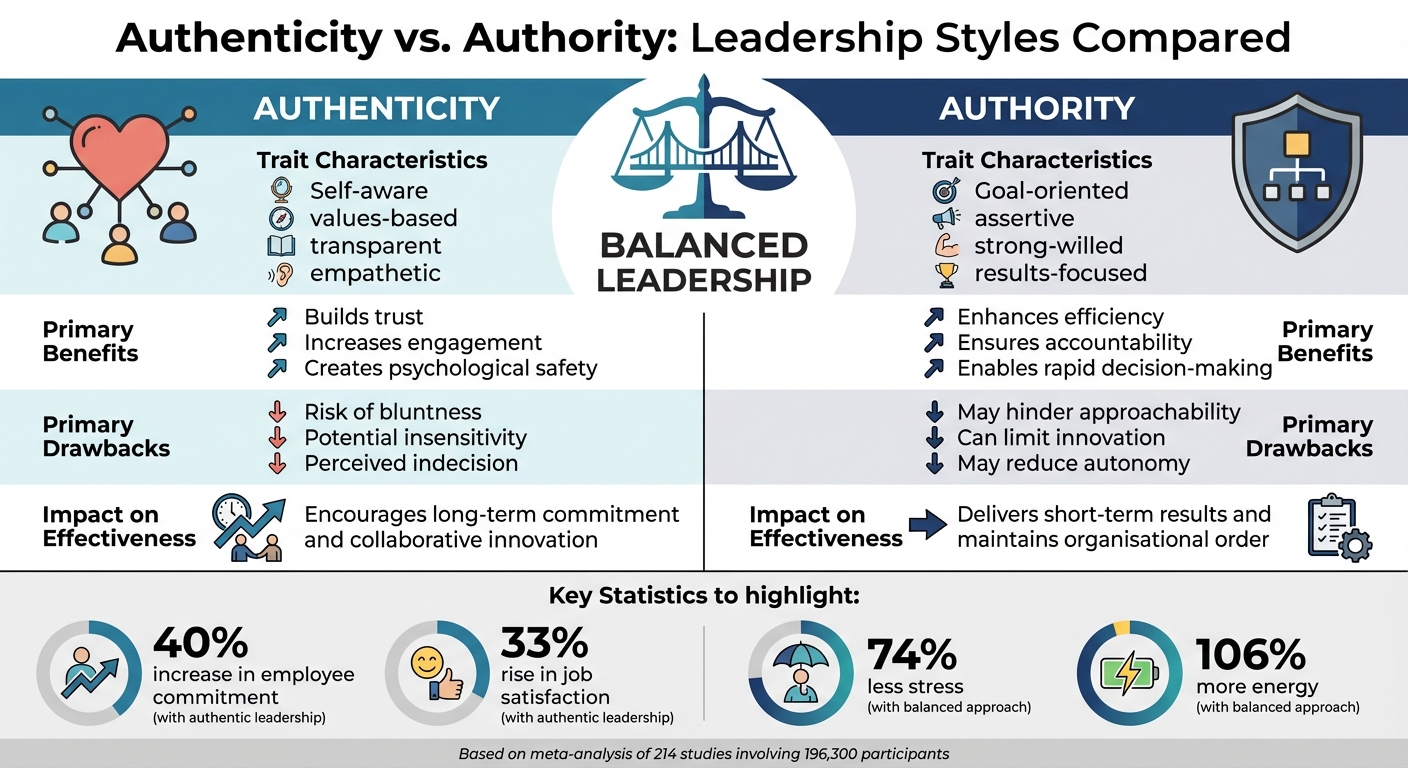
Authenticity vs Authority Leadership Styles Comparison
Strengths and Weaknesses of Authenticity
Authentic leadership promotes trust, psychological safety, and innovation while enhancing job satisfaction for managers by aligning their actions with personal values. This approach often creates an environment where employees feel secure and engaged, encouraging creativity and collaboration.
However, authenticity has its pitfalls if not balanced with self-regulation. Excessive focus on being genuine can sometimes lead to bluntness or lack of sensitivity. Hannes Leroy, Professor of Leadership Development at Rotterdam School of Management, highlights this risk:
"Authenticity can turn toxic when your intention to stay true to yourself begins to crowd out curiosity, collaboration, or care for how others experience you".
Leaders who equate honesty with unfiltered bluntness may fall into the category of "authentic jerks", a term used to describe individuals who prioritise their own values at the expense of professionalism and empathy. Additionally, a rigid commitment to personal principles can make leaders appear inflexible, potentially shutting down alternative perspectives.
On the other hand, authority-based leadership offers a structured approach to decision-making.
Strengths and Weaknesses of Authority
Authority-driven leadership is rooted in discipline and structure, enabling leaders to provide clear direction, enforce accountability, and prioritise efficiency. This style is particularly effective in high-pressure situations, where quick alignment and adherence to organisational standards are critical for achieving immediate goals.
However, over-reliance on authority has its challenges. Research involving 306 participants in business organisations revealed that leadership predictability, a key component of trust, mediates the relationship between leadership style and team effectiveness. Leaders who dominate conversations or dismiss input risk creating environments where innovation is stifled, and approachability declines. Overemphasis on formal power can also undermine employee autonomy, leading to disengagement and a breakdown in trust. What may be seen by leaders as "principled and consistent" behaviour could be interpreted by teams as "rigid and dismissive".
Comparison Table: Authenticity vs. Authority
The table below highlights the key differences between authenticity and authority in leadership.
| Dimension | Authenticity | Authority |
|---|---|---|
| Trait Characteristics | Self-aware, values-based, transparent, empathetic | Goal-oriented, assertive, strong-willed, results-focused |
| Primary Benefits | Builds trust, engagement, and psychological safety | Enhances efficiency, accountability, and rapid decision-making |
| Primary Drawbacks | Risks bluntness, insensitivity, or perceived indecision | May hinder approachability, limit innovation, and reduce autonomy |
| Impact on Effectiveness | Encourages long-term commitment and collaborative innovation | Delivers short-term results and maintains organisational order |
How to Balance Authenticity and Authority
Combine Empathy with Clear Boundaries
Strong leaders understand the difference between being nice - avoiding conflict to maintain harmony - and being kind, which involves offering honest but respectful feedback. While authenticity fosters trust, setting clear boundaries ensures accountability. This balance is vital for creating genuine relationships without sacrificing structural order.
George Kohlrieser, a Distinguished Professor of Leadership and Organisational Behaviour at IMD, emphasises this distinction:
"Being kind is an essential component of good leadership whereas being nice isn't. It might temporarily send you to the top of the popularity charts, but it can harm your chances of leading effectively in the long run".
Establishing roles and consequences early on creates clarity and predictability, reinforcing trust by offering a stable framework. This approach allows empathy to thrive within a structured environment.
A striking example comes from the US Navy SEALs, where leaders empower individuals to make quick decisions and innovate independently. At the same time, they enforce strict accountability through rigorous safety and performance standards. This combination of autonomy and responsibility is central to their success in high-stakes scenarios.
Be Transparent and Direct in Communication
Transparency is about finding the middle ground between withholding too much and oversharing. Leaders who are overly reserved may seem distant, while those who share excessively personal emotions risk undermining their authority. The solution lies in sharing relevant information and admitting mistakes without seeking emotional support from the team.
Researchers refer to this approach as "tactful insight", which involves being honest and concise. Personal stories can help build connections, but leaders must ensure their instructions are clear and expectations unambiguous.
Studies reveal that authentic leadership is linked to a 40% increase in employee commitment and a 33% rise in job satisfaction. However, this only holds true when transparency is paired with directness. Leaders should encourage dissent and evaluate feedback objectively, demonstrating humility and a willingness to adapt. This kind of communication fosters trust and facilitates emotionally disciplined decision-making when it matters most.
Use Emotional Discipline in Critical Decisions
High-pressure situations test whether leaders can harmonise authenticity with authority. Emotional discipline means managing emotions as a professional resource while staying aligned with personal values. This isn’t about suppressing feelings but about projecting calmness when the team needs it.
The difference between "surface acting" (hiding emotions) and "deep acting" (genuinely adopting the required emotional state) is crucial. Leaders who cultivate genuine calmness during crises are seen as more authentic than those who merely mask their stress. This alignment helps leaders remain true to their values while providing the confidence their teams rely on.
Acknowledging mistakes strengthens trust, but it must be done with composure and followed by decisive action. This blend of vulnerability and decisiveness signals both humanity and competence. Organisations that adopt this balanced approach to leadership see tangible benefits, including 74% less stress and 106% more energy among employees.
Results of Balanced Leadership
Engaged and Committed Teams
When leaders strike a balance between being genuine and maintaining authority, team engagement and commitment often improve. A study involving 143 groups (566 employees) highlighted that authentic self-expression enhances job performance by building trust among colleagues. This trust emerges when leaders are open about their values while also setting clear expectations.
Further research indicates that daily authentic leadership correlates positively with daily work engagement and reduces emotional irritation among team members. However, this effect hinges on consistency - any deviation from authentic behaviour can erode trust.
The concept of "humble authenticity" plays a pivotal role here. Leaders who align their personal values with a genuine curiosity about how others perceive their leadership can avoid coming across as abrasive. This approach ensures that their authenticity does not undermine their authority, which is essential for maintaining accountability.
Such engagement naturally fosters respect and strengthens a leader's influence within their organisation.
Maintained Respect and Influence
Respect and influence cannot be sustained by authority alone. A meta-analysis of 214 studies involving 196,300 participants found that authentic leadership is strongly linked to positive outcomes for subordinates, leaders, and overall performance. In contrast, tactics like self-promotion - often associated with authority - show no significant connection to job performance. Predictability is key: leaders who demonstrate consistent, authentic behaviours maintain credibility, while exaggerated claims of competence can damage trust and hinder performance. Rob Goffee and Gareth Jones summarise this well:
"Employees will not follow a CEO who invests little of himself in his leadership behaviours. People want to be led by someone 'real'".
Consistency in leadership not only earns respect but also builds a foundation for long-term organisational stability.
Long-Term Organisational Stability
Sustained stability within organisations requires leaders who can balance personal authenticity with the authority of their role. This balance is essential for reducing stress and fostering psychological safety. As Uncertainty Management Theory suggests, inconsistent leadership behaviours create stress and emotional irritation among teams. By consistently expressing their core values while maintaining clear boundaries, leaders reduce uncertainty and provide the psychological safety teams need to excel.
Daily authentic leadership, when applied consistently, enhances team energy and dedication. Consistency here does not mean inflexibility - it means that teams can depend on a leader's principles and decision-making approach, even as circumstances change. Leaders who successfully integrate personal values with organisational norms exhibit behavioural integrity, a quality directly tied to higher team performance and long-term stability.
Conclusion
Balancing authenticity with authority is essential for effective, long-term leadership. While authenticity fosters trust and credibility, authority ensures accountability and the ability to uphold standards. Leaning too heavily on authenticity risks blurring boundaries and delaying decisions, whereas overusing authority may enforce compliance but suppress engagement and creativity. A well-calibrated balance between the two underpins the strategies discussed earlier.
It’s also important to distinguish between kindness and niceness. George Kohlrieser, Distinguished Professor of Leadership and Organisational Behaviour at IMD, highlights this distinction:
"The trick in overcoming the approachable/authority paradox is holding your authority with authenticity".
This involves addressing uncomfortable truths and holding individuals accountable, rather than avoiding conflict for the sake of being liked.
Leaders should recognise that moments of feeling inauthentic during behavioural shifts often indicate personal growth rather than a loss of integrity. Adjusting behaviours strategically to align with situational needs - known as impression management - can actually enhance perceptions of trustworthiness and authenticity among teams. The challenge lies in understanding where personal expression should give way to professional duty.
House of Birch provides bespoke leadership advisory services, helping executives define clear boundaries while maintaining genuine connections, enabling them to lead with both impact and integrity.
FAQs
How do I know if I’m being too authentic or too authoritative?
Balancing being genuine with projecting authority demands self-awareness and emotional control. Leaders who lean too heavily into authenticity - such as oversharing personal details or rigidly clinging to their own beliefs - risk pushing others away or stifling their own development. On the other hand, focusing too much on authority without showing authenticity can erode trust and undermine credibility. Successful leadership involves striking this balance: staying aligned with personal values while adapting to different situations, setting clear boundaries, and demonstrating kindness and openness to foster trust and influence.
How can I be transparent without oversharing?
To strike a balance between transparency and discretion, it’s important to share information that aligns with your leadership responsibilities and the specific context. This requires a strong sense of self-awareness and the ability to set boundaries that safeguard your personal privacy. Additionally, consider how your words and actions might affect others. By maintaining this equilibrium, leaders can project openness and honesty while upholding their professionalism.
How can I stay calm and decisive under pressure?
To maintain composure and make clear decisions under pressure, it's essential to focus on managing emotions and fostering resilience. Viewing challenges as opportunities can shift your mindset, while mindfulness techniques, like deep breathing, can help you stay grounded. Developing emotional intelligence is equally important - it allows you to identify triggers and respond thoughtfully rather than react impulsively. Incorporating regular self-care, dedicating time to reflection, and planning ahead can further support a calm and confident approach, even in high-pressure situations.

